Supreme god of Mesopotamia, sky god and father of all gods.
Type: Supreme deity, sky god
Pantheon: Mesopotamia (Sumer, Akkad, Babylon, Assyria)
Function: Creator and guarantor of the cosmic order, father of the gods, keeper of supreme authority
Main attributes: Horned crown, scepter, Bull of Heaven, eagle
Main cult sites: Anu and Enlil sanctuary in Uruk (Eanna), Assur, Nippur
Sumerian name: An
The tradition concerning Anu extends from the earliest Sumerian king lists and temple texts (ca. 3rd millennium BCE) through the Akkadian, Babylonian and Assyrian periods into the late Hellenistic era.
The Enuma Elish (ca. 1200 BCE) shows an Anu whose power is already being superseded by Marduk. Clay tablets from Nippur and Uruk attest prayers and offering lists for Anu over many centuries.
Anu, the sky god of the Mesopotamian religions, is one of the oldest and highest gods of the Sumerian and Babylonian pantheon. His name literally means “sky,” and he represents the universal, the supreme principle of the universe.
Anu is the father of all gods and kings, and from his body the cosmos originally arose. Although he is regarded as the supreme god, Anu is paradoxically depicted as less active in the myths, because his power is so transcendent that he leaves the handling of cosmic affairs to other gods.
Venerated throughout all of Mesopotamia: from Sumer and Akkad through Babylon to the Assyrian empire. The Anu and Enlil temple at Uruk (Eanna) was one of the most significant sanctuaries of Mesopotamia. His influence reached into the Hittite and Elamite border regions, where he was recognized as the supreme cosmic power.
At the core of the tradition are the cosmological epics: the Enuma Elish shows the transfer of power from the older sky god Anu to Marduk.
The Atrahasis Epic and the Epic of Gilgamesh mention Anu as the unconditional supreme authority. Added to these are thousands of clay tablets from temple libraries containing hymns, incantation formulas and treaties concluded under Anu’s protection.
Sumerian: An (𒀭), one of the oldest god names in the written tradition, directly related to the Sumerian word for “sky.” Akkadian: Anu, the Akkadian form of the Sumerian An, predominant in Babylonia and Assyria.
Epithets: Anum (Latinized in ancient sources), Abu Ilani (father of the gods), Kal-u-sa-ag (whose word is true), Lord of the Heavens. Role in the triad: Anu, Enlil and Ea, the three highest gods of Mesopotamia, with Anu standing at the head. Roman counterpart: Caelum (the sky personified), not directly Jupiter as with Zeus.
Appearance
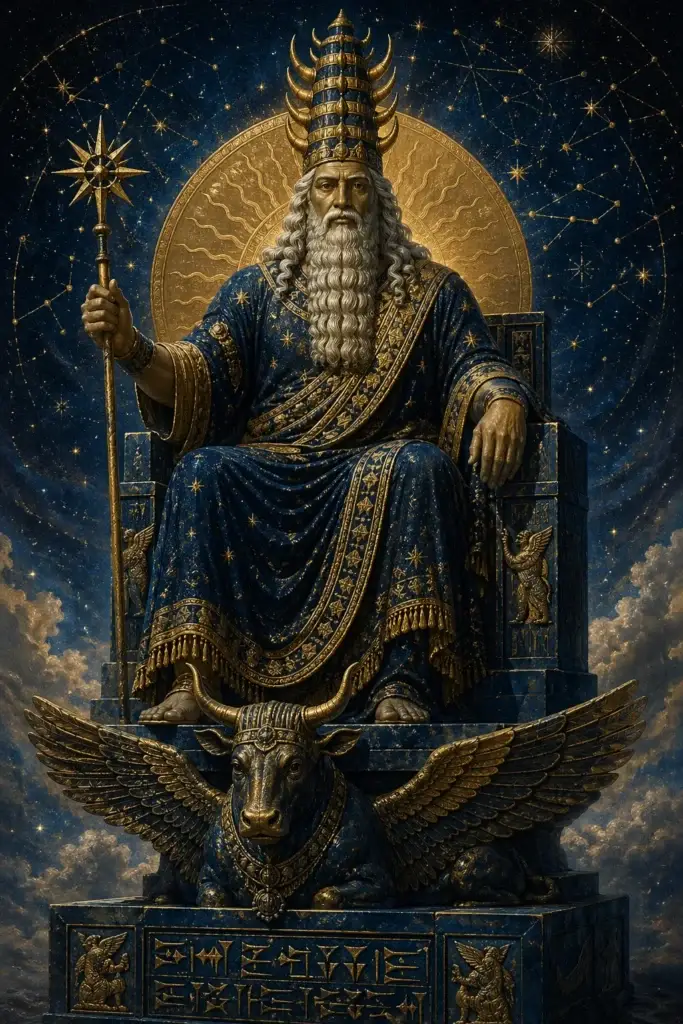
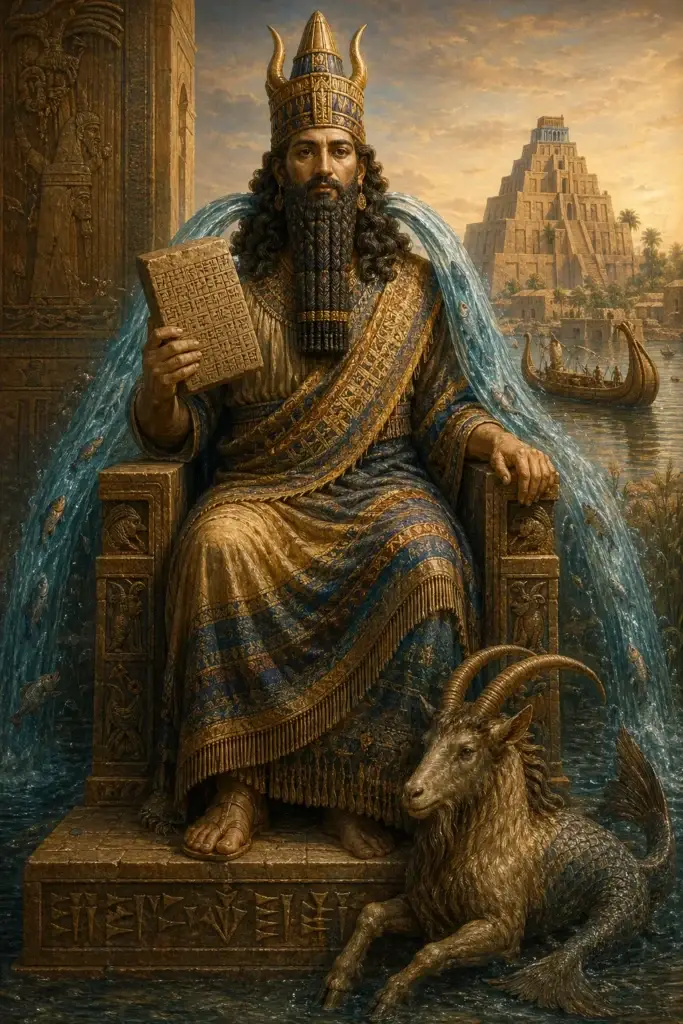
Anu is rarely depicted anthropomorphically in Mesopotamian art; instead, the horned crown and the sky itself symbolize him. When he is shown in bodily form, he appears as a bearded, exalted man on a throne, holding scepter and staff.
The Bull of Heaven and the eagle are his sacred animals. His crown bears four or more horns, a sign of supreme divinity within the Mesopotamian iconographic system.
Nature and Activity
Anu is not the creator of the world in the Christian sense, but the representative of the cosmic order and the heavenly hierarchy. He exists transcendently, far removed from mortal affairs. His decisions are unalterable and beyond appeal.
In the epics he is frequently consulted, yet he rarely takes action himself; he delegates this task to subordinate gods such as Enlil (storm and fate) or Marduk (order and kingship). His remoteness is his strength: Anu remains untouched by the mortal and divine conflicts that unsettle the pantheon.
Anu is rarely depicted in anthropomorphic form and is instead represented through symbolic signs such as the celestial dome or a shining star. When he is personified, he appears as an exalted male figure with a crown of stars or with sky attributes.
His primary symbol is the celestial sphere itself. The bull is his sacred animal, since the strength and stability of the bull reflect the cosmic foundation. Anu’s color is the deep blue of the clear sky.
The most important aspects of Anu at a glance. The table summarizes origin, function, appearance, veneration, symbols and parallels.
Origin of Mesopotamian cosmogony, not begotten but pre-existent as the sky itself. From him or alongside him arise Enlil (air/storm), Ea/Enki (water/wisdom) and other gods. The god of all gods, without predecessor.
Supreme cosmic authority and keeper of the world order. Father of all gods in a legal and hierarchical sense. His consent is required for every major divine act; his word is irrevocable. In everyday matters rather remote, his authority is invoked in treaties, oaths and the proclamation of cosmic punishments.
A bearded, calm man on a throne, or abstractly the sky itself. Horned crown, scepter, blue or star-studded robe. The Bull of Heaven and the eagle accompany him. Depicted in human form less often than other gods, more a cosmic power than a personality.
Main cult sites: the Anu and Enlil sanctuary in Uruk (Eanna), Assur, Nippur. Not venerated for personal concerns but for the stability of the world.
Sacrifices were brought above all at state ceremonies and the conclusion of treaties, his name being a guarantor of binding force. Festivals and processions took place during the New Year ritual, where Anu and Enlil were solemnly invoked.
Horned crown (crown with four or more horns), Bull of Heaven (the celestial bull, later opponent of Tiamat in the Enuma Elish), eagle, scepter, the scepter of order. The Tablet of Destinies, the heavenly document in which fate is inscribed.
Zeus (Greece) as a functional supreme-deity counterpart. Dyaus Pita (Vedic India) as a sky-father analogy. El (Levant) as an ancient supreme-god archetype. Brahman/Brahma (Hinduism) as the original sky-father principle. Tengri (Turkic-Mongolian) as the Central Asian sky god. Hardly any etymological kinship (Anu is not Indo-European), but often paralleled in function.
Anu was in a particular way a god of the public sphere and of law, not of personal veneration. Private individuals tended to invoke Shamash (justice), Ishtar (love and war) or local protective gods. Yet in three areas Anu’s name was central:
In contract law, every Babylonian or Assyrian treaty invoked Anu as the supreme guarantor. His name stood at the top of stone documents; his curse threatened anyone who broke the treaty.
In cosmic ritual, during the New Year festivities Anu and Enlil were formally invoked to confirm the cosmic order for the coming year. Priests sang hymns to his unshakable authority.
In state sacrifice, during military undertakings, coronations or famines, kings made offerings to Anu in order to secure his support for their power. It was not about personal salvation but about state legitimacy.
Greek Tradition
Zeus is functionally comparable as a supreme deity and keeper of the cosmic order. Both are remote, exalted sky gods whose authority is unconditional. Zeus, however, is more active and more strongly colored by personality; Anu remains colder and more absent.
Vedic and Hindu Tradition
Dyaus Pita (“sky father”) and later Brahman as original supreme-deity equivalents. Like Anu, Dyaus is superseded by the younger, more active Indra. Brahman and Brahma share Anu’s role as originator and silent ordering principle.
Semitic Tradition (Levant)
El as the highest god in Ugaritic and Phoenician religion, the oldest, quietest and most remote deity, similar to Anu. Baal later takes over the more active functions, as Marduk does with Anu.
Central Asian Tradition
Tengri (Turkic-Mongolian) as a personified sky god with comparable transcendence. Both are cosmic ordering forces, rarely personally involved yet unconditionally powerful.
Anu, Sumerian An, stands at the head of the Mesopotamian pantheon. His name is at the same time the ordinary word for sky; the god and the celestial vault he embodies cannot be separated linguistically. Anu is regarded as the father of the gods and as the originator of supreme authority.
Characteristic of Anu, however, is that he rarely acts directly in the myths. He is enthroned in the highest heaven, and his power is expressed above all in the fact that he confers authority and legitimizes decisions.
The Mesopotamian texts know the concept of Anu-dignity, the anutu, as the epitome of the highest royal power that can be conferred upon a god. When another god rises to supremacy, for example Marduk in the Babylonian creation epic Enuma Elish, this happens by his being granted the Anu-dignity.
This position makes Anu a resting, rather passive supreme figure. Religious studies have compared him to the type of the deus otiosus, the idle god who stands at the top yet leaves the actual course of world events to others.
Other scholars emphasize that Anu’s restraint is not a loss of significance but the expression of a dignity that stands above direct intervention. His will is regarded as incontestable, and decisions that Anu has confirmed are final.
The most important cult center of Anu was the city of Uruk in southern Mesopotamia, one of the oldest large cities in the world. There stood the temple precinct Eanna, whose name means House of Heaven. Anu shared this precinct with the goddess Inanna, or Ishtar.
The archaeological layers of Uruk reach back into the fourth millennium BCE, and the Eanna precinct is among the most intensively researched temple areas of Mesopotamia.
The relationship between Anu and Inanna in Uruk is complex in terms of the history of religion: in some traditions Inanna is regarded as the daughter or granddaughter of Anu, in other texts she appears as his consort. The tradition here, as is often the case in the Mesopotamian pantheon, is not uniform.
In later times, especially in the Hellenistic era under the Seleucids, the Anu cult in Uruk experienced a remarkable renewal. During this period the Bit Resh, a large temple complex dedicated to Anu and his consort Antu, was built.
From this late period detailed ritual texts survive that describe the temple cult, the processions and the times of offering. These texts are among the most valuable testimonies for the practice of the Babylonian temple cult in general and show that Anu was still cultically alive in the final centuries of cuneiform culture.
One of the few myths in which Anu intervenes actively and with immediate consequences is found in the Epic of Gilgamesh.
After the hero Gilgamesh has rejected the courtship of the goddess Ishtar and moreover mocked her, Ishtar turns to her father Anu and demands that he hand over the Bull of Heaven to her in order to punish Gilgamesh.
Anu hesitates at first and points to the consequences: releasing the Bull of Heaven would bring seven years of famine upon the land.
Only when Ishtar threatens to break open the gates of the underworld and bring up the dead, so that they would devour the living, does Anu give in. The Bull of Heaven is lowered to the earth, wreaks havoc in Uruk and kills numerous men with its snorting.
Gilgamesh and his companion Enkidu finally slay the bull, which in turn so enrages the gods that they resolve upon Enkidu’s death.
This episode is instructive for religious studies, because it shows how Anu’s power functions. He commands cosmic means of destructive force, the Bull of Heaven being an embodiment of drought and devastation. But he does not deploy them on his own initiative, only at the urging of another deity.
Here too, Anu remains the instance that grants power, not the one who strikes himself. The constellation Taurus was associated with the Bull of Heaven, which also ties the episode into Babylonian astronomy.

Anu (Sumerian An, Akkadian Anu) is the Sumerian and Babylonian sky god, the supreme god of the early Mesopotamian pantheon and the grandfather of almost all other gods. His name simply means sky; in the oldest layer he is the invisible, abstract sky god who governs the world.
Over time Anu lost active significance, with Enlil and later Marduk taking over his reign. Anu nevertheless remained the titular god, all royal power and dignities were originally conferred by him.
The upper Mesopotamian divine triad consists of Anu (sky), Enlil (earth, air, wind) and Enki/Ea (fresh water, wisdom). This three-god complex structured the universe: Anu ruled the upper realm, Enlil the middle one (atmosphere, earth), Enki the lower fresh-water realm.
The triad is the precursor of many later three-god schemes. In the later Babylonian pantheon it was supplemented by an astral triad: Sin (moon), Šamaš (sun) and Ishtar (Venus). Marduk later effectively inherited the power of all three upper gods.
Against its influence, cross-cultural tradition names these protective means:
Compare in the Protection Compass →Recommended protective means
The simplest protective means in this collection: 41 layers of fine gold 999, platinum, silver and silicon, manufactured in Ruhla, Thuringia. It requires no activation, is bound to no person, and is effective within a radius of around 50 meters, even without being worn.
Related Beings

Nyyrikki, son of Tapio and Finnish god of the hunt: he carves trail marks for hunters and lays br...

Kannon is the Japanese form of the bodhisattva Avalokiteshvara, the most popular Buddha figure in...

Euros, the warm east wind of the Greeks. Origin, his absence in Hesiod and the classification in ...

Mula sem cabeça, the headless fire mule of Brazil. Origin in the curse for a love affair with a p...

Asmodeus, king of demons, ruler between Tobit, Talmud and grimoire. Sefer Raziel, Pseudo-Solomon ...

La Llorona, the weeping woman of Mexico. Origin, the drowned children, the search at bodies of wa...