Ereshkigal, goddess of the Mesopotamian tradition
By Ralf Ittermann · last reviewed on
Ereshkigal is a goddess of the Mesopotamian tradition.
Mistress of the underworld, sister of Ishtar, ruler over Kur and Irkalla. Ereshkigal is the most powerful goddess of the underworld, not evil, but relentless.
While her sister Ishtar roams the earth and the heavens, Ereshkigal sits untouchable in Irkalla, the realm of the dead, and rules with her husband Nergal over all who cross the threshold into the beyond. She does not receive visitors easily; whoever steps before her throne must be fearless or cursed.
Quick overview: Ereshkigal
Type: Mesopotamian principal deity, queen of the underworld
Pantheon: Sumer, Akkad/Babylon/Assyria
Function: Ruler of the realm of the dead (Kur, Irkalla), judge of the dead, fate of the deceased
Main attributes: Diadem, black mantle, tablet of destinies, seven gate guardians
Main cult sites: Kutha (together with Nergal), no large dedicated temples of her own
Husband: Nergal (after the myth „Nergal and Ereshkigal“)
Historical context
Period of the texts
Ereshkigal is attested from the 3rd millennium BC (Sumerian) onward.
The main flowering of her mythology is the Old Babylonian period (early 2nd millennium BC) with the two central myths: Inanna’s Descent into the Underworld (Inanna comes to Ereshkigal, is killed, then revived through Ea’s intermediaries; her husband Dumuzi must descend into the underworld as atonement) and Nergal and Ereshkigal (Nergal comes into the underworld, is first cursed by her, then becomes her husband, the mythic pattern of a patriarchy that forces the old queen of the underworld into a marriage position).
In later traditions there is a marked decline of her direct veneration; she is feared, not popular.
Area of distribution
Direct Ereshkigal temples are rarely documented; she is a feared goddess of the dead. The main cult site she shares with Nergal is Kutha (today Tell Ibrahim, north of Babylon), the „city of Nergal“ that was understood as an entrance to the underworld.
In personal cult she was invoked in funerary rites and incantation texts rather than in temples of her own. In the Greco-Roman magical-theurgic tradition (e.g. PGM IV) she was received as a powerful incantation goddess.
State of the sources
Central sources: Inanna’s Descent into the Underworld (Sumerian, 2nd millennium BC), Ishtar’s Descent into the Underworld (Akkadian, more compact version), the Nergal and Ereshkigal epic (Middle Assyrian and Late Babylonian recensions), Epic of Gilgamesh tablet XII (Enkidu’s depiction of the underworld).
Secondary literature: Wolkstein/Kramer, Inanna; Lambert, Babylonian Wisdom Literature; Bottéro, La plus vieille religion; Black/Green, Gods, Demons and Symbols.
Designation and spellings
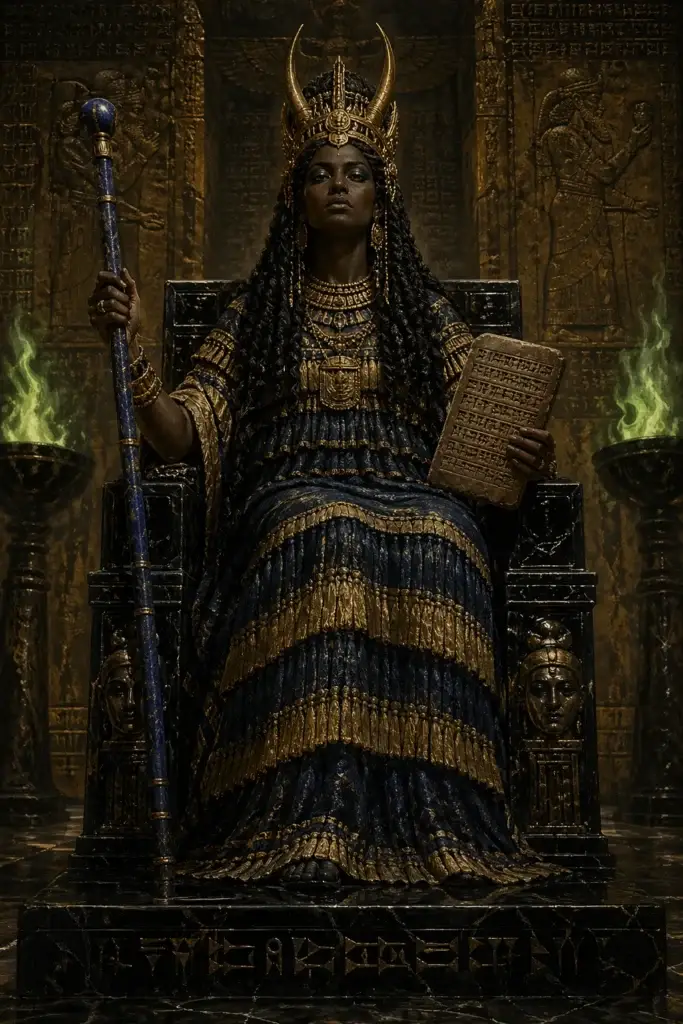
Ereshkigal is often depicted enthroned, regal, with a horned crown and scepter. Her eyes glow with subterranean fire or darkness. She wears black or dark violet robes and is surrounded by demons and the souls of the dead.
Sometimes she sits beside Nergal, her somber husband. Her crown (horn gold) distinguishes her from mortal nobility. The symbol of her power is the barred door, impassable for the living, inevitable for mortals.
Description
Ereshkigal receives the souls of the deceased and orders their fate in Irkalla. She is not free of suffering and passion, as she is sometimes described, but clever and wrathful; whoever breaks the laws of the underworld experiences her revenge.
In the Descent of Ishtar narrative she acts as a moral force: Ishtar tries to intrude into the underworld, and Ereshkigal punishes the attempt with death. There were no great public festivals for her, but offerings were made to her in private rites of honoring the dead and to appease her power.
Appearance and symbolism
Ereshkigal is depicted as a somber, magnificently dressed goddess with a crown of horns, symbols of her queenly power. Her skin is dark blue or gray-black, her eyes glow with an eerie light.
She wears a heavy diadem and sits on a throne of stone or bone. Her body is majestic, yet visibly under a kind of torment or suppressed anger. An eight-armed demon or a serpent may be her servants. Darkness itself is her garment.
Profile: Ereshkigal
The most important aspects of Ereshkigal at a glance. The following fields summarize origin, function, appearance, veneration, symbols, and cultural parallels.
Ereshkigal (Sumerian Ereš-ki-gal, „Mistress of the great earth“ = underworld) is the daughter of Anu (heaven) and the earth goddess.
Sister of Inanna/Ishtar (central in the descent myth), in earlier tradition sole ruler of the underworld, in later tradition wife of Nergal. Mother of Ningishzida (serpent god of the underworld) and Namtar (messenger of fate). Mother of Ninazu in some versions.
Ruler of the realm of the dead Kur or Irkalla, beyond the seven gates of the underworld. She holds the tablet of destinies (mes), on which the fate of all the dead is recorded.
Without her permission no one can leave the realm of the dead (Inanna’s descent myth: only through Ea’s means and Dumuzi’s atoning offering may Inanna return). In personal cult, invocation took place in funerary rites and in the black magic tradition (PGM incantations).
Ereshkigal has no fixed iconographic depiction. In the myth texts she is described as a somber, sublime figure, diadem, black mantle, long robe. Seated in a dark hall, surrounded by her seven Anunnaki judges.
When she receives Inanna, she is blue and sallow-yellow in the face (symbols of sickness/death). Attributes: tablet of destinies, writing stylus. Companions: Namtar (her vizier), Ningishzida (son, serpent god).
Sphere of influence: Ereshkigal was rarely invoked directly, because she was feared. But: in every funerary rite she was present as the recipient of the deceased. In the incantation tradition (Maqlu, Shurpu) she was invoked as a feared helper against black magic.
In the Greco-Roman magical-theurgic tradition (Papyri Graecae Magicae) she was identified as Ereschigal with Hecate in incantations. In modern esoteric reception she is often used as a symbol of the power of the underworld and of unbending resolve.
Diadem, black mantle, tablet of destinies (mes), seven gate guardians, Namtar (vizier), Ningishzida (son, serpent god). Sacred plant: asphodel (in modern reception). Sacred number: 7 (seven gates of the underworld, seven Anunnaki judges). Sacred colors: black, dark blue.
Inanna/Ishtar (Mesopotamia, sister, antagonist in the descent myth), Nergal (Mesopotamia, husband in later tradition), Persephone (Greece, queen of the underworld), Hecate (Greece, identified directly with Ereshkigal in PGM texts), Hel (Germanic, ruler of the underworld), Mictecacihuatl (Aztec), Izanami (Japan, queen of Yomi), Hine-nui-te-pō (Māori).
The female ruler-of-the-underworld type is present in numerous cultures, often with the tension of female doubles (Ereshkigal-Inanna as sisters, Demeter-Persephone as mother and daughter).
Practical defense
Apotropaic rituals
Ereshkigal as mistress of the underworld (Kur-nu-gi-a, „land of no return“) was not venerated directly but apotropaically avoided; the rituals aim at keeping away her messengers (Galla, Edimmu) by purifying thresholds.
The purification series bīt rimki, with ritual exposure of the king to water, aimed specifically at protection from subterranean powers (cf. Bottéro, Mesopotamia).
Incantations
In the myth „Inanna-Ishtar’s descent to the underworld“ (Akkadian, Foster, Before the Muses) the central invocations of Ereshkigal appear; through seven gates the goddess is disrobed, a ritualized self-abasement.
Late incantation texts from Assur (1st millennium BC) appeal to Ereshkigal as „šēpti-ša-irṣitim“ (one who sets the traces of the earth) to end sickness of the dead.
Amulets and protective symbols
Apotropaic clay pins with an engraved „entrance inscription“ („May Ereshkigal not come to me“) were buried at house entrances (excavations Nimrud, Mallowan 1953-57).
On Kassite cylinder seals the symbol of the inverted spear appears, indicating the gate of the underworld. Lapis lazuli plaques bearing her name were placed in the grave as offerings to the dead.
Ereshkigal, parallels in other cultures
Ereshkigal resembles the Greek Persephone, who likewise exercises subterranean or invisible power. With Hades she shares rule over the realm of the dead, but differs through her femininity and strategic authority.
The Egyptian Isis and the Indian Kali have similar aspects, divine women who oversee life and death. Ereshkigal’s inviolability and justice make her one of the most complex female deities of antiquity.
Inanna's journey to the underworld: The central myth
The most important source for Ereshkigal is the Sumerian myth of Inanna’s descent into the underworld, transmitted on cuneiform tablets of the early second millennium BC. The narrative depicts how the heavenly goddess Inanna resolves to descend into the realm of her elder sister Ereshkigal, the land of no return.
At seven gates of the underworld Inanna must each time remove an item of clothing or jewelry, until she stands naked and stripped of her insignia of power before Ereshkigal and the seven judges of the underworld, the Anunna.
These fix the gaze of death upon her, and Inanna becomes a corpse hung on a stake.
Only through the intervention of the wise god Enki, who sends down two sexless beings with the food of life and the water of life, can Inanna be revived. She may, however, only escape if she provides a substitute, which finally falls upon her husband Dumuzi.
A related Akkadian version, the myth of Ishtar’s descent to the underworld, is shorter and differs in details. Religious studies has examined the text intensively, among other things with regard to the motif of the disrobing descent and the question of a ritual background.
At the center stands Ereshkigal as the relentless mistress of a domain whose laws even a great goddess cannot violate without punishment.
Ereshkigal and Nergal: The tale of the marriage of the rulers of the underworld
A second important myth explains how Ereshkigal came to her husband. The text Nergal and Ereshkigal survives in several recensions, including a shorter one from Tell el-Amarna in Egypt from the 14th century BC and a longer one from the library of Ashurbanipal from the 7th century.
The narrative begins with a banquet of the gods of heaven, in which Ereshkigal cannot take part, since she may not leave the underworld. She sends her messenger up to fetch her share. The god Nergal fails to rise before this messenger, which counts as an insult.
As atonement, Nergal must descend into the underworld. There it comes to a union between him and Ereshkigal. In the longer recension Nergal first tries to flee, but Ereshkigal threatens to send the dead up to devour the living if he is not returned to her. Finally Nergal returns and becomes co-ruler of the underworld.
This narrative is instructive in terms of religious history, because it shows that the Mesopotamian pantheon also endowed the underworld with an ordered structure of rule. Older sources know Ereshkigal as sole mistress or name Gugalanna as her husband.
The connection with Nergal is likely a later theological systematization that brought together two conceptions of the underworld. Scholarship discusses whether this also reflects political or cultic developments.
The underworld of the Mesopotamians and Ereshkigal's realm
To understand Ereshkigal’s position, the Mesopotamian conception of the underworld itself is decisive. It is described in the texts as a dark place, the land of no return, in which the dead eat dust and have clay for food, clothed like birds in a garment of feathers.
It is not a place of punishment in the moral sense, but the common, joyless fate of all the deceased, independent of their deeds.
Over this realm Ereshkigal rules. Her name means roughly mistress of the great earth or mistress of the great below, where the great land is a paraphrase of the underworld.
She resides in a palace with names such as Ganzir, guarded by seven gates and her vizier Namtar, the bringer of fate and pestilence. At her side stand the Anunna as a judicial body.
Characteristic of the Mesopotamian conception is the severity of the laws of the underworld. Whoever descends is subject to the rule that only a substitute permits escape. Even gods are subject to these laws, as Inanna’s fate shows. Ereshkigal thus embodies a cosmic order that is incorruptible.
The famous epic Gilgamesh reflects the same somber conception in its depiction of the realm of the dead. Religious studies sees in Ereshkigal less a malevolent than a necessary figure, who occupies the inescapable pole of death within an otherwise life-affirming worldview.
Further links
Sources and literature
Further standard works in the literature index.