Nabu is a god of the Mesopotamian tradition.
God of writing, scribe of the gods, son of Marduk. Nabu (also Nebo) is not the most powerful, but one of the most learned gods of Mesopotamia.
He sits with stylus and writing tablet in Borsippa, recording the fate of every person on the stone tablets of the world’s law. Where other gods rule through lightning and war, Nabu rules through the word; his writings and incantations are the foundation of all magic and lawful order.
Type: Mesopotamian principal deity, god of scribes and wisdom
Pantheon: Babylon, Assur (son of Marduk)
Function: Writing, tablets of fate, astronomy, wisdom
Main attributes: writing stylus, clay tablet, tall horned crown, dragon (Mušhuššu)
Main cult sites: Borsippa (principal cult site, E-zida temple), Babylon, Nineveh
Astronomical identification: Mercury
Nabu is attested from the Old Babylonian period (early 2nd millennium BCE). His main heyday lies in the Neo-Babylonian period (7th to 6th century BCE); under Nabopolassar and Nebuchadnezzar II the Borsippa temple E-zida was expanded into one of the most important complexes of Babylon.
Still central in the late Achaemenid and Seleucid eras, the cult faded with the decline of the Babylonian empire (1st century CE).
The principal cult site was Borsippa (today Birs Nimrud, ca. 17 km south of Babylon), with the famous temple E-zida. In addition Babylon (a temple in the Esagila complex), Nineveh (principal cult site in Assyria), Kalhu (Nimrud, a cult niche in the Ezida of Kalhu).
In the Neo-Babylonian empire the annual Akitu procession was a central occasion: Nabu travelled by boat from Borsippa to Babylon to Marduk.
Central sources: Enuma Elish (son of Marduk), the inscriptions of the Neo-Babylonian kings (Nebuchadnezzar, Nabonidus), the Erra epic (a mention), the Ezida inscriptions from Borsippa, the Nabu Hymn.
Secondary literature: Pomponio, Nabû. Il culto e la figura di un dio del pantheon babilonese ed assiro; Lambert, Babylonian Wisdom Literature; Black/Green, Gods, Demons and Symbols.
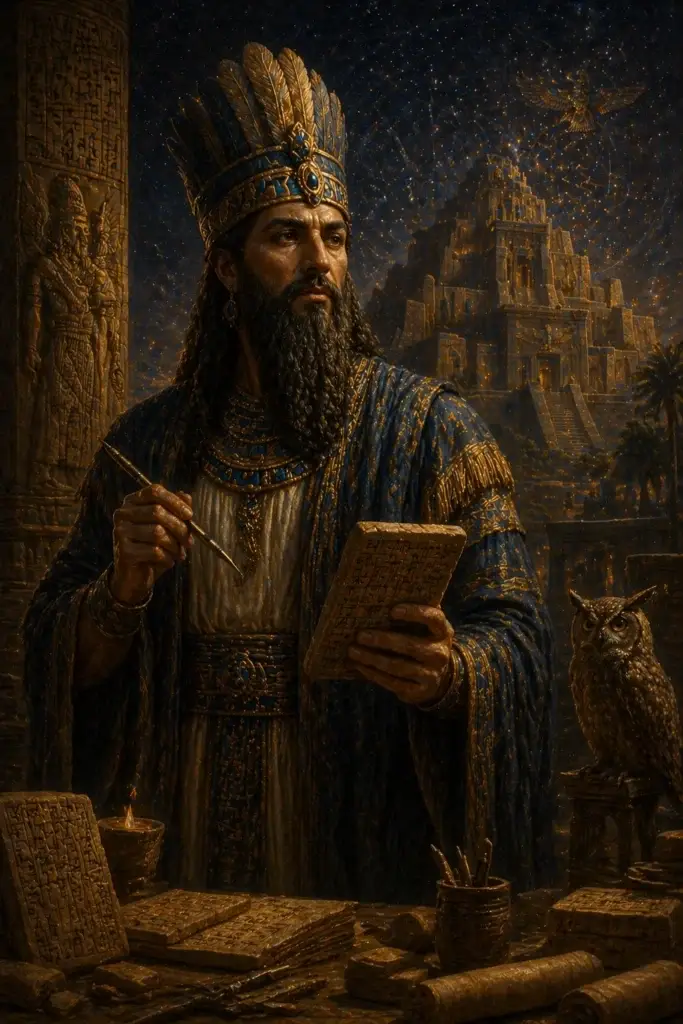
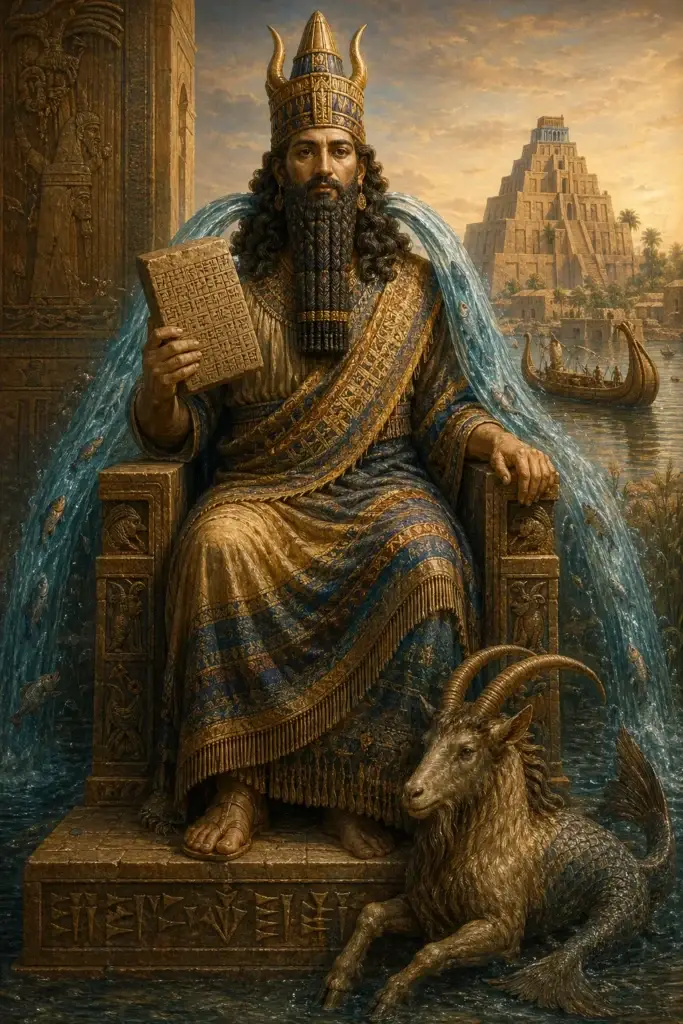
Nabu is depicted as a young, bearded man with a pointed hat or crown, often seated at a writing desk or bent over clay tablets. His attribute is the writing stylus (kalam) and the writing tablet.
He sometimes holds a scroll or carries the legendary Tablet of Destiny (Tuppi Šīmāti). At times a scribe bird or a dragon (his heraldic animal) is shown beside him. His colour is blue or purple, noble and wise.
Nabu is the god of scribes, scholars and astronomers. Whoever wished to read and write prayed to Nabu. Priests consulted him when interpreting sacred signs and omens. In magical rituals his name was invoked; a written incantation by a scribe was powerful because Nabu himself blessed writing.
His festival (the Nabu procession) was a procession from Borsippa to Babylon, where he visited his father Marduk. Scribes and scholars venerated him as their patron. The library of Nineveh was consecrated to Nabu; all collections of knowledge belonged under his protection.
Nabu is depicted as a young man with a tall crown, carrying a writing stylus and tablets. He is often surrounded by scrolls or books. His sacred animal is the winged dragon Mushussu or sometimes a bird that carries messages.
Nabu frequently wears a blue or green robe, the colours of writing and knowledge. A stylus or a quill is his primary symbol. His eyes are intense and knowing, for they see all hidden truths. His presence is surrounded by light that represents intelligence and enlightenment.
The most important aspects of Nabu at a glance. The following fields summarise origin, function, appearance, veneration, symbols and parallels.
Nabu is the son of Marduk and Sarpanitu. Consort of Tashmetu (goddess of mediation). In the theogonic order he belongs to the second generation of the Babylonian pantheon. In the Assyrian tradition he is held in high esteem alongside Marduk; the Assyrian kings often bear the name Nabu-… as an element.
Patron of writing and of scholars; the scribal profession stood directly under him. Keeper of the Tablets of Destiny (Akkadian tup šimâti): on these the destinies of all people and things are recorded.
Patron of astronomy and of scholarly practice; astronomer-priests (tupšarrû) were regarded as his servants. In personal cult too he was patron of every school and learning activity.
Anthropomorphic as a bearded male figure with a tall horned crown and a long, multi-layered robe. Characteristic attributes: the writing stylus (Sumerian gi-dub-ba) and the clay tablet, often on a pedestal or held in the hand.
Accompanied by the dragon hybrid creature Mušhuššu (which he took over from Marduk). In glyptic art often seated with a clay tablet on his knee. Stylised symbol: the writing stylus (comparable to the caduceus).
Area of effect: Nabu was invoked by all scribes and scholars. Scribal schools began the day with a Nabu prayer. In personal cult he was asked for a favourable entry of fate; the tup šimâti were considered determining.
The Akitu procession of Nabu from Borsippa to Babylon (in the month of Nisan) was one of the greatest popular festivals of Mesopotamia. Kings displayed their piety by taking part in this procession.
Writing stylus (gi-dub-ba), clay tablet, tall horned crown, dragon (Mušhuššu), astronomical stars (Mercury), stacks of school tablets. Plants: tamarisk (writing tablets were set on tamarisk wood), cedar wood. Sacred number: 14.
Thoth (Egypt, god of scribes and wisdom, almost functionally identical), Hermes (Greece, patron of scribes, messenger), Mercurius (Rome, astronomically identical via Mercury), Sarasvati (Hinduism, goddess of knowledge and writing), Manjušri (Buddhism, bodhisattva of wisdom), Mimir (Germanic, well of wisdom), Ogma (Celtic, inventor of the Ogham script).
Nabu, god of scribes and wisdom, had his main cult centre E-zida at Borsippa (8 km south of Babylon). His father Marduk and he formed a central father-son dyad of gods.
At the New Year festival akītu Nabu’s statue was carried in procession from Borsippa to Babylon, an eight-day festival with the king ritually humbling himself before Marduk. Scribal apprentices honoured Nabu with tablet dedications (clay cones with standard phrases from the Edubba school routine, cf. Bottéro).
The “Nabu Hymn from Eridu” (BWL 113-115) praises him as “rēʾi māti” (shepherd of the land). At the conclusion of contracts Nabu’s reed pen and writing tablet were invoked as guarantors. The daily reed-pen prayer of the scribes began “Nabû šūpū qātīya” (Nabu, make my hands perfect).
The reed pen (qan-ṭuppi) with tablet, the iconographic symbol of Nabu, appears on Babylonian and Assyrian boundary stones (kudurrus, cf. Slanski).
Apotropaic clay cylinders with impressed texts placed under house entrances were meant to protect knowledge, writing and contracts. His sacred animal is the mušḫuššu (serpent dragon), to be seen at the Ishtar Gate of Babylon.
Nabu resembles the Egyptian Thoth; both are gods of writing, wisdom and magical words. With the Greek Hermes he shares the role of mediator and dominion over language. There is no direct parallel in the Hebrew tradition, yet the figure carries traits of the word Dabar Adonai (word of God).
In Indian cultures one might compare him with Saraswati, goddess of language, the arts and knowledge. Nabu is the one god who is not lost through silence, but persists through the tablets and temples that bear his name.
In the Babylonian and Assyrian pantheon Nabu was regarded as the god of writing, of learning and of wisdom. His most important attribute is the writing stylus, with which one wrote on clay tablets.
In texts and depictions he appears as the one who guides the stylus, and he was credited with oversight of the Tablets of Destiny, into which the fate of human beings and the world is entered.
This responsibility gave Nabu a special position in relation to the scribes and scholars, who in Mesopotamia formed a distinct and highly respected class. Scribes sometimes expressly described themselves as servants of Nabu, and libraries and archives stood under his protection.
The famous library of the Assyrian king Ashurbanipal in Nineveh, from which a large part of the surviving Mesopotamian literature comes, was connected with Nabu, and colophons of clay tablets name the god in blessing formulas.
The connection of writing, knowledge and fate is no coincidence here. In the Mesopotamian conception writing was an activity of high rank, because the written word held fast and fixed things permanently.
A god who commanded writing thereby also commanded that which was set down and thus became binding. Nabu was therefore not only the patron of a craft, but a power connected with order, fixation and the permanence of what had once been recorded.
The main cult centre of Nabu was the city of Borsippa, not far from Babylon. There stood his temple with the name E-zida, the true or enduring house, to which a temple-tower complex also belonged.
Borsippa and Babylon were closely linked, and this proximity was reflected in the relationship of the two principal gods, for Nabu was regarded as the son of the Babylon god Marduk.
At the great Babylonian New Year festival, the Akitu festival at the beginning of the year, Nabu played a visible role. The cult image of Nabu was brought from Borsippa to Babylon to take part in the celebrations.
This procession of the son to the father was an essential part of the festival. Texts describing the course of the Akitu festival mention the arrival and participation of Nabu, and the connection between the two cities was thus renewed ritually each year.
The New Year festival itself had a cosmological dimension. It was about the renewal of the world order, the confirmation of kingship and the fixing of destinies for the coming year.
It was precisely on this last point that the festival touched Nabu’s own domain, for the fixing of destinies was closely tied to writing and to the Tablets of Destiny.
Nabu’s participation in the Akitu festival was therefore not only a gesture of familial closeness to Marduk, but fitted in substantively with what this god stood for.

Nabu’s position in the Mesopotamian pantheon was not from the outset as prominent as it later became.
Research observes that Nabu gained in importance over the course of the second millennium and, in the first millennium before our era, in the Assyrian and Neo-Babylonian period, rose to become one of the most important deities of all.
His rise ran parallel to that of his father Marduk, whose elevation to the highest deity of Babylon is a central process of Babylonian religious history.
Nabu’s growing importance becomes visible in several findings. Royal names containing the divine name Nabu become frequent in the first millennium; the best known is Nebuchadnezzar, whose name contains the god Nabu.
The Assyrian kings promoted Nabu, had temples built for him and named him in inscriptions. The close connection of Nabu with the scribal class and with the libraries contributed to the god’s strong anchoring in the educated stratum.
In late antiquity, when Babylonian culture continued under Persian and later Hellenistic rule, Nabu remained an important figure. The temple in Borsippa was still maintained for a long time. With the gradual extinction of cuneiform culture in the first centuries of our era, the cult also faded.
For modern research Nabu is accessible above all through the texts that were written under his protection, a circumstance well suited to a god of writing. His father Marduk forms the nearest point of reference in the pantheon.
Further standard works in the literature index.
Against its influence, cross-cultural tradition names these protective means:
Compare in the Protection Compass →Recommended protective means
The simplest protective means in this collection: 41 layers of fine gold 999, platinum, silver and silicon, manufactured in Ruhla, Thuringia. It requires no activation, is bound to no person, and is effective within a radius of around 50 meters, even without being worn.
Related Beings

Habagat, the personified southwest monsoon of the Philippines. Origin, the old wind word and the ...

Ceridwen is the Welsh witch-goddess and keeper of the Awen cauldron of inspiration. Mother of Tal...

Protectress of the home, motherhood and the sistrum. The Bubastis temple, the popular festival an...

Silenus, the drunken and wise tutor of Dionysus: the capture by King Midas, the wisdom of Silenus...

Tjinimin is the bat ancestor and mythical trickster of the Murinbata in northern Australia. A rel...

Moosleute and Moosweibchen: small forest spirits of German folklore, hunted by the Wild Hunter. T...