Girra, the purifying fire of Babylonia
By Ralf Ittermann · last reviewed on
Girra is a god of the Mesopotamian tradition.
The fire that burns away witchcraft and refines metals. The article situates Girra within the ritual practice of Babylonia, where fire was invoked to dissolve curses.
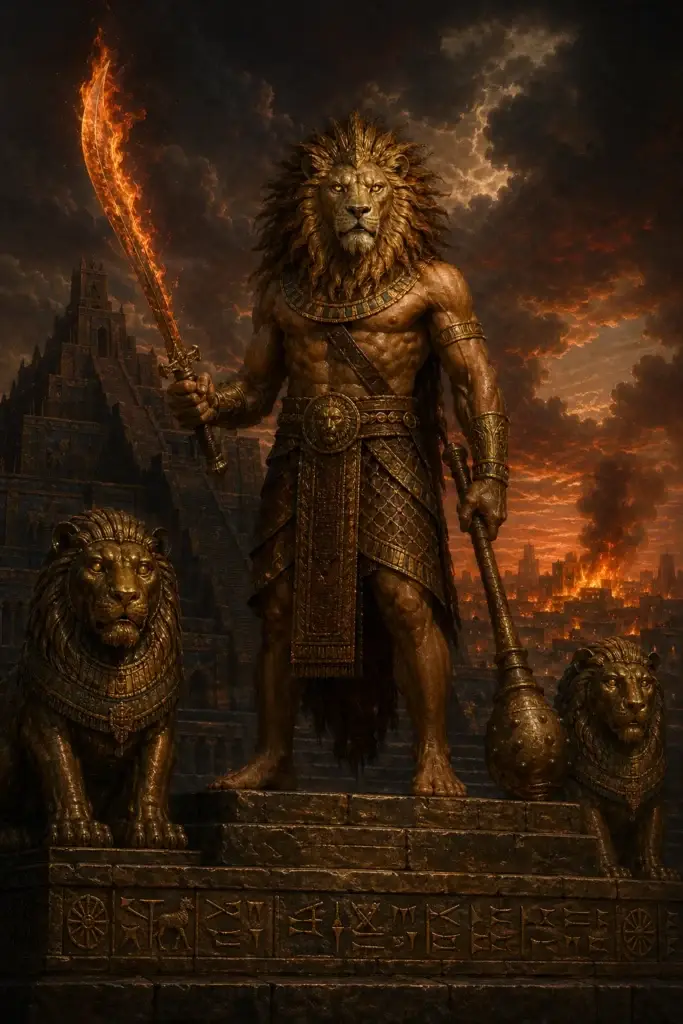
Girra, Sumerian Gibil, is the fire and smith god of Mesopotamia. His fire is purifying, destructive and refining all at once; in the incantation series it is invoked to burn away witchcraft and purify people and places alike.
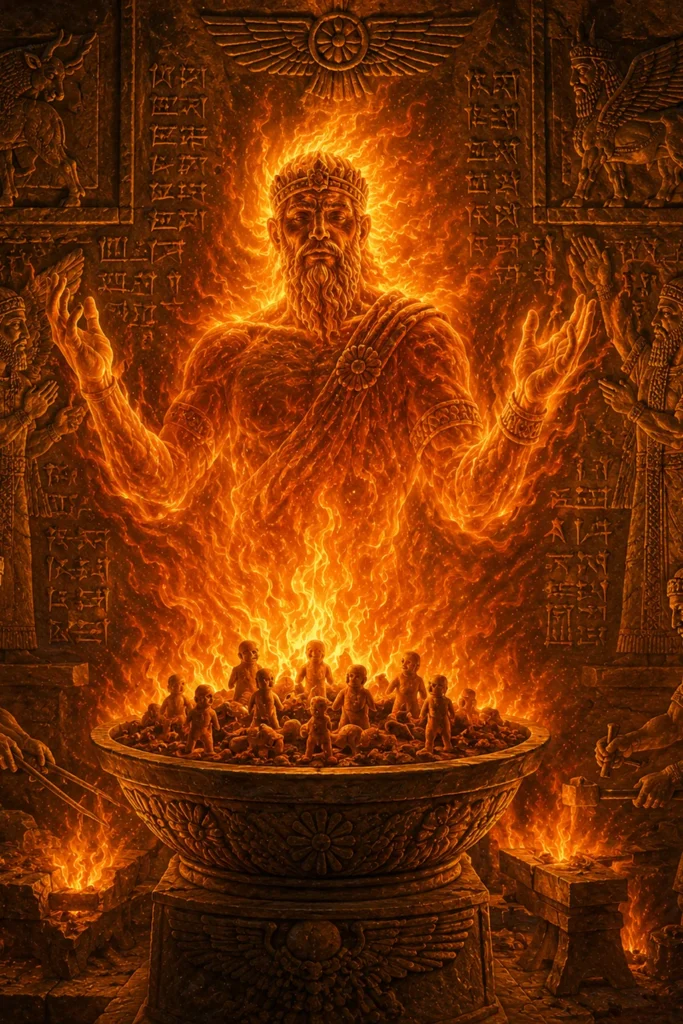
In the incantation series Maqlû, Girra is regarded as the firstborn of Anu and as a great counterforce against malevolent magic: there, figures of witches are burned in the fire basin. As the melter of metals, he is also the patron of metalworkers, the fire that transforms raw material into tools and weapons.
Type: fire and smith god, personification of the flame
Origin: Sumerian as Gibil, Akkadian Girra or Gerra
Texts: incantation series Maqlû and Šurpu
Period: from Sumerian times into the Seleucid era
Appearance: personification of fire, invoked as a blazing god
Textual history
Period of the Texts
Attested from Sumerian times as Gibil into the Seleucid era; the central evidence appears in the incantation series Maqlû and Šurpu.
Area of Diffusion
All of Mesopotamia: Girra belongs to the established stock of the Babylonian and Assyrian incantation tradition.
Sources
Well documented: the editions of the Maqlû and Šurpu series, above all the Maqlû editions by Abusch, together with the handbooks of Assyriology.
Name and variants
Sumerian: Gibil; Akkadian: Girra or Gerra. In Maqlû the god is called the firstborn of Anu; as mother the sources usually name Šala or Antu, though not consistently, so that several place-bound genealogies exist side by side. A typical invocation formula reads: O blazing Girra, firstborn of Anu.
Nature and effect
Appearance
Girra is the personification of fire and flame and is invoked as the blazing god. As the smelter of metals, he is the fire that transforms raw material into tool and weapon.
Effect
Girra embodies fire in its threefold nature: purifying, destroying and refining. He is regarded as a great counterforce against malicious magic: in Maqlû and Šurpu his purifying fire is used to banish demons and to purify people and places, often invoked together with Ea, Marduk and Šamaš. In the Maqlû ritual, figurines of witches are burned in the fire basin.
Profile: Girra
The key aspects of the fire god at a glance.
Fire and smith god of Mesopotamia, attested from the Sumerian era as Gibil through to the Seleucid period.
Exorcist priests, metalworkers and those seeking protection against witchcraft; his fire purifies people and spaces.
Personification of fire and flame, invoked as the blazing god and firstborn of Anu.
Burns witches and evil magic, purifies people and spaces, and as patron of metallurgists refines metals.
Invoked in incantations and purification rites; in the Maqlû ritual, figurines of witches are burned in the fire basin.
The Vedic Agni and the smith gods Hephaistos and Vulcanus; closely related are Nusku and Ishum.
From Gibil to Girra: the god of the incantation series
In Sumerian the god is called Gibil, in Akkadian Girra or Gerra. He is the fire god and the god of smithcraft and metallurgy. In the incantation series Maqlû he is described as the firstborn of Anu; the mother is mostly named in the sources as Šala or Antu, though not consistently, so several place-bound genealogies exist.
Girra has his great hour in the defence against witchcraft: in Maqlû and Šurpu his purifying fire is invoked to banish demons and to purify people and places, often together with Ea, Marduk and Šamaš. The typical invocation formula, O blazing Girra, firstborn of Anu, sums up the god’s rank and nature in a single sentence.
Reception and classification
Girra is received purely through Assyriology and the history of religion; there is no living cult. He is present chiefly in the editions of the incantation series.
In terms of religious studies, Girra embodies fire as an ambivalent power: purification and refinement on one hand, destruction and punishment on the other. At the same time, he connects ritual purity with craft, since the smelting of metal is regarded as a purification. According to the sources, his fire is dangerous only for witches and evil powers; for those seeking protection, it is a purifying force.
Fire against witchcraft: the cult forms
Well attested in the sources are the invocation of Girra in incantations and purification rites, the burning of witch figurines, and fire as a purifying counterforce against evil magic. In the Maqlû ritual, figurines of witches are burned in the fire basin while the god is invoked as the blazing firstborn of Anu. As patron of metallurgists, Girra is furthermore connected with the smith’s fire; the smelting of metal itself is regarded as a purification.
Fire gods compared
Girra corresponds to the Vedic Agni, fire as a purifying, destroying and sacrifice-mediating power, as well as to the smith gods Hephaistos and Vulcanus. Most closely related are the two other Mesopotamian fire gods: Nusku, the god of light, lamps and messages and vizier of Enlil, and Ishum, the torch-bearing night watchman of the streets. Where these two stand for light and nocturnal protection, Girra is the pure power of fire and the forge.
Frequently asked questions about Girra
Is Girra the same as Gibil?
Yes. Gibil is the Sumerian, Girra the Akkadian name of the same fire deity.
Why was Girra invoked against witchcraft?
Because fire was regarded as the strongest counterforce against harmful magic. In the Maqlû ritual his fire symbolically burned the figurines of witches in the fire basin.
Is Girra also a smith god?
Yes. As the smelter of metals, he is the patron of metallurgists; his fire transforms raw material into tool and weapon.
Further links
Further reading:
- Mesopotamia – all beings of the land between the rivers
- Nusku and Ishum – the related fire gods of Mesopotamia
- Agni – the Vedic fire god as a parallel
- Smoke cleansing, salt, amulet – traditional protective means
- Protection Compass – an overview of protective means
Literature (selection)
Further standard works in the bibliography.
As a Mesopotamian fire god with the ancient Sumerian name Gibil, Girra represents the whole span of the flame: the purification of the cleansing rites, the punishment of witches and the creative glow of the forge.