Agni, Vedic fire god and messenger of the gods
By Ralf Ittermann · last reviewed on
In the Vedic pantheon, Agni is regarded as the fire god and as messenger of the gods, who carries the offerings of humans to the heavenly beings.
In Hinduism, Agni is the fire god and mediator between humans and the gods. His name literally means “fire” and is linguistically related to the Latin ignis. In the Rigveda, Agni is among the most frequently celebrated gods, alongside Indra and Soma.
He is the god of the sacrificial fire that carries the offerings of humans up to the gods in heaven, and at the same time the god of the hearth fire, of lightning, and of the inner fire (digestion).
In religious studies, Agni is regarded as one of the most important Vedic gods, whose significance declined with the decline of the Vedic sacrificial religion, but who has remained present as a ritual element up to the present day.
Myth and Origin
In the Rigveda, Agni is one of the three central gods, alongside Indra and Soma. The first hymn of the Rigveda (1.1) is dedicated to Agni.
It begins: “I praise Agni, the household priest, the divine priest of the sacrifice, the Hotr, the highest bestower of treasures.” This opening hymn of the oldest sacred text of India underscores Agni’s fundamental position.
In the Vedic texts, Agni is celebrated in many aspects: as household priest (Purohita), as Hotr (sacrificial priest), as father of the gods, as son of the waters (Apam Napat), as the embodiment of truthfulness.
His father-son relationships with other gods are complex: he is the son of heaven (Dyaus) and earth (Prithvi), but also father of the gods, since the sacrificial fire gives life to the gods. This paradoxical genealogy is a typical feature of Vedic theology.
In terms of religious history, Agni is related to the Iranian Atar, the fire god of the Avestan tradition. Indo-Iranian religious history sees in the fire cult one of the shared heritages of both traditions.
In the Avesta, Atar is the sacred fire of Ahura Mazda, in the Vedic texts Agni is the central sacrificial god. This parallel was described in detail by Hermann Oldenberg in “Die Religion des Veda” (1894) and in later Indo-Iranian scholarship.
Agni’s fundamental position in the Vedic pantheon is reflected in the sheer quantity of hymns dedicated to him. In the Rigveda, about 200 of 1028 hymns are dedicated to Agni, which is nearly 20 percent of the entire text.
Only Indra (about 250 hymns) and Soma (about 120 hymns) come close to this frequency. This statistical preponderance shows that Agni was not only a theologically important figure, but also a cultically central one.
The etymological relationship of the name Agni with Latin ignis (fire), Lithuanian ugnis, and Old Church Slavonic ognj points back to an old Indo-European language family.
This linguistic continuity across millennia is one of the strongest indications of the reality of a shared Indo-European religious culture in which fire played a central ritual role.
Symbols and Attributes
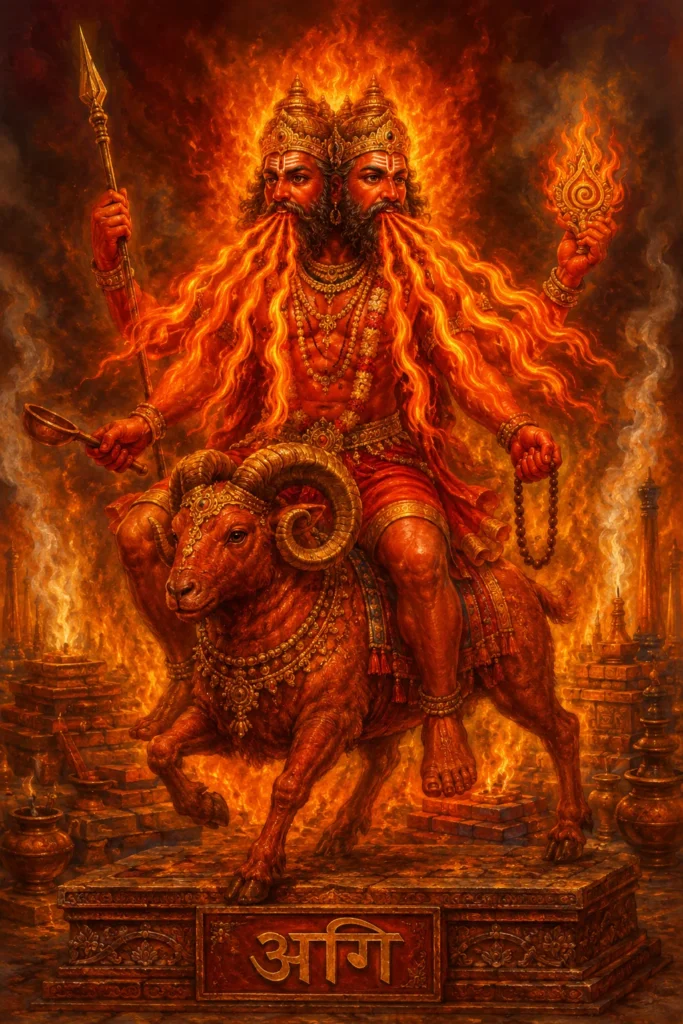
Agni is typically depicted with two heads, seven tongues, three or seven arms, four horns, and wrapped in flames. The two heads embody his dual nature as earthly and heavenly fire. The seven tongues, each with its own name (Kali, Karali, Manojava, Sulohita, Sudhumravarna, Sphulingini, Vishvaruchi), each carry different offerings.
His mount is the ram, an animal that plays a central role in the Vedic sacrifice. The ram symbolizes the offering itself, which comes into the fire. Agni rides on it through the three worlds (earth, atmosphere, heaven).
His attributes in the later iconographic tradition are the offering plate (with offerings), the cup, the axe, and the spoons (Sruva and Sruk, Vedic sacrificial spoons). These attributes embody his function as a sacrificial priest.
His garment is red, his skin sun-colored or fiery red. On his chest he wears a Yajnopavita (sacred thread) as a sign of his Brahmanic priestly dignity. In temples he is usually depicted in a smaller niche, since he does not belong to the principal gods of classical Hinduism.
Cult and Worship
In Vedic ritual, Agni was the central ritual element. The entire yajna (sacrifice) was mediated through Agni.
The most important sacrifices were the Agnihotra (daily fire sacrifice), the Agnishtoma (Soma sacrifice with fire), the Vajapeya (victorious sacrifice), and the Ashvamedha (horse sacrifice). In all of these rituals, Agni was the focal point.
Today, the classical Vedic sacrificial practice (Shrauta ritual) survives only in a few families of South India (above all among the Nambudiri Brahmins of Kerala, the Athirathra families of Tamil Nadu, and a few families in Andhra Pradesh).
In “Agni: The Vedic Ritual of the Fire Altar” (1983), Frits Staal documented the remarkable Athirathra ritual of 1975 in Kerala, a twelve-day sacrifice with substantial quantities of wood, Soma, and animal offerings (today replaced by symbolic offerings). This documentation is among the most important works of religious ethnography in modern Indology.
In the daily domestic cult of many Hindu families, Agni is present through the house fire and the wedding fire. At the Hindu wedding ceremony, bride and groom circle Agni’s fire seven times.
This Saptapadi ritual is regarded as the most important act of the marriage. Agni is the witness of the marriage vow. The Saptapadi mantras refer directly to Agni’s position as witness and keeper of the marital obligations.
Agni is also central to the Hindu funeral (Antyeshti). The deceased is cremated on a pyre. Agni consumes the body and carries the soul to the gods. This funerary function of Agni is one of the most important in religious history and is described in detail in many Vedic and Puranic texts.
Temples dedicated exclusively to Agni are rare. The Agni temple in Thirupugalur (Tamil Nadu) is one of the few special sanctuaries. In most temples of India, however, Agni stands in a niche among the Dikpalas (guardians of the cardinal directions), as guardian of the southeastern direction.
Important Myths
The first important myth is the birth of Agni. In Rigveda 3.29 it is told that Agni is born from the rubbing of two pieces of wood (Arani).
This physical reality is rendered mythologically: the upper piece of wood is his father, the lower his mother. Thus he is born anew each day, each time a fire is kindled. This narrative connects cosmic theology with ritual practice.
The second myth is Agni’s flight into the water. In Rigveda 10.51 and in the Mahabharata it is told that Agni, overwhelmed by the burden of his office as bearer of the sacrifice, hid from the gods by plunging into the water. The gods sought him, found him, and persuaded him to resume his task.
This myth has its own variant in the Mahabharata (Adi Parva 220-225): Agni wishes to burn the Khandava forest, but cannot, because Indra protects it. With the help of Krishna and Arjuna he finally succeeds. The Khandava-Daha (burning of the Khandava forest) is one of the most dramatic episodes of the Mahabharata.
The third myth is Agni’s position in the battle of the gods. In the Mahabharata and in the Puranas, Agni is mentioned several times as a fighter against demons.
He is not only a priest, but also a warrior. In the “Bhagavad Gita” (chapter 11) he is celebrated as one of the aspects of the cosmic Vishnu-Krishna.
A fourth myth is Agni’s relationship with the wives of the seven sages. In the Mahabharata (Vana Parva) it is told that Agni saw the wives of the seven great sages (Saptarishis) and became inflamed with desire for them. Out of shame he withdrew.
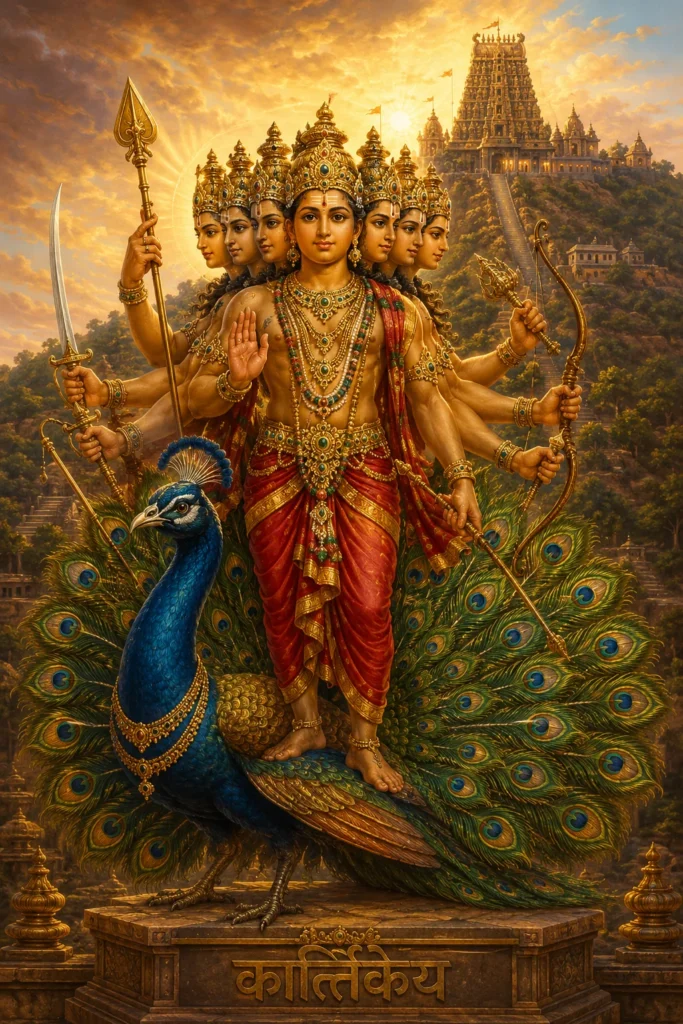
Svaha, the personified sacrificial invocation, finally persuaded him by transforming herself into each of the wives and uniting with him. From this union arose Skanda-Kartikeya. This myth interweaves Agni’s story with the genealogy of Kartikeya and shows the complexity of the Hindu web of gods.
The narrative of the Khandava-Daha (burning of the Khandava forest) in the Mahabharata is among the most dramatic depictions of a fire in world literature.
Agni suffers from digestive disorders because he has consumed sacrifice-rich food for too long. He asks the gods for the Khandava forest as a remedy. Indra protects the forest, however, because his friend Takshaka, the serpent king, lives there.
Krishna and Arjuna help Agni: Krishna with the discus Sudarshana, Arjuna with his arrows that prevent Indra’s rain. The fire destroys the entire forest, all inhabitants except six, who are saved through special grace.
From the flames Krishna and Arjuna receive their wondrous weapons: Krishna the Kaumodaki mace and the Sudarshana Cakra, Arjuna the Gandiva bow and inexhaustible quivers.
The Khandava episode is ambivalent in terms of religious sociology. On the one hand it shows the omnipotence of Agni (the burning of an entire forest), on the other hand his neediness (he must be entreated by humans).
It also shows a conflictual relationship between Indra and Agni: two central Vedic gods come into conflict, mediated by the human-divine heroes Krishna and Arjuna. This constellation reflects the religious tension of the post-Vedic era, in which the old Vedic gods (Indra, Agni) were overshadowed by new Puranic deities (Krishna-Vishnu).
Relationships within the Pantheon
Agni is married to Svaha, the personification of the ritual invocation “Svaha” (roughly “may it be well”), which is called out at the end of every sacrificial mantra. This marriage is more theological than narrative: every sacrifice is the ritual union of Agni (fire) and Svaha (invocation).
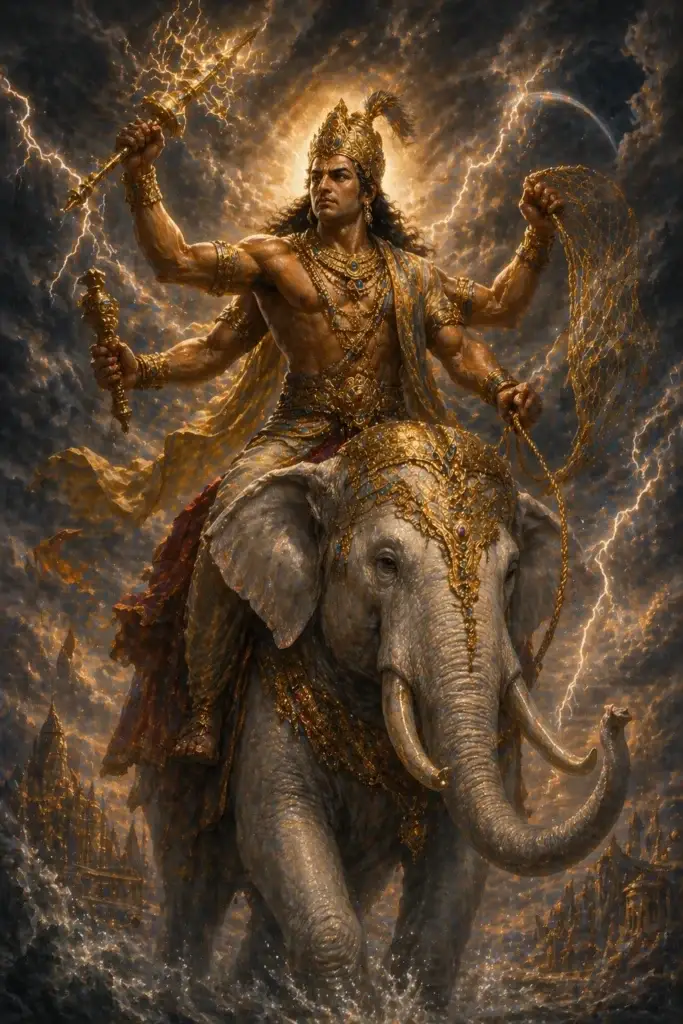
Agni stands in close connection with Indra. In the Vedic pantheon the two are on equal footing, often invoked in tandem. Indra is the warrior god, Agni the priest. This warrior-priest doubling embodies a central Indo-European structural principle according to Dumezil.
Sacrificial practice connects him with Soma. Soma is the ritual drink, Agni the ritual fire. The two belong inseparably together. In the Vedic texts they are often named as a complementary pair.
In the later Puranic tradition, Agni is classified among the eight Dikpalas (guardians of the cardinal directions). He is the guardian of the southeast.
The Dikpalas are: Indra (east), Agni (southeast), Yama (south), Nirriti (southwest), Varuna (west), Vayu (northwest), Kubera (north), Ishana (northeast). This classification shows Agni’s continued presence in classical Hinduism, but also his loss of status relative to the principal gods Vishnu, Shiva, and Devi.
Reception and Influence
In classical Sanskrit drama and in Kavya literature, Agni is omnipresent, above all in descriptions of weddings, funerals, and sacrificial ceremonies. Kalidasa’s “Raghuvamsha” and “Shakuntala” contain elaborated Agni scenes. The Mahabharata episode of the Khandava-Daha is among the most striking depictions of a fire in world literature.
In Buddhism and Jainism, Agni was partly deconstructed. The Buddha criticized the Vedic animal sacrifice and thus indirectly the Agni-centered practice. In the Pali texts, Agni appears as a Hindu figure that Buddhists reject, but recognize as a cultural reality. This criticism contributed to the decline of Agni worship in the post-Vedic centuries.
In modern Indian society, Agni is above all a ritual reality: at weddings, funerals, and inauguration ceremonies a fire is kindled.
Agni is also present in the political symbolism of India: the ballistic medium-range missile of the Defence Research and Development Organisation (DRDO) is named Agni, an indication of the continuous cultural influence of the Vedic fire god.
In the West, Agni became known through the Indology of the 19th century. Friedrich Max Muller presented the significance of Agni in detail in his edition of the Rigveda (1849-74) and in his lectures on Vedic religion. In the 20th century, Mircea Eliade, Heinrich Zimmer, Wendy Doniger, and Frits Staal continued the research.
Classification in Religious Studies
According to the classification of Georges Dumezil, Agni is a priestly-ritual figure of the first Indo-European function. He belongs to the sphere of sovereignty, with particular emphasis on the ritual aspect (in contrast to the magic of Varuna or the truthfulness of Mitra). This classification was carried further by Edgar Polome and Jean Haudry.
In terms of the phenomenology of religion, Agni is one of the best examples of a mediator god who connects humans and gods.
In “Patterns in Comparative Religion” (1958), Mircea Eliade classified the fire cult as a universal religious structure. Parallels to Agni are found in the Iranian Atar, the Greek Hephaistos, the Roman Vulcanus, the Germanic Loki, and the Celtic Belenos.
In “Agni: The Vedic Ritual of the Fire Altar” (2 vols., 1983) and in “Rules without Meaning” (1989), Frits Staal developed an independent theory of Vedic ritual theory.
He sees in the Agni ritual an autonomous system of rules that is not primarily understood through its symbolic meaning, but as ritual self-reproduction. This thesis is contested in scholarship, but methodologically influential.
In “Agni: The Vedic Ritual of the Fire Altar” (2 vols., 1983), Frits Staal presented one of the most monumental religious-ethnographic studies of modern Indology. In April 1975, together with Adelaide de Menil and Robert Gardner, he documented a twelve-day Athirathra ritual in Kerala.
The Nambudiri Brahmin families performed the complete Atiratra-Agnicayana ritual, probably the last time this ritual was carried out in its classical form.
The documentation comprises film recordings, audio recordings of all mantras, photographic documentation of the altar constructions, and ethnographic descriptions of the family tradition. This documentation is regarded as a unique testimony to a ritual tradition over three thousand years old.
Staal’s theoretical conclusions from this field research have provoked controversial discussions in religious studies. In “Rules without Meaning” (1989) he argued that the Vedic ritual is primarily a system of rules that reproduces itself, without the symbolic meaning being the driving force.
This “meaninglessness thesis” was criticized by Brian K. Smith, Stephanie Jamison, and others: the ritual does indeed have symbolic and cosmological meaning that escapes Staal’s systems-theoretical reduction.
Agni’s position in modern Hinduism is firmly anchored despite the decline of Vedic sacrificial practice. At Hindu weddings, Agni is central: the Saptapadi (seven steps) around the fire is the legally relevant act of marriage. At funerals, Agni is central: the deceased is cremated on a pyre whose fire is Agni.
At business openings, house dedications, and the start of examinations, the kindling of a small fire or a clay spoon with ghee is a widespread practice. Agni is therefore no longer a principal god in classical Hinduism, but is omnipresent as a ritual reality.
Sources and Further Reading
Primary sources: Rigveda (above all 1.1, 3.29, 10.51, approximately 1500-1200 BCE), Yajurveda, Atharvaveda, Shatapatha Brahmana, Aitareya Brahmana, Mahabharata (especially Khandava-Daha in Adi Parva 220-225), Bhagavad Gita chapter 11. Liturgical texts: Agnishtoma ritual (in the Shrauta Sutras), Agnihotra mantras. English translations: Rigveda by Stephanie Jamison/Joel Brereton (2014), Mahabharata by John D. Smith (2009).
Secondary literature: Frits Staal “Agni: The Vedic Ritual of the Fire Altar” (1983) and “Rules without Meaning” (1989), Hermann Oldenberg “Die Religion des Veda” (1894), Jan Gonda “Vedic Ritual: The Non-Solemn Rites” (1980), Wendy Doniger “Hindu Myths” (1975), Heinrich Zimmer “Myths and Symbols in Indian Art and Civilization” (1946), Klaus Klostermaier “A Survey of Hinduism” (3rd ed. 2007), Axel Michaels “Der Hinduismus” (2nd ed. 2006), Stephanie Jamison “Sacrificed Wife / Sacrificer’s Wife” (1996), Asko Parpola “The Roots of Hinduism” (2015).