iWell Guard

Varuna, guardian of truth and lord of the waters

Varuna is a god of the Hindu tradition.

Guardian of the oath, whose noose binds lies and perjury.

Table of Contents

Varuna, god of the Hindu tradition
Varuna

Varuna is among the oldest gods of India, an Aditya, son of the goddess Aditi. In the Rigveda he watches over the Rta, the cosmic order. His noose binds oathbreakers, but whoever confesses his guilt is forgiven.

With the rise of Indra, Vishnu and Shiva, he became Lokapala of the west and lord of the waters.

At a glance: Varuna

Type: Vedic god of order, later god of the waters
Origin: Aditya lineage
Texts: Rigveda to Puranas
Period: c. 1500 BC to present
Appearance: royal figure with a noose, riding a sea being

Area of origin and sources

Period of the Texts

From the Rigveda into the Puranas, the coastal cult is alive to this day.

Area of Diffusion

The Indian subcontinent, today above all coastal and fishing communities.

Sources

Very good: Vedas, epics, Puranas and a dense body of research literature.

Name and variants

Sanskrit: Varuna belongs to the Adityas and bears the title Lokapala of the west. An earlier equation with the Greek Uranus is now considered uncertain.

Appearance and symbolism

Appearance

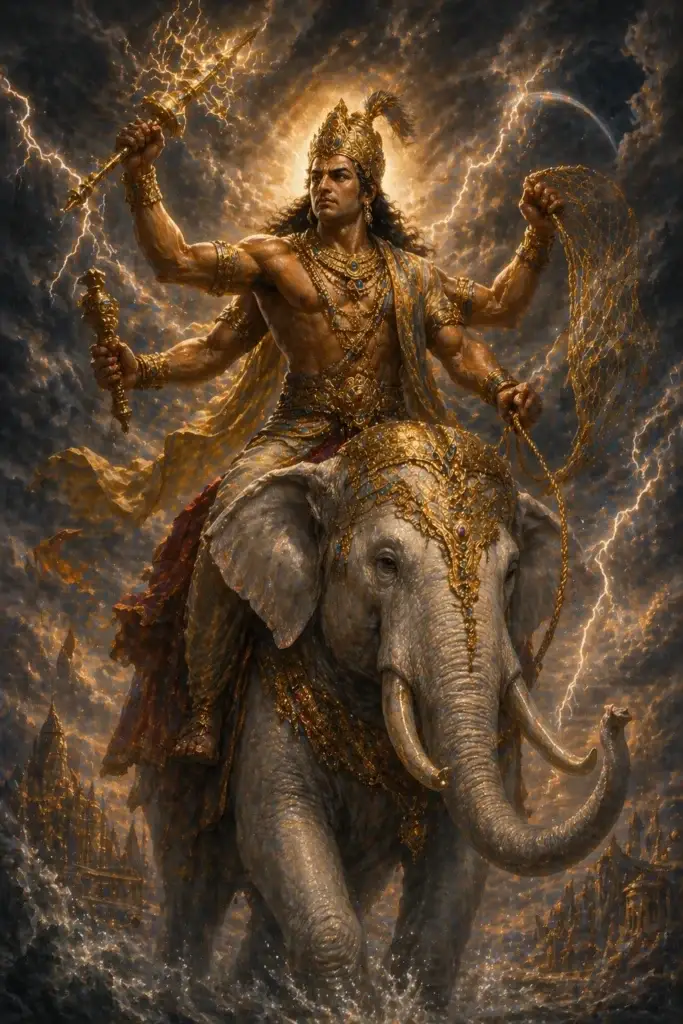
Varuna is enthroned as a king in a golden robe, his emblem is the noose Pasha; four-armed, he rides the Makara.

Effect

Perjury brings his bonds upon the perjurer, but confession loosens them; as lord of the waters he grants rain and safe passage.

Profile: Varuna

The key characteristics at a glance.

Tradition

Vedic high god of the Adityas.

Responsible for

Oath, cosmic order, ocean and rain.

Depiction

Royal figure with a noose, riding a sea being.

Function

Judge over oaths, giver of rain and safe passage.

Cult

Confession, Tarpana offerings, coconut gifts at Narali Purnima.

Related

The river goddess Yamuna, distant from the Greek Poseidon.

The noose of the oath and the way to the water

The hymns of the seer Vasishtha show Varuna as a judge who knows transgressions before they are spoken: his noose binds the oathbreaker, and the Brahmana texts name dropsy as punishment.

With the rise of Indra, Vishnu and Shiva, he lost his rank as king of heaven. Lüders saw his seat as always in the water, because that is where oath and truth dwell.

From temple cult to naval motto

Varuna has almost vanished from temple life: the Indian Navy bears the motto ‘Sham No Varunah’, and on the Konkan coast his cult lives on in the festival of Narali Purnima. Popular retellings simply make him a sea god, which shortens his older role as guardian of order.

Scholarship sees in him a displaced high god, though the finding remains disputed.

Confession, offering and the gift to the sea

The forms of protection are directed against Varuna’s punishment, not against him: confession and the plea to loosen the nooses, water offerings and invocation before sea voyages. To this day the coastal custom of the coconut gift at Narali Purnima endures, alongside amulet, holy water and salt as an ancient purifying agent.

Rulers of the sea in cultural comparison

The Greek Poseidon too answers wrongdoing with storms, and Japan’s Kappa has its own rules by the water. Varuna stands as lord of all waters beside the river goddess Ganga.

Frequently asked questions about Varuna

Is Varuna a sea god?

Only secondarily: in the Rigveda he is above all guardian of order and the oath, with the waters added only later.

Is he still worshipped?

Yes, on India’s coasts at Narali Purnima and as Jhulelal among the Sindhi Hindus.

Further links

Recommended internal links:

Literature (selection)

A selection of key sources:
  • Jan Gonda: Die Religionen Indiens I. Veda und älterer Hinduismus. 1960.

Further standard works in the bibliography.

Whether sought as the Vedic god Varuna or as Varuna, god of the water: the same guardian of order is meant, whose noose once bound the oathbreaker.

Classification & Protection

IILEVEL
The Protection Compass assigns this being to influence level II, Noticeable influence.

Against its influence, cross-cultural tradition names these protective means:

Compare in the Protection Compass →

Recommended protective means

iWell Guard

The simplest protective means in this collection: 41 layers of fine gold 999, platinum, silver and silicon, manufactured in Ruhla, Thuringia. It requires no activation, is bound to no person, and is effective within a radius of around 50 meters, even without being worn.

All protective means at a glance →