Between the 9th and 1st centuries BCE the Etruscans inhabited present-day Etruria (Tuscany, Latium, Umbria) and developed an independent advanced culture with a complex religion. Their tradition shaped early Rome substantially, from haruspicy to the bulla worn as a protective pendant. The Etruscan language is non-Indo-European and only partly deciphered.
The Etruscan protective tradition is presented here in its own right.
The haruspex pantheon, that is, the circle of gods which the diviners of the entrails (haruspices) consulted in their interpretation of the liver, divided the sky into sixteen sectors and assigned each region its own deity.
Etruscan culture grew out of the local Villanovan culture (from around 900 BCE) and flourished in the 7th to 5th centuries BCE. Its main centres were Tarquinia, Caere, Vulci, Veii, Volterra, Perugia and Chiusi.
Etruscan kings ruled at times in Rome as well (the Tarquin dynasty). With the Roman conquest of Etruria (4th and 3rd centuries BCE) the Etruscans were integrated into the Roman world, while their religion and language survived into the early imperial period.
When reading the liver, the haruspices consulted a fixed circle of gods: the sky was divided into sixteen sectors, each region belonging to a deity of its own.
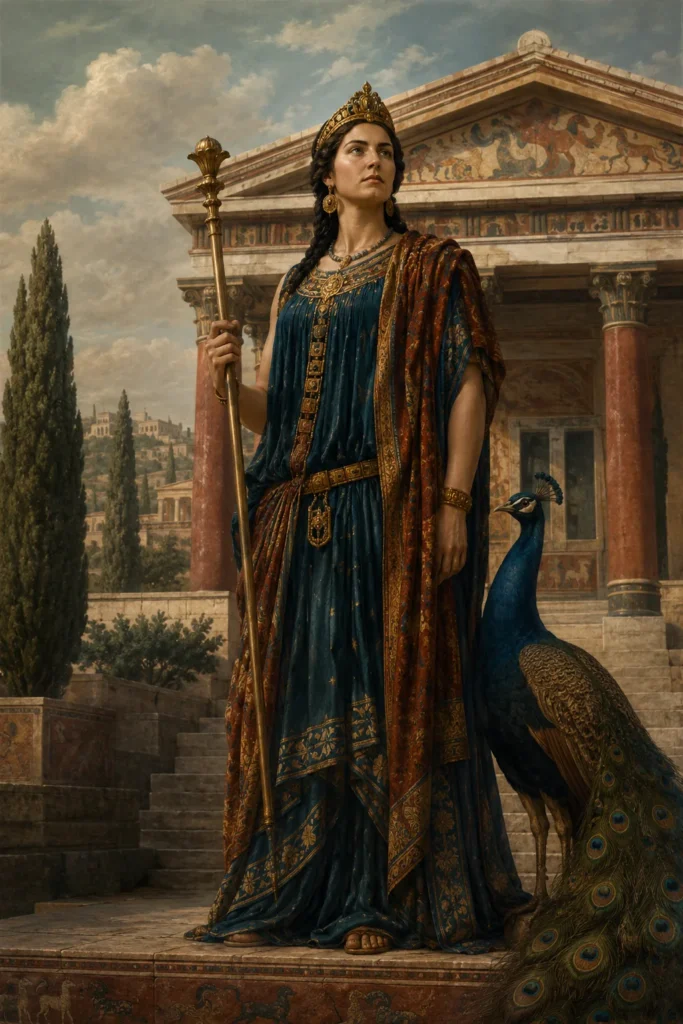
The chief Etruscan triad of gods consisted of Tinia (sky god, later identified with the Greek Zeus and the Roman Jupiter), Uni (sky goddess, later Hera/Juno) and Menrva (goddess of wisdom and war, later Athena/Minerva). This triad was adopted in the Capitoline sanctuary of Rome.
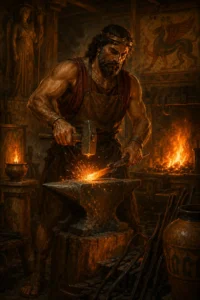
Alongside them stood Turms (counterpart of Hermes), Sethlans (Hephaestus), Aplu (Apollo), Fufluns (Dionysus), Selvans (forest) and Nethuns (water). Voltumna was the federal god of the Etruscan league, and his sanctuary near Volsinii served as the meeting place of the twelve cities.
Etruscan religion was highly systematised and maintained a learned class of its own. The Disciplina Etrusca comprised three fields of knowledge: the Libri Haruspicini (liver inspection, examination of the entrails), the Libri Fulgurales (interpretation of lightning) and the Libri Rituales (ritual lore, the founding of cities, the drawing of boundaries, and knowledge concerning death).
The mythical founder of this teaching was Tages, who according to legend sprang up from a furrow in an Etruscan field. The books were set in bronze or written on linen, and the surviving Liber Linteus is the only extensive Etruscan textual witness (reused as the wrapping of an Egyptian mummy).
The haruspex (in Etruscan: netsvis) read the will of the gods from the liver of the sacrificial animal. The bronze liver of Piacenza, a model with 40 fields assigned to various gods, offers insight into the complexity of this practice.
Etruscan liver inspection was taken over by the Romans and, in the course of the imperial period, became an institution observed throughout the empire. The interpretation of lightning likewise followed a strictly systematic division of the sky into 16 sectors.
The bulla, a hollow pendant of gold (for the children of the nobility), leather or bronze, was hung around a child’s neck after birth and protected against harmful powers, especially against the evil eye.
Inside it, amulet substances could be enclosed, often together with a fascinus (a phallic protective sign). The tradition was adopted by the Romans, and bullae are the archetypal portable protective object for children in Italic antiquity. Adult women often wore lunula pendants (in the shape of a crescent moon).
About 200 Etruscan gods are known by name, many only through inscriptions or depictions on bronze mirrors. Etruscan writing has not yet been deciphered to an extent that would allow a complete reconstruction of the religion.
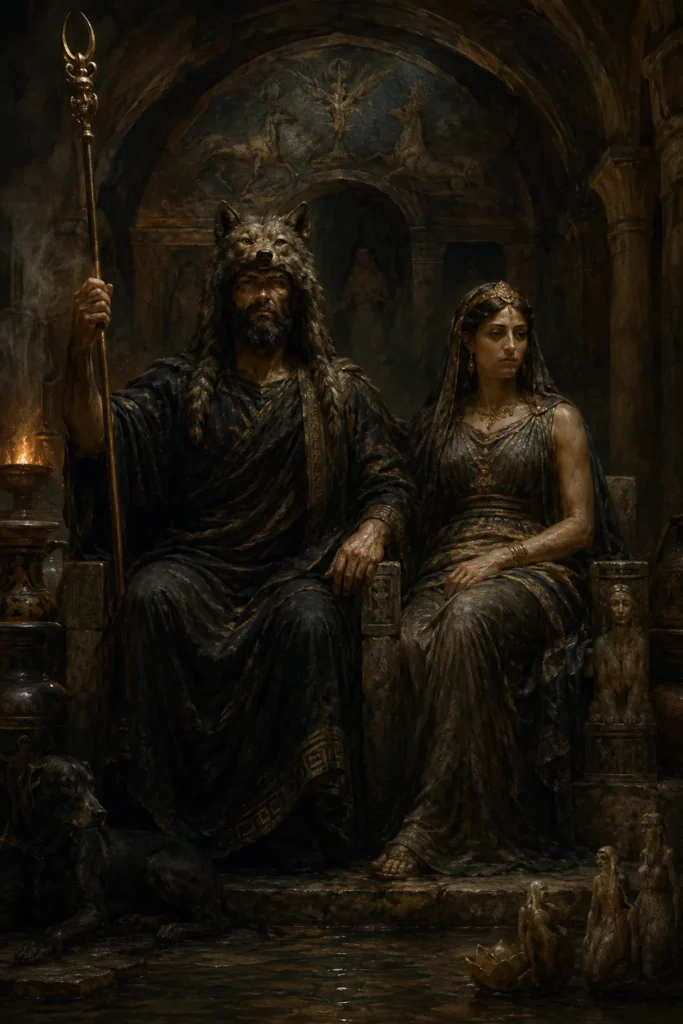
The chief gods are Tinia, Uni and Menrva (the triad), together with Aita (the underworld), Nethuns (the sea), Fufluns (wine) and others.
Tinia is the chief Etruscan god, of thunder and the sky, comparable to Zeus/Jupiter. With his consort Uni and his daughter Menrva he formed the Etruscan triad, which passed directly into the Roman pantheon as the Capitoline triad.
The haruspex was the Etruscan divinatory priest who read the will of the gods from the liver of animals (above all sheep).
The liver of Piacenza (a bronze model, 2nd century BCE) shows 40 regions, each assigned to a deity. This Disciplina Etrusca continued to be practised in Rome until the 4th century CE, and imperial senators consulted haruspices.
With the Roman conquest of Etruria (4th and 3rd centuries BCE) many gods were taken into the Roman pantheon: Tinia became Jupiter, Uni became Juno, Menrva became Minerva.
Haruspex practice remained alive until the Christian period. The Etruscan language died out in the 1st century CE, while its religion lived on in fragmentary form in Rome.
The Etruscan necropolises, the Banditaccia near Caere, Tarquinia and Vulci, are among the most impressive cities of the dead of antiquity. Tumulus tombs are designed as dwellings for the deceased, with wall and ceiling paintings, furniture, and dining and drinking vessels.
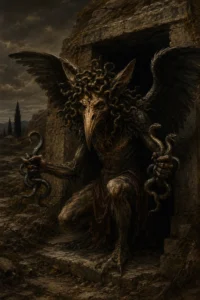
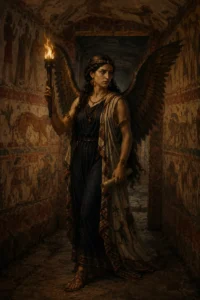
The conception of the afterlife included a habitable, joyful existence (in the earlier phase) and gloomy underworld beings such as Charun and Vanth (in the later phase). The sarcophagi of Cerveteri depict the deceased as couples dining together.
Original Etruscan texts are sparse (the Liber Linteus, the Tabula Capuana, the Cippus Perusinus, and many short grave inscriptions). The language is non-Indo-European and only partly deciphered in its vocabulary.
Important works include Jean-René Jannot’s Religion in Ancient Etruria, as well as studies by Larissa Bonfante and Massimo Pallottino. Ancient sources include Cicero’s De Divinatione, Livy and Servius. Macrobius and Festus also cite Etruscan religious practice.
At the centre of Etruscan religion stood a highly formalised system of sign interpretation, which ancient authors summarised under the term Etrusca disciplina.
According to Cicero and other Roman sources, it was divided into three main branches: the examination of the entrails (haruspicina), the interpretation of lightning (fulgura) and the reading of prodigies (ostenta).
Unlike Greek divination, which relied more strongly on inspiration and oracular pronouncements, Etruscan practice rested on the assumption that the will of the gods could be read in a regular, ordered way in the material world.
The best-known witness to liver inspection is the bronze liver of Piacenza, a model of a sheep’s liver found in 1877, whose surface is divided into more than forty inscribed fields. Each field bears the name of a deity and corresponds to a region of the sky.
The haruspex compared the findings on the actual sacrificial animal with this cosmic map. Scholarship, including the work of Massimo Pallottino and later Nancy de Grummond, sees in it a reflection of the Etruscan conception of an ordered sky divided into sectors.
The doctrine of lightning distinguished bolts according to their direction of origin and assigned each to a different divine subject. The thunder god Tinia commanded several kinds of lightning, some of which could only be hurled after consultation with other gods.
This gradation reflects a theology in which even the highest god did not act without restriction. The Etruscan interpreters, the haruspices, remained sought-after specialists into the Roman imperial period and were still consulted in the fourth century CE.
The Etruscan language is not an Indo-European idiom and stands without any secure close relationship within the Mediterranean region. Only the fragment of the Lemnos stele from the northern Aegean shows clear correspondences, which is why some scholars speak of a Tyrsenian language family.
The script itself is readily legible, since it was derived from a West Greek alphabet. Understanding, however, founders on the limited vocabulary.
Around thirteen thousand inscriptions are known, yet the overwhelming majority consist of short grave and votive inscriptions with recurring formulas, names and statements of kinship. Longer continuous texts are rare.
The most extensive is the so-called Liber Linteus, a ritual book written on linen that reached Egypt as a mummy wrapping and is today kept in Zagreb. It contains a cult calendar with sacrificial instructions but remains unintelligible in many passages.
Further key texts are the Tabula Capuana, a clay tablet with ritual prescriptions, and the Tabula Cortonensis, a bronze tablet with a legal content. Bilingual inscriptions, which would permit a direct comparison, are extremely rare.
The most important is the trio of gold tablets from Pyrgi, which transmits an Etruscan text alongside a Phoenician one and thus documents a bridge to the Phoenician cultural sphere.
Language research therefore works with the so-called combinatorial method, that is, the recovery of meanings from context. Reliable progress is slow, and some religious terms remain disputed to this day.

The greater part of our knowledge of Etruscan religion derives from necropolises, since settlements and temples are far less well preserved. The grave chambers of Tarquinia, Cerveteri and other sites were in part elaborately furnished with wall paintings.
The older images of the sixth and fifth centuries BCE show above all banqueting scenes, dances and games, that is, a worldly, festive picture.
In the more recent tombs of the fourth and third centuries the tone changes markedly. Now demonic figures appear, accompanying or threatening the deceased. The best known is Charun, a being of the dead carrying a hammer, whose name recalls the Greek Charon but who has an independent function.
To him is added the winged Vanth, often depicted as a companion without a threatening character. Scholarship interprets this change partly as growing Greek influence and partly as a reaction to the political crisis of the Etruscan cities under Roman pressure.
About the precise conception of the afterlife itself the images give less information than one might expect. There are indications of an underworld with its own rulers, yet a systematic doctrinal structure such as in Egypt is not graspable.
Sarcophagi and ash urns with reclining figures of the deceased show a continuing interest in the individual person. Whether this expresses a hope for continued existence or was meant above all to secure the social rank of the family is judged differently in scholarship.
Interest in the Etruscans began in the Renaissance, when Tuscan scholars saw in them a glorious prehistory of their homeland. This enthusiasm, known as Etruscheria, was strongly marked by local pride and mixed finds with speculation.
In the eighteenth century the Accademia Etrusca in Cortona brought about a first institutional engagement, which, however, likewise bore romanticising traits.
A critical turn came in the nineteenth and early twentieth centuries with the systematic excavation of the necropolises and the collection of the inscriptions in the Corpus Inscriptionum Etruscarum.
From the 1940s onward Massimo Pallottino shaped modern research. He turned away from the old question of the origin of the Etruscans and emphasised instead that a people forms through its development in place, not through a single migration.
The question of origin itself goes back to Herodotus, who claimed a migration from Lydia, while Dionysius of Halicarnassus held the Etruscans to be indigenous. Genetic studies of recent years tend to support a continuity with the local Bronze Age population, without closing the debate.
For the history of religion it is important that many ancient accounts of the Etruscans come from Roman authors who had an interest of their own, for example in justifying the appropriation of divination. Etruscan religion is therefore transmitted in large part through a Roman lens, which requires every reconstruction to be treated with caution.


Etruscan religion forms an independent Italic tradition, whose disciplina etrusca was taken over by the Romans and shaped liver inspection, the interpretation of lightning and ritual order into late antiquity.
Related key terms: Etruscans, Haruspex, Disciplina Etrusca, Bulla, Tinia, Uni, Menrva, Voltumna, Liber Linteus, Tages.
The Etruscan tradition knew the bulla, a hollow protective pendant for children made of gold, bronze or leather, filled with amulet substances, as well as lunula pendants for women and phallic fascinus signs against the evil eye.
iWell Guard places itself within this cultural-historical line of portable protective objects, in a contemporary material architecture, manufactured in Germany. 41 layers, genuine gold, platinum, silver. 30-day right of return.
Personal experiences may vary. Not a medical device. No promise of healing.