Tinia: Etruscan Sky and Supreme God, Hurler of Lightning
By Ralf Ittermann · last reviewed on
Tinia (also written Tin, Tina, Tinia) is regarded in Etruscan religion as the supreme god and ruler of the sky. He is the Etruscan counterpart to the Roman Jupiter and the Greek Zeus, with his own distinctive characteristics.
This account describes his religious-studies standing within the Etruscan pantheon, his iconographic traces, and his role in the ritual life of Etruria.
Profile: Tinia
Tinia: the most important aspects at a glance. The following fields summarise origin, function, appearance, veneration, symbols and parallels.
In Etruscan religion Tinia is regarded as the highest god, ruler of the sky and chair of the council of the gods. His name is attested on numerous inscriptions, most famously on the Liver of Piacenza (2nd/1st century BCE). A secure etymology has not been reconstructed.
Tinia is the thrower of lightning and stands at the centre of the lightning interpretation of the Disciplina Etrusca. He hurls three kinds of lightning: warning, punishing and destroying. He makes decisions in agreement with other deities in the council of the gods (consensus deorum).
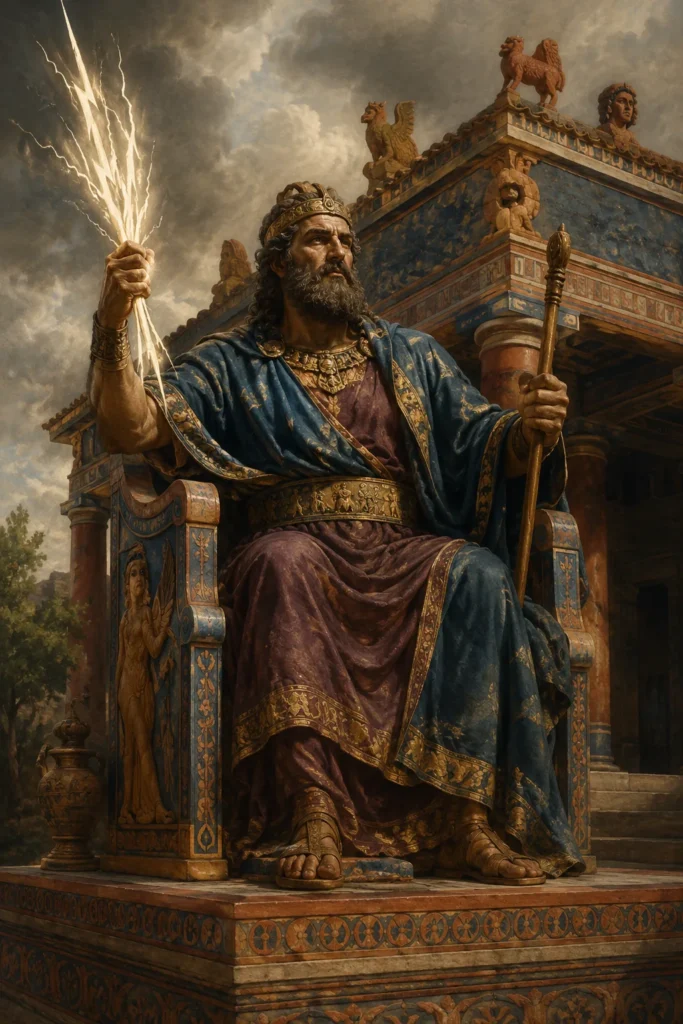
In Etruscan art Tinia appears as a bearded man, often with a thunderbolt, sceptre or lotus staff, seated or standing on bronzes. On mirrors (4th/3rd century BCE) he appears in mythological scenes, sometimes accompanied by eagles. A statuette comes from Piombino (5th century BCE).
Tinia was venerated in numerous city temples. Important cult sites were the temple of Veii and the great temples of Tarquinia, Caere and Volsinii. The rituals comprised sacrifices, especially bull sacrifices, prayers and divinatory practices.
Belonging to Tinia are the thunderbolt, the sceptre, the lotus staff and the eagle as companion. Occasionally he carries a symbol of the clouded sky. The bull is named as sacrificial animal.
Tinia corresponds functionally to the Greek Zeus and the Roman Jupiter. In comparative religion he is connected with Indo-European sky gods such as Dyaus Pita (Vedic), Dievas (Baltic) and Tyr (Germanic), but Etruscan is not Indo-European.
Classification within the Etruscan pantheon
Tinia is the supreme god of Etruscan religion and presiding head of the council of gods. In research he is often grouped with Uni (counterpart to Iuno) and Menrva (counterpart to Minerva) into a triad, which is interpreted as the model for the triad Jupiter, Juno and Minerva on the Roman Capitolium.
Important sources on Etruscan religion include Massimo Pallottino’s Die Etrusker (1942, German 1965), Larissa Bonfante and Judith Swaddling’s Etruscan Myths (2006) and Jean-Rene Jannot’s Religion in Ancient Etruria (2005). Tinia stands at the centre of any reconstruction of Etruscan theology.
Anyone seeking to place Tinia must first understand the special position of Etruscan religion: it lies at the meeting point between the Greek-influenced Mediterranean world and the emerging Italic-Roman culture, and mediates between the two.
This bridging position is what makes it so instructive for religious studies. Researchers such as Massimo Pallottino, Jacques Heurgon, Sybille Haynes, Mauro Cristofani and Giovanni Colonna have shown in their work that this is a self-contained religious tradition in its own right.
Within Etruscan theology the pantheon was clearly structured: there were graded hierarchies, at whose head Tinia stands, and each god was assigned specific responsibilities. Older accounts often described this system of gods as enigmatic or strange. In fact, however, it is a distinct expression of Mediterranean religion with a coherent internal order.
In the religious history of Italy the Etruscans held a pivotal role: through them Greek ideas reached the region in which Roman religion was taking shape.
It is precisely this mediating position, for which Tinia and his later equation with Iupiter is an example, that ranks among the most instructive aspects of Etruscan culture from a religious-studies perspective.
Name and etymology
The name Tinia is attested on numerous Etruscan inscriptions, most famously on the Liver of Piacenza (2nd/1st century BC), which names Tinia in the first and last of the 16 sections of the celestial heaven, so that he bounds the entire heaven of the gods.
A secure etymological meaning of the name has not been reconstructed.
Suggested etymologies range from ‘day’ (from Etruscan *tin) to ‘peak, summit’. Helmut Rix collected the entire epigraphic material in his Etruscan Texts: Editio Minor (1991). Besides Tin, Tinia is also attested under the epithets Tinia Calusna (‘Tinia of the lower heavens’), Tinia Sosnial and Tinia Thufltha, each with specific functions.
Etruscan stands on its own linguistically; it cannot be assigned to any established language family. One hypothesis groups it with a so-called Tyrsenian family, to which Lemnian and Raetic may also belong.
Work on deciphering the texts has gone on since the 19th century, but a definitive conclusion is still pending, which also affects the interpretation of theonyms such as Tinia.
The foundational epigraphic work is Helmut Rix’s Editio Minor, in which the Etruscan language corpus is gathered and in which the name Tinia is documented. The Thesaurus Linguae Etruscae and the online database ETP, the Etruscan Texts Project, are now available as supplements.
Where the Etruscans originally came from has been disputed since antiquity: Herodotus derived them from Lydia, Dionysius of Halicarnassus regarded them as an indigenous Italic people.
This debate matters for the history of religion because it is bound up with the question of whether Etruscan religion, and thus figures such as Tinia, show connections to cults of Asia Minor.
Description and iconography
In Etruscan art Tinia is depicted as a bearded man, often with a bundle of lightning, a sceptre or a lotus staff. The bronzes that show him as a seated or standing divine figure are well known. A prominent statuette comes from Piombino (5th century BC).
On Etruscan mirrors (4th and 3rd centuries BC) Tinia frequently appears in mythological scenes, often with an accompanying inscription. Larissa Bonfante elaborated the iconographic variety in her studies of Etruscan visual language. Tinia sometimes carries the cloud-sky symbol or is accompanied by eagles.
Since written myth texts are lacking, the pictorial art of the Etruscans is the most important source, including for the depiction of Tinia. Mirrors, vases, tomb paintings and bronze figures provide the bulk of our knowledge and are exceptionally rich from the standpoint of the phenomenology of religion.
In her studies, Larissa Bonfante has emphasised that this visual language forms a tradition of its own and is not merely derived from Greek models.
Tomb painting, preserved above all from Tarquinia, Cerveteri and Vulci, has a particularly high source value for the religion and the conceptions of the afterlife of the Etruscans. On the walls are banquet scenes, mythological episodes and images of dance and music. They convey an afterlife imagined as a continuation of earthly life.
Characteristic of Etruscan image-making is that it combines several figures into scenes, hints at narrative connections and condenses meanings symbolically. Tinia, too, regularly appears in such multi-figure compositions. Opening up this mode of representation is the task of Etruscan religious iconography.
Mythology and mythical narratives
Unlike the Greek and Roman traditions, we possess only fragmentary sources on Etruscan mythology. The Etruscans themselves did not write in the form of extensive mythological works. What we know comes from Etruscan pictorial sources (mirror inscriptions, vase paintings, tomb paintings) and from Greco-Roman secondary sources.
It is known that Tinia hurls three kinds of lightning: warning, punishing and annihilating. This differentiation is part of the Etruscan Disciplina Etrusca, the religious-divinatory science that Cicero describes in De Divinatione. In antiquity the Etruscans were regarded as experts in the interpretation of lightning (fulguratio).
Unlike Greek or Roman mythology, Etruscan mythology does not survive in fully formulated narrative texts. What we know about myths surrounding Tinia must be inferred from pictorial depictions, inscriptions and the reports of Greek and Roman authors. This indirect tradition demands a particularly careful approach from scholarship.
The relationship between Etruscan and Greek mythology cannot be reduced to simple borrowing. While the Etruscans took up many Greek subjects, for instance those concerning Achilles, Odysseus or Oedipus, they frequently reinterpreted them and set their own emphases. How this process of appropriation unfolded in detail is examined closely in scholarship.
A defining feature of Etruscan theology is the idea of a council of gods, the consensus deorum. Tinia does not make decisions on his own, but consults with other deities. From the standpoint of the phenomenology of religion, this deliberative body is a distinctive feature of Etruscan religion.
Tinia and Etruscan divination
The Etruscans developed a highly differentiated system of divination, which in antiquity was called the ‘Disciplina Etrusca’. It consisted of three main areas: the inspection of entrails (haruspicina), the interpretation of lightning (fulguratio) and the observation of birds.
Tinia stands at the centre of the interpretation of lightning, since he is the divine figure who hurls the lightning bolts.
The bronze liver of Piacenza is the most important material testimony of this tradition. It is divided into 16 celestial sections, each assigned to a god.
Tinia is represented no fewer than three times: in the sections Tin/Cilensl, Tin/Thuf and Tin/Thne, which documents his central position. Jannot’s Religion in Ancient Etruria offers the most thorough discussion.
The Disciplina Etrusca is the ordered system of divination of the Etruscans. It is composed of three areas: the inspection of entrails (haruspicina), the interpretation of lightning (fulguratio) and the observation of birds (auspicia).
The interpretation of lightning in particular is closely connected with Tinia as the hurler of lightning. The Romans adopted this system, which was practised until the 4th century AD; we owe detailed descriptions of it to Cicero and Seneca.
The Disciplina Etrusca was transmitted in priestly schools set up specifically for the purpose. Its teaching was recorded in books, among them the Libri Rituales, the Libri Haruspicini and the Libri Fulgurales, in which, among other things, the interpretation of Tinia’s lightning was regulated.
These writings have not survived, but can be partly recovered from quotations in Roman authors such as Cicero, Festus and Macrobius.
The religious life of the Etruscans was closely tied to the individual cities. Each of the great centres, namely Tarquinia, Caere, Vulci, Veii, Clusium, Volsinii, Cortona, Perugia, Arezzo, Volterra, Populonia and Roselle, maintained its own principal cults and religious particularities, so that the veneration of Tinia, too, took locally varying forms.
Cult and rituals
Tinia was venerated in numerous Etruscan city temples. The temple of Veii, the Apollo temple of Veii (designed by Vulca) and the great temples of Tarquinia, Caere and Volsinii were important cult sites. The Capitoline triad Iupiter, Iuno and Minerva on the Capitolium in Rome was built by Etruscans; whether it continues an Etruscan Tinia-Uni-Menrva triad is an open question in research.
Rituals included sacrifices (especially bull sacrifices), prayers and divinatory practices. The Etruscans had a pronounced priestly hierarchy. The chief priest was often at the same time the political leader of a city, a connection of religion and politics that was characteristic of Etruscan society.
Architecturally, Etruscan temples in which Tinia too was venerated stand out through the Tuscan style, a distinct order of columns that Vitruvius described in his work De Architectura. Their ground plans emphasise the cella and a broad front porch, and in this they differ markedly from Greek temple buildings.
Many Etruscan temples were on a monumental scale. A well-known example is the Iupiter temple on the Roman Capitolium, on which Etruscan builders and artists worked, first and foremost Vulca of Veii. Since Iupiter corresponds to the Etruscan Tinia, this building is regarded as a testimony of Etruscan religiosity in early Rome.
The league of the twelve Etruscan cities assembled year after year at the Fanum Voltumnae near Volsinii, where religious and political affairs were dealt with together. The protective deity of this confederation was Voltumna, who held a religious significance reaching beyond the cults of the individual cities.
Protective traditions and the apotropaic
In protective contexts, Tinia was invoked primarily through the Disciplina Etrusca. Anyone who built a new house, founded a city or wished to make an important decision consulted haruspices (inspectors of entrails) or augures (observers of birds). This practice was strongly institutionalised and part of the Etruscan state apparatus.
Apotropaic practices in the narrower sense were widespread among the Etruscans. The evil eye was warded off by phallus amulets, by certain gestures and by inscriptions.
The connection of such practices to Tinia consists in the fact that every great undertaking took place under the protection of the supreme god. Larissa Bonfante has documented the apotropaic visual language in several works.
Etruscan protective custom includes a whole range of warding, apotropaic signs: phallus amulets, gorgoneion images, eye symbols, bullae and certain formulas.
Warding symbols were ubiquitous in the Etruscan world, among them the eye of Tinia, phallus amulets and gorgoneia. They were attached to temples, tombs and household shrines as well as to personal objects. This practice was continued in Roman and in the wider Mediterranean popular belief.
The Etruscan idea of protection was scarcely separable from the Disciplina Etrusca. Before beginning a significant undertaking, whether the founding of a city, a military campaign or the building of a house, one obtained the will of the gods through divination, among whom Tinia ranked at the very top.
Parallels in other cultures
Functionally, Tinia corresponds to the Greek Zeus and the Roman Jupiter. The connection is not only typological but also historical: the Etruscans were a bridge between Greek and Roman religion.
Many Greek myths were transmitted into the Roman world through Etruscan mediation. The Capitoline triad of Rome is often interpreted as the adoption of an Etruscan Tinia-Uni-Menrva system; whether the Etruscans understood this group of three as a fixed unit is an open question.
In comparative religious terms, Tinia can be linked with other Indo-European sky and supreme gods: Dyaus Pita (Vedic), Dievas (Baltic), Tyr (Germanic, originally a sky god). The idea of a supreme lord of the sky is widespread in Indo-European religions, which supports the functional parallel; however, Etruscan is not Indo-European, and the name Tinia is not related to Dyaus or Dievas.
In the course of the interpretatio Romana, Etruscan deities received Roman names: Tinia became Iupiter, Uni became Iuno, Menrva became Minerva. Such equations, however, rarely captured the whole figure, but only highlighted selected traits.
The scholarship of the past fifty years has sought to make visible again what is specifically Etruscan about Tinia and the other gods.
Etruscan religion shows manifold points of contact with Anatolian, Phoenician and Near Eastern traditions. The Pyrgi tablets provide concrete evidence of the Phoenician exchange. This Mediterranean-wide interweaving, in which the cult of Tinia is also embedded, is among the important fields of research of recent decades.
Viewed comparatively, the Etruscan cult belongs to the larger Mediterranean family of religions and stands in relation to Greece, Phoenicia, Egypt, Anatolia and Latium. This embedding, which also concerns the veneration of the sky god Tinia, forms a significant field of research.
Present-day research
Etruscan religion is today the subject of intensive international research. Important institutions are the Istituto Nazionale di Studi Etruschi ed Italici (Florence), the Etruscan wing of the Vatican Museums and the Boston Museum of Fine Arts. Important present-day researchers are Larissa Bonfante (1931 to 2019), Nancy Thomson de Grummond, Jean MacIntosh Turfa and Marie-Laurence Haack.
Over the past 50 years, research has developed from a purely philological and archaeological description into an interdisciplinary analysis in the history of religion. Etruscan religion is no longer ‘mysterious’, but is well documented in many respects.
Etruscan religion, and with it a central figure such as Tinia, is studied today by an internationally networked field of research. Among the important locations are the universities of Florence, Rome Sapienza, Pisa, Tübingen and Princeton. Each year several international conferences are devoted to individual questions of the subject.
In present-day research on Etruscan religion, digital methods are increasingly being used: three-dimensional scans of temples and tombs, databases for inscriptions and pictorial sources, and geographic information systems for analysing settlement structure. Such tools open up new insights, including into the cult sites of Tinia.
A wider public is acquainted with the state of Etruscan research through exhibitions, for instance in the Vatican Museums, the Museo Nazionale Etrusco di Villa Giulia and the Boston Museum of Fine Arts, supplemented by a great many publications.
Sources and state of research
The most important sources for research on Tinia are the Etruscan inscriptions (Helmut Rix’s Editio Minor), the bronze liver of Piacenza, the Etruscan mirrors with inscriptions, the Roman sources (Cicero, Pliny, Seneca), the Greek sources (Diodorus) and the archaeological findings from the great Etruscan cities.
A deeper placement within Etruscan religious history as a whole shows how Tinia is to be understood not in isolation, but within the web of relationships with Uni, Menrva and the other Atua. This interconnection is essential from a religious-studies standpoint.
Anyone studying Tinia and Etruscan religion is dealing with a heterogeneous source basis: epigraphic testimonies, collected in Helmut Rix’s Editio Minor, archaeological finds, pictorial sources and secondary literature. This variety calls for an interdisciplinary approach, and more recent research systematically links philology, archaeology, religious studies and anthropology.
A sound source criticism presupposes that one knows both the original Etruscan testimonies and the Greco-Roman secondary tradition. Maintaining this dual perspective is demanding, yet without it the religious history surrounding Tinia cannot be adequately reconstructed.
A thorough placement of Tinia in religious history is only possible if one has an overview of the epigraphic, archaeological and literary sources as well as of the approaches of modern religious studies. This multilayered approach is by now regarded as standard in scholarship.
The bronze liver of Piacenza and the position of Tinia
One of the most important sources for the position of Tinia in the Etruscan heaven of the gods is not a text, but an object: the so-called Liver of Piacenza, a bronze model of a sheep’s liver found in 1877 near the northern Italian city.
It probably dates from the 2nd or 1st century before our era and was a teaching or practice aid for the Etruscan inspection of entrails, the haruspicy.
The surface of the model is divided into numerous fields, forty of which bear engraved divine names in Etruscan script. The outer rim is divided into sixteen sections corresponding to the sixteen celestial regions into which the Etruscans divided the sky.
Tinia, the supreme sky and lightning god, appears several times on the model, which indicates his prominent but not sole position. His name forms occur in different fields, which could point to different aspects or responsibilities of the same god.
Research, beginning with works of the 19th century and continued by Etruscologists such as Massimo Pallottino and later Nancy de Grummond, has treated the liver as a key to Etruscan cosmology.
It shows that the Etruscan sky was conceived as an ordered system of zones inhabited by particular deities, and that the direction from which a bolt of lightning came could therefore be interpreted.
Tinia’s distribution across several fields underscores that, as lord of the lightning, he stood at the centre of this interpretive system. The exact meaning of each field, however, remains partly disputed, since supplementary texts are lacking.
The three kinds of Tinia's lightning
An Etruscan doctrine preserved only through Roman transmission concerns the graded power of Tinia over lightning. The Roman scholar Seneca reports in his Naturales quaestiones, drawing on Etruscan sources, that the supreme god could not dispose freely of all lightning.
Some bolts he was permitted to hurl alone, but they were of a mild, rather warning kind.
For the heavier bolts, according to the transmitted doctrine, Tinia had to seek the advice of an assembly of gods referred to as the di consentes. Only with their consent could he hurl a bolt that really did damage.
A third, still more destructive kind of bolt he could send only with the consent of the higher, hidden gods, and such a bolt altered the state of things permanently.
This three-stage doctrine is remarkable in religious history because it embeds the supreme god in a web of consultation and limitation, rather than ascribing unrestricted power to him. Tinia is powerful, but not arbitrary; his gravest interventions are bound to collective consent.
Researchers have pointed out that this model fits the Etruscan conception of a thoroughly ordered, interpretable world, as it is also expressed in the discipline of the interpretation of lightning.
The doctrine, however, is transmitted only through Roman authors such as Seneca and in allusions by other writers. To what extent Seneca reproduces the Etruscan conception exactly or has already translated it into Roman categories cannot be decided with certainty.
Literature (selection)
- Massimo Pallottino: Die Etrusker (1942, German 1965)
- Larissa Bonfante and Judith Swaddling: Etruscan Myths (2006)
- Jean-Rene Jannot: Religion in Ancient Etruria (2005)
- Cicero: De Divinatione
Further standard works in the literature index.
The Etruscan myth shows Tinia as the supreme lord of the sky, who secured the order of the world with three kinds of lightning; later Latin sources such as Seneca transmit this doctrine of the fulgura from Etruscan disciplinary books.
Related key terms: Tinia Etruscans supreme god lightning Disciplina Etrusca Piacenza Jupiter Tinia Calusna.
iWell Guard and protective traditions
iWell Guard ties in with the cultural-historical tradition of portable protective objects, in the tradition of Etruscan culture and many others worldwide. 41 layers, solid gold, platinum, silver, made in Germany. 30-day right of return.
Personal experiences may vary. Not a medical device. No promise of healing.