iWell Guard

Hui Lu, the fire sorcerer with the calabash

Hui Lu is a god of the Chinese tradition.

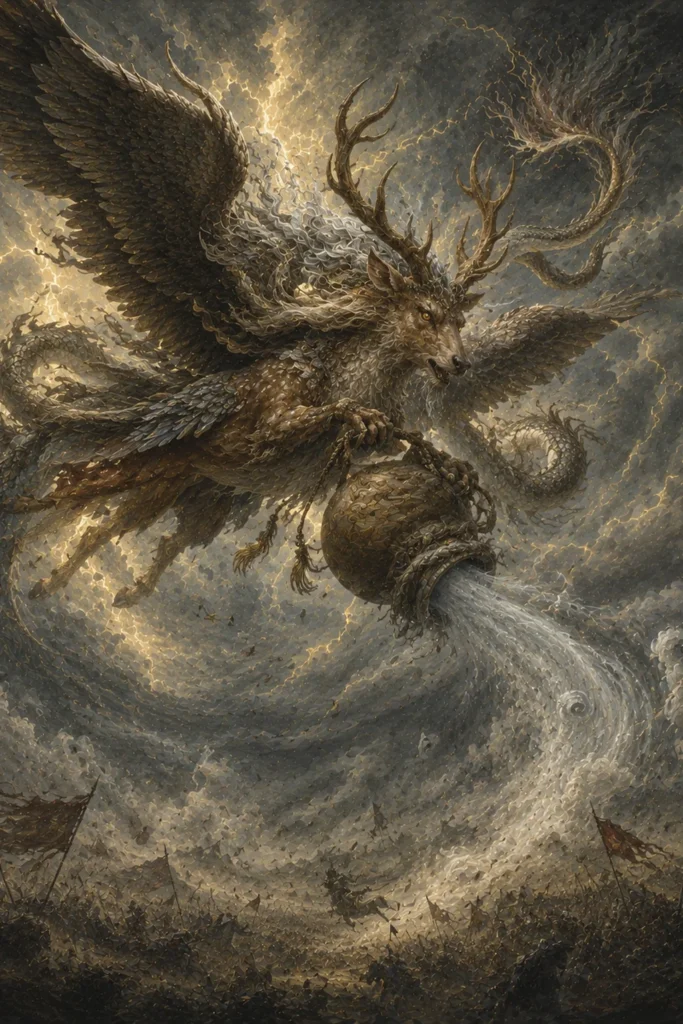
He keeps a hundred fire birds imprisoned in a calabash.

Table of Contents

Hui Lu, the Chinese fire god of the fire birds
Hui Lu

Hui Lu is a Chinese fire god figure, a fire sorcerer who keeps the fire bird Pi Fang and a hundred other fire birds imprisoned in a calabash. If he releases them, a country-wide firestorm arises.

The name Huihuo is not attested as a standard figure; the literarily documented figure is Hui Lu. His most important popular source is E. T. C. Werner’s retelling from 1922, while the cultic substance of Chinese fire god belief lies with Zhurong and Huoshen.

At a glance: Hui Lu

Type: Fire god figure, fire sorcerer with fire birds
Origin: Chinese mythography
Texts: Shen xian tong jian according to Werner 1922, Pi Fang in the Shanhaijing
Period: classical mythography, popular since Werner 1922
Appearance: fire sorcerer with a calabash full of fire birds

Textual history

Period of the Texts

The figure belongs to classical mythography and lives before the reign of Di Ku; it became popular through Werner’s retelling of 1922.

Area of Diffusion

China; the figure is transmitted in literature and is not bound to a single region.

Sources

Moderate and literary-mythographic: Werner’s Myths and Legends of China, based on the Shen xian tong jian, together with the Shanhaijing for the fire bird Pi Fang.

Name and variants

Chinese: huǒ means fire, lóng means dragon; the term Huolong, fire dragon, is a generic motif, not a named deity. Hui Lu is an old name for the fire god and for conflagrations; the name Huihuo is not attested as a standard figure.

Form and Activity

Appearance

Hui Lu is a fire sorcerer whose emblem is the calabash containing the imprisoned fire birds. Pi Fang is described as a crane- or bird-like being whose appearance heralds fire and conflagration. The fire dragon Huolong is a coiling, flaming dragon.

Effect

Hui Lu commands the destructive power of fire, which he keeps enclosed in the calabash. If he opens it, he unleashes the fire birds and thus country-wide conflagrations. In the Zhurong tradition, the fire dragon appears as the fire god’s mount.

Profile: Hui Lu

The key aspects of the fire sorcerer at a glance.

Cultural Context

Chinese mythography: According to Werner’s source, the Shen xian tong jian, Hui Lu lives before the reign of Di Ku.

Object of Influence

Conflagrations: The fire birds imprisoned in the calabash unleash a country-wide firestorm when released.

Depiction

Fire sorcerer with a calabash; the fire bird Pi Fang is considered crane- or bird-like and heralds fires.

Function

Embodiment of fire as an enclosed and releasable natural force, tamed only by the vessel.

Handling

The broad fire god cult with temples and offerings for fire prevention applied to Huoshen and Zhurong; a distinct cult for Hui Lu is only weakly attested.

Distinctions

Zhurong as the cultically anchored principal fire god; typologically the Norse wildfire Logi.

Pi Fang, calabash and fire dragon: the tradition

Chinese huǒ means fire, lóng means dragon; the term Huolong, fire dragon, is a generic motif, not a named deity. Hui Lu is an old name for the fire god and for conflagrations. The relevant popular source is E. T. C. Werner’s Myths and Legends of China from 1922, based on the Shen xian tong jian; there, Hui Lu lives before the reign of Di Ku.

The fire bird Pi Fang is already attested in the Shanhaijing, the Classic of Mountains and Seas. In the narrative, Hui Lu keeps him and a hundred other fire birds in his calabash; their release means the burning of the entire land. The image of fire as an imprisoned force, releasable at any time, is the core of the figure.

Reception and classification

Fire god figures appear in the novel Fengshen Yanyi, the Investiture of the Gods from the 16th century, and in modern popular culture. Werner’s retelling strongly shaped the English-language reception.

From a religious-studies perspective, Hui Lu presents fire as an enclosed and releasable natural force. Three clarifications are important: Huolong is not the proper name of a deity but fire dragon in general; Huihuo cannot be attested as a standard figure; and the central, state-anchored fire god is Zhurong, or Huoshen, not Hui Lu.

Fire god cult and fire prevention

The general Chinese fire god cult is broadly attested, though chiefly under the title Huoshen and in relation to Zhurong. There were fire god temples and offerings, among other things for fire prevention and to placate the fire. A distinct, broad cult specifically for Hui Lu, by contrast, is only weakly attested; the cultic substance lies with Zhurong and Huoshen.

Zhurong, Fenghuang and the tamed fire

Within China, Hui Lu is closely interwoven with the principal fire god Zhurong and the fire bird complex, but clearly to be distinguished from him: Zhurong is the ordering fire god, cultically and institutionally anchored, while Hui Lu is the literary figure of the releasable conflagration. The fire birds are motivically related to the phoenix-like Fenghuang, but not identical with it. The motif of fire enclosed in and released from a vessel is typologically similar to the Norse wildfire Logi.

Frequently asked questions about Hui Lu

Who is Hui Lu?

A Chinese fire god figure, a fire sorcerer who keeps fire birds trapped in a calabash and can unleash nationwide conflagrations with them.

Is Huihuo the same?

The name Huihuo cannot be verified as an independent fire deity; the figure attested in literature is Hui Lu.

Who is the actual Chinese fire god?

The central, cultically anchored fire god is Zhurong, also known as Huoshen; the substance of the fire god cult, with temples and offerings, lies with them.

Further links

Recommended internal links:

Literature (selection)

A selection of key sources and studies:
  • Werner, Edward T. C.: Myths and Legends of China. London 1922.
  • Birrell, Anne: Chinese Mythology. An Introduction. Baltimore 1993.
  • Birrell, Anne (transl.): The Classic of Mountains and Seas (Shanhaijing). London 1999.

Further standard works in the bibliography.

As a Chinese fire god of his own kind, Hui Lu keeps the fire birds trapped in the calabash: the image of the confined blaze, ready to break out at any moment, makes him the most vivid literary figure of unleashable fire in Chinese mythography.

Classification & Protection

IIILEVEL
The Protection Compass assigns this being to influence level III, Burdensome influence.

Against its influence, cross-cultural tradition names these protective means:

Compare in the Protection Compass →

Recommended protective means

iWell Guard

The simplest protective means in this collection: 41 layers of fine gold 999, platinum, silver and silicon, manufactured in Ruhla, Thuringia. It requires no activation, is bound to no person, and is effective within a radius of around 50 meters, even without being worn.

All protective means at a glance →