iWell Guard

Logi, the consuming wildfire of the Snorra Edda

Logi is a demon of the Germanic tradition.

The wild fire that defeats even Loki in the eating contest.

Table of Contents

Logi, the personification of fire in Norse mythology
Logi

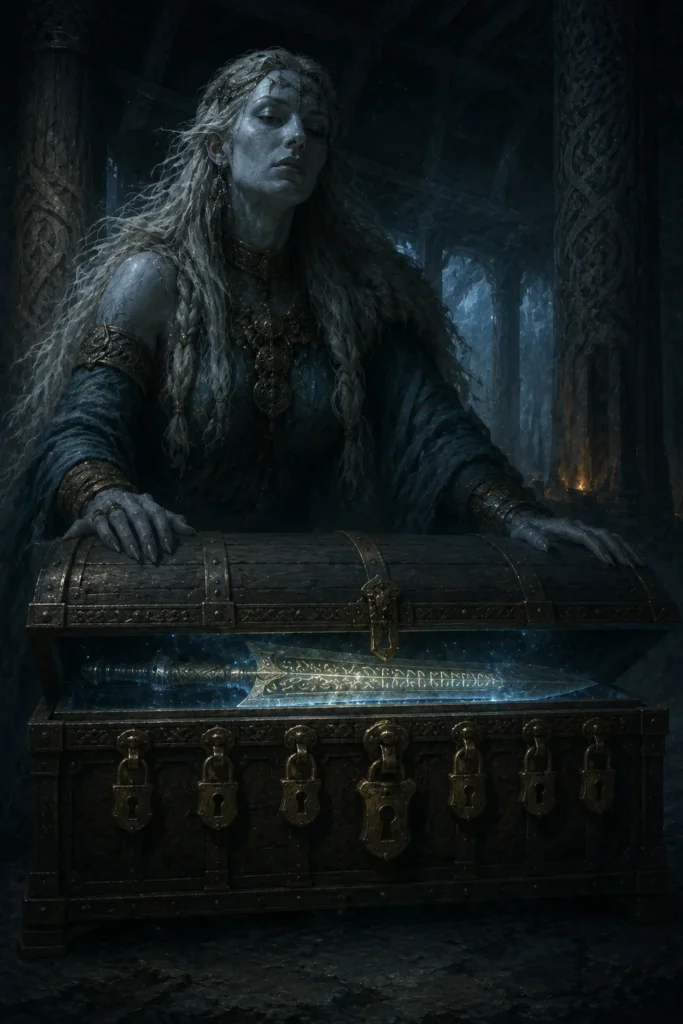
Logi, also Hálogi, is in Norse mythology the personification of wild, consuming fire. Famous is his eating contest against Loki in the hall of the giant Utgard-Loki, in which it becomes apparent that Logi is in truth fire itself.

One clarification first: Logi is not identical with Loki. One is the element fire in mythical form, the other the cunning god; only the similarity of names keeps bringing the two together. Logi is attested chiefly in Snorri Sturluson’s Gylfaginning in the Prose Edda.

At a glance: Logi

Type: Personification of wild, consuming fire
Origin: Nordic-Germanic region, Fornjótr genealogy
Texts: Snorra Edda (Gylfaginning)
Period: high-medieval record, around 1220
Appearance: without fixed form, the wildfire itself

Textual history

Period of the Texts

The central source is the high-medieval Snorra Edda, composed around 1220; there the Gylfaginning recounts the eating contest in Utgard-Loki’s hall.

Area of Diffusion

The Nordic-Germanic region. In the genealogical traditions surrounding the primordial giant Fornjótr, Logi belongs to the elemental family of the far north.

Sources

Good: the Snorra Edda provides the main evidence, supplemented by the standard works of Nordic studies by Simek and Lindow.

Name and variants

Old Norse: logi, flame or blaze, related to German lohen. The variant form Hálogi is usually interpreted as High Blaze and is folk-etymologically linked to the region of Hálogaland in northern Norway; this connection, however, remains disputed.

Being and effect

Appearance

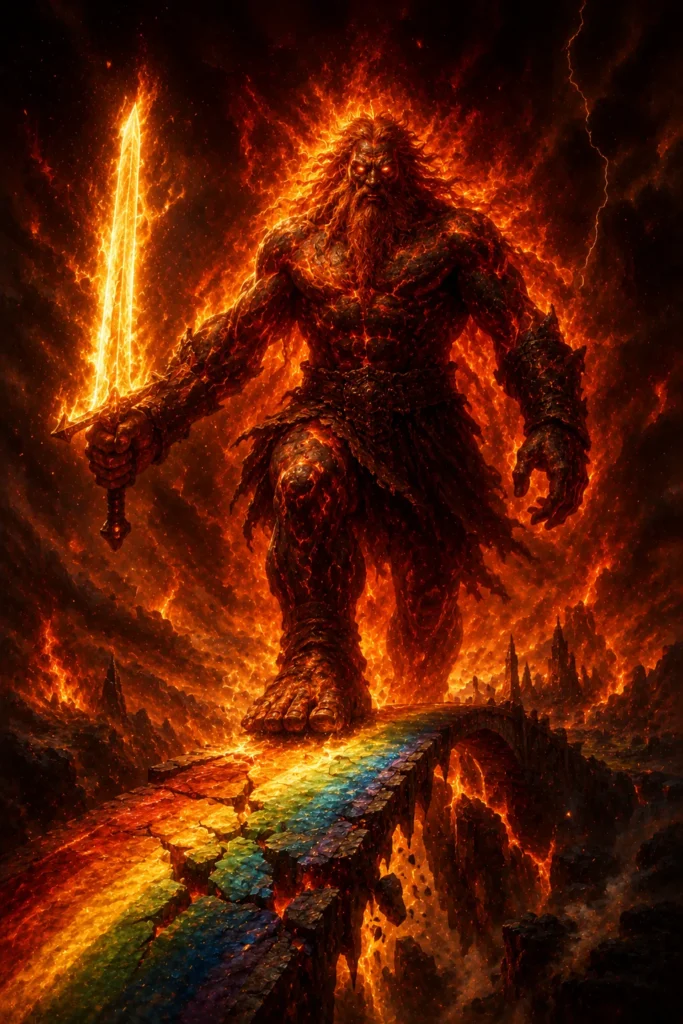
Logi has no elaborately described form; he is the embodiment of wild fire. What he is shows not in his appearance but in what he consumes.

Effect

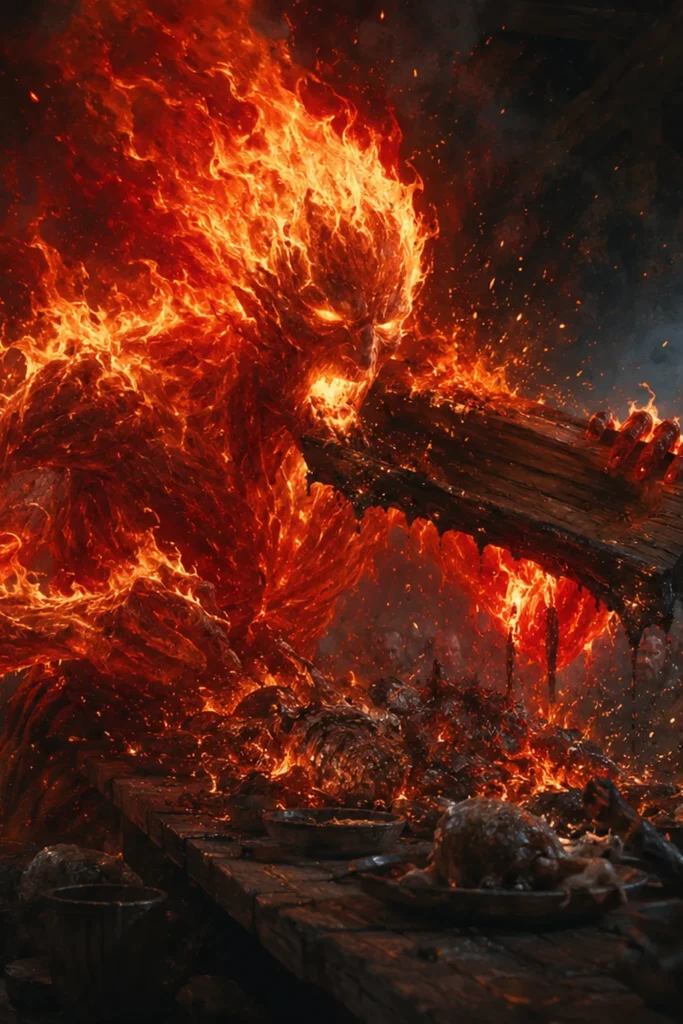
In the eating contest in Utgard-Loki’s hall, Loki and Logi eat from a trough, each from one end. They meet in the middle, but Loki has only consumed the meat, while Logi has devoured meat, bones and the trough itself. Later Utgard-Loki reveals that Logi was in truth the wildfire: an illusion that shows fire consumes everything.

Profile: Logi

The key aspects of the fire personification at a glance.

Cultural Context

Son of the primordial giant Fornjótr and brother of Kári, the wind, and Ægir, the sea: fire alongside wind and water as an elemental triad.

Object of Influence

Anything combustible: in the eating contest, Logi devours meat, bones and even the wood of the trough, completely and without selection.

Depiction

Without fixed form; the sources describe no appearance, but let Logi appear as the consuming fire itself.

Function

Mythical embodiment of the wildfire that consumes everything completely; destructive like fire itself, but without malice.

Handling

A cult is not attested. Logi is a literary-mythological personification, not a venerated deity with rituals or offerings.

Distinctions

Three figures must be distinguished: Loki, the cunning god, Logi, the fire, and Utgard-Loki, the host of the eating contest.

From the blaze to the son of Fornjótr

Old Norse logi means flame or blaze, related to German lohen; the name thus directly denotes what the figure embodies. The central source is Snorri Sturluson’s Gylfaginning in the Prose Edda, where Logi appears as the eater in Utgard-Loki’s hall.

Alongside this stands the genealogical tradition: in the traditions surrounding the primordial giant Fornjótr, Logi appears as his son and brother of Kári, the wind, and Ægir, the sea. Fire here stands alongside wind and water, as part of a family in which the elements themselves are kin. The variant form Hálogi, usually interpreted as High Blaze, was folk-etymologically linked to the region of Hálogaland in northern Norway, which remains disputed.

Reception and the confusion with Loki

Logi is a fixed part of modern retellings of the Edda and is often adapted in fantasy and popular culture as a fire demon or fire elemental. Because of the similarity of names, he is frequently confused with Loki.

From a religious-studies perspective, Logi is a textbook example of the mythical personification of an element. Two clarifications are important: the widespread equation of Loki with a fire god is an outdated 19th-century scholarly view and is considered a mistake. And three figures must be distinguished: Loki, the cunning god, Logi, the fire, and Utgard-Loki, the host.

No cult for the wildfire

A cult is not attested. Logi is a literary-mythological personification, not a venerated deity; there are no recorded rituals, offerings or protective formulas directed at Logi. Recording this honestly is more important than inventing a cult. Anyone wishing to encounter the figure will find him where he belongs: in the tale of the eating contest and in the genealogy of the elements.

Fire, wind and sea: parallels

Logi stands alongside the fire giant Surtr and the Muspell sphere, with which the giantess Sinmara is also connected. Within the Fornjótr genealogy, he forms an elemental triad with Kári, the wind, and Ægir, the sea. The motif of fire as a superhuman eater also appears elsewhere as an image for the consuming power of flame.

Frequently asked questions about Logi

Is Logi the same as Loki?

No. Logi is the personification of fire, Loki the cunning god; the host Utgard-Loki is in turn a third figure.

What does the eating contest show?

That fire consumes everything completely: Logi devours meat, bones and the trough, while Loki manages only the meat.

Was Logi worshipped?

No. He is a literary personification without an attested cult; no rituals or offerings for Logi have been passed down.

Further links

Recommended internal links:

Literature (selection)

A selection of key sources and studies:
  • Snorri Sturluson: Edda (Gylfaginning), German trans. by Arnulf Krause. Stuttgart 1997.
  • Simek, Rudolf: Lexikon der germanischen Mythologie. Stuttgart 2006.
  • Lindow, John: Norse Mythology. Oxford 2001.

Further standard works in the bibliography.

As the Norse personification of fire, Logi remains tradition’s clearest answer to the question of what fire is: the wildfire of the Edda, which in an eating contest devours flesh, bones and the trough itself, leaving every eater of flesh and blood far behind.

Classification & Protection

IILEVEL
The Protection Compass assigns this being to influence level II, Noticeable influence.

Against its influence, cross-cultural tradition names these protective means:

Compare in the Protection Compass →

Recommended protective means

iWell Guard

The simplest protective means in this collection: 41 layers of fine gold 999, platinum, silver and silicon, manufactured in Ruhla, Thuringia. It requires no activation, is bound to no person, and is effective within a radius of around 50 meters, even without being worn.

All protective means at a glance →