


Angel Contact, Invocation and Communication
Angel contact denotes the invocation, communication and ritual-magical binding of angel beings. This overview presents Jewish angel magic, Christian angelology after Pseudo-Dionysius, the Islamic Mala’ika tradition and contemporary New Age angel practice.
Table of Contents
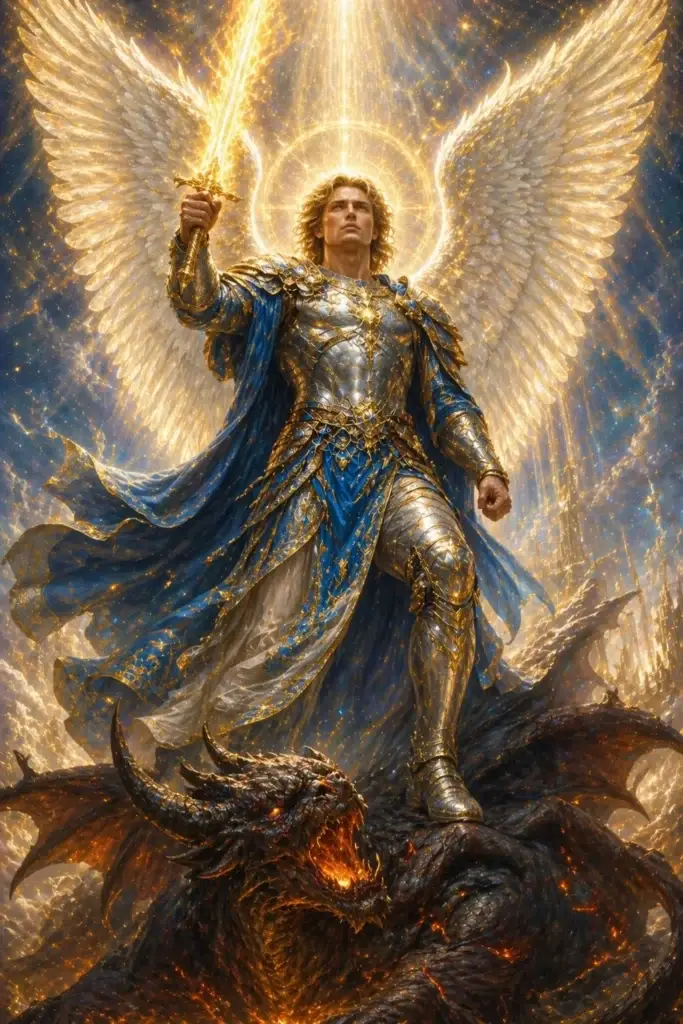
Practices of conscious contact with angelic beings, from biblical-traditional invocations through Kabbalistic rituals to modern channeling methods of the New Age sphere.
The tradition in one sentence
Angel contact is, in the history of religion, the most broadly documented form of conscious communication with higher beings in the Jewish-Christian-Islamic world; it stands between prayer and magic, between mystical experience and ritual-magical practice, and its tradition reaches from biblical angel vision (Jacob, Daniel, Mary, Muhammad) through the Kabbalah and medieval mysticism to modern New Age practice.
Angel contact denotes the invocation, communication and ritual-magical binding of angel beings from the Jewish-Christian-Islamic tradition.
The term encompasses both the liturgical angel invocation of the major religions and the ritual-magical angel-magic tradition since late antiquity, as well as contemporary New Age angel practice since the 1990s. In substance, angel contact overlaps with the archangel corpus of the iWell Guard class of beings of light, but focuses more strongly on the methodical side (how is contact established?) than on the description of the beings themselves.
Context and Background
Invocation formulas, angel hierarchies, meditation, channeling, prayers of protection, Kabbalistic tradition.
Layers in the history of religion
The oldest layers of angel invocation are found in Jewish apocryphal literature (the Books of Enoch, 3rd to 1st century BCE), which fundamentally shaped the system of archangel hierarchies.
In late antiquity angel magic was elaborated, above all in the Jewish magical Sefer ha-Razim (3rd to 4th century) and in the Christian angel invocation texts of the late patristic period.
In the Middle Ages, Pseudo-Dionysius the Areopagite systematized the nine angel choirs in De caelesti hierarchia (ca. 500), which became the standard architecture of Western angelology.
The ritual-magical tradition
Ritual-magical angel invocation culminates in the 16th and 17th centuries with Trithemius (Steganographia, 1499; published 1606), Heinrich Cornelius Agrippa von Nettesheim (De occulta philosophia, 1531) and John Dee with his scribe Edward Kelley, whose angel diaries founded what later came to be called “Enochian magic.” This tradition was taken up again in the Golden Dawn of the late 19th century and carried, by way of Aleister Crowley and Israel Regardie, into the modern ritual-magical tradition.
Traditions
The angel invocation tradition divides, by religion and by method, into several clearly distinguishable strands.
Jewish angel magic
Jewish angel magic extends, beyond the Sefer ha-Razim, to the Sefer Raziel HaMalakh (a medieval compilation, oldest manuscripts 13th century), the Sefer Hekhalot (3rd to 7th century) and the Kabbalistic angel literature of the Zohar (13th century) and Isaac Luria (16th century).
It knows an elaborate hierarchy with the four (or seven) archangels (Michael, Gabriel, Raphael, Uriel, supplemented by Sariel/Saraqael, Raguel and Remiel) as well as the 72 angels of the Shemhamphorasch, which are derived from the three verses of Exodus 14:19, 20, 21.
Christian angelology
The Christian tradition adopts the Jewish angel hierarchy and structures it, by way of Pseudo-Dionysius, into three triads with three choirs each (Seraphim, Cherubim, Thrones; Dominions, Virtues, Powers; Principalities, Archangels, Angels).
Liturgical invocation takes place in the Catholic tradition through the Officium Sancti Michaelis and the archangel feast days, and in the Orthodox tradition through the synaxes of the heavenly hosts. In the sphere of protection, the Archangel Michael, as dragon-slayer and guardian angel, is the central figure of invocation.
Islamic angelology
In Islam the Mala’ika are a central element of belief. The most important angels are Jibril (Gabriel) as bringer of revelation, Mikail (Michael) as the angel of provision, Israfil as the trumpet angel of the Last Day and Izrail as the angel of death.
The Islamic ritual-magical tradition (for example the Shams al-Maʿarif of al-Buni, 13th century) knows extensive angel invocation formulas and protective talismans, which in Western scholarship have most recently been treated by Noah Gardiner and Jean-Charles Coulon.
New Age angel practice
Since the 1990s a distinct New Age angel tradition has developed, in which Doreen Virtue (between 1995 and 2017, with books such as Healing with the Angels) and Diana Cooper (with her conception of the Angels of Light) are central mediators.
This tradition works less with ritual-magical invocations than with visualizations, meditations and tarot-like angel cards. In terms of religious studies it belongs to esoteric postmodernity (Hanegraaff, New Age Religion, 1996), yet it has in the meantime developed institutionalized training structures (Doreen Virtue Angel Therapy Practitioner) with their own brand logics.
Methods
The methodical paths of angel contact can, across the religions, be mapped onto a small number of recurring operational forms.
Invocation methods
Ritual-magical invocation uses a fixed apparatus of verbal formulas (angel names, Hebrew names of God, Shemhamphorasch verses), often combined with ritual purification, incense (frankincense, myrrh, storax), magical tools (pentagram, hexagram, Tetragrammaton sigils) and defined times of day or planetary hours.
In Steganographia, Trithemius gives calendar assignments for the angels of the hours and weekdays; Agrippa systematizes this in De occulta philosophia Book III.
Vision methods
The contemplative angel vision is found in Jewish Merkavah mysticism (the Hekhalot literature), in Christian contemplation (Hildegard of Bingen, Mechthild of Magdeburg, Teresa of Ávila) and in the Islamic Sufi tradition (al-Ghazali, Ibn Arabi). Methodically it works with breathing techniques, repetitive prayer practice and visualization.
The Enochian magic of John Dee combines ritual-magical and visionary methodology in a hybrid approach that prepares what later came to be called the “scrying method” (gazing into a crystal or a black mirror glass).
Writing methods
Automatic writing as a form of angel contact is attested since the 16th century (John Dee/Edward Kelley) and becomes an elaborated method in the Spiritualist movement of the 19th century (Allan Kardec, Le Livre des Esprits, 1857).
In more recent angel practice (Doreen Virtue, Diana Cooper) it is systematically trained as channeling or angel writing.
Classification on iWell Guard
We treat angel contact as a phenomenon of transmission with a long history, and we distinguish between historical-religious-studies sources and modern channeling practices. Your own perceptions are individual; we make no promises of healing.
Historical depth
Conscious contact with angelic beings reaches in its roots back into the ancient Jewish tradition.
The Hekhalot and Merkavah literature (3rd to 7th century CE) describes ascent visions in which the adept ascends through seven Hekhalot (“palaces”) and in doing so speaks with the watcher angels; the practice is bound up with detailed invocation formulas, preparations of purification and warnings of danger.
In the Kabbalistic tradition this ascent practice is continued; the writings of the circle around Abulafia (13th century) develop letter meditations that are understood as a methodology of angel contact.
In the Christian Middle Ages the angel hierarchy is systematized after Pseudo-Dionysius; the mystical practice of Meister Eckhart and Heinrich Seuse incorporates angel contact as an element of inner experience.
Early modern high magic
Early modern high magic developed angel contact into one of its central forms of practice.
John Dee’s Enochian magic (16th century) is probably the most elaborate attempt to develop a systematic angel language and a systematic system of invocation; Dee and his mediator Edward Kelley recorded their sessions in detailed minutes that are still studied today as a source for the history of religion.
The Enochian tradition was revived in the 19th and 20th centuries by the Golden Dawn and systematically integrated into a ritual-magical practice. Aleister Crowley’s writings on angel magic (in particular “The Vision and the Voice”) are a late stage of development in this tradition.
Modern New Age practice
In the modern New Age movement, angel contact has developed from a theological discipline into an independent spiritual practice. Doreen Virtue’s “Angel Therapy” and similar methods offer standardized invocations, affirmations and meditations that address angels as personal helper beings.
This modern practice is methodically far less demanding than the older ritual-magical tradition; it is, however, very widespread in the broad esoteric scene of the Western world and is practiced by millions of people.
Methodical caution
The history-of-religion tradition of angel contact is bound up with several methodical cautions. First: in all classical traditions, angel contact is understood as a demanding practice that requires preparation, ethical purity and experience; a “light” practice is not found in the tradition.
Second: the tradition explicitly knows the danger of deception, lower powers can masquerade as angels, and the discernment of spirits (“discretio spirituum”) has become a discipline in its own right within Christian mysticism.
Third: the psychological risks of an intensive angel-contact practice should not be underestimated, hallucinations, dissociative phenomena and psychotic episodes are extensively documented in the psychology of religion.
On iWell Guard
We treat angel contact as a phenomenon in the history of religion with a long tradition; we present the most important methods, sources and figures. We do not recommend any particular practice and give no instructions.
Anyone wishing to take up an angel-contact practice should become familiar with the tradition, seek experienced guidance and pay attention to their own psychological stability. We collect reports of experience from our readership in the Experiences section; they are marked as personal perceptions and are not intended as a recommendation.
References
Important source editions on angel magic are the critical editions of Dee (“True and Faithful Relation”, Casaubon 1659; modern treatment by Klein 1992), the studies on the Hekhalot literature (Peter Schäfer, “Synopse zur Hekhalot-Literatur”, Tübingen 1981ff.) and the standard works on the Jewish-Kabbalistic angel hierarchy (Gershom Scholem, “Major Trends in Jewish Mysticism”, 1941; Moshe Idel, “Kabbalah: New Perspectives”, 1988).
The discussion in the psychology of religion is found in William James, “Varieties of Religious Experience” and in more recent research on spiritual experiences (Ann Taves, “Religious Experience Reconsidered”, 2009).
In Depth
Conscious contact with angelic beings reaches in its roots back into antiquity. In the biblical tradition there are accounts such as Jacob’s dream (Genesis 28), the Annunciation to Mary (Luke 1) or the vision of Daniel (Daniel 9). In Judaism, the Kabbalah develops detailed angel hierarchies with Sephirot, archangel names and invocation formulas.
In the Christian Middle Ages, Pseudo-Dionysius structures the heavenly hierarchy into nine choirs. In Islam, angels (malaika) are mediators between Allah and humankind, with Gabriel (Jibril) as the chief messenger. These traditions provide the framework for angel-contact practice to this day.
iWell Guard and Traditions of Protection
Across all documented cultures, protective objects can be traced that people carried on their bodies, from Pazuzu amulets in Mesopotamia through the Hamsa in the Mediterranean region to the Mezuzah on Jewish doorposts and to Christian protective medals. iWell Guard takes up this tradition in a contemporary material architecture, manufactured in Germany, 41 layers, fine gold, platinum, silver. 30-day right of return.
Personal experiences may vary. Not a medical device. No promise of healing.
Angels and Ascended Masters at a Glance
Related pages on beings in the iWell Guard lexicon: Michael (sword archangel, leader of the heavenly hosts), Gabriel (messenger archangel of the Annunciation), Raphael (healing archangel), Uriel (archangel of light and guardian of wisdom), Metatron (the highest angel of Jewish mysticism, archchancellor of the divine court).
From the ascended-master tradition: Kuthumi (world teacher, Theosophy), Saint Germain (the violet ray), collective term for ascended masters (overview of the tradition).
Frequently Asked Questions about Angels and Ascended Masters at a Glance
Which archangels are named in the Jewish-Christian-Islamic tradition?
The tradition knows four canonically named archangels: Michael (leader of the heavenly hosts, sword archangel), Gabriel (messenger archangel of the Annunciation), Raphael (healing archangel) and Uriel (archangel of light and wisdom). Alongside these, Jewish mysticism knows further high-ranking angels such as Metatron and Sandalphon. The number seven is customary in many traditions; the exact names vary depending on the canon.
What are ascended masters compared with angels?
Ascended masters are, in the Theosophical-esoteric tradition (Helena Blavatsky, Alice Bailey, New Age), historical or mythical teachers who have completed the ascent into higher spheres after millennia of spiritual work and who remain available to humanity as teachers. Unlike angels, who do not incarnate, ascended masters have completed their path through human incarnations. Well-known ascended masters are Kuthumi, Saint Germain, El Morya and the world teacher Maitreya.