harmful magic, magical practice
This overview presents practices of harmful magic from several cultures in a concise form.
Harmful magic refers to ritual, magical acts intended to deliberately inflict harm, illness or misfortune on others, ranging from curses and binding spells to the transfer of illness. Evidence extends from the Old Babylonian Maqlú tablets through medieval witch-trial records to twentieth-century ethnographic fieldwork in Africa and Oceania.
The practice combines symbolic action, cursed objects and psychosomatic or meta-empirical mechanisms of causation with a function of social sanction. These practices are broadly attested in cultural history and ethnographically documented across various cultures.
Table of Contents
Concept and Distinction
Harmful magic is distinguished from love magic, healing magic or ritual magic by the fact that the intention is harm. The practices are often formally similar (ritual, object, formula), but the aim sets them apart: harm rather than healing or binding.
One important difference: harmful magic is explicitly tabooed and condemned in numerous cultures, not in secret, but ideologically recognized as dangerous and impure. This distinguishes it from legitimate magic and supports the cultural maintenance of norms against harm.
Related terms: maleficium (in Christian theology), witchcraft (in early modern Europe), though these terms are ideologically charged. Harmful magic is more neutral and describes the phenomenon independently of regional condemnation.
Examples from Cultural History
Ancient curse tablets (Latin: defixio) are lead tablets or potsherds on which curses were inscribed, often against competitors, lovers or opponents in legal cases. Thousands have been found archaeologically, particularly from Athens, Rome and Egypt.
A classical defixio might read: „I bind the mouth of my legal opponent and his heart against my enemy.“ They were often buried in graves or sacred places, addressed to the underworld.
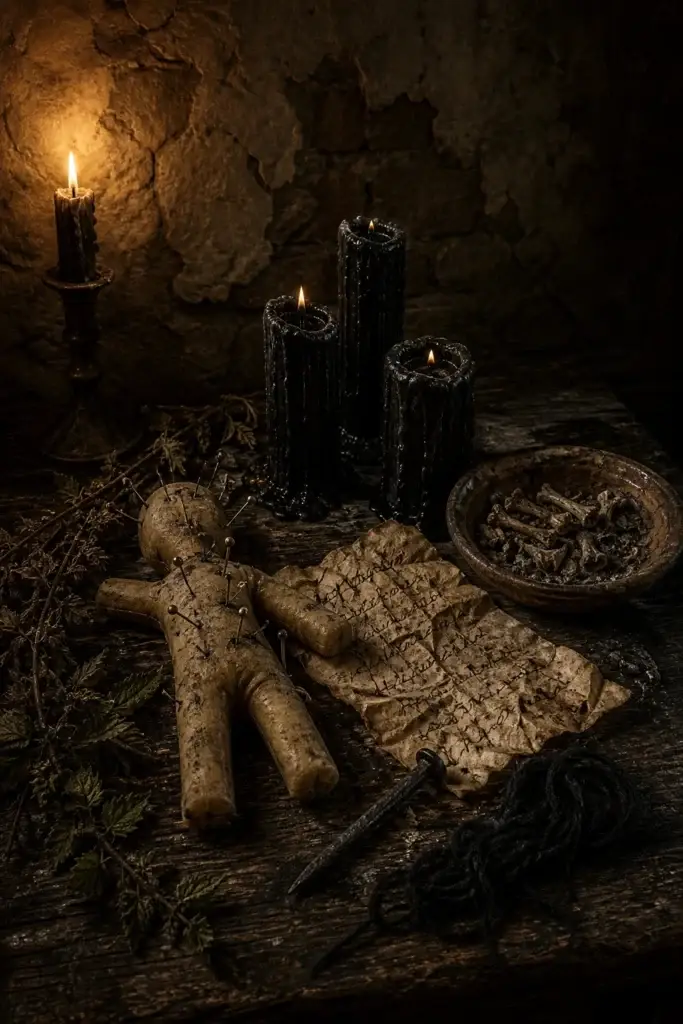
European witchcraft (medieval to early modern) treats harmful magic as a central reality: glances that wound, substances that kill cattle, wax or clay figures that are pierced. The witch trials documented thousands of such practices; whether they were actually carried out or were projections remains contested.
African practices (well documented ethnographically in South Africa and West Africa): sorcerers can transfer illness through objects (buried animal bones, human hair) or spells. Such practices are culturally real and, in traditional contexts, institutionalized (sanctioned by the village, the ancestors).
Islamic practices: sihr (sorcery) is mentioned in the Quran and treated in detail in hadith and later Islamic texts. It includes harmful magic and is conceptualized as spiritual harm, understood not as psychological but as the action of unseen forces.
Mesopotamian and Egyptian roots: Maqlu and defixiones
Harmful magic is not a modern development but is already documented in the Akkadian Maqlu tablets (first millennium BCE), a collection of anti-witchcraft incantations.
The tablets contain formulas for warding off sorceresses and for neutralizing their magic through counter-rituals and fire. In parallel, Egyptian texts such as the Book of the Dead show strategies for repelling the Hechetiu (evil sorceresses of the underworld).
In the Greco-Roman world, the so-called defixiones emerged from the fifth century BCE onward, curse tablets of lead or clay on which private individuals called upon gods and demons to paralyze, curse or kill a rival.
The standard edition is Auguste Audollent, Defixionum Tabellae (1904); David Jordan reviewed the state of research in his Survey of Greek Defixiones (1985).
State of the Sources
Ancient curse tablets: archaeological finds in Mainz, Athens, Egypt (papyrus collections). Editions by Audollent and more recent catalogues. European witchcraft: Malleus Maleficarum, witch-trial records (particularly Bamberg, Trier, Salem), demonological treatises. African ethnography: Evans-Pritchard, Marwick, Mary Douglas. Islamic sources: Quran, hadith collections, later scholarly works. European folk magic: Kittredge, Keith Thomas.
Middle Ages and early modern period: witch-trial theology and demonology
Medieval Christendom interpreted harmful magic as a pact with the devil. Theologians such as Thomas Aquinas (Summa Theologiae, 13th century) debated whether a human being could command demons at all, or whether these could act only as instruments of divine punishment.
With the rise of the early modern witch trials (16th to 18th century), harmful magic became a capital offence; the most influential work in this tradition is the Malleus Maleficarum (Heinrich Kramer, 1486).
The Inquisition and Protestant authorities provided a legal stage for neighbourhood conflicts: a cow dies, a child falls ill, a harvest fails, and the suspected woman is prosecuted for harmful magic.
Robin Briggs (Witches and Neighbors, 1996) shows that many of the accused were in fact familiar with ritual practices, while others were entirely innocent.
Present-Day Significance / Related Beings
Anti-witchcraft rituals and apotropaic magic
Apotropaic (defensive) practices arose in parallel against harmful magic. The customary practice of the German-speaking world, documented by Willem de Blécourt and other authors of ethnographic witchcraft research, worked with blessings, healing herbs and counter-curses to neutralize the harm done by witches.
In the African context, nganga and diviners operate similarly: they diagnose harmful magic and break it with counter-magic and ancestor invocation. This ethical dimension shapes religious consciousness to this day: legitimate magic is directed against illegitimate harmful magic. See also curse and invocation.
Further standard works in the literature index.
iWell Guard and Traditions of Protection
Across all documented cultures, protective objects can be traced that people wore on their bodies, from Pazuzu amulets in Mesopotamia and the Hamsa in the Mediterranean region to the Mezuzah on Jewish doorposts and Christian protective medals. iWell Guard takes up this tradition in a contemporary material architecture, made in Germany, 41 layers, solid gold, platinum, silver. 30-day right of return.
Personal experiences may vary. Not a medical device. No promise of healing.