


Blood Magic, Rituals of Blood and Sacrifice
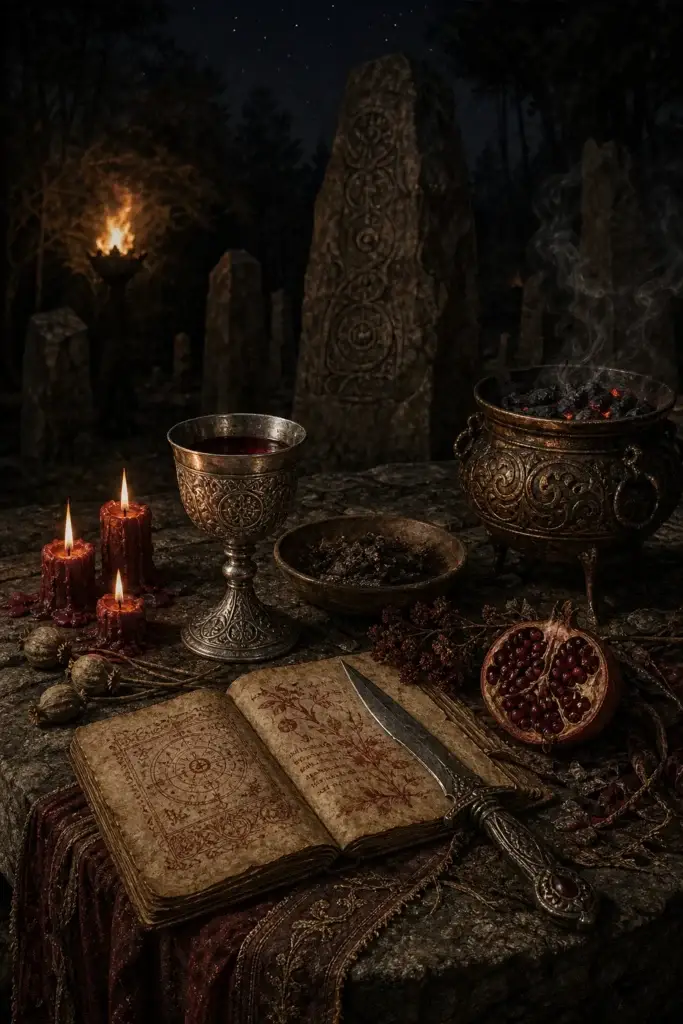
Blood magic is a ritual practice that employs blood as a potent substance for magical binding, transfer of power, or the swearing of oaths, rooted in archaic sacrificial traditions and animistic blood-soul doctrines. Archaeological and ethnographic evidence comes from Mesopotamia, South and Mesoamerica, as well as European witchcraft practices and shamanisms.
The practice operates at the boundary between phenomenological-ritual meaning and the assumption of biomagical causality, as well as the creation of social bonds in various contexts. Blood functions as seal, oath, and vehicle of power in magical operations.
Table of Contents
This page provides a religious-ethnological overview of magical blood practices.
Quick Overview (Definition List)
Type: Magical practice Class: Blood magic Distribution: Ancient, medieval, modern (occultism, extremism) Main features: Blood as substance, binding, force of will, sacrifice, often polarizing Related sub-categories: Practices, sacrifice rituals, demonic magic, pact magic
Blood magic has meaning and history across several advanced civilizations, from the ancient Egyptian sacrificial cult to the Roman inspection of entrails.
Concept and Demarcation
Blood magic is the specific use of blood as the primary magical substance. It differs from mere ritual sacrifice (historically common in many religions, but not necessarily magical) in that blood magic treats blood as a medium of power, a substance that transmits will.
It also differs from modern forms of magic that are verbal or visualization-based (without substances). Blood magic is physical and material, it requires real blood, not merely symbolic blood. This makes it ethically complicated: self-injury or animal sacrifice may be required.
Blood Sacrifice in Mesopotamian and Roman Religio-Political Practices
Blood magic is rooted in ancient sacrifice traditions. In Mesopotamia, blood sacrifices to the gods (carried out by priests) legitimized kingship; similarly in Rome, where Lustratio (atonement sacrifice) with animal blood protected the people and their borders.
The psychological logic was constant: blood symbolizes life, power, and binding, and is therefore regarded as the strongest sacrifice medium.
In Mesopotamian magic literature, the omen series and other texts show that blood was used in curse rituals to amplify the effect.
The sacrifice of a sheep or a dove together with an invocation was meant to bind a demon or seal a curse. This religious sacrifice practice was later reinterpreted as blood magic, but retained its logic: blood as a medium of power.
Cultural-Historical Examples
Ancient sacrificial cultures in Greece, Rome, Egypt, Mesopotamia, and Mesoamerica practiced blood sacrifice: animals or, in extreme cases, humans were sacrificed, and their blood was poured out as an offering to deities.
This was religious, but possibly also magical, a pact through blood. In the Hebrew Bible, blood is sacred: the blood of the lamb at Passover marks a pact between God and people.
The incarnation of Jesus in Christian theology is symbolized by blood (the blood of Christ in the Eucharist). In the Middle Ages, blood pacts with the devil were documented; witches and magicians were said to have made contracts with blood.
Modern Satanism and extreme occultism use blood magic as transgression and source of power. In modern practiced magism (Chaos Magic, Tantrism), blood is optional, but for some a „more intensive“ variant.
Medieval Witch-Trial Pacts and Ritual Blood
In the early modern witch persecution, blood magic became central. The Malleus Maleficarum (Kramer, 1486) describes that witches made a blood pact with the devil: they cut themselves and signed a diabolical document with their blood. Female witnesses in witch trials (often confessions under torture) reported nocturnal blood sacrifices to demonic idols.
Whether these accounts were truth or projection is historiographically disputed; what is certain is that blood-sacrifice rituals were regarded in the European written tradition as the signature of the devil’s pact. Stuart Clark (Thinking with Demons, 1997) shows that blood imagery was theologically more central in pact narratives than the magic itself.
Source Situation
Blood sacrifices are documented in ancient sources (Herodotus, Pausanias, Roman ritual texts), in medieval demonological texts (Hexenhammer, conjuration treatises), in witch-trial records, and in modern occult literature.
Academic research on sacrificial rituals is extensive (René Girard, Walter Burkert), but on blood magic specifically less so. Modern Satanists and occultists document their own blood-magic practices, but publications are limited.
Ethnographic Continuities: West Africa, Haiti, and Diasporic Blood Rituals
In West Africa and in the Caribbean Vodou tradition, blood ritual is not marginal but cosmologically central.
The sacrifice of chickens, goats, or guinea pigs is part of legitimate Lwa invocation; blood is regarded as the strongest medium for attracting ancestral presence or Lwa power. Ethnographers document that blood sacrifices take place in the context of healing, protection, and community binding.
In the European esoteric tradition (Chaos Magic, modern witchcraft), blood magic is often practiced as menstrual blood or ritual pricking, less to symbolize violence than to integrate biological power (menstruation as a sign of fertility and of cyclical life) into magic practice.
This distinction, sacrifice as cosmological necessity versus magic as a technology of consciousness, characterizes modern blood magic.
Contemporary Significance / Related Beings
Blood magic remains practiced in extreme occult circles, but is more controversial than other forms of magic. The ethical problem is clear: self-injury, animal sacrifice, pact implications. Legally, blood magic is problematic in many countries (animal welfare, bodily harm).
Psychologically, blood magic can lead to obsession or pathology. Paranormal research has produced no evidence for the effectiveness of blood magic. Symbolically and therapeutically, blood-magic metaphor (without real blood) can play a cathartic role. Related practices are sacrificial rituals, demonic magic, and pact theology.
Depth in the History of Religion
Blood is a central symbol in almost all religions, as carrier of life, as vehicle of kinship, as substance of reconciliation.
The Mesopotamian creation myth has humans arise from the blood of a slaughtered anti-god (Kingu); in the Old Testament, blood is explicitly the subject of religious-legal regulations (Leviticus 17 forbids its consumption); in the Christian Eucharist, the blood symbolism is central in a ritualized gesture of remembrance; in Hindu Tantra, the offering of blood to certain Dakini beings is part of individual forms of practice.
Anyone who wants to understand blood magic as a phenomenon must read this density of meaning from the history of religion alongside it; it is not merely harmful sorcery, but part of a broad religious-anthropological complex.
Sacrifice Tradition and the Transition to Practical Magic
Ancient sacrificial cultures distinguish between animal sacrifice and human sacrifice; animal sacrifice is culturally central and religiously prescribed in almost all ancient Mediterranean cultures, while human sacrifice is the exception and is tabooed in most societies.
With the closing of the ancient sacrificial cults, through the Christian prohibition, through the Islamic reform, through the Buddhist Ahimsa practice, ritualized animal sacrifice disappears from the center of religious practice and partly migrates into folk-magical and harmful-sorcery practice.
The blood magic of the early modern witch discourses is not the continuation of ancient sacrificial practice, but an independent, often polemically constructed world of ideas; the actual historical practice was considerably more limited than the construction in the sources suggests.
Context of Modern Practice
In modern occult circles, in the chaos-magic tradition, in individual witchcraft currents, in the practice of certain ritual orders, the use of one’s own blood (typically a drop from a finger prick) is understood as a personal act of connection.
The practice carries considerable health risks (risk of infection, hygiene), and we mention it here solely out of historical-religious and phenomenological interest. No instructions are given on iWell Guard; the ethical and legal assessment of the practice lies with the individual practitioner.
Related Articles
The classification in the history of religion connects to the articles on Goetia, on Chaos Magic, and on individual beings in whose tradition blood offerings play a role, such as Sekhmet in Egypt, Kali in Hinduism, Erzulie Dantor in Vodou.
The tradition of beings of light does not know blood magic; in Christian-angelic practice, blood is present only as a symbol of the sacrifice of Christ, not as a magical substance.
Note on Source Criticism
The source situation regarding historical blood magic is methodologically delicate: a large part of what is described as blood magic in the early modern witch records and in the Inquisition protocols is a construct of the interrogation situation and not historical practical reality.
Research in the history of religion has been intensively working through the tension between the polemically constructed image and the actual practice for about thirty years (Stuart Clark, “Thinking with Demons”, Oxford 1997; Wolfgang Behringer, “Hexen und Hexenprozesse in Deutschland”, Munich 1988).
Anyone working with the early modern sources should by all means read these methodological reservations alongside them.
Theological and Ethical Discourses
Blood magic stands under particular normative observation in almost all religious traditions. In the Jewish-Christian-Islamic context it is expressly forbidden or equated with harmful sorcery; in Hinduism and Buddhism the Ahimsa precept (the commandment of non-injury) is, for most schools, an obstacle to using blood as a magical substance.
Only in individual tantric currents, in pre-Islamic Arabian folk-magical practices, and in some syncretic traditions (Vodou, Santeria, Candomblé) is a ritualized use of blood established, mostly as animal sacrifice within a clearly regulated religious context, not as a private harmful-sorcery practice.
The ethical evaluation of blood magic depends decisively on the context in which it stands: ritualized, religiously embedded, with the consent of those involved, or as an individual-magical practice without this framework.
Forensic Examination of the Sources
The witch records of the early modern period are one of the most important source groups for the historical conception of blood magic, and at the same time one of the methodologically most delicate.
The practices described in the interrogation protocols (blood-drinking, desecration of the Eucharist, infanticide) are, in almost all cases, a construct of the interrogation situation: the inquisitors deliberately asked about these practices because the demonology schema expected them; the accused confessed under torture or pressure to whatever fit the schema.
The critical examination of the records shows that the reality behind the schema was in almost all cases far more banal, everyday conflicts, neighborly tensions, social exclusion. Anyone working with witch records as a source for historical blood magic must always carry this forensic distance with them.
iWell Guard and Protective Traditions
Across all documented cultures, protective objects can be traced that people wore on their bodies, from Pazuzu amulets in Mesopotamia and the Hamsa in the Mediterranean region to the Mezuzah on Jewish doorposts and Christian protective medallions. iWell Guard takes up this tradition in a contemporary material architecture, manufactured in Germany, 41 layers, fine gold, platinum, silver. 30-day right of return.
Personal experiences may vary. Not a medical device. No promise of healing.