iWell Guard

Hawaiian gods, Pele and Hawaii's spirit world

Hawaii’s Polynesian inhabitants, settled from the Society Islands and the Marquesas probably between the 11th and 13th centuries, developed a distinct religious tradition built around the Kapu rule system, the volcano goddess Pele and the family protective spirits, the Aumakua. Following the fall of the Kapu system in 1819 and the mission efforts from 1820, it has experienced an ongoing cultural revival since the Hawaiian Renaissance of the 1970s.

Hawaii’s spirit world is closely linked to the volcano, the sea and the ancestors of the families.

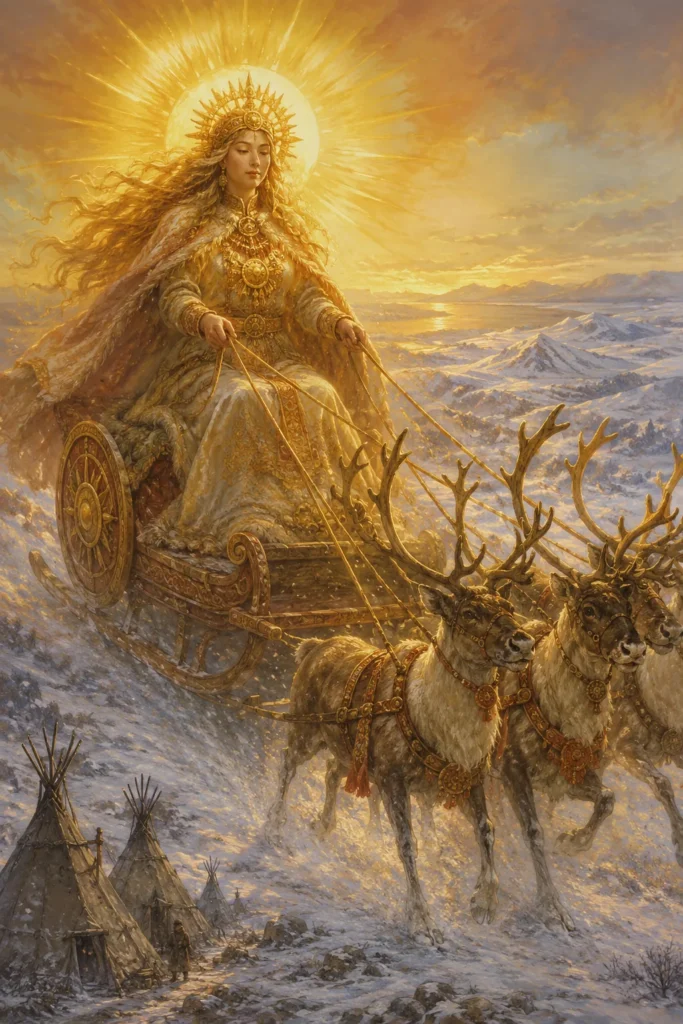
Beaivi: gods from the Sami tradition, historically illustrative
Hawaiian Aumakua veneration forms the backbone of Hawaiian religion alongside the cult of the great Akua gods.

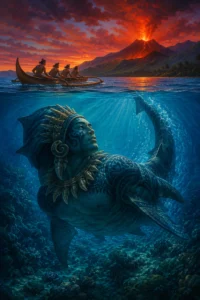
Hawaiian gods are divided into the four principal gods, Kū, Kāne, Lono and Kanaloa, the Pele family of volcano and snow goddesses, and wind and sea deities such as Kamohoaliʻi. They are still actively honoured in Hawaii today.

Hawaiian language and settlement history

Hawaiian (ʻŌlelo Hawaiʻi) belongs to the Polynesian branch of the Austronesian language family. According to current archaeological research, Hawaii was settled by seafarers from central East Polynesia, probably the Society Islands and the Marquesas, no earlier than around 1000 to 1200 CE, considerably later than previously assumed.

Island society was organised into hereditary chiefly ranks (Aliʻi), whose status was closely tied to the Kapu rule system and the concept of mana, a supernatural power. In 1778 the British seafarer James Cook reached the islands; in 1819 King Kamehameha II (Liholiho) and the regent Kaʻahumanu abolished the Kapu system (ʻAi Noa); in 1820 Protestant missionaries from the USA began systematic Christianisation.

Volcano and sea structure Hawaii’s world of gods: in the earth and craters the fire goddess Pele, in the water deities such as Kamohoaliʻi. The Hawaiian Renaissance keeps this knowledge alive to this day.

Akua and Aumakua, gods and ancestral spirits

Akua denotes the gods in the narrower sense, foremost among them the four principal deities Kū (war and politics), Kāne (life and creation), Lono (fertility and peace) and Kanaloa (the sea). ʻAumākua, by contrast, are the deified ancestral spirits of individual families, who often appear in animal form, for instance as a shark, a pueo owl or an octopus, and are regarded as mediators between the family and the great Akua.

According to tradition, ʻAumākua warn of danger, appear in dreams and punish misconduct, but are above all regarded as personal and family protective powers in everyday life. This idea remains part of Hawaiian identity and narrative tradition to this day.

The Kapu system and its abolition in 1819

Kapu denoted a comprehensive system of taboos and prohibitions that regulated ritual purity, social order and the status of the Aliʻi. Best known is the ʻAi Kapu, the separate eating of meals by men and women, along with the prohibition of certain foods, such as pork or bananas, for women. Violations could be punished by death.

In 1819 King Kamehameha II and the influential regent Kaʻahumanu abolished the Kapu system through the demonstrative shared eating of men and women, known as ʻAi Noa, ‘free eating’. Conservative forces resisted at the Battle of Kuamoʻo but were defeated. The formal abolition had social and religious repercussions for a long time afterwards.

Pele, the volcano goddess, and her family

Pele, goddess of the volcano, is said to dwell in the crater of Halemaʻumaʻu on Kīlauea. The migration myth tells of her flight from the mythical homeland of Kahiki, pursued by her elder sister, the sea goddess Nāmaka, with whom she remains in rivalry; according to this tradition, several failed attempts to kindle fire on other islands precede her final settlement on Hawaii.

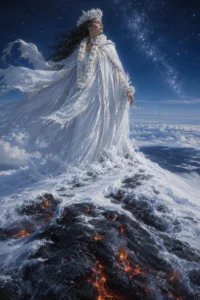
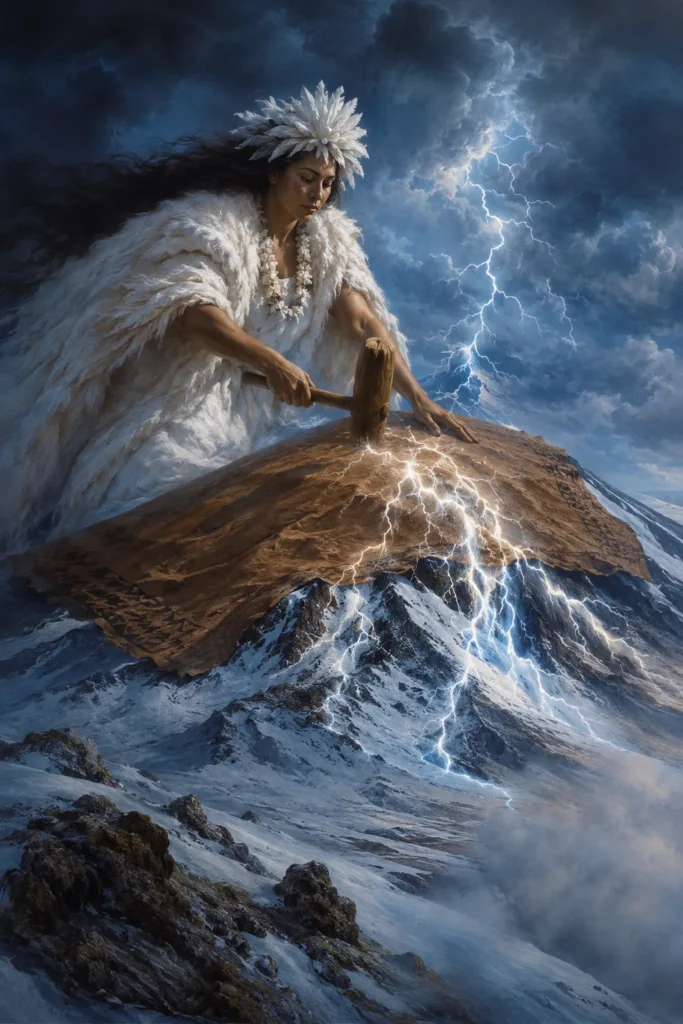
Pele’s siblings include Hiʻiaka, known for hula and the healing arts, and the shark god Kamohoaliʻi. Her rival is considered to be Poliahu, the snow goddess of Mauna Kea, whose myth ends with a sledding contest in which Pele releases lava and Poliahu contains it with snow and ice, interpreted as a symbol of the opposition between fire and snow.

Frequently asked questions about the Hawaiian tradition

Who is Pele?


Pele is Hawaii’s volcano goddess, who according to tradition lives in the crater of Halemaʻumaʻu on Kīlauea. She is regarded as a powerful, capricious figure and remains a firm part of Hawaiian narrative tradition and art to this day.

What is the difference between Akua and Aumakua?


Akua are gods in the narrower sense, such as the four principal gods Kū, Kāne, Lono and Kanaloa. ʻAumākua, by contrast, are the deified ancestral spirits of individual families, who often appear in animal form and are regarded as personal protective powers.

What were the Night Marchers?


The Night Marchers, Huakaʻi Pō, are ghostly processions of deceased warriors and chiefs who, according to tradition, travel old paths at night. Folk belief advises lying flat on the ground and avoiding eye contact if one encounters them.

What was the Kapu system?


Kapu was a comprehensive taboo system that regulated ritual purity and social order, including the separate eating of food by men and women. It was formally abolished in 1819 under King Kamehameha II and the regent Kaʻahumanu.

Night Marchers, the ghostly processions of warriors

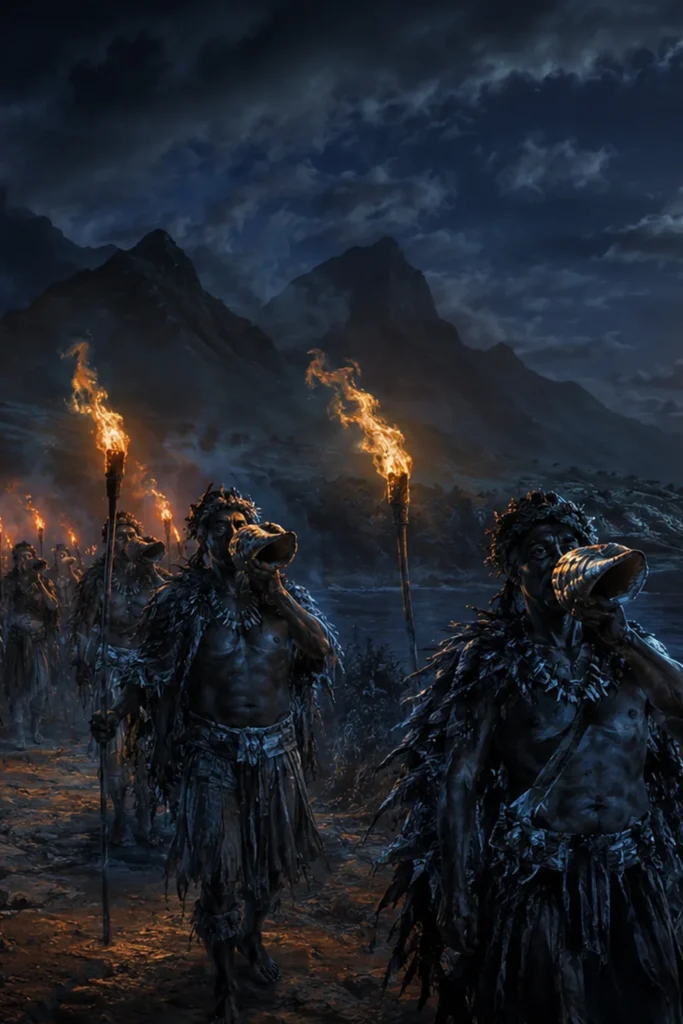
The Night Marchers, Huakaʻi Pō, are ghostly processions of deceased warriors and chiefs who, according to tradition, travel old paths above all on the nights sacred to certain gods, such as Kū, Kāne, Lono or Kanaloa, accompanied by torches, drums and conch shell horns.

Folk belief strongly advises respect when encountering them; eye contact is considered dangerous, and it is recommended to lie flat with one’s face to the ground. According to tradition, rescue is possible if a present ancestor recognises the person concerned as a descendant. The Night Marchers remain a living part of Hawaiian narrative tradition to this day.

Poliahu, Waiau, Lilinoe and the sisters of Mauna Kea

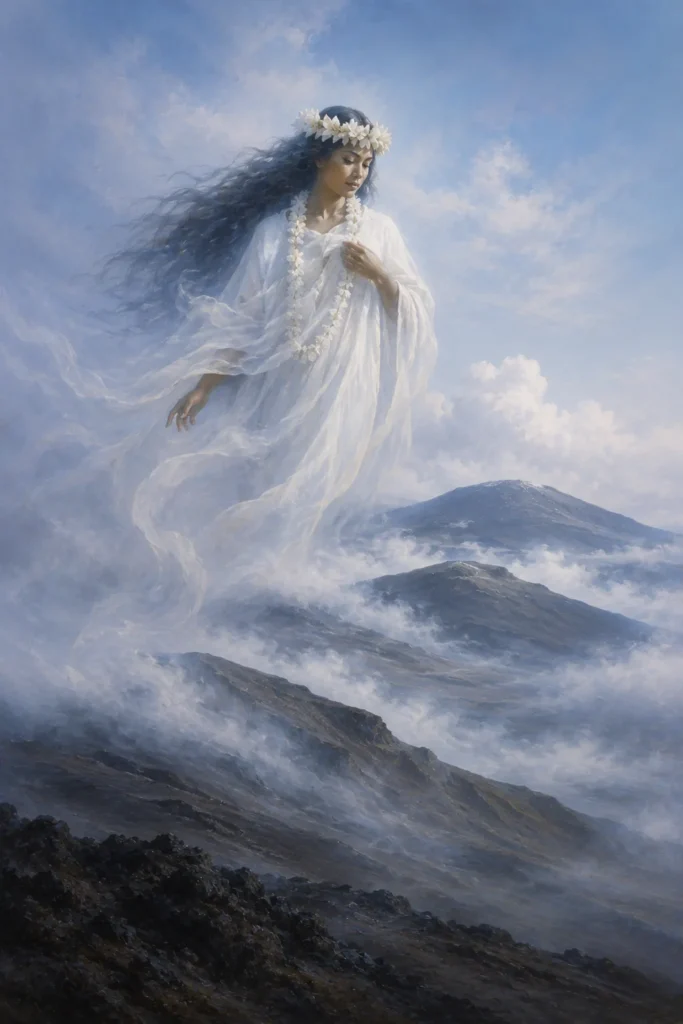
Poliahu, goddess of the snow on Mauna Kea, is regarded as Pele’s rival and is venerated together with several other sisters. Waiau, the youngest of these figures, embodies the high-lying crater lake Lake Waiau and, according to tradition, watches over Poliahu; Lilinoe embodies the mountain’s mist, often interpreted as Pele’s hair turned to fog; Kahoupokāne is likewise counted among this circle of mountain sisters and is associated with Mount Hualālai.

In oral tradition, this group of snow goddesses of Mauna Kea stands in opposition to the fire goddess Pele of the south of the island of Hawaii, a motif that reflects the geographical contrast between snow and lava on the same island.

Missionisation, suppression and the Hawaiian Renaissance

Following the abolition of the Kapu system in 1819, an intensive Protestant mission began from 1820, traditional worship of the gods was suppressed, and the Hawaiian language was pushed back sharply in public life and schooling during the later 19th and 20th centuries, intensifying after the overthrow of the Kingdom of Hawaii in 1893.

Since the 1970s, the Hawaiian Renaissance has contributed to a visible cultural and linguistic revival, with Hawaiian-language immersion schools, the cultivation of hula and traditional navigation, and a renewed public interest in Pele, the Aumakua and other figures of tradition. Foundational scholarly works come from Martha Warren Beckwith, Mary Kawena Pukui and the Hawaiian scholars David Malo and Samuel Kamakau in the 19th century.

An island realm with diverse local traditions

Hawaii consists of several large and numerous smaller islands that formed independent chiefdoms for centuries before political unification under Kamehameha I around 1810. This political diversity was reflected in differing local expressions of worship, for example in the particular importance of Pele and her family on the island of Hawaii with its active volcanoes.

The sisters of Mauna Kea, Poliahu, Waiau, Lilinoe and Kahoupokāne, are likewise closely tied to this one island and its highest mountain, while other figures, such as the wind-god complex around Lāʻamaomao and her descendant Pākaʻa, appear in narratives that span several islands.

The genealogical depth of the Hawaiian nobility, the Aliʻi, tied religious authority closely to individual families and places, so that veneration of the family Aumakua also varied from place to place and lineage to lineage. Sweeping statements about ‘the Hawaiian religion’ therefore obscure considerable internal diversity.

Common to the islands, however, was the veneration of the four principal gods Kū, Kāne, Lono and Kanaloa, the Kapu order system, and the notion of personal, family protective spirits, the Aumakua. These shared elements, too, are attested differently across regions in the sources.

Akua, Aumakua and the powers of the Hawaiian worldview

At the centre of the Hawaiian world of gods stand the four principal gods: Kū, responsible for war and politics, Kāne for life and creation, Lono for fertility and peace, and Kanaloa for the sea. Alongside them stand numerous other Akua and semi-divine hero figures, who play an important role in individual family or local traditions.

The ʻAumākua form a category of their own, deified ancestral spirits who often appear in animal form, for instance as a shark, owl or octopus, and are regarded as the personal protective powers of individual families. According to tradition, they warn of danger, appear in dreams and punish disrespectful behaviour.

The Pele family occupies a special position: the volcano goddess Pele with her siblings, including the shark god Kamohoaliʻi and the sea goddess Nāmaka, as well as her rival Poliahu with the sisters of Mauna Kea, Waiau, Lilinoe and Kahoupokāne. Wind and sea have their own deities, such as Lāʻamaomao with her legendary wind gourd and the hero Pākaʻa as her descendant.

The dead and the ancestors have their own place, still present in oral tradition today, in the Night Marchers, the nightly ghostly processions of deceased warriors.

There is no complete agreement on the precise systematics of this pantheon, because the precolonial religion was transmitted only orally and written records did not begin until Hawaiian scholars of the 19th century, such as David Malo and Samuel Kamakau, and the comparative research of Martha Warren Beckwith in the 20th century.

The sources: Hawaiian chroniclers and comparative myth research

The earliest written tradition concerning Hawaiian religion derives in essential part from Hawaiian scholars themselves, who recorded their own knowledge in the 19th century after the introduction of writing by American missionaries, not solely from outside observers.

Central to this is David Malo with his work Moʻolelo Hawaiʻi, in English Hawaiian Antiquities, regarded as one of the most important Hawaiian inside perspectives on precolonial society. The historian Samuel Kamakau supplemented this with extensive records on precolonial history and society.

In the 20th century, the ethnologist Martha Warren Beckwith, with her 1940 standard work Hawaiian Mythology, provided a systematic, comparative Polynesian classification of the transmitted myths. The linguist and cultural preservationist Mary Kawena Pukui contributed substantially to the preservation of this knowledge through linguistic and ethnographic research, including a foundational Hawaiian-English dictionary.

A source category of its own is formed by orally transmitted hero narratives (moʻolelo), such as those surrounding Pākaʻa and the wind gourd of his relative Lāʻamaomao, which were only fixed in writing at a late stage and whose oral variants differ considerably in places.

Researchers emphasise that the reconstruction of precolonial Hawaiian religion rests on an interplay of Hawaiian inside perspectives and later comparative research, and therefore offers a more nuanced picture of sources than in many other colonised regions, where predominantly outside perspectives have been transmitted.

Fall of the Kapu, mission and the Hawaiian Renaissance

After the arrival of the British seafarer James Cook in 1778, Hawaii’s contact with the West intensified rapidly, accompanied by introduced diseases that severely decimated the native population. In 1819 King Kamehameha II and the regent Kaʻahumanu abolished the Kapu system through the ʻAi Noa; conservative forces were defeated at the Battle of Kuamoʻo.

As early as 1820, the first Protestant missionaries from the USA arrived and began systematic Christianisation, the writing down of the Hawaiian language, and the establishment of a school system. Traditional worship of the gods was suppressed but survived in part in family traditions, oral narrative and folk belief, for instance around Pele or the Night Marchers.

In 1893 the Kingdom of Hawaii was overthrown; in 1898 the USA annexed the islands; in the 20th century the Hawaiian language was at times heavily suppressed in public life and schools, and the number of speakers fell drastically.

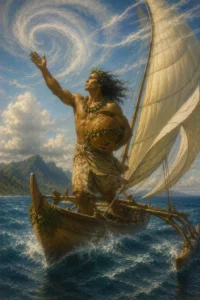
Since the 1970s, the movement known as the Hawaiian Renaissance has contributed to a broad cultural and linguistic revival, visible in Hawaiian-language immersion schools, the cultivation of hula and traditional navigation, for example through the voyages of the double-hulled canoe Hōkūleʻa, as well as a renewed public and scholarly interest in Pele, the Aumakua and other figures of tradition.

This revival is closely tied to a political sovereignty movement. At the same time, Hawaiian religion remains, for many people on the islands, part of a lived, evolving cultural and partly religious identity, not merely a subject of historical study.

The Pele family unites volcano, snow and sea in a narrative and protective tradition that remains alive to this day, in which the family protective spirits known as Aumakua ancestral spirits offer warning and support in everyday life.

Related key terms: Pele Aumakua Akua Kapu Kāne Kanaloa Kū Lono Mauna Kea Hawaii.

Protective objects in this cultural tradition

Hawaiian tradition includes braided lei as a sign of respect and blessing, the Kapu-shaped handling of sacred places and objects, and the notion of family Aumakua protective spirits; portable amulets in the European sense are attested less often than these ritual, place- and family-bound forms of protection, comparable at most to the prayers or talismans of other cultures. An overview of protective objects from various traditions is offered by the Protection Compass.

iWell Guard takes its place within this cultural-historical line of portable protective objects, in a contemporary material architecture, crafted in Germany. 41 layers, real gold, platinum, silver. 30-day return policy.

Personal experiences may vary. Not a medical device. No promise of healing.