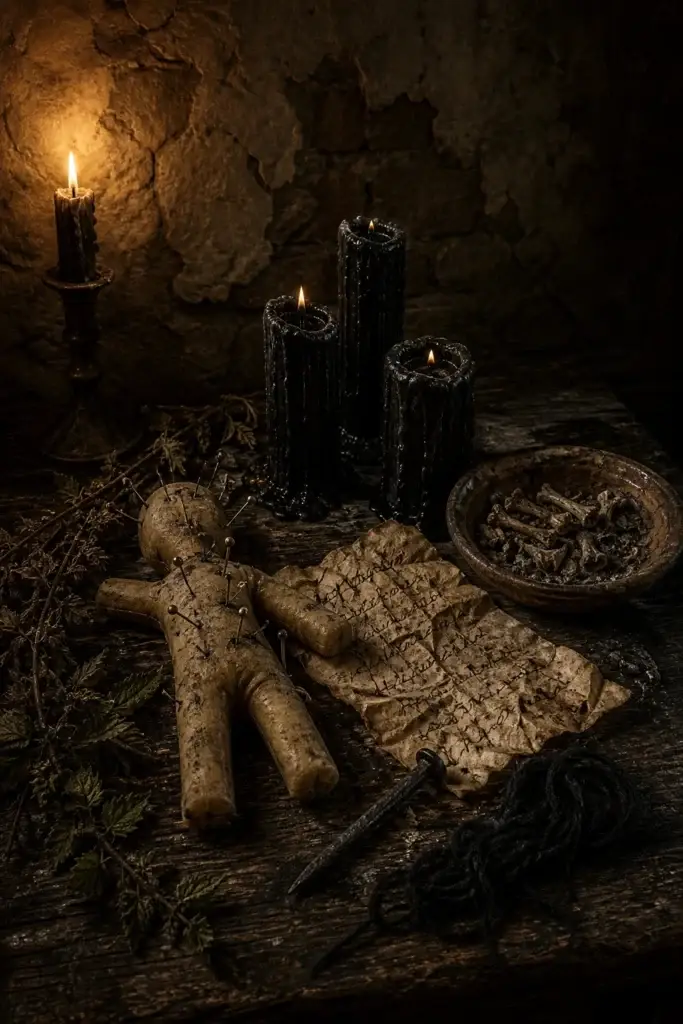
Voodoo Spell, a magical practice
This overview introduces the most important voodoo-spell traditions of West Africa, Haiti, and the diaspora.
The voodoo spell is a syncretic ritual system of African-Caribbean origin that employs ancestor veneration, loa invocation, and herbology for healing or harmful magic, historically attested in Haiti, Louisiana, and West Africa. Anthropological studies document complex cosmologies with loa hierarchies, possession, and trance states.
Modern misrepresentation in Western popular culture obscures the theological systematics, soteriological intention, and cosmological deep structure of this complex tradition. This tradition is the expression of a syncretic theology with African, European, and American elements.
Table of Contents
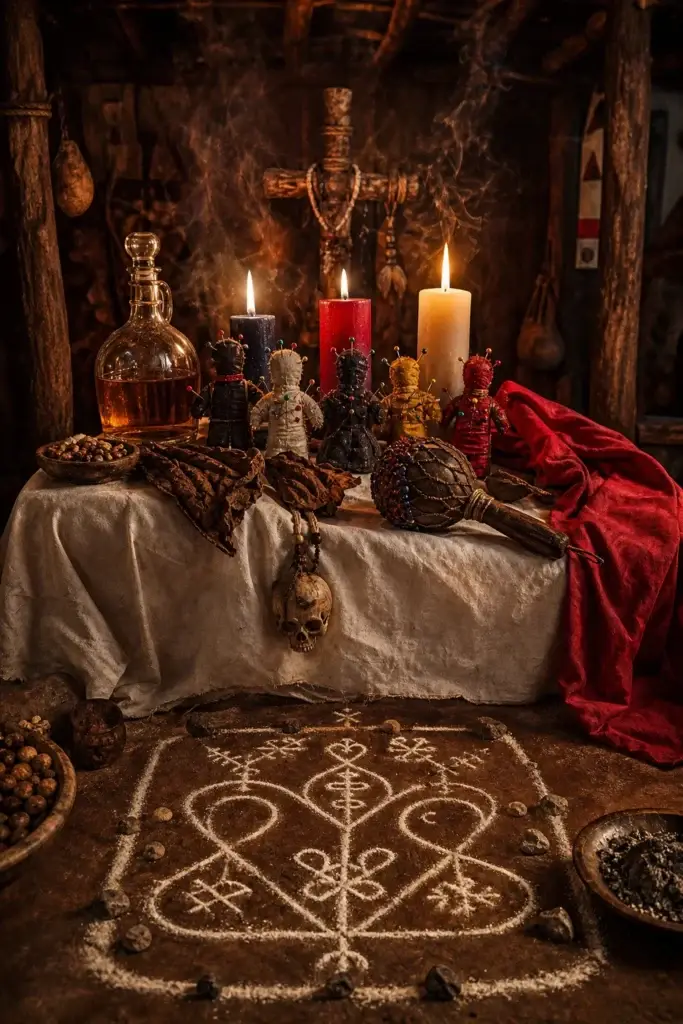
Concept and Distinction
The voodoo spell is not simply „black magic“ or harmful magic, although these practices may be included. It is a magical priesthood and healing system with hierarchy (mambo, houngan), rites, and a cosmology. The loa are not demons but ancestors or subordinate divine beings, similar to the orishas in the Yoruba system.
Distinction from Hoodoo: Hoodoo (African-American) uses similar practices (dolls, herbs, objects) but is less systematically religious and more a matter of everyday folk magic. Vodou is a religion in Haiti, Hoodoo a collection of practices.
Distinction from Santería or Candomblé: these are syncretic Afro-Caribbean religions of similar origin but different geography and history.
The voodoo spell denotes the Haitian magical practice within the Vodou system, with loa and ancestor worship.
Cultural-Historical Examples
Origin in Haiti: After the French colonization of Haiti (1697), millions of Africans were enslaved. Their religions (especially Yoruba beliefs) mingled with Catholicism and indigenous practices. From this fusion emerged Vodou, a survival strategy and a way of keeping the African spiritual world alive despite oppression.
The loa: the Vodou deities (loa) include Papa Legba (gatekeeper, Hecate-like), Erzulie (love, sensuality), Baron Samedi (death, the underworld), Damballa (serpent, wisdom), and many others. They are invoked through possession trance, and the priest or priestess is „ridden“ by the loa (chevaucher).
Voodoo dolls: these are not primarily weapons of harm but objects of focus; an image of the target is inscribed and filled with objects (hair, nails, earth from the grave, plant material). The object is then ritually activated to establish contact with the target person, for healing, binding, or harm.
Zombification: a concept of Haitian folklore, the deprivation of the soul (ti-bon-anj) by magical means, whereby the person remains a living body without will. This was long held to be supernatural; modern explanations point to the use of poison (tetrodotoxin).
Modern practice: in Haiti and among the diaspora (USA, Caribbean), Vodou is a recognized religion. Practitioners consult a mambo or houngan for healing, spiritual protection, loa invocation, and ritual.
Bokor and Houngan: Priests and Magicians in Vodou
The Vodou tradition distinguishes between the houngan (male priest) or mambo (female priestess), who act as legitimated mediators of the lwa spirits, and the bokor, who works with demonic and self-serving magic.
While the houngan and mambo strive for healing, protection, and communication with the lwa, the bokor practices magie noire: harmful magic, zombification, and pact rituals.
This dichotomy is not a modern construct but is rooted in the historical slavery resistance of the 18th and 19th centuries; bokors embodied a counterforce against colonial oppression, while houngans preserved the spiritual cohesion of communities.
The ethnographic works of Maya Deren (Divine Horsemen: The Living Gods of Haiti, 1953) document this tension as central to Vodou’s ethics and cosmology.
Source Situation
Academic sources: Alfred Métraux (Voodoo in Haiti, 1959), Daniéle Modan, Zora Neale Hurston (Tell My Horse, 1938). Haitian primary sources: their scope is limited, since Vodou was long transmitted orally. Modern ethnography: Karen McCarthy Brown, the Mambo Marie Laveau collection. African roots: Yoruba studies, Orisha literature.
Pwen and Wanga: Object Magic in the Petro Pantheon
The term pwen denotes in Vodou a magical knot of power, a ritual object that is charged through prayer, blood sacrifice, or binding symbols.
Pwen function as anchors for lwa presence and are central to wanga, the classic harmful-magic packets: small linen pouches containing bones, hair, nails, and powder, usually deposited on the threshold or under the victim’s bedstead.
The Petro pantheon, that is, the wilder, more combative lwa such as Baron Samedi, Erzulie Dantor, and Marinette, provides the magical power for such operations, while the milder Rada pantheon remains responsible for healing.
Alfred Métraux (Le Vaudou Haïtien, 1958) documents the ritual sequences of pwen manufacture, including the drumming invocation rhythms that attract the lwa.
Present-Day Significance / Related Beings
Historical Continuity: Slavery Resistance and Spiritual Sovereignty
The voodoo spell did not arise in cultural isolation but as a syncretic reaction to slavery in Saint-Domingue (today Haiti). Slaves of African origin, forced under Spanish and French colonialism to conceal their religions, integrated Yoruba-Orisha, Kongo-Ndoki, and Taino practices into Catholic saint veneration.
The famous Bois Caïman oath of 1791, which set off the Haitian Revolution, was a Vodou ritual with blood sacrifice and lwa invocation. Bokor and houngan thereby functioned as spiritual leaders of the liberation. This historical dimension still shapes the religious self-understanding in the diaspora today. See also Baron Samedi and Erzulie Freda.
Further standard works in the literature index.
iWell Guard and Protective Traditions
Across all documented cultures, protective objects can be traced that people wore on the body, from Pazuzu amulets in Mesopotamia, through the Hamsa in the Mediterranean region, to the Mezuzah on Jewish doorposts and to Christian protective medallions. iWell Guard takes up this tradition in a contemporary material architecture, manufactured in Germany, 41 layers, fine gold, platinum, silver. 30-day right of return.
Personal experiences may vary. Not a medical device. No promise of healing.