The Shaman Drum of the Sámi: Ritual and Protective Object from Sápmi
By Ralf Ittermann · last reviewed on
The shaman drum of the Sámi, named with various words in the Sámi languages, is a ritual object made of a wooden frame or a hollowed wooden bowl with a stretched skin membrane. As the central instrument of the noaidi, the Sámi ritual specialist of Sápmi, it accompanied his work with the spiritual powers.
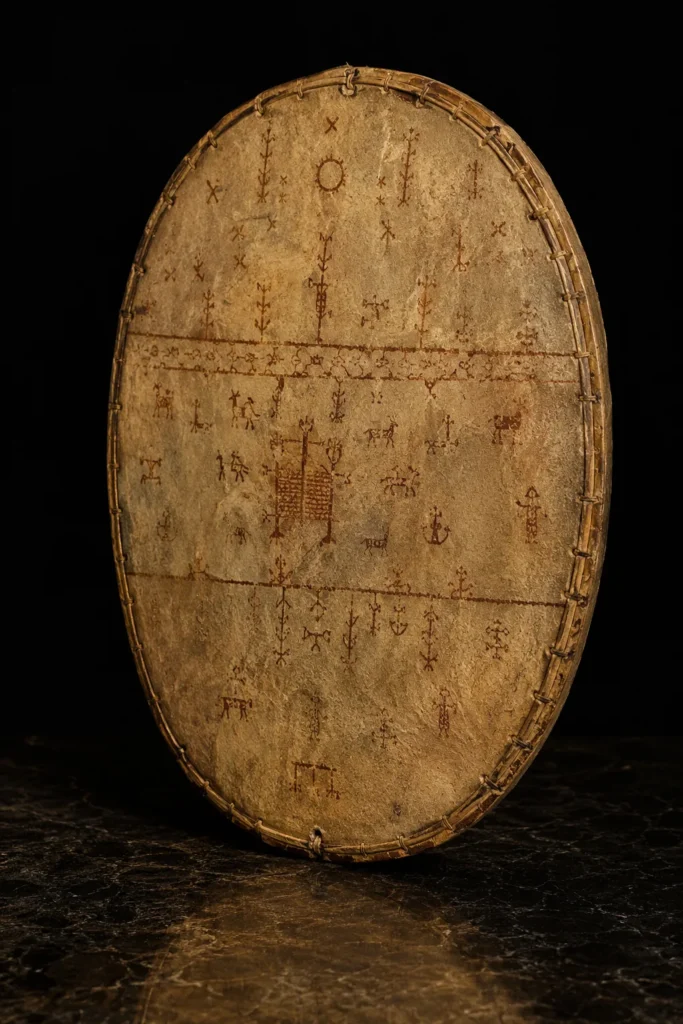
Figures are painted on this membrane, rendering an image of the world of the Sámi. The drum served the ritual specialist for consulting the spiritual powers and for protecting the community.
From a religious-studies view it is a central testimony of the pre-Christian religion of the Sámi. Since this religion was suppressed by Christian mission, this text describes the drum from an outside perspective and with regard for what is sacred to the Sámi. Coming from Sápmi, the Sámi drum is treated here as the noaidi’s instrument, with attention to its form and its role.
Classification of the Sami Drum
The shaman drum of the Sámi is a ritual object made of wood and skin that played a central role in the pre-Christian religion of the Sámi. In the various Sámi languages it is named with different words.
The Sámi are the Indigenous people of northern Scandinavia and the Kola Peninsula. Their settlement area, Sápmi, extends across parts of Norway, Sweden, Finland and Russia. The Sámi have their own languages and their own culture.
Unlike a portable amulet, the drum is a larger ritual device. It was used by a ritual specialist who is often referred to in scholarship with the word shaman, but who carries his own names in the Sámi languages, such as noaidi.
Figures are painted on the skin membrane of the drum. These figures depict a worldview in which deities, animals, people and places have their place. The drum is thus at once a ritual device and a painted image of the world of the Sámi.
From a religious-studies view the Sami drum belongs to the wider context of protective symbols and of shamanic ritual objects. It served the protection and the orientation of the community.
Important for a respectful presentation is that the pre-Christian religion of the Sámi was suppressed by centuries of Christian mission. Much knowledge was lost or is deliberately protected today. This text describes only what is publicly documented.
The drum thereby combines two properties that distinguish it from a worn amulet. It is a larger device that was used by a specialist, and it is at the same time a painted image that represents the world of the Sámi.
Origin and History
The religion of the Sámi was shaped, before Christianization, by the notion of an animate nature and by the mediation between people and spiritual powers. The drum was a central device in this religion.
How old the tradition of the drum is cannot be precisely determined. Written sources begin only with the accounts of travelers, clergy and officials who wrote about the Sámi from the 17th century onward.
With the Christian mission the drum moved to the center of persecution. Clergy saw in it a tool of heathen religion. In the 17th and 18th centuries numerous drums were confiscated, burned or taken away.
Some drums found their way into the collections of churches, universities and museums in Scandinavia and beyond. One well-known drum is the so-called Freavnantjahke drum, whose history and whereabouts have been much discussed.
Through this persecution only a few dozen old drums survive today. They are spread across museums in various countries. Each individual surviving drum is therefore a rare and valuable testimony.
An important early source is the writing of a clergyman who reported in the 17th century on the religion of the Sámi and described numerous drums. Such texts are ambivalent.
They transmit knowledge that would otherwise be lost, yet are written from the perspective of the mission and portray the drum as an object to be combated.
Christianization led to the open practice of the old religion being interrupted for a long time. Knowledge about the drum and its use was passed on only partly and often in secret.
Form, Material and Manufacture
The Sami drum consists of a body and a stretched skin membrane. In one type of construction a bent wooden frame forms the body; in the other the body is hollowed from a single piece of wood as a flat bowl.
A skin is stretched over the body, often the skin of the reindeer, which is an animal of great importance for the Sámi. The skin forms the membrane on which the figures are painted.
Figures were painted onto the membrane with a reddish color. Depicted are deities, people, reindeer and other animals, the sun, boats, tents and landscapes. The arrangement of the figures follows an image of the world.
Belonging to the drum are a beater and a pointer that was used in the consultation of the drum. The pointer, often a ring or a small piece of metal or horn, moved across the painted figures during the drumming.
The arrangement of the figures differs from drum to drum. Researchers broadly distinguish several regional image types. The exact interpretation of individual figures is often uncertain, since the original knowledge is transmitted only in fragments.
This text deliberately gives no instructions for making a ritual drum. The drum was a sacred device of the religion of the Sámi. Replicating it without the cultural context would remain an appropriation of the outward form.
Religious and Mythological Background
The religion of the Sámi knew a multitude of deities and spiritual powers connected with nature, weather, the hunt and the well-being of people. The world was divided into several levels that the noaidi could traverse.
The drum was the most important device of the noaidi. With its sound he placed himself into an altered state of consciousness in order to come into contact with the spiritual powers. The drum was thus the means of the ritual journey.
At the same time the drum served for consultation. A pointer was placed on the membrane, and depending on which figures it moved across during the drumming, an answer to a question was read off. In this way decisions could be secured spiritually.
The painted figures depict a worldview. They show the position of the deities, the people, the animals and the places in relation to one another. The drum is thus a painted model of the world as the Sámi understood it.
From a religious-studies view the Sami drum can be placed in the wider context of shamanic traditions of northern Eurasia. Similar drums are known from Siberia. Such comparisons must not, however, blur the distinctiveness of Sámi religion.
It is important that the drum did not act on its own. Its meaning unfolded only through the skill of the noaidi, in the songs, the joik, and in the prescribed actions. Without this context it remains a painted device.
Ritual Use and Bearers
The bearer of the drum tradition was the noaidi, the ritual specialist of the Sámi. He possessed special knowledge and was regarded as able to mediate between the world of people and the world of the spiritual powers.
The noaidi used the drum to answer questions of the community, for instance about the whereabouts of lost animals, about the success of the hunt, about illness or about the right time for important undertakings.
In the use of the drum its membrane was struck while the noaidi sang. The sound of the drum and the singing placed him into a state in which the ritual journey was possible.
The drum also served the protection of the community. With its help the noaidi sought to recognize dangers, interpret illness and secure the well-being of people and of the reindeer herds.
Handling the drum was bound to particular care. There were notions about who was allowed to touch the drum and how it was to be treated. Such rules emphasized its sacred rank.
With Christianization this ritual use was suppressed. To possess or use the drum could lead to persecution. The tradition was thereby interrupted, and much knowledge was lost.
Regional Variants and Related Objects
Within Sápmi there were various constructions of the drum. The frame drum and the bowl drum hollowed from a single piece are broadly spread across different regions. The image programs also differ regionally.
Researchers distinguish several types of painting. In one type the figures are distributed across the whole membrane; in the other they arrange themselves around a central sun figure. These types reflect regional traditions.
Related to the Sami drum are the shamanic drums of Siberia, which were likewise made of wood and skin and used in ritual contexts. The article on the protective symbols field places such objects in context.
Other ritual objects of Siberia and northern Eurasia also belong to the wider context. Shamanic mirrors and material spirit dwellings are examples of how various peoples of the North equipped their religion with objects.
From a religious-studies view caution is advisable in such comparisons. The shamanic traditions of northern Eurasia share basic features but are each independent. A sweeping equation would not do justice to Sámi religion.
Within Sápmi itself the drum traditions of the southern Sámi, the northern Sámi and the eastern areas differ. The surviving drums can be partly assigned to these areas, yet the source situation is fragmentary. Research here proceeds with caution, since the destruction of many drums has left the picture of regional diversity incomplete.
Within the field of protective and ritual objects the Sami drum is an example of a device that was not worn on the body but used by a specialist for the whole community. The article on amulet and talisman explains such differences.
Significance as a Protective Object
The Sami drum was regarded as protective because it helped the noaidi to recognize dangers and to secure the well-being of the community. The protection was directed at people, at the reindeer herds and at the success of important undertakings.
The protection rested not on the drum as an object, but on the mediation between the worlds that the noaidi performed with its help. The drum was the means by which the spiritual powers were consulted and favorably disposed.
From a religious-studies view the protective function of the drum can be described as part of a coping with uncertainty. In a life-world shaped by cold, the hunt and care for the herds, the consultation of the drum offered orientation.
This text makes no statements about actual effects. It describes only what meaning the religion of the Sámi ascribed to the drum. Healing promises and assurances of effect are expressly excluded.
The protection was at the same time bound to the skill and the responsibility of the noaidi. The drum alone effected nothing. Only in the interplay of specialist, song and community did it unfold its meaning.
It should be noted that the protective meaning of the drum was bound to the pre-Christian religion of the Sámi. Outside this context the drum is a historical testimony, not a self-acting protective object.
History of Research, Ethical Questions and Cultural Appropriation
The scholarly engagement with the Sami drum began with the accounts of clergy and scholars from the 17th century onward. These early sources are at the same time testimonies of persecution, since many drums were confiscated in the course of the mission.
Later research examined the surviving drums, their constructions and their painting. In doing so it became clear that the interpretation of the figures often remains uncertain, because the original knowledge was lost through Christianization.
A serious ethical problem is the history of appropriation. Drums were taken from the Sámi under coercion and found their way into museums of various countries. The return of individual drums to Sápmi has been negotiated for years.
For many Sámi the drum today is a sign of their suppressed religion and of their cultural renewal. Handling it is therefore connected with particular sensitivity. Some knowledge is deliberately not made public.
The cultural appropriation of the Sami drum by modern esotericism is a problem of its own. Replicated drums, seminars and courses that invoke Sámi models detach the object from its meaning and are criticized by Sámi voices.
A serious presentation describes the drum from an outside perspective, names the history of persecution and appropriation, and refrains from any instruction for replication or shamanic use.
Reception Today
For the Sámi the drum is today an important sign of cultural renewal. After centuries of suppression of the old religion, Sámi artists are connecting again with the tradition of the drum.
The question of the return of drums from museums is an ongoing topic. Individual drums have returned to Sápmi or are kept in cooperation with Sámi institutions. These returns have symbolic significance.
Sámi museums and cultural institutions display drums and explain their meaning. They do this from the perspective of the Sámi themselves and thus contribute to the recognition of their own history.
The scholarly engagement with the drum has changed over the past decades. Research today takes place more often in cooperation with Sámi institutions, and the question of which knowledge may be published is expressly raised. This brings the view of the Sámi themselves to the center of the presentation.
In modern esotericism drums are sold and used in seminars that invoke Sámi or generally shamanic models. From a religious-studies view this is a reception form of its own that is to be kept separate from the religion of the Sámi.
In art and literature Sámi creators take up the drum to recall their history and to express their identity. The drum thus becomes a sign of self-assertion.
For interested readers a restrained approach is recommended. Acquiring knowledge about the Sami drum is legitimate, but imitating its ritual practice is not. A respectful attitude honors the limits of what is publicly accessible. Further protective objects are presented by the section protective symbols.
Literature (Selection)
Related key terms: Sami drum shaman drum Sámi Sápmi noaidi reindeer skin joik Lapland Indigenous religion shamanism repatriation northern Scandinavia.
iWell Guard and Protective Traditions
iWell Guard stands in the cultural-historical line of portable protective objects, to which the Sami drum also belongs. A modern companion for people who live with protective symbols: made in Germany, 41 layers of solid gold, platinum and silver, with a 30-day right of return.
Personal experiences can vary. Not a medical device. No healing promise.