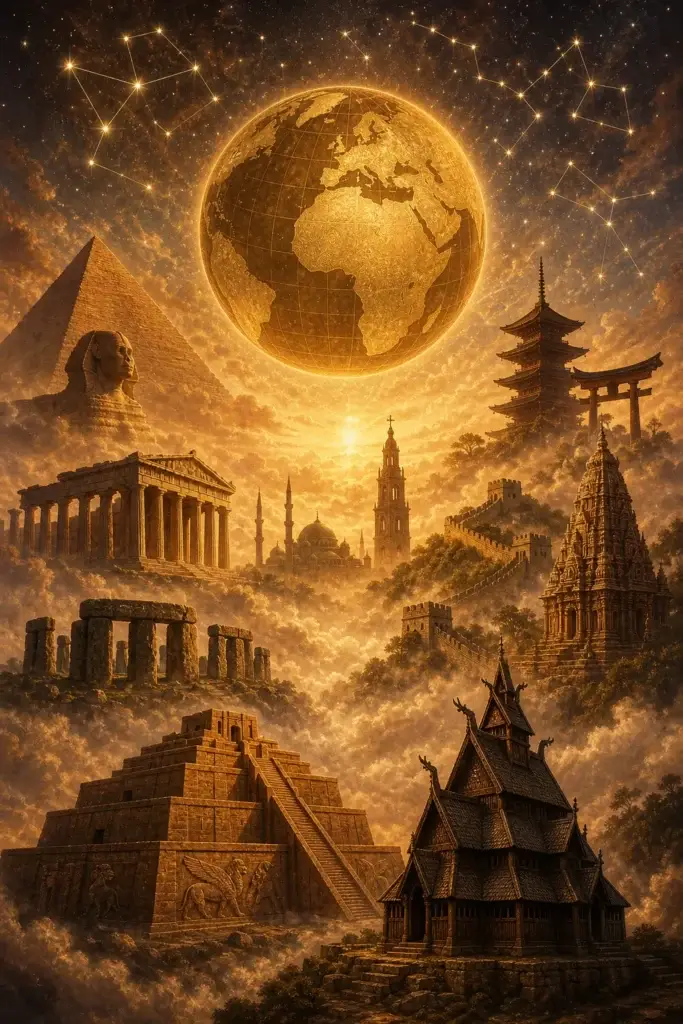
Cultures Overview: 30 Mythologies Worldwide
iWell Guard documents beings and practices from 30 cultures, from Mesopotamia and Egypt through Greece and Rome to Tibet, Vodou and the modern New Age movement.
This overview shows the full spectrum of cultures with entry points into each tradition and arranges the mythologies broadly by period, region and focus.
Cultures Overview
The overview of all mythologies and historical religious traditions documented on iWell Guard.
Thirty main cultures plus two specific contexts, Vodou as an Afro-Caribbean form of syncretism and New Age as a modern Western esotericism, are recorded as separate landing pages, each with the history of the pantheon, characteristic beings, the state of the sources and cross-references to related cultures.
The cultural ordering complements the typological ordering used in the class overview beings.
Anyone looking for a particular being can reach their goal through either route; the cultural ordering is especially useful for comparative questions, such as how beings of the dead relate to one another in the Egyptian, Mesopotamian and Greek traditions, or how similar functions are filled in entirely different pantheons.
This cultures overview brings together 30 mythologies worldwide.
Logic of selection in the study of religion
The 30 mythological cultural areas documented on iWell Guard are selected according to criteria from the study of religion.
Three selection criteria were paramount: first, the density of sources for the respective tradition (available primary sources, developed secondary literature, academic research); second, the historical-religious autonomy of the tradition (its own pantheon, its own classes of beings, its own ritual form); third, the relevance for the iWell Guard tradition of protection (beings or practices addressed in the protective mantra).
This selection is not exhaustive; further cultures with a rich historical-religious tradition will be added over the medium term.
30 documented mythologies
Overview from the study of religion
The cultures and their religious traditions treated on iwell-guard.com span a temporal arc from about 3000 BC to the present and geographically from Egypt through Mesopotamia, Greece, Rome, India, Tibet, East Asia to Africa and the New World.
Each culture brings with it its own ontology, its own assumptions about the nature of reality, the structure of the supernatural world and the role of humanity.
Egyptian religion (ca. 3100 to 30 BC) is shaped by a complex pantheon structure, in which gods are at once cosmic forces (ma’at = order) and local figures of salvation.
Mesopotamian gods (Sumer, Babylon, ca. 3500 to 330 BC) are more like powerful rulers over specialized domains (Enuma Elish as cosmogony). Greek antiquity (8th to 1st century BC) humanizes its gods more strongly, links them to city-states (polis) and develops philosophical reflections on the divine.
Roman religion absorbs Greek gods, makes them pragmatic and subordinates them to the state cult. Hinduism (ca. 1500 BC to the present) works with trinities (Brahma, Vishnu, Shiva), philosophical schools (Vedanta, Tantra) and a cyclical cosmology.
Buddhism (ca. 500 BC to the present) deconstructs the conception of gods in favor of enlightenment and the transcendence of suffering. Tibetan Buddhism absorbs local deities under the roof of dharma.
The Chinese and Japanese traditions combine ancestor veneration, Taoism, Buddhism and Shinto worship. The Celtic tradition (ca. 1000 BC to the Middle Ages) leaves behind sparse sources, but is partly reconstructed in Irish collections of mythology (Lebor Gabála).
The Germanic tradition (Edda, Saxo Grammaticus) shows gods under an eschatology, Ragnarök, the end of the world. The Slavic tradition is fragmentary, is rejected by ecclesiastical polemicists and is difficult to reconstruct.
The Islamic (ca. AD 610 to the present) and Christian (ca. 1st century to the present) traditions bring monotheistic, scripture-centered systems. The Jewish tradition (ca. 1300 BC to the present) interweaves history, legal principles and mystical speculation (Kabbalah).
And the Afro-American tradition (Vodou, Santería, Candomblé, ca. 16th to 20th century) merges West African concepts of ancestral and spirit worlds with Christian saints and New World realities.
The special pages on each culture on iwell-guard.com offer deeper overviews, history, religious doctrines, deities and spirits in detail.
The iwell-guard.com encyclopedia pursues an interest grounded in the study of religion (not a theological or devotional one): how do people in different cultures understand the supernatural world, which concepts do they use, which ritual practices did they develop? Such an overview helps to recognize parallels and differences, and thereby to appreciate the depth of each individual tradition.
Structural cross-connections between the cultures
Comparative religious research recognizes a number of recurring structural patterns that are found in practically all developed mythologies.
The high-god function (Wilhelm Schmidt, Mircea Eliade) is filled in almost all documented pantheons: Anu in Mesopotamia, Ra/Atum in Egypt, Zeus in Greece, Jupiter in Rome, Brahma in Hinduism, Odin in the Germanic tradition, Tengri in the Turkic-Mongolian tradition.
The death-god function is analogously universal: Hades, Osiris/Anubis, Yama, Hel, Mictlantecuhtli, Yanluo Wang. The mother-complex function is found as Demeter, Cybele, Ceres, Bhumi, Pachamama, Asase Yaa.
These constants have found two different readings in research. The structural reading (Georges Dumézil, Mircea Eliade) interprets them as a mirror of fundamental categories of human experience, which must find their own answer in every developed pantheon.
The diffusionist reading (older historical comparison) interprets them as the result of cultural processes of transmission between the high cultures. Current research combines both perspectives: some structures are genuine cultural constants, others are the result of documented processes of contact and transmission between neighboring traditions.
Methodological notes on using the culture hubs
Each of the 32 culture hubs on iWell Guard is built according to a uniform scheme: a two-column hero with H1, lead and image, followed by a cluster text on historical-religious classification, a card grid with the documented beings of the respective culture (gods, demons, spirits, beings of light) and a list of sources.
The card grids are arranged by class of being; each card opens the detail page for the respective being. Through the tradition pills (high deity, protective deity, deity of the dead, anti-god and corresponding spirit subclasses) beings with a similar function can be compared across cultures.
32 cultures at a glance


Regional classification
The 32 documented cultures can be ordered broadly by major geographic areas. The division follows the convention of the study of religion and makes comparative reading easier.


iWell Guard and cultural traditions of protection
Each of the 32 cultures develops its own rituals of protection, apotropaism and purification. The central practices, Hamsa, Mezuzah, protective symbols, sigil magic, shamanism and similar ones, are documented in the practices overview.
Anyone looking for the practices of a particular tradition reaches the respective relevant beings and means of protection directly through the culture page.
From the documented cultures iWell Guard does not adopt any specific belief, but brings them together as comparative material for the study of religion.