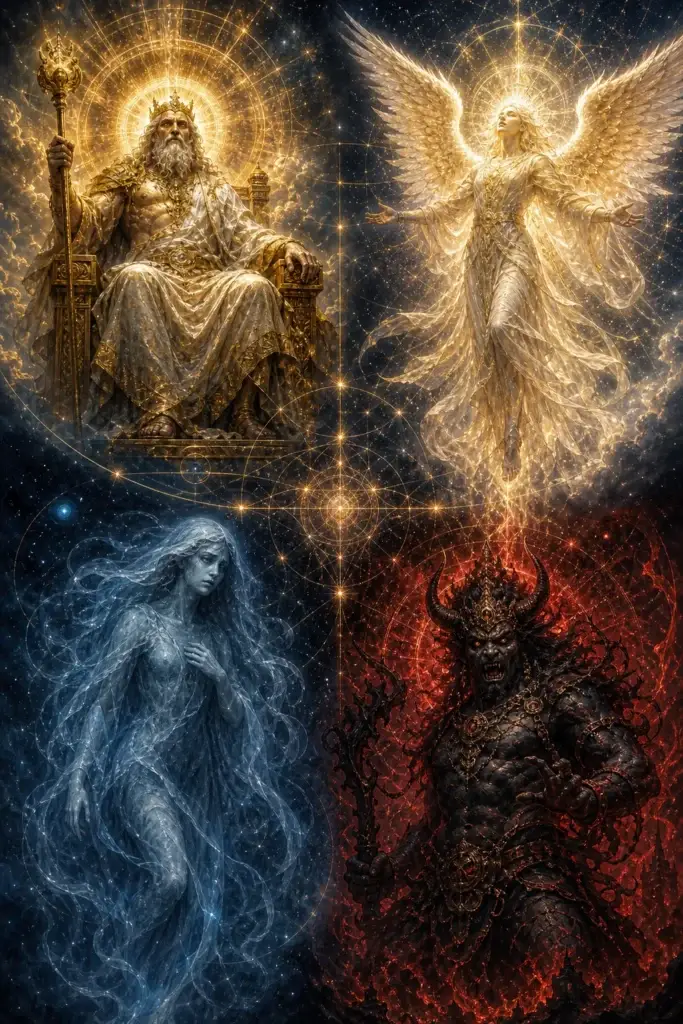
On iWell Guard we sort the beings of various mythologies into four main classes: gods, beings of light, spirits and demons.
This overview explains the classification system by which we distinguish them, where the boundaries are fluid, and how we handle beings that can be assigned to more than one class.
The class overview of all types of beings in the lexicon.
Beings, class overview
The collective page for the four classes of beings, gods, demons, spirits and beings of light, brings together the class landing pages, their sub-categories and all individual entries contained in the iWell Guard lexicon.
It is the entrance to the entire directory of beings and at the same time the answer to the question of how we order the highly heterogeneous material from around 18 cultural spheres in a uniform way without flattening the culture-specific particularities.
The classification follows a simple logic: we distinguish between the highest personified powers of a pantheon (gods), the harm-oriented or ambivalent beings below the gods (demons), the beings tied to a place, to the deceased or to natural thresholds (spirits), and the spiritual helper figures of Western esotericism and the modern New Age (beings of light).
Where a figure fits several classes, for instance Lilith as a demoness, spirit and, in a feminist reading, goddess, she is linked in all relevant classes and explained accordingly in each context.
This overview presents the four classes of beings worldwide.
Four classes of beings
The beings documented in the iWell Guard lexicon are broadly divided into four functional main classes: gods as originally or by definition powerful exalted figures with a supra-regional cult; demons as deliberately harmful or seductive powers; spirits as intermediary beings often bound to a place, a family or the deceased; and beings of light as helping, protecting or enlightening appearances (angels, bodhisattvas, ascended masters).
This fourfold division is not universal; many cultures know transitional and mixed forms, such as Indian Yakshas, Japanese kami or Mesopotamian apkallu.
Scholarly religious history therefore avoids dogmatic classification and describes beings primarily in functional terms: for what is the being invoked, in what ritual context does it appear, what cultural history does its veneration or banishment have? (Cf. Hans Kippenberg: Die Entdeckung der Religionsgeschichte, Munich 1997; Jan Assmann: Religion und kulturelles Gedächtnis, Munich 2000.) This functional perspective also shapes the structure of each individual entry page of the lexicon.
In addition to the main classification, the lexicon notes, where relevant to religious history, further sub-categories, such as high deity, creator god, deity of the dead, vegetation deity, protective deity, trickster, messenger, water spirit, forest spirit, house spirit, archangel, ascended master, dharmapāla. These so-called tradition pills (see pill system) allow readers to quickly identify comparable beings across cultures, for example to set side by side all high deities of the world religions or all messengers of the dead of various pantheons.
Across all documented cultures, protective objects can be attested that people wore on the body, from Pazuzuamulets in Mesopotamia through the Hamsa in the Mediterranean region to the Mezuzah on Jewish doorposts and to Christian protective medallions. iWell Guard takes up this tradition in a contemporary material architecture, made in Germany, 41 layers, solid gold, platinum, silver. 30-day right of return.