iWell Guard

Mezuzah, Jewish scroll on the doorpost

The Mezuzah is a small parchment scroll that is fixed in a case to the right doorpost of Jewish homes. It contains the Shema Israel text from the book of Devarim and is regulated by halacha. Its protective function is contested in rabbinic discourse, yet it is deeply rooted in popular belief.

Protective symbolJudaism

Table of contents

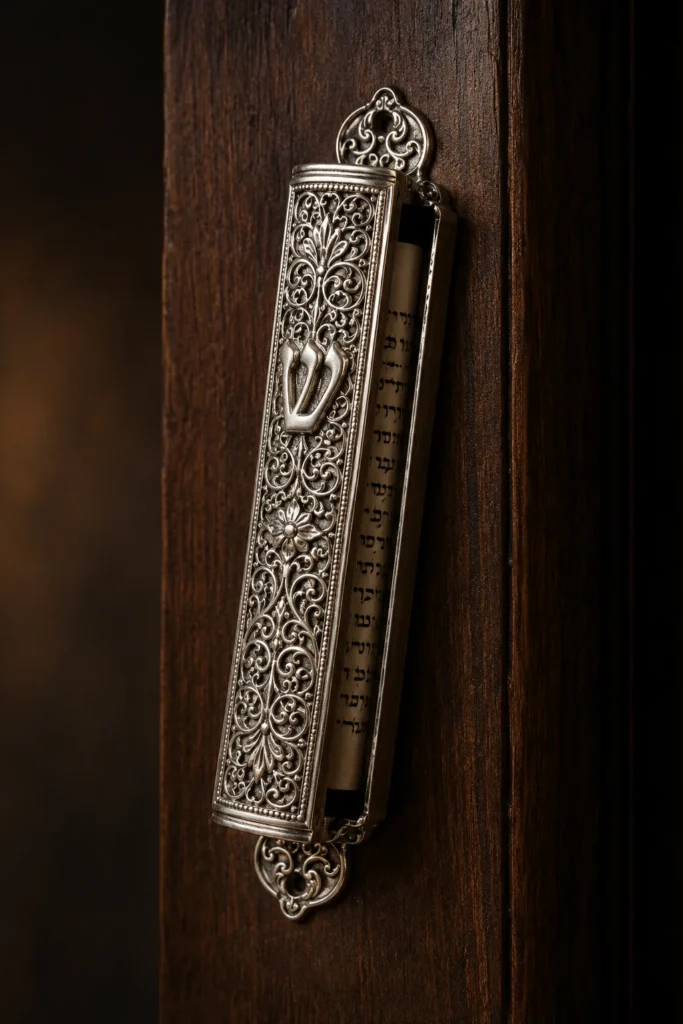
Silver Mezuzah case with shin letter and visible klaf parchment on the dark doorpost

What the Mezuzah is

The Mezuzah is a small parchment, inscribed with two passages from the fifth book of Moses, rolled up and fixed in a case to the right doorpost of Jewish homes.

In biblical Hebrew the word mezuzah originally means nothing more than doorpost. The term only came to refer to the object hanging on this post in rabbinic usage.

The scroll is called klaf and consists of the parchment of a kosher animal. It is written with indelible black ink and a quill, by a trained scribe, the sofer.

The letter form must correspond exactly to one of two permitted styles, the Ashkenazi ktav Beit Yosef or the Sephardic ktav Ari. A single faulty or damaged letter renders the Mezuzah halachically invalid.

The text on the Klaf

Two text passages appear on the Mezuzah. The first is Devarim 6:4 to 9, the Shema Israel with the affirmation of the unity of God and the commandment to write these words “on the doorposts of your houses and on your gates”.

The second is Devarim 11:13 to 21, the text of promise and obedience. On the back of the scroll the letter shin usually appears, which stands for one of the names of God, Shaddai, and which in popular interpretation is also read as an acronym for “Guardian of the doors of Israel”.

Halachic rules concerning the Mezuzah

Affixing the Mezuzah is a positive commandment, a mitzvah aseh, which is obligatory for Jewish homes.

The Shulchan Aruch, the most important rabbinic legal work of the early modern period, regulates the obligation in Yoreh De’ah 285 to 291. According to this, the obligation applies to every entrance to a living space with at least four cubits of interior area, with two doorposts and a lintel.

Bathrooms, toilets and rooms with unworthy use are exempt. The obligation also only applies after thirty days of residence.

It is affixed to the right post upon entering, in the upper third of the height. In the Ashkenazi custom the scroll is fixed at an angle leaning inward, in the Sephardic custom vertically. A blessing is recited when it is affixed.

The case as an art form

The case of the Mezuzah, beit mezuzah, is not prescribed by halacha. The klaf is what is actually sacred, the case merely protection.

In Jewish art history, however, the case has developed into a genre of its own, from silver filigree work from the Ottoman region through lacquered wooden cases from Galicia to contemporary design pieces made of bronze, glass and even 3D-printed material.

Collections such as the Israel Museum in Jerusalem, the Jewish Museum Berlin or the Magnes Collection in Berkeley document this variety. A Mezuzah case from Vienna around 1900 looks completely different from a Moroccan one from the 18th century, yet both hold the same klaf text.

Protective aspect in rabbinic discourse

Is the Mezuzah an amulet? This has been debated in rabbinic literature since the Middle Ages. Maimonides, the Rambam, explicitly rejected the idea in the 12th century that the Mezuzah is a protective object in a magical sense.

It is an object of remembrance and affirmation, not a talisman. This position is the rabbinically classical reading.

Other voices, such as the Zohar in the 13th century or later kabbalistic commentators, do indeed emphasise a protective dimension, often linked to the name of God Shaddai and to names of angels that appeared additionally on the back of the klaf in some Mezuzot.

This variant is not permitted in the Ashkenazi mainstream because it is regarded as an addition to the biblical text.

Popular protective interpretations

In popular belief the Mezuzah was associated for centuries with concrete protection. In childbed it was understood as protection against Lilith, the mythical child-snatcher of Jewish tradition.

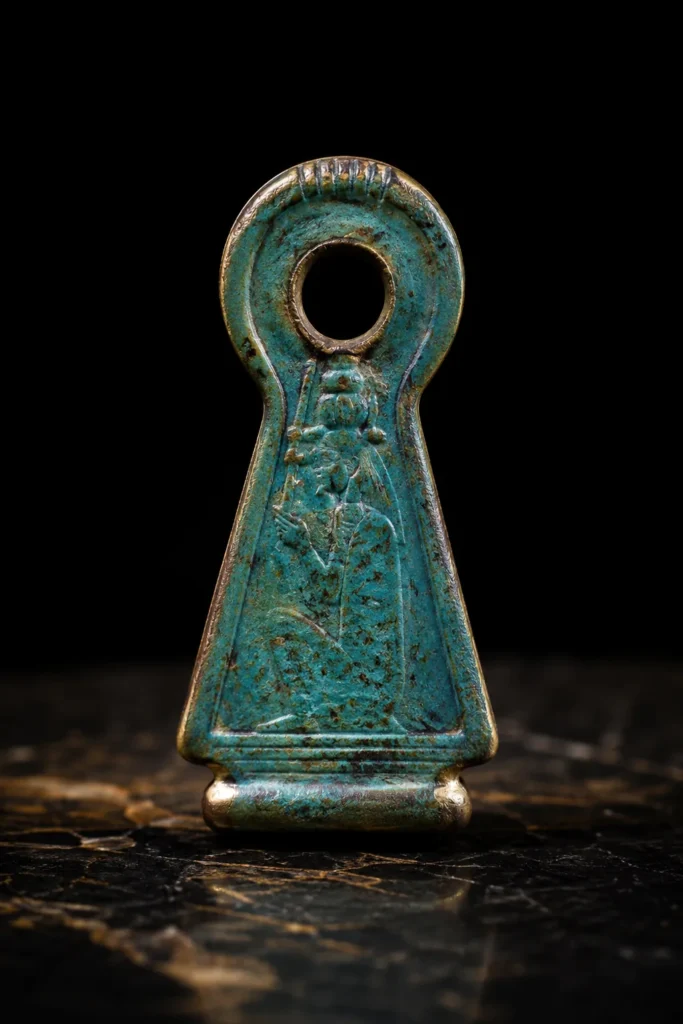
Young mothers and newborns were to be safeguarded by the Mezuzah and by additional amulets bearing the names Senoy, Sansenoy and Semangelof, those three angels who appear as Lilith guardians in the Alphabet of Ben Sira.

The Mezuzah was also invoked against the ayin hara, the evil eye. In some communities it was part of the custom to kiss the Mezuzah or to lay a hand on it when leaving the house, in order to carry along its effect of remembrance and protection.

Materials and production

Klaf parchments are still produced today by a few specialised sofrim, often in Israel and the United States. A correctly written Mezuzah costs between 40 and several hundred euros, depending on size, scribe qualification and writing style.

Cases range from the simple plastic tube under ten euros to artisanal objects of precious metal in the four-figure range.

Significance in the diaspora and Shoah remembrance

In the Jewish diaspora the Mezuzah is one of the most visible symbols of identity. It makes a home recognisable as Jewish, which historically meant both protection and risk.

After the Shoah, preserved Mezuzot from destroyed or plundered homes are among the most emotionally charged items in the collections of Jewish museums. The Jewish Museum Berlin shows Mezuzot from pre-war Berlin homes whose residents were murdered or driven out, as testimonies of an erased everyday culture.

In contemporary diaspora practice the Mezuzah is an affirmation of tradition, at the same time a design object and for many also a spiritual reminder when entering the home.

Pop culture and modern adaptations

In films and series with a Jewish setting the Mezuzah appears frequently, from Fauda through Shtisel to Unorthodox. Designers such as Tobi Kahn and studios such as the Israeli Yair Emanuel have reinterpreted the Mezuzah case as a contemporary object.

Outside Jewish contexts the object is sometimes worn today, which is not unproblematic in cultural-historical terms and calls for respectful engagement.

Classification in the iwell-guard lexicon

In the iwell-guard lexicon the Mezuzah stands as an example of a protective symbol that is not primarily worn but fixed to a set place, the doorpost.

In this it differs from the Hamsa and from portable pendants, yet belongs to the same symbol family of Jewish protective traditions, in which Lilith guardian amulets with the three angels and the ayin hara also play a role.

In the wider lexicon context there are related entries such as Lilith, Asmodai, Azazel and Dybbuk for Jewish and kabbalistic points of reference.

Literature and sources

  • Joseph Caro: Shulchan Aruch, Yoreh De’ah 285, 291. Standard halacha work, 16th c.
  • Maimonides: Mishneh Torah, Hilchot Mezuzah. 12th c.
  • Encyclopaedia Judaica, 2nd edition 2007, entry “Mezuzah”.
  • Bracha Yaniv: The Hidden Beauty, Mezuzah Cases from Around the World. Israel Museum 2018.
  • Marc Michael Epstein: The Medieval Haggadah. Yale University Press 2011, chapter on ritual objects.
  • Jerusalem Talmud, Megillah 4:12 on Mezuzah practice in early rabbinic Judaism.

External links for the detail page:

  • Sefaria entry Shulchan Aruch Yoreh De’ah 285
  • Encyclopaedia Judaica online via Jewish Virtual Library
  • Israel Museum collection online entry Mezuzah cases
  • Jewish Museum Berlin, Mezuzot collection
  • Magnes Collection Berkeley, online catalogue Mezuzot
Disclaimer at the end of the page

The contents of this page are a religious-studies and cultural-historical classification. iwell-guard is not a medical product and does not replace medical or psychotherapeutic treatment. Personal perceptions may differ. No promise of healing.