iWell Guard

The Cylinder Seal: Seal and Personal Amulet of the Ancient Near East

For thousands of years the cylinder seal was the most important sealing tool of the Ancient Near East. At the same time it was a personal amulet, for the stones, the engraved images and the worn form gave it a protective meaning.

Protective symbolMesopotamiaSeal amulet
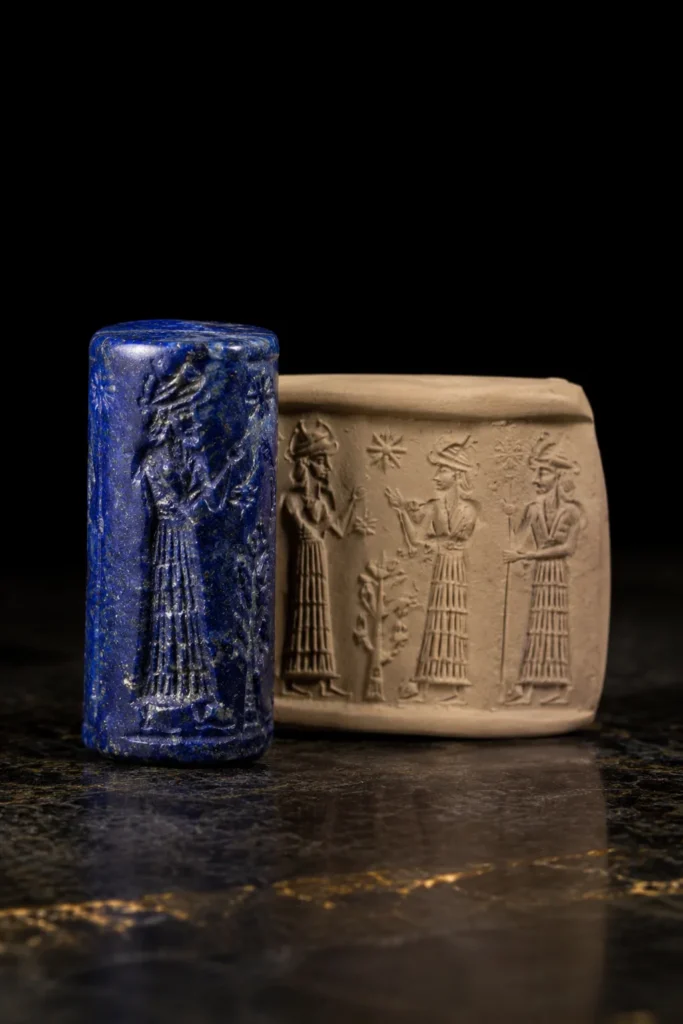
Cylinder seal: protective symbol, museum-style illustration

Classification

The cylinder seal is a small, roller-shaped object made of stone. Along its entire length a scene or a pattern is engraved. When the seal is rolled over soft clay, it leaves a continuous impression.

For thousands of years the cylinder seal was the most important sealing tool of Mesopotamia and the adjoining regions. It is among the characteristic objects of Ancient Near Eastern culture.

The principal function of the cylinder seal was practical. It served to authenticate documents, to seal containers and to mark property. It was a tool of administration and of law.

At the same time, however, the cylinder seal was more than a mere tool. It was worn on the body, it was made of often precious stones, and it bore images that held a protective meaning.

From this dual nature follows the place of the cylinder seal in the world of protective objects. It is a sealing tool and a personal amulet at once. Both sides belong to it.

In religious studies and in Ancient Near Eastern studies the cylinder seal is a good example of the fact that the boundary between everyday object and protective object does not always run sharply.

Form and Working Principle

The cylinder seal has the form of a small roller. It is usually only a few centimetres long and so narrow that it lies comfortably in the hand and can be worn.

As a rule the cylinder seal is bored lengthwise. Through this perforation a cord or a pin could be threaded. In this way the seal could be worn and at the same time easily handled.

On the lateral surface of the cylinder a depiction is engraved. This depiction is worked in relief in reverse, so that it stands out in raised form when rolled out.

The working principle is simple and ingenious. When the seal is rolled over a surface of soft clay, the engraved depiction is transferred to the clay as a continuous, raised image.

Because the seal is rolled, the impression is not limited to a single spot. It can be of any length and can repeat. Therein lies an advantage over a mere stamp.

This construction remained essentially the same over thousands of years. The cylinder seal was a proven, reliable solution that endured over an extraordinarily long period.

The Seal in Law and Administration

The most important task of the cylinder seal lay in the sphere of law and administration. Here it was an indispensable tool of daily life.

With the seal, documents were authenticated. Whoever concluded a transaction, confirmed a contract or gave an instruction rolled their seal over the clay of the document. The impression was their binding confirmation.

The seal also served for sealing. Containers, doors and storage vessels could be fitted with a clay closure into which the seal was rolled. An intact impression showed that nothing had been opened without authorisation.

Beyond this, the seal marked property. The impression indicated to whom something belonged or who was responsible for something.

The cylinder seal was thus closely bound up with the person of its owner. It represented him, it confirmed in his name, it was as it were his signature in a world in which only few could write.

This close connection between seal and person is important. The seal was not an arbitrary object but a highly personal one that embodied the identity of its owner.

The Seal as Personal Amulet

Beyond its practical function, the cylinder seal was a personal amulet. This second side is decisive for its place among the protective objects.

Several reasons speak for the amuletic character of the seal. It was worn on the body, constantly and close. It was frequently made of stones to which a protective power was ascribed. And it bore images that often had a protective meaning.

The seal was thus not merely a tool that one brought out when needed. It was a permanent companion that accompanied its owner through the day and stayed close to him.

In this permanent closeness the seal resembles the worn amulets. Like an amulet it was constantly on the body, and like an amulet it could grant its bearer protection.

The close connection between seal and person reinforced this character. The seal embodied the identity of its owner. To wear it meant to carry a highly personal object on one’s person.

The cylinder seal is thus an example of an object that was more than a tool from the very beginning. Tool and amulet, administrative instrument and protective object coincided in it.

Stones and Their Protective Power

Cylinder seals were fashioned from a great range of stones. This choice of material is significant for their amuletic character.

Hard stones were used that could be cut well and were durable. Among them were lapis lazuli, carnelian, hematite, agate and many further kinds of stone.

Many of these stones were ascribed a power of their own in the Ancient Near East. Certain stones were regarded as favourable, as salutary or as protective. The choice of stone was therefore not arbitrary.

A seal made of a stone regarded as protective carried this protective power within it, independently of the engraved depiction. The material itself was a part of the amuletic effect.

Lapis lazuli in particular, the deep blue stone, held a high rank in the Ancient Near East. It was regarded as precious and as significant. A seal of lapis lazuli was thus not only valuable but also of protective meaning.

In the cylinder seal, therefore, several layers work together. The stone carries a meaning, the engraved image carries a meaning, and the worn form makes the seal a constant companion.

The Images of the Seals

The engraved depictions of the cylinder seals are extraordinarily varied. They are among the richest pictorial sources of the Ancient Near East.

The seals frequently show gods and religious scenes. Deities, scenes of worship and mythical events appear. Such images placed the seal owner in connection with the divine world.

Protective motifs are also widespread. Protective spirits, hybrid beings and scenes of combat appear in which good triumphs over evil. Such images carried a protective meaning directly.

Some seals also bear an inscription. This frequently names the owner, his profession and the name of a deity under whose protection he placed himself.

The image on the seal was thus not mere ornament. It could connect the owner with a deity, it could depict protective powers, and it could express the wish for protection and well-being.

Thus the cylinder seal unites the inscribed and the illustrated protective object. Its image and its inscription belong to the same patterns that are also encountered with unambiguous amulets.

Tool and Protective Object at Once

The cylinder seal shows in particularly clear form that the boundary between tool and protective object does not run sharply. It was both at once.

As a tool the seal served law and administration. It authenticated, it sealed, it marked. In this function it was an indispensable object of practical life.

As a protective object the seal was a worn amulet. Its stone, its image and its constant closeness gave it a protective meaning.

These two sides do not contradict each other but belong together. For the people of the Ancient Near East it was a matter of course that an object could be useful and protective at the same time.

This finding is instructive. It shows that the protective was not separated from the rest of the lived world in the Ancient Near East. A tool of everyday life could at the same time be a protective object.

The cylinder seal thus stands for a world in which the practical and the religious, the tool and the amulet, did not lie in separate spheres but could meet in a single object.

Distribution and Long History

The cylinder seal has an extraordinarily long history. Over several thousand years it was in use in the Ancient Near East. Few objects in human history have so long and continuous a use.

Its distribution reached far beyond the heartland of Mesopotamia. Cylinder seals have been found in Anatolia, in the Levant, in Iran and in further regions.

Over the long period the images of the seals changed. Each epoch brought forth its own pictorial themes and its own styles. The seals are thus an important source for the art history of the Ancient Near East.

Because so many cylinder seals are preserved, they offer an exceptionally rich insight. They show gods, myths, protective spirits and everyday scenes across thousands of years.

With the end of the Ancient Near Eastern cultures the cylinder seal finally disappeared as well. It was replaced by other forms of seal, such as the stamp seal.

The long history of the cylinder seal shows how well proven this object was. Over thousands of years it combined the practical task of authentication with the meaning of a personal protective object.

Reception Today

The cylinder seal is today familiar above all to connoisseurs of the Ancient Near East. In Ancient Near Eastern studies and in art history it is an extraordinarily important and well-researched object.

In the collections of many museums cylinder seals are preserved in great number. They are frequently shown together with modern roll-outs, so that the engraved scene becomes recognisable.

For the study of the Ancient Near East the cylinder seals are of inestimable value. They give insight into law, into administration, into religion and into art over a very long period.

For the theme of protective objects the cylinder seal is particularly instructive. It shows that an object of practical life could at the same time be a personal amulet.

The cylinder seal thus connects two worlds that today often appear separate. It was signature and protective sign, administrative instrument and amulet, and both sides belonged together as a matter of course for its owners.

The cylinder seal is therefore a striking example of how far the concept of the protective object reaches. Not only specially made amulets but also an everyday, indispensable tool could mean protection for its bearer.

References (selection)

  • Dominique Collon: First Impressions. Cylinder Seals in the Ancient Near East (1987)
  • Henri Frankfort: Cylinder Seals (1939)
  • Jeremy Black, Anthony Green: Gods, Demons and Symbols of Ancient Mesopotamia (1992)
  • Edith Porada: Corpus of Ancient Near Eastern Seals (1948)
  • Eckart Frahm (ed.): A Companion to Assyria (2017)

Related key terms: cylinder seal seal amulet lapis lazuli roll-out authentication protective stone Mesopotamia.

iWell Guard and Protective Traditions

iWell Guard stands in the cultural-historical line of portable protective objects to which the cylinder seal also belongs. A modern companion for people who live with protective symbols: made in Germany, 41 layers of solid gold, platinum and silver, with a 30-day right of return.

Personal experiences may vary. Not a medical device. No healing promise.