Drudenfuss and Pentagram
By Ralf Ittermann · last reviewed on
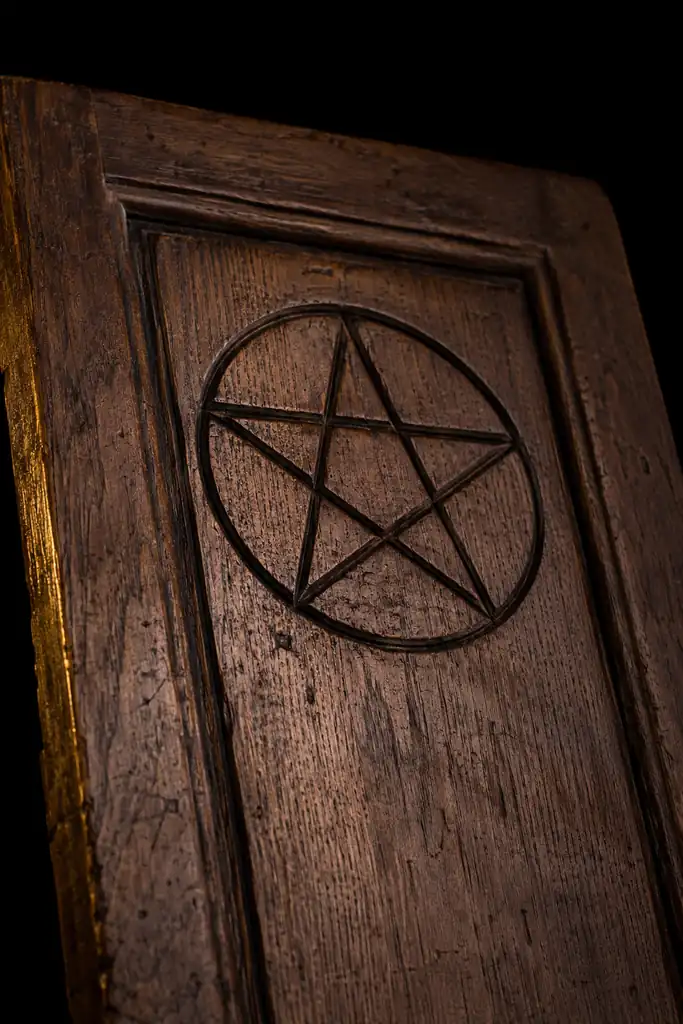
The Drudenfuss (the pentagram protective sign) is one of the best-known protective signs in German-speaking folk belief. It is a five-pointed star pattern that can be drawn in a single stroke, without lifting the pen.
This property, the closed line, was regarded in tradition as essential to its warding power: such a sign has neither beginning nor end and therefore, according to the belief, leaves no entrance open.
The term “Drudenfuss” refers to the Drude, a nocturnal pressing being of Alpine and Bavarian-Austrian folk belief. Related signs and similar ideas are, however, found far beyond this region, in late antique philosophy as well as in the Arabic tradition of the Middle Ages.
This page places the sign in its folkloristic context.
It gives no guarantee of protection, but describes what cultures have attributed to it. If you are looking for an overview of related signs, you will find it on the overview page Protective Symbols; the Protection Compass assigns the Drudenfuss to the beings against which it was used according to tradition.
Quick overview
In tradition, the Drudenfuss is regarded as an apotropaic sign: it is said to prevent Druden, elves and other nocturnal influences from entering a house or sleeping place. The sign is scratched or painted as a single closed line on doors, window frames and implements.
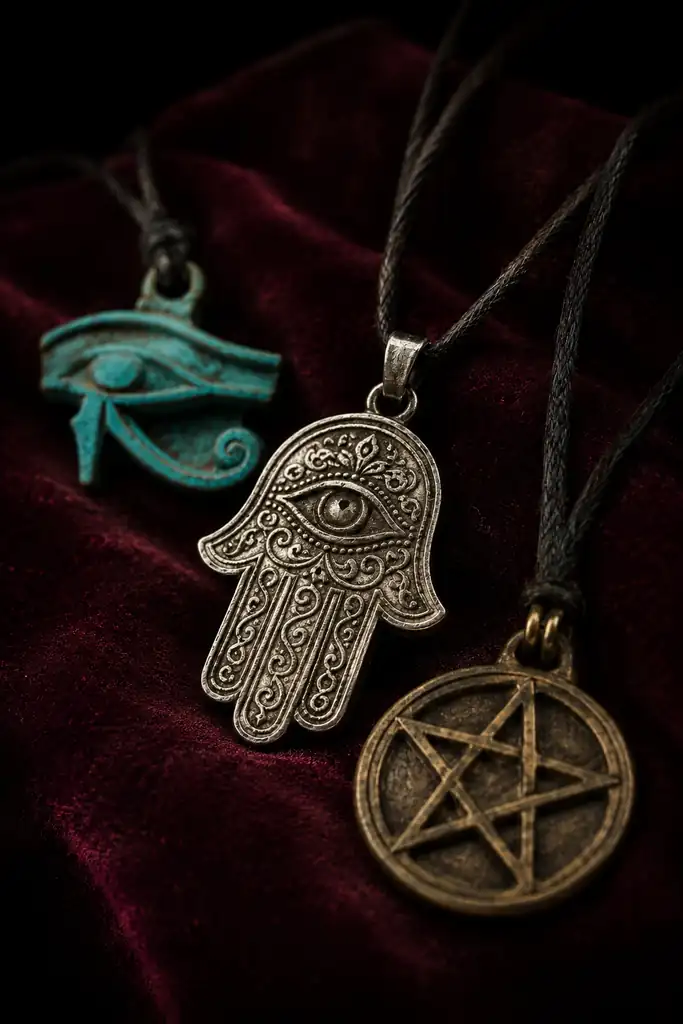
Outside the German-speaking world, the same geometric symbol is known as the pentagram and was, for example in the Pythagorean tradition, a sign of recognition among the like-minded, to which protective properties were attributed at the same time.
In the folk belief of the late Middle Ages and the early modern period, the Drudenfuss was so widespread in the southern German and Austrian region that it appears on tavern signs, chest fronts and house beams.
Origin and tradition
The oldest evidence for the five-star pattern as a deliberate sign comes from the Mesopotamian region, where it occurs on ceramics and clay tablets. A warding or protective meaning cannot, however, be clearly demonstrated there; the signs had a more classificatory character.
In the Greek cultural sphere, the Pythagorean school adopted the pentagram as a sign of recognition. Late sources of Neoplatonism interpreted it as a symbol of harmony and health; the term “Hygieia” was occasionally inscribed in the points.
From this learned tradition, the sign entered the European intellectual horizon through Arabic tradition and medieval scholastic philosophy.
In German-speaking folk belief, the name “Drudenfuss” is attested since the late Middle Ages. The Drude, sometimes also written “Trude”, is a being that according to tradition lies on the chest of sleeping people at night and constricts their breath, thus producing that oppressive sensation which today corresponds to the sleep phenomenon of sleep paralysis.
The imprint of this being’s foot was said to leave the five-pointed pattern, hence the name.
Johann Wolfgang von Goethe’s “Faust” contains the well-known scene in which Mephistopheles gets caught at the pentagram in the doorframe, which shows how alive this idea still was in the early 19th century. The sign on the threshold or the doorpost was regarded as a barrier for beings that tried to enter.
Working principle according to tradition
Tradition explains the effect of the Drudenfuss in two closely related ways. First, the unbroken, closed line is regarded as the key: a being that approaches such a sign is compelled to follow the course of the line without finding a way out, and is thus bound or distracted until the night ends.
Second, the sign is understood as a threshold barrier that physically prevents a being from crossing the doorstep.
Both explanatory models assume that certain beings react to geometric forms and must participate in their rules.
This idea is found in a very similar form in the circle of protection, which as a drawn line secures the inner space. The difference: the Drudenfuss is a permanent sign in fixed places, not a situational ritual.
In the learned magic of the Middle Ages and the early modern period, the pentagram was used as a binding means for spirits: whoever drew it in the correct proportions and inscribed it with the name of the being to be bound was supposed to be able to confine that being within the sign.
This learned tradition is to be distinguished from the popular practice of house protection, but it shares the basic principle of the binding closed form.
Cross-cultural spread
The five-pointed star pattern occurs in numerous cultures, without direct adoption always being demonstrable. In Ethiopian Christianity, the sign appears as the “Seal of Solomon” on amulets and parchments intended to protect against demons and the evil eye.
In the Islamic tradition of the Middle Ages, it is found as one of the seals in Arabic magical texts. In the European Middle Ages, it was widely used both in popular warding practice and in learned magic.
The tradition of the Cherokee and other North American cultures knows its own five-pointed patterns, but there a connection with the European Drudenfuss cannot be established; these are independent developments.
The Drudenfuss as a house sign is especially well attested in the southern German, Austrian and Swiss region. Further north, other protective signs predominate, such as runes or the so-called “witch’s cross”.
In England there is a related term, “witch’s foot”, and in the building archaeology there pentagrams occur as scratched signs on doorposts and mantelpieces.
What it is used against
In popular tradition, the Drudenfuss is primarily directed against Druden: nocturnal pressing beings that lie on the sleeping person, paralyse and torment them. The same category includes the Alp, known in northern German and Scandinavian folk belief as “Mahr” or “Mare”, and other beings that act during sleep.
In addition, the sign is used in tradition against:
- Witches and persons skilled in sorcery, who were said to be able to pass through closed doors or to harm livestock and stores.
- Ghosts and revenants, which were regarded as bound to certain paths or thresholds.
- General harmful influences from outside on the house, stable and sleeping place, without a precise kind of being being named.
In the learned magic of the 16th to 18th centuries, the use expanded to the binding and banishing of demons in the sense of the devil books and conjuration manuals of that time. This practice differs considerably from the simple tradition of house protection, but it shows how broadly the sign was used.
Application and limits
The popular application was simple and lasting: the Drudenfuss was scratched into beams or doorposts, painted on cowshed walls or applied to implements such as chests and butter moulds.
According to tradition, it was crucial that the sign be executed in a single stroke and without lifting the drawing tool, for only in this way did the closed line arise without interruption.
Placed on the threshold or the windowsill, it was meant to block the entrance. Drawn in the bedroom on the floor or on a sheet of paper under the bed, it was meant to protect the resting person.
The tradition itself knows limits: an incompletely drawn Drudenfuss, in which the line was interrupted, was considered ineffective or even an invitation, because it left the being an entrance. The poor condition of an engraved sign, for example through weathering or abrasion, was also regarded as a possible weakening of the warding effect.
Historically, it should also be borne in mind that signs of this kind were used above all in combination with other measures: herbs at the threshold, consecrated objects, prayer formulas. The Drudenfuss was rarely the only means, but rather part of a more comprehensive protective practice.
Literature (selection)
Related key terms: drudenfuss pentagram drudenstein alp warding.
iWell Guard and protective traditions
Cultures on different continents have observed independently of one another that certain geometric forms and signs are experienced as a boundary between the protected and the threatening. The Drudenfuss represents the European heritage of this practice: a permanent sign anchored at the threshold that marks the wearer’s sphere of influence.
The iWell Guard takes up this principle on a different level: as a worn sign that condenses this protective tradition and makes the person themselves into a threshold.
If you would like to learn more about how different cultures have developed their protective traditions and how the Protection Compass brings them together, you will find an introduction at /en/protection-compass/.
Personal experiences may vary. Not a medical device. No promise of healing.