Protective Runes: Runes and Runic Inscriptions as Protective Signs
By Ralf Ittermann · last reviewed on
Runes were first of all a script. Yet in the Germanic world individual runes and runic inscriptions also served the purpose of protection. Carved runic amulets and protective formulas attest to this use. A single rune with an averting meaning is today often called a protective rune. In the Germanic world, runes could serve as apotropaic signs against harm.
Classification
Runes are the script characters of the Germanic peoples. Over many centuries, inscriptions were cut with them in stone, wood, bone and metal.
In the first place, the runes were a script. With them, names were recorded, objects were marked, messages were conveyed, and the deceased were honoured on stones. This writing function is the foundation of everything further.
Beyond mere writing, however, runes could also serve as protective signs. Individual runes, runic sequences and entire runic inscriptions were associated with a protective effect.
This page treats the runes from this point of view, as protective signs. A careful distinction is important here, for what is actually attested and what only the modern era has added are not the same thing.
In scholarship, the runes are a well-studied field, but also one that has been heavily overlaid with myth. A precise account separates the findings that are secured archaeologically and linguistically from the modern interpretations.
The protective runes are thus an example of how important this distinction is. There are genuine runic protective inscriptions, and there is a modern system that assigns a fixed meaning to every rune. The two must be distinguished.
The Runes as a Script
The runes arose in the first centuries of our era. They were probably developed under the influence of the scripts of the Mediterranean region and adapted to the Germanic languages.
The oldest runic row is called the Elder Futhark. The name derives from the sound values of the first runes. This runic row comprises twenty-four characters.
Over the course of time the runes changed. In Scandinavia a shorter runic row arose, the Younger Futhark, which was used in the Viking Age. In England and in other regions, distinct, expanded runic rows arose.
The runes were scratched and cut into hard materials. Their angular, straight form is well suited to this technique. Curved lines are largely absent, for straight strokes are more easily cut into wood and stone.
The runes were used for quite varied purposes. On the great rune stones of Scandinavia the deceased were commemorated. On objects the owner or the maker was named. There were short messages and simple communications.
The runes were thus first and foremost a script of everyday life and of remembrance. This writing function is the secured foundation. Only upon it does everything that can be said about runes as protective signs build.
Runes as Protective Signs
Alongside the writing function there is evidence that runes were also used as protective signs. This use is genuine and attested by finds.
Objects have survived that bear runic inscriptions whose content is protective or invocatory. Such inscriptions call upon protection, turn against misfortune, or contain formulas to which a power was ascribed.
Well known is a short runic sequence that appears on several finds and has been much discussed in scholarship. It is associated with the sphere of protection and aversion, even though its precise meaning is debated.
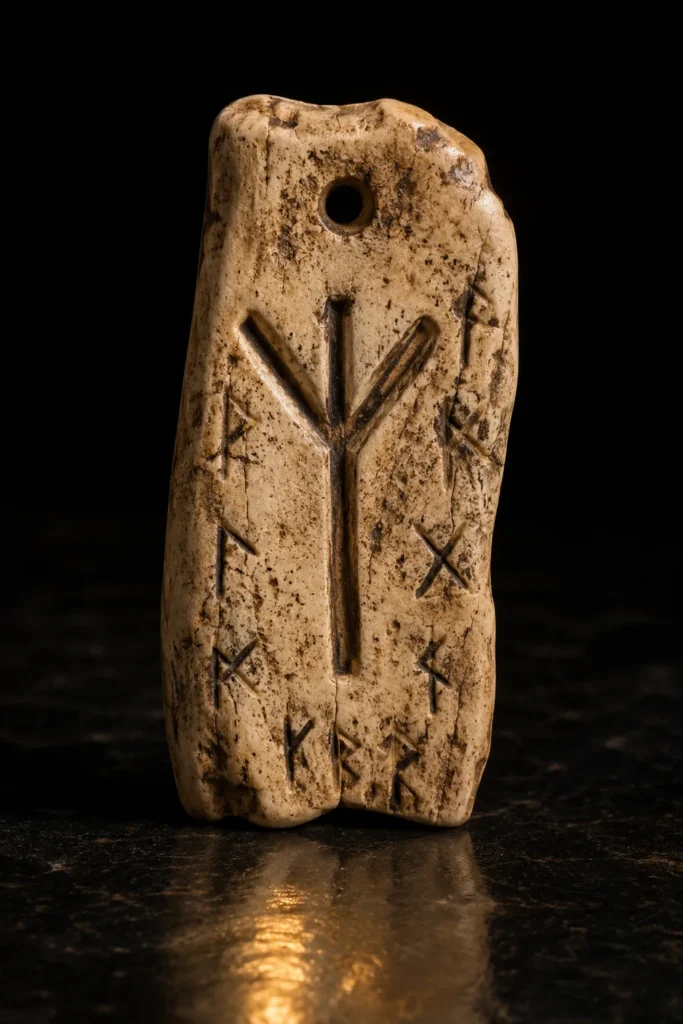
Runic inscriptions on amulets are also attested. Small pendants and metal sheets with runes were worn, and their content points to a protective intent.
These findings show that the runes were not merely a sober script. In the conception of the Germanic world, an effect could attach to the written word. An inscription could be more than mere communication.
It is therefore secured that runes were used as protective signs. This use rests on the general conception of the efficacy of the written word, a conception that other cultures also know.
The Algiz Rune
In the present-day picture, one particular rune is regarded as the protective rune par excellence. It is the rune called Algiz or Elhaz in scholarship. It has the form of an upward-pointing, splayed sign.
In modern presentations the Algiz rune is almost universally ascribed the meaning of protection. It appears as the rune of aversion, of the shield and of preservation.
Here, however, caution is warranted. The old rune poems, which hand down mnemonic verses for some runes, do not readily assign the meaning of protection to this rune. The transmitted verses speak of other things.
The fixed assignment of the Algiz rune to protection is thus to a large extent a modern interpretation. It became established only in the more recent engagement with the runes.
This does not mean that the assignment is meaningless. The upright, splayed form of the rune can well be read as an averting sign. Yet it is a later interpretation, not a secured ancient meaning.
The Algiz rune is thus a good example of the difference between evidence and interpretation. That it is regarded today as a protective rune is a modern fixing that is not unambiguously supported by the older sources.
Runic Amulets
Among the protective runes belong the runic amulets. These are worn objects that bear runes and to which a protective effect was ascribed.
Such amulets are attested by finds. There are small pendants, metal sheets and objects of bone or wood into which runes are cut. A portion of these runic inscriptions is of a protective or invocatory nature.
The runic amulets were worn on the body. In this they followed the same basic idea as the written talismans of other cultures, such as the Islamic Taʿwīz or the Jewish protective amulets with script characters.
The golden bracteates of the Migration Period too, which were worn as pendants, frequently bear runic inscriptions. On the page about the bracteate this connection of gold pendant and runic inscription is presented in more detail.
The runic amulets show that the written runic word was regarded as effective in the Germanic world. A word cut onto a worn object was meant to accompany and preserve its bearer.
The runic amulets thus belong among the well-attested protective objects of the Germanic world. They are not a product of modern interpretation but are secured by finds.
Evidence and Modern Interpretation
With the protective runes, the distinction between evidence and interpretation is particularly important. In the present-day picture the two areas are often mixed, yet they can be clearly separated.
The secured evidence comprises two things. First, the runes were a script. Second, there is genuine proof that runes and runic inscriptions were also used protectively, for example on amulets.
To be distinguished from this is the modern system that ascribes a fixed meaning to every single rune. In this system every rune has a name, a meaning, and often an assignment to areas of life.
This system is to a large extent a creation of the nineteenth and twentieth centuries. It draws on the old rune names and on the rune poems, but in its completeness it goes far beyond what the old sources yield.
This does not mean that this modern system is worthless. It is meaningful for many people and belongs to the present of the runes. It should not, however, be passed off as secured ancient knowledge.
An honest account of the protective runes therefore keeps both levels apart. It names the genuine evidence, and it marks the modern interpretation as what it is, as a modern elaboration.
Runes and the Effective Word
The use of runes as protective signs rests on a general idea, the idea of the effective word. This idea is not confined to the Germanic world.
In very many cultures the written or spoken word was regarded as effective. A name, a formula or a saying could, according to this conception, be more than mere communication. They could unfold an effect.
From this idea grew the written talismans of many cultures. The Islamic Taʿwīz bears Quran verses, the Korean Bujeok bears signs, kabbalistic amulets bear names of God. The runic amulet belongs to this worldwide family.
The runes were well suited to this use. They were the script of the Germanic world, and their angular form could easily be cut into durable materials. A runic word could thus be firmly bound to an object.
Protection through runes is therefore a particular form of a widespread basic pattern. What is particular lies in the writing system, in the runes themselves, not in the basic idea of the effective word.
The protective runes thus join the large group of written talismans. They show that the Germanic world too knew and used the written word as a means of protection.
Runes and Their Appropriation
In presenting the runes, a further point must be named. In recent history the runes have repeatedly been appropriated and misused for purposes that have nothing to do with their original meaning.
In the nineteenth and twentieth centuries runes were taken up by völkisch and later by National Socialist movements. Individual runes were made into signs of these movements and have thereby become tainted.
This appropriation is a late and extraneous development. It has nothing in common with the Germanic script and with the genuine runic protective inscriptions. It is a misuse of the signs.
A factual account of the runes must name this point. The runes are an ancient script with a long, venerable history. Their misuse by certain movements does not belong to this history but is a later distortion.
Anyone engaging with runes should be aware of this tension. The individual runes are tainted to differing degrees, and a mindful approach knows this history.
The runes in their actual nature remain untouched by this. They are the script of the Germanic peoples and a testimony to their culture. As such, and as genuine protective signs of their time, they are presented here.
Present-Day Reception
The runes are today widely known and are used in many ways. They appear as jewellery, as tattoos and as a motif in design. Individual runes in particular, among them the Algiz rune, are worn as protective signs.
In modern pagan movements that invoke the Germanic religion, the runes have a firm place. There they are used as a script, as signs, and as a means of interpretation.
Also widespread is the modern system that ascribes a fixed meaning to every rune and uses them for casting and interpreting. This system is, as set out, a modern elaboration.
In all this use, the distinction that this page emphasises is important. The runes were a genuine script, and they were genuinely used as protective signs. The modern system of meanings is to be kept separate from this.
Equally important is the knowledge of the appropriation of the runes by tainted movements. A mindful approach to runes knows this history and names it.
The runes thus remain a many-layered subject. They are a venerable ancient script, they were genuine protective signs of their time, and they are at the same time an example of how carefully one must distinguish, with ancient signs, between evidence, interpretation and misuse.
Anyone who today speaks of a protective rune almost always means a single runic sign worn as a pendant or as a tattoo. In the great majority of cases the Algiz rune is meant, which has established itself in the modern understanding as the protective rune par excellence.
References (selection)
Related key terms: protective rune protective runes runes Algiz Futhark runic amulet runic inscription effective word Germanic.
iWell Guard and Protective Traditions
iWell Guard stands in the cultural-historical line of portable protective objects, to which the protective runes also belong. A modern companion for people who live with protective symbols: made in Germany, 41 layers of solid gold, platinum and silver, with a 30-day return right.
Personal experiences may vary. Not a medical device. No healing promise.