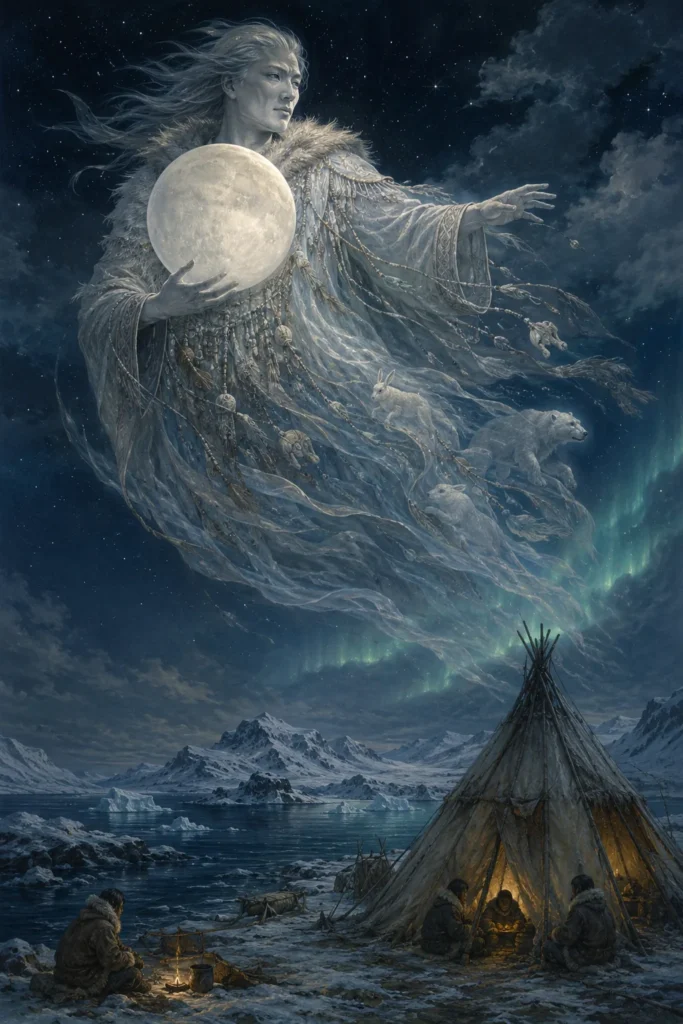
The Inuit population, from Siberia (Yupik) across Alaska, Canada and Greenland to Labrador, developed a religious tradition in which the sea, the animals of the hunt and the spirit world of the deceased structure daily life.
Sedna as mistress of the sea animals, the Angakkuq (shamans) as ritual specialists and portable protective objects made of bone, stone and walrus ivory shape the religious inventory of this circumpolar culture.
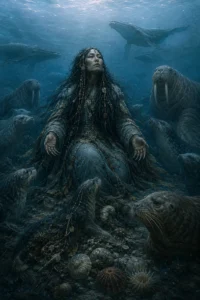
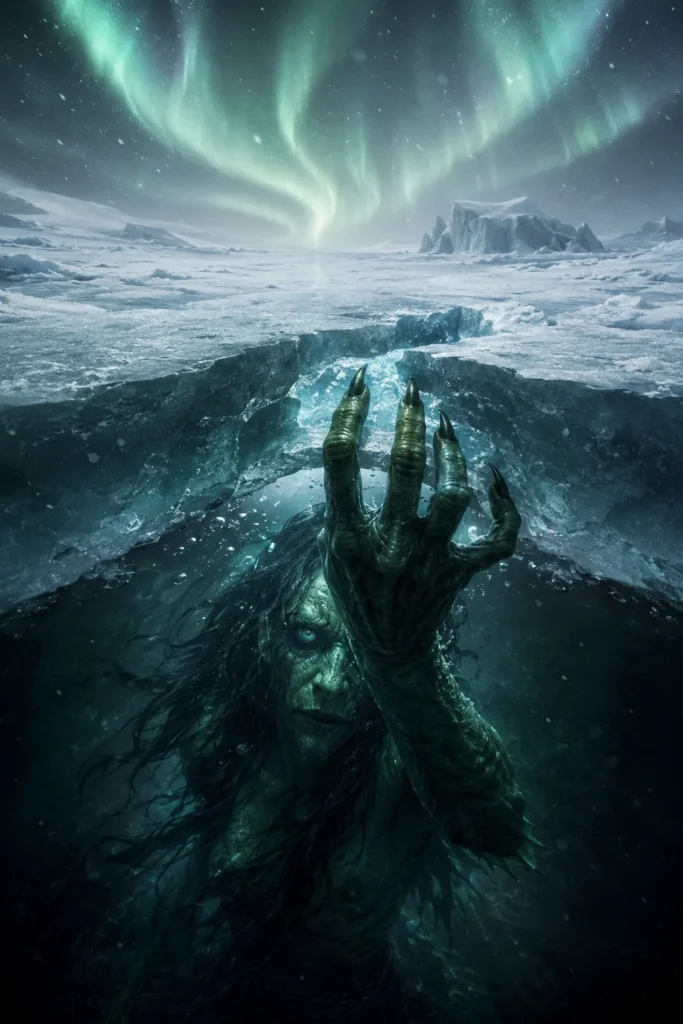
Sedna (also Nuliajuk, Takannakapsaluk, Arnapkapfaaluk) is the central deity of the circumpolar Inuit religion. In the most concise myth she is a young woman who, set adrift in a boat by her father, clings to the edge of the boat; he cuts off her fingers; from these arise seals, walruses and whales.
She sinks to the bottom of the sea and rules there as mistress over all the animals of the hunt. When the hunt fails, her hair is tangled through taboo violations of the people, and the shaman must descend to her and comb her hair.
Sila is the all-encompassing principle of breath, weather and consciousness, a quasi-deistic entity without clear personification, comparable to the Chinese Dao or the Polynesian Mana. Tornit (singular: Tornarssuk) are powerful helper spirits, often with animal or half-animal form.
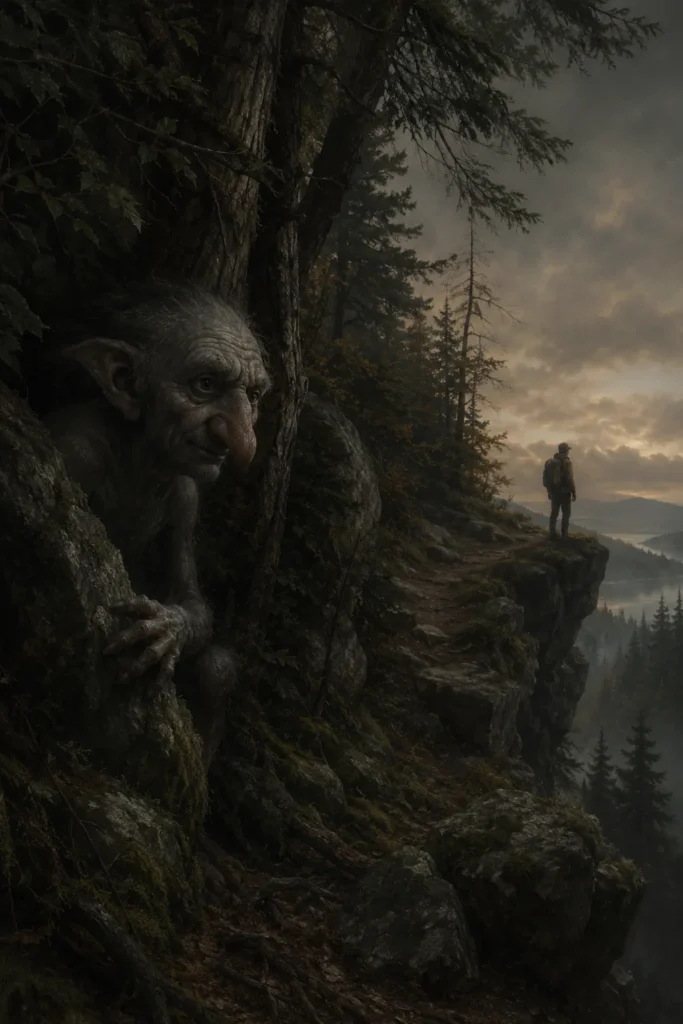
Tunit are the mythical ancestor giants who inhabited the land before the present-day Inuit. The dead live on in two heavens and one underworld; the heaven is reserved for those who died heroically, the underworld for natural deaths.
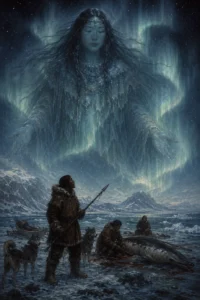
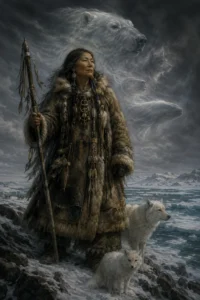
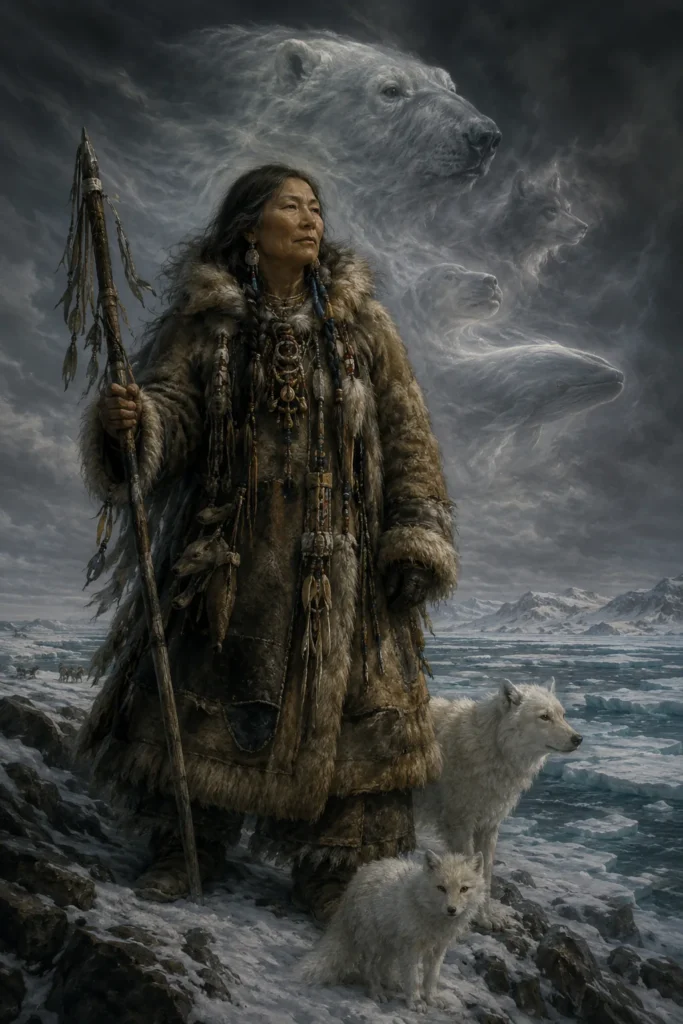
The Angakkuq (plural: Angakkut) is the religious specialist of the Inuit. His initiation involves a spirit quest in the tundra, an encounter with helpers and the acquisition of an inner strength (Qaumaneq). He acts as healer, weather forecaster and mediator to the spirit world.
Trance journeys often take place in animal company: polar bear, wolf, eagle. The drum (Qilaut) is his central instrument, often plainly made of driftwood and seal leather. Female shamans are also attested in the tradition.
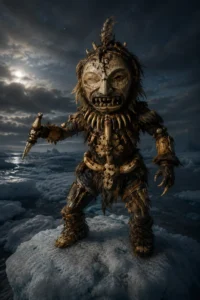
Tupilak are originally spirit constructs, animated beings that a shaman sent out in an act of attack or protection. In the East Greenlandic tradition they were also depicted as carved figures made of walrus ivory, whale bone or caribou antler.
Today tupilak carvings are popular internationally as souvenirs and carry a religious-traditional background. Alongside these there are portable amulets made of animal teeth, bone and stone, often worked with symbolic animals (bear, whale).
Inukshuk (plural: Inuksuit) are anthropomorphic stone constructions that serve as markers in the Arctic land: paths, caribou corridors, fishing places, hiding spots. Etymologically, in the form of a person.
They are not gods themselves, but part of the religious and practical relationship with the land. The inukshuk is today the emblem of Nunavut and the symbol of the 2010 Olympic Games in Vancouver.
Inuit religion is strongly structured by taboo: certain animals may not be eaten together, women during menstruation and after childbirth are subject to restrictions, and land and sea hunting are ritually kept separate. Violations lead to disturbances of Sila and to the wrath of Sedna.
The festival following a successful hunt (especially in whale and polar-bear catches) is a great ritual with drum, song and the sharing of food. Remains of the animals, above all the bladders and jaws, are returned to the sea so that the animal can be reborn.
From the 18th century onward (Greenland, Danish mission) and in the 19th and 20th centuries (Canada, Alaska), the Inuit were largely Christianized (Lutheran in Greenland, Anglican and Roman Catholic in Canada, Russian Orthodox in Alaska). Shamanism was in part forcibly suppressed.
Today a cultural and religious revitalization is taking place, with its own throat-singing tradition and a renaissance of jewelry and carving. Important works of religious studies: Knud Rasmussen, Across Arctic America; Daniel Merkur, Becoming Half Hidden; Ann Fienup-Riordan.
The Inuit inhabit an enormous, sparsely populated region that stretches from East Greenland across the Canadian Arctic to Alaska and the Bering Strait. Across this vast area there is a related language family and similar ways of life, but no uniform religion.
The regional traditions of the Greenlandic Inuit, of Canadian groups such as the Iglulik or Netsilik, and of the Alaskan Yupik and Iñupiat differ considerably in the names of gods, in rituals and in narratives.
The older literature often used the term Eskimo, which today is regarded as derogatory in Canada and Greenland and is replaced by Inuit, while in Alaska Yupik and Iñupiat are in part still in use as self-designations. This terminological question is not merely linguistic but touches the self-understanding of the communities.
Despite the diversity, some widespread basic features can be identified. Among them is the idea that animals and natural forces possess an inner side of their own, a kind of person whom one must meet with respect.
Among them is the importance of prohibitions and commandments that regulate dealings with the hunt, birth and death. And among them is the figure of a person who can commune with the spirits, called angakkoq in the Greenlandic area. How these elements were concretely shaped, however, must be distinguished from region to region.
At the center of Inuit religious conceptions stands the relationship between humans and the animals on which survival in the Arctic depends. The widespread assumption was that animals give themselves up to the hunters voluntarily, provided they are treated with respect.
From this assumption arose a dense web of commandments. Certain activities were not allowed to be mixed, for instance the processing of land animals and sea animals, and bones and remains had to be treated in a prescribed way.
If these rules were violated, so the conception went, the animals withdrew and hunger threatened. In many regions, above all in the central Canadian area, it was the task of a mistress of the sea animals to watch over the seals and whales.
This figure, often called Sedna, though under various names, lived at the bottom of the sea. When people broke rules, the transgressions became entangled in her hair, and the animals stayed away. Then an angakkoq had to descend to her in a spirit journey, set her hair in order and reconcile her.
The human being itself was in many cases regarded as composed of several soul components, among them a life component and a name component. The name of a deceased person was often given to a newborn child, which thereby received a connection to the deceased person.
These conceptions vary regionally, but consistently show a worldview in which human, animal and spirit world were not separated but joined in an ever-endangered balance.

The religion of the Inuit was oral. Knowledge lived in narratives, songs, incantation formulas and in practical instruction by elders. There was no writing of its own; in Greenland a written form of the language first emerged with the Danish mission in the eighteenth century, in Canada later the syllabic script.
The most important systematic record of the traditional conceptions comes from the Fifth Thule Expedition of 1921 to 1924 under Knud Rasmussen. Rasmussen, himself raised in Greenland and fluent in the language, traveled through the Canadian Arctic and recorded narratives, songs and statements of individual angakkut, among them the much-cited Aua.
His volumes remain to this day a central source, but must be read critically, because at that time mission and social change had already strongly altered the old traditions. Rasmussen often documented a religion in transition.
Older sources are the reports of Danish missionaries in Greenland such as Hans Egede, as well as the records of whalers and research travelers. These are often fragmentary and shaped by a missionary or curious outside perspective.
For the Alaskan Yupik and Iñupiat there are separate, later ethnographic collections. Present-day research places great value on incorporating the knowledge preserved within the communities themselves and on not treating the colonial sources as neutral reports.
The Christianization of the Inuit proceeded differently by region, but was everywhere far-reaching. In Greenland the Danish mission began in the eighteenth century; in the Canadian Arctic Anglican and Catholic missionaries arrived above all in the nineteenth and early twentieth centuries; in Alaska Russian Orthodox and later Protestant missions were active.
The angakkut were in many places pressured to give up their practice, and the old rituals fell into disrepute or were forbidden.
The consequences were a far-reaching break in the public exercise of the traditional religion. Today most Inuit are Christians of various denominations.
At the same time, elements of the older worldview were preserved, for instance in narratives, in conceptions about the treatment of animals and in the practice of naming. In some communities, conceptions about spirits and about prohibitions surrounding the hunt lived on even beneath a Christian surface.
Since the late twentieth century there has been a growing interest in the communities’ own cultural tradition. Inuit organizations, schools and researchers from the communities themselves collect narratives, document languages and convey traditional knowledge, often under the term Inuit Qaujimajatuqangit, which designates the transmitted knowledge of the Inuit.
This is less a religious revival in the narrower sense than a cultural self-affirmation. A serious account therefore describes the present situation as Christian in character, with surviving older conceptions and a conscious cultivation of the cultural heritage, and avoids the image of an old religion still practiced unbroken.


Related key terms: Inuit Yupik Sedna Sila Tornit Tunit Angakkuq Iqaluit Greenland Tupilak Inukshuk.
The Arctic Inuit tradition knows tupilak carved figures of walrus ivory or whale bone, portable amulets of animal teeth and stone, as well as Inuksuit as land markers; each family has its own protective objects with a personal history.
iWell Guard fits into this cultural-historical line of portable protective objects, in a contemporary material architecture, manufactured in Germany. 41 layers, solid gold, platinum, silver. 30-day right of return.
Personal experiences may vary. Not a medical device. No promise of healing.