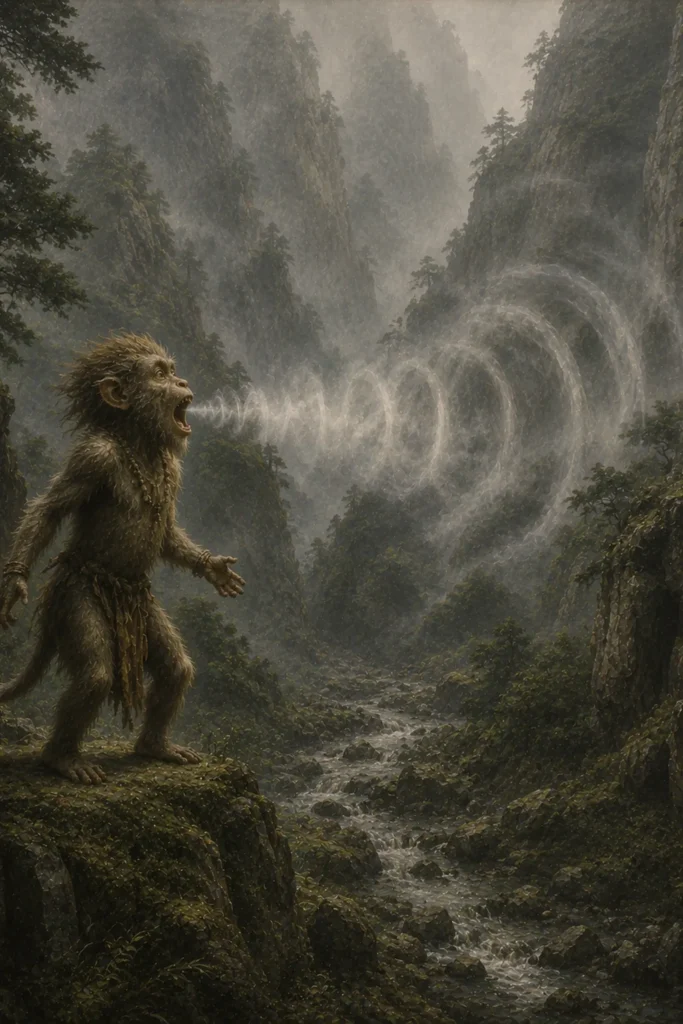
In the conception of the central Arctic Inuit, Sila is not a personal god in the narrower sense, but the ordering principle of air, weather, breath and understanding.
Whoever knows Sila knows the weather, thought and the order of the world all at once, for the Inuit language captures these spheres in a single term. In terms of religious studies, Sila is one of the conceptually deepest terms in the entire circumpolar history of religion.
In the classification of religious studies, Sila belongs to the rare terms that denote a cosmological, meteorological and epistemic principle at the same time.
Knud Rasmussen, who opened up the term in his records of the Fifth Thule Expedition as a religious key to the central Arctic Inuit, rendered it as world reason, while other authors such as Daniel Merkur and Frederic Laugrand speak of the world-breath.
This range of translations is not an expression of vagueness, but corresponds to the semantic depth of the word itself, which has no direct equivalent in Western vocabulary.
Unlike Sedna, Sila is not embedded in a narrative biography. Sila has no finger joints, no boat, no father, no suitors. Sila is the invisible, all-pervading condition within which animals and humans move.
For precisely this reason, the Inuit regard the weather as the manifestation of a thoughtful, observing, sometimes punishing agency. The mediation between human and world does not occur through the representation of a god, but through the breathing of the world itself.
This dual character as weather and as reason makes Sila a bridging concept between the perception of nature and religious reflection. The present-day climate debate has taken up the term: when Inuit elders say that Sila has changed, this means not only the weather, but a world order in crisis.
This contemporary relevance makes Sila perhaps the most living term in the Inuit history of religion and distinguishes it from the purely historical concepts of other religions.
The word sila is attested in almost identical form throughout the entire Inuit language area from Chukotka to Greenland, which points to the great depth of the conception. Its meanings include: the weather outside, the outer world, the sky, the understanding, reason, prudence, the correct assessment of a situation.
Derived from this, silatujuq denotes a clever, wise person, literally one who possesses Sila. This word formation is central in the phenomenology of religion, because it shows that cleverness is not primarily a cognitive achievement, but a possession of Sila.
That the same root carries both meteorological and intellectual meaning is no accident in terms of linguistic history. Religious studies sees in this an indigenous epistemology in which the correct assessment of the environment and right thinking form a unity.
Whoever cannot read the weather is not clever, and conversely: whoever is not clever overlooks the signs of the weather. In the phenomenology of religion, this interlocking is an independent phenomenon without direct parallel in European languages.
In religious usage, the compound expression sila inua additionally occurs, literally the person of Sila or the man of the weather. This denotes a quasi-personal agency that can be addressed in shamanic discourse, without thereby a fully developed deity figure arising.
This suspension between principle and person is especially instructive in religious studies and corresponds to a kind of modal theology: depending on the context, Sila is addressed in a more or less personalized way.
The oldest and densest descriptions of Sila come from Rasmussen’s conversations with the Iglulik shamans Aua, Ivaluardjuk and Kibkarjuk in the 1920s. Aua explained to Rasmussen that Sila was a power whose voice was so soft that only children heard it, and whose message, when it made itself known, could turn into storm, driving snow and hunger.
This statement has become a classic passage in the standard repertoire of religious studies on Arctic religion.
Sila was accordingly in every respect both the surrounding weather and the watchful agency that registers human behavior. Another Iglulik shaman said: the dead and the sun and the moon, they all belong to Sila, for everything that happens is Sila.
From this, Merkur concludes that Sila is, in Iglulik theology, a kind of monistic background principle that encompasses the personal deities without absorbing them. This interpretation is contested in religious studies, but it has gained considerable influence in subsequent research.
In Greenland, Hinrich Rink transmits the term in the form silap inua, in the central Canadian tundra sila, among the Mackenzie Inuit partly hila. Despite dialectal variation, the religious function is consistent throughout.
The stability of the term across thousands of kilometers is remarkable in religious studies and points to a very old conceptual layer that probably goes back to the Proto-Eskimo-Aleut stage of the language and could thus be several millennia old.
In everyday Arctic life, Sila as weather decides over life and death. A sudden whiteout, blizzards, the breaking up of the sea ice are not random natural events, but the expression of an agency that responds to human behavior.
In religious studies, this is not animism in the classical sense, but an ecological theology in which the weather is regarded as an entity addressable as a person. This difference from the animism of older research definitions is analytically important.
Cosmologically, in some Iglulik statements Sila is described as the former giant who, after his death, was spread out over the world and whose breath now moves the wind. Other narratives know Sila only as the surrounding element, without genealogical story.
In religious studies, this variation is not a contradiction, but a reflection of the fact that Inuit religion is not a dogmatic system but lives in oral tradition and configures itself depending on context.
Important is the interlocking with other agencies. Sila stands alongside Sedna as mistress of the sea animals, alongside Igaluk the moon, and alongside Pinga, who watches over the land animals. Power is distributed; Sila forms the all-encompassing framework.
In the phenomenology of religion, this distribution is a pattern in its own right and makes Inuit religion a theology of relationship rather than of hierarchy. The world of the gods is organized not pyramidally, but as a network.
The semantic double meaning makes Sila an ethical entity. Whoever violates pittailiniq, the taboos, will lose the animals, and will lose their Sila as well, that is, become unwise, misjudge the weather, get lost, freeze to death.
Errors of understanding and misfortune of weather are thus two forms of appearance of the same violation of the world order. This interlocking is profound in religious studies, because it shows that Inuit ethics functions not through categories of guilt, but through categories of prudence.
Among the Iglulik, Rasmussen reports a concept that he describes as Inuit stoicism: the right attitude in the storm is not desperate resistance, but patient, clear, Sila-conforming endurance. Whoever passes through the weather without losing Sila will not freeze to death.
The discipline of mastering the affects is, in religious terms, a form of devotion to Sila. This control of affect has found considerable room for discussion in ethnopsychological research.
This connection between weather, understanding and ethical self-discipline received considerable attention in the philosophy of religion of the second half of the twentieth century, for instance in the works of Merkur and the discussion of Arctic spirit ecology in Tim Ingold.
The structural proximity to ancient Stoic ethics is striking, but it should not lead to premature identification, since the cultural-historical contexts are different and Inuit ethics arose from a different historical situation.
The angakkuit, the shamans, had alongside the journey to Sedna a second task, less dramatic but closer to everyday life: to calm the weather or to move it. This practice was addressed to Sila.
With a storm threatening, a shaman could enter into a trance and call upon Sila, sometimes by holding his breath, sometimes by striking the air with a whip of sealskin. These practices are documented less dramatically than the Sedna journeys, but in the everyday of religious practice they are equally significant.
Other practices consisted of drawing small images or reciting old words that were held to be forms of Sila. The attitude was what mattered: one did not ask Sila, one attuned oneself correctly to Sila.
The difference from a magical-instrumental incantation is decisive in religious studies and distinguishes Inuit practice from related Siberian traditions, in which weather conjuring was often shaped more concretely and manipulatively.
Apotropaically, the Inuit also worked with language. Certain words toward Sila were taboo, others had to be said. Whoever rebuked a child did not address it too harshly, because Sila might register this and then turn the weather against the one who rebuked.
This fine constellation shows how religious order, upbringing and weather regulation were interwoven. In religious studies, this is a paradigmatic case of a pervasive religiosity that is not confined to ritual islands.
In religious studies, Sila is distinctive because it is comparable neither with the Mediterranean Zeus type nor with the Indo-European thunder-god model.
It is more akin to the Chinese qi, the Stoic pneuma and the Polynesian mana, though specifically anchored in the Arctic in the weather dependence of the hunting society. This comparability is productive in the phenomenology of religion, but it should not result in premature constructions of universalism.
Within the circumpolar region, the closest parallel appears to be the Sami conception of Ilmaris or the Nenets Num, which likewise encompasses weather and sky as a monistic principle.
Here too the personalization is weak, while the reach of the term is great. This correspondence suggests an old circumpolar layer of religious concept formation whose exact history has not yet been worked out.
The bridge to European natural philosophy has been drawn several times. Hugh Brody and Tim Ingold have argued that Sila can be read as an indigenous variant of a broad concept of the atmospheric, which appears in Western phenomenology, for instance in Hermann Schmitz or Gernot Bohme.
The religious depth of Sila, however, points beyond any Western philosophy of atmosphere, because it is descriptive and, beyond that, relevant to action.
Since the 1990s, Sila has become the central term in the Inuit discourse on climate. Inuit elders, for instance in the reports of the Inuit Tapiriit Kanatami and the Inuit Circumpolar Council, describe climate change not primarily as a rise in temperature, but as the loss of the predictability of Sila.
The weather is becoming unpredictable, which at the same time means: it no longer fits the inherited reason.
In religious studies, this is remarkable, because a traditional religious term becomes the language of the ecological crisis, without issuing into a fundamentalist restitution.
The scholar Sheila Watt-Cloutier used Sila in The Right to Be Cold as a translational term for the climate debate in international law, thereby showing how indigenous religious concepts can become globally effective in political terms.
This contemporary relevance shows that Sila is not a past religious phenomenon, but a living, transforming term. The Inuit teaching of weather ethics here meets global scientific and political discourses, without losing its own depth.
In religious studies, this is a paradigmatic case of the activation of traditional terms for present-day global discourses, one with methodological significance far beyond the Inuit tradition.
The study of Sila passes through three phases. First, the polar explorers of the late nineteenth and early twentieth centuries documented the term fragmentarily (Boas, Rink, Birket-Smith).
Rasmussen provided the foundation in 1929 that remained unquestioned for decades. Daniel Merkur and Mircea Eliade built from it the religious-studies synthesis that was canonical for the second half of the twentieth century.
Since the 1990s, Frederic Laugrand and Jarich Oosten have devoted themselves to the more precise regional differentiation of the Sila concept. They show that Iglulik, Netsilik, Baffin and Greenland develop slightly different connotations, without the basic structure dissolving.
A fourth phase marks the ecological and political updating since the 2000s, in which Inuit authors themselves publish on Sila and thereby decisively change the state of research.
Within the Inuit cultural area itself, Sila has found its way into school and university education. The transmission of the concept to the younger generation is today part of a conscious preservation of language and knowledge that is accompanied by, but not replaced by, religious studies.
This doubling between indigenous knowledge community and academic research is a point in its own right in the phenomenology of religion and an example of the postcolonial reformatting of religious studies.
Whoever wishes to explore the interweaving of Sila with other agencies will find in the lexicon the entries on Sedna, Igaluk, Pinga, Tornarssuk, Nanook, Tupilak, Anguta, Malina and Qailertetang.
At a higher level, the culture hub Inuit tradition frames the religious topography of the central Arctic. Whoever wishes to understand Sila in the broader circumpolar comparison will find important parallels in the Sami concepts of weather and atmosphere, particularly in the Beaivi-Sara constellation.
The term Sila, attested in various spellings such as Silap Inua or Sila Inua, belongs to the conceptions of the Inuit traditions that resist Western categories of translation particularly stubbornly. The word covers a field of meaning that in German is distributed across several separate terms.
Sila can denote the outer world in the sense of weather and climate, it can mean the air and the sky, and it can at the same time mean understanding, reason or consciousness. A child who begins to become reasonable can be described with a phrase that contains Sila.
This breadth of meaning is not a deficiency of the language, but the expression of a different way of carving up the world. Sila connects the encompassing outside with the understanding inside. The conception of Silap Inua, the inua or owner of Sila, thinks this connection as a personal power.
Inua, often translated as owner or inhabitant, denotes in the Inuit traditions the indwelling person of a place, an animal or a phenomenon. Silap Inua is thus not simply a weather god in the European sense, but the personal inner side of the entire surrounding order.
Knud Rasmussen, who recorded conversations with shamans during the Fifth Thule Expedition, preserved several statements in which Sila appears as a great, intangible power that cannot be addressed in ordinary words and that expresses itself through the weather, through storm and through the behavior of the animals.
Rasmussen’s renderings are valuable, but they are translations of translations, mediated through interpreters and through his own search for a graspable theology. Some researchers suspect that the coherence with which Sila appears in some secondary literature as a high deity is partly an effect of this recording situation.
From this two things follow for a precise account. First, Sila should not be reduced prematurely to a weather god, for this would lose the connection to understanding and the order of life that is essential to the Inuit conception.
Second, with every statement about Sila the colonial mediation must be kept in mind. The sources are thin, hard to control in a single language, and colored by the collectors’ interest in an ordered religious system.

Related key terms: Sila Silap Inua World-breath Weather principle Inuit reason Pittailiniq Iglulik.
iWell Guard ties in with the cultural-historical tradition of portable protective objects, in the tradition of the Inuit and many other cultures worldwide. 41 layers, solid gold, platinum, silver, crafted in Germany. 30-day right of return.
Personal experiences may vary. Not a medical device. No promise of healing.
Against its influence, cross-cultural tradition names these protective means:
Compare in the Protection Compass →Recommended protective means
The simplest protective means in this collection: 41 layers of fine gold 999, platinum, silver and silicon, manufactured in Ruhla, Thuringia. It requires no activation, is bound to no person, and is effective within a radius of around 50 meters, even without being worn.
Related Beings

Phi Am, Thailand's chest-presser and spirit of sleep paralysis. An overview of origin, the weight...

Chir Batti, the ghost light of the Rann of Kutch salt desert. Origin, the modern sighting phenome...

The Trasgu, the Asturian household kobold with the hole in his hand. Origin, getting rid of him, ...

Hinkypunk, the one-legged will-o'-the-wisp from Somerset and Devon. Origin, its good and evil sid...

Jabmiidaibmu is the land of the dead in Sámi religion, the subterranean realm of the deceased. Ac...

Polevik, the field spirit of East Slavic tradition. Origin, appearance at the field's edge, the d...