Malina: Sun Goddess and Sister of the Moon in the Inuit Tradition
By Ralf Ittermann · last reviewed on
In the central Arctic Inuit tradition, Malina is the sun goddess, sister of the moon Igaluk, and protagonist of one of the central Inuit myths. Her flight from her brother explains the separation of day and night. Within the study of religion, she is always named in relation to the myth surrounding her brother Igaluk and not as an independent, self-standing deity.
Malina is the Inuit sun goddess and sister of the moon god Igaluk in Arctic mythology.
Classification and Short Profile
In the Inuit pantheon, Malina is the sun in personified female form.
From the perspective of the study of religion, it is notable that the Inuit tradition, like most circumpolar and northern European traditions, conceives of the sun as female and the moon as male, in contrast to many Mediterranean traditions in which the polarity is reversed.
This gender attribution is an important feature within the phenomenology of religion.
Malina is not an independent, self-standing deity, but is always named in relation to the myth surrounding her brother Igaluk.
Her flight into the sky and her permanent pursuit by Igaluk structure the daily cycle and thereby the basic order of time. This narrative binding to Igaluk is, within the phenomenology of religion, a distinct phenomenon in its own right.
Despite this narrative binding, Malina has her own ritual functions, above all in the sphere of the cold winter, whose end is marked by her return after the polar night.
Her religious significance is closely tied to the Arctic annual cycle and makes her a key figure in the cyclical conception of time among the Inuit.
The sun goddess Malina, who is always transmitted in relation to the myth surrounding her brother Igaluk, has been studied by more recent research using broadened methodological approaches that combine ethnographic precision, linguistic source criticism, and a comparative perspective.
Today the Inuit knowledge community itself is part of this research and corrects older Western attributions, some of them shaped by colonialism.
Further insight is provided by the sociological-of-religion question of Malina’s function in the social order of the traditional Inuit community.
Since her ritual significance was bound to the annual cycle, she shows that the religious structure was not separated from social practice but closely interwoven with it. This interweaving forms a distinct field of religious anthropology that Frédéric Laugrand and Jarich Oosten in particular have studied systematically.
Name and Etymology
The name Malina is most frequently attested in the West Greenlandic dialect. Etymologically it is not conclusively explained, but it may be related to the stem maliŋŋuq, which denotes pursuing. Within the study of religion this fits the narrative, in which the structure of pursuit is the central motif.
Other names for the sun in the Inuit languages are seqineq, siqiniq, or siqinniq. These names, however, denote primarily the celestial object, not the personified goddess.
The distinction is important within the study of religion: not every designation for the sun carries the theological figure of Malina. Methodological care in working with sources is decisive here.
In Iglulik the form Akycha or Malik appears, in East Greenland Naajaa. The regional variation corresponds to the general linguistic diversity of the Inuit world and should be taken into account in scholarly treatment within the study of religion. A systematic linguistic synthesis is still outstanding.
In comparative religious studies, Malina fits the pattern of circumpolar religious topography, which is preserved across thousands of kilometers in a remarkably consistent structure. This structural stability is, within the phenomenology of religion, among the most remarkable findings of the discipline and continues to be discussed to this day.
The Incest-Flight Myth
The core myth about Malina is identical to the Igaluk myth and was already described there. From Malina’s perspective it is a narrative of female self-assertion and of the creation of cosmic order through independent flight. This perspective is productive within the study of religion.
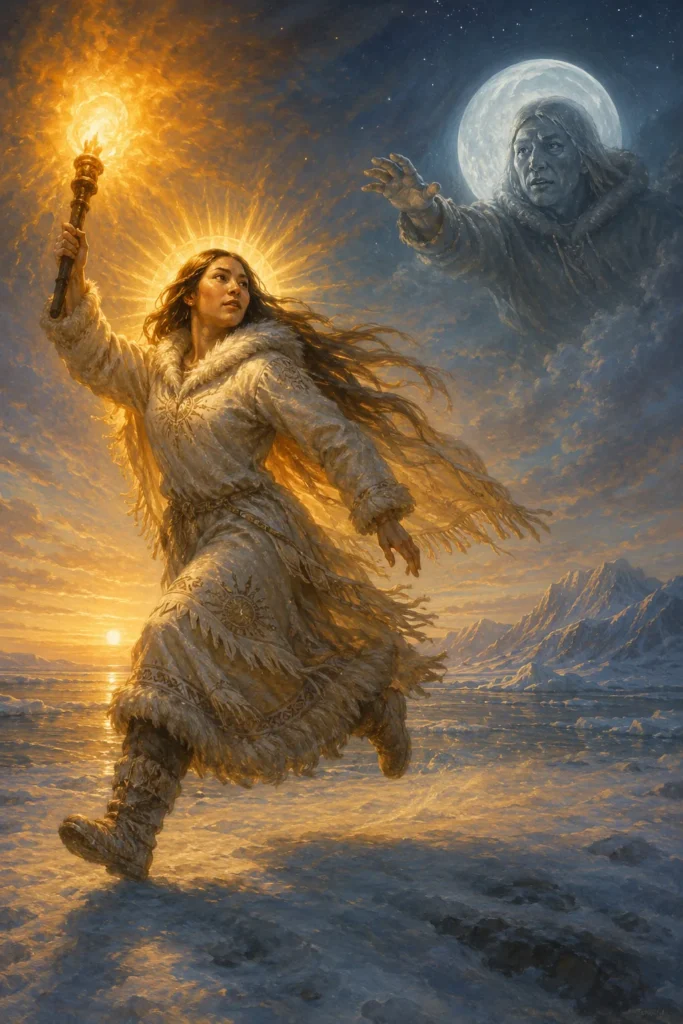
Malina marks her brother with soot, recognizes his identity, cuts off her breasts out of shame, throws them to him, and flees with a bright torch into the sky. Her brightness surpasses that of her brother because she fled first and seized the brighter torch. Igaluk follows but remains behind.
Within the study of religion this narrative is not a passive sacrifice narrative but an act: Malina acts by marking herself, by mutilating herself, by fleeing.
She becomes the sun through her own initiative, not through a divine intervention. This active component deserves particular attention within the phenomenology of religion and differs from purely sacrifice-oriented sun myths.
Sun, Darkness, and the Arctic Annual Cycle
Malina’s religious significance is shaped by the Arctic annual cycle. The polar night, in which the sun does not rise above the horizon for weeks, was a religiously charged state. Malina’s return in spring was greeted ritually, in some regions with small festivals, in others with particular taboos.
Rasmussen reports from Iglulik that at the first sight of the sun after the polar night children sang special chants with which they greeted the returning sun goddess.
This practice was not comparable to the intense festive culture of southern sun cults, but had its own ritual depth and significance within the study of religion as an Arctic sun-greeting ritual.
In summer, when the sun does not set, Malina was a different presence: constantly visible, bright, in some respects overwhelming. The doubling of absence and omnipresence is, within the phenomenology of religion, a distinctive feature of Arctic sun veneration and produces a religious rhythm of experience that is not possible in temperate climate zones.
Malina and Women's Practice
Malina is close in religious practice to women in particular.
The religious idea was that the sun, as an older, tested woman, was receptive to the experiences of human women. This constellation of empathy is, within the phenomenology of religion, a distinct phenomenon.
Within the study of religion this belongs to the broader class of female sun venerations, which are attested in variations across the circumpolar region and form a comparative field of research in their own right.
Among the Caribou Inuit this connection was less pronounced than among the Iglulik. The regional variation is considerable and should not be combined into a unified Malina theology. The scholarly task within the study of religion lies in differentiated regional description rather than a harmonizing synthesis.
The Sun as a Symbol of Hope and Time
In shamanic practice, Malina could be invoked as a symbol of hope. In illness, hunger, or despair, her return from the polar night was interpreted as a model of an upturn.
Shamans did not travel in trance primarily to the sun as they did to the moon, but they could draw on her power as a support.
In terms of time, Malina structures the daily cycle. While the lunar cycles determine the months, the sun gives the day and the season. Within the study of religion, this complementary structure of time is an important element of Inuit cosmology and makes the sibling pair Malina and Igaluk a calendrical-religious dyad.
In contemporary Inuit art, Malina is present, often in a diptych with Igaluk. The asymmetry of the two siblings, their conflict, their pursuit, is made artistically productive. Within the phenomenology of religion, this shows the continuing vitality of the myth and its capacity to serve as artistic inspiration.
Comparison with Other Sun Goddesses
Female sun deities are widespread in the circumpolar and northern European region. The Sami Beaivi, the Finno-Ugric Päivätär, the Germanic Sól and the Baltic Saulė form a comparable class of sun goddesses.
Within the study of religion this distribution is not coincidental. It reflects a broad northern gender attribution of the celestial bodies, which forms a distinct region in the global comparative perspective. The historical-religious depth of this layer is the subject of ongoing research and should not lead to premature constructions of universalism.
Within the Inuit tradition, Malina stands in a complementary relationship to Igaluk, similar to Sedna to Anguta. These pairs of relationships, between siblings in the case of Malina and Igaluk and between daughter and father in the case of Sedna and Anguta, form a recurring religious pattern and are, within the phenomenology of religion, a distinct structural pattern of Inuit theology.
Mission and Modern Reception
The mission attacked Malina less than Sedna or Tornarssuk, because her function was not directly connected with shamanism or taboo structures. Nevertheless, the incest myth was in part perceived as offensive and held back in public narration.
In contemporary Inuit culture, Malina is present as a symbolic figure, often in a feminist reading as an example of female self-assertion against sexualized violence. This modern appropriation is not historically verifiable within the study of religion, but it is culturally relevant and an example of the activation of traditional narratives in current discourse.
In textbooks and museums, Malina is conveyed with caution. The historical-religious depth of her figure is increasingly acknowledged without a systematic theology being reconstructed. This caution is appropriate in the teaching of religion, because the source situation does not permit a harmonizing synthesis.
Research and the Current State of Knowledge
Research on Malina is interwoven with research on Igaluk. Rasmussen, Boas, Birket-Smith, and Merkur are the main sources. There is no independent monograph on Malina, which itself mirrors the history of the research: the male side of the myth received attention longer than the female side.
In the future of Inuit religious research, a more precise treatment of the women’s rituals surrounding Malina would be desirable, as far as the sources allow. Such treatment would substantially supplement the overall picture of the Inuit pantheon and correct the research situation, which has been one-sidedly shaped by the male side.
Lexicon Cross-References
Malina connects with Igaluk, Sedna, Sila, Pinga, Anguta, Nanook, Tornarssuk, Tupilak, and Qailertetang. The cultural hub Inuit tradition frames the solar theology. Structurally similar sun goddesses are found in the Sami series of entries under Beaivi.
The Pursuit Narrative of Sun and Moon
The best-known tradition about Malina, the female figure frequently referred to in English-language ethnography as the Sun Sister, is the narrative of siblings who, after a breach of the social taboo, become the sun and the moon.
In the versions recorded by Knud Rasmussen during the Fifth Thule Expedition (1921 to 1924), for example in Intellectual Culture of the Iglulik Eskimos, the narrative describes how a brother secretly importunes his sister in the darkness of a gathering house.
The sister colors her hands with soot in order to mark the unknown assailant. When she discovers the soot marks on her brother’s face the next day, she seizes a burning torch and flees.
The brother pursues her, but his torch partly goes out and only smolders. Both rise into the sky: the sister becomes the brightly shining sun, the brother the more dimly shining moon, who has chased her ever since without ever catching up.
The narrative simultaneously explains several observations: why the sun and the moon follow one another across the sky, why the moon shines less brightly than the sun, and in some versions the spots on the lunar disk as soot marks. Within the study of religion it is to be read as an aetiological myth that at the same time marks the gravest social offense, incest, as the origin of the cosmic order. The regional distribution of the narrative reaches from Greenland across the Canadian Arctic to Alaska, with considerable differences in names and details. The name Malina itself is attested above all from Greenlandic traditions, while other Inuit groups name the sun sister differently or give her no fixed name.
The Source Situation and the Risk of Generalization
The tradition about Malina is difficult in terms of source criticism, and every account must disclose this limitation. There are no pre-colonial written sources; all knowledge derives from records compiled from the 19th century onward by missionaries, whalers, traders, and ethnographers.
The most important collection is owed to Knud Rasmussen, who, as the son of a family partly of Inuit descent, spoke Greenlandic and thereby had more direct access to the storytellers than many other researchers.
Nevertheless, the material remains incomplete. The Inuit do not form a uniform culture but a group of regionally distinct communities distributed across the entire circumpolar Arctic, with different dialects and traditions.
The name Malina and the sun-sister narrative associated with it are not equally attested everywhere. In West Greenland the form is better documented than elsewhere, and it is methodologically inadmissible to infer a pan-Inuit sun deity from a Greenlandic version.
In addition, many early collectors tore the narratives out of the context in which they were performed. Inuit narratives were bound to season, occasion, and storyteller; their fixation in writing turned them into static texts. Within the study of religion, Malina is therefore better understood as a regionally bound figure of a widespread narrative motif than as a clearly delineated goddess in the sense of the Mediterranean pantheons. Research, for example by Daniel Merkur in Becoming Half Hidden (1985), has emphasized that Inuit cosmology was determined less by named high gods than by beings such as the Sea Woman and by shamanic practices.
Literature (Selection)
- Knud Rasmussen: Intellectual Culture of the Iglulik Eskimos (Copenhagen 1929)
- Franz Boas: The Central Eskimo (Washington 1888)
- Daniel Merkur: Becoming Half Hidden (Stockholm 1985)
- Birgitte Sonne: Worldviews of the Greenlanders (Fairbanks 2017)
- Pamela Stern: Historical Dictionary of the Inuit (Lanham 2013)
- Hinrich Rink: Tales and Traditions of the Eskimo (Edinburgh 1875)
In the narratives of the Inuit, Malina is the sister of Igaluk, the moon, from whose advances she flees to the sky and has ever since traced her path as the sun.
Related key terms: Malina Inuit sun goddess Akycha Iglulik polar night moon-sun myth incest flight.
iWell Guard and Traditions of Protection
iWell Guard ties in with the cultural-historical tradition of wearable protective objects, in the tradition of the Inuit and many other cultures worldwide. 41 layers, solid gold, platinum, silver, made in Germany. 30-day right of return.
Personal experiences may vary. Not a medical device. No promise of healing.