Izanami, goddess of the Japanese tradition
By Ralf Ittermann · last reviewed on
Creator goddess, condemned to the underworld, symbol of decay.
Izanami is a goddess of the Japanese tradition and the mother deity of the Shinto creation myth.
Izanami belongs to the cosmogonic divine couple of Japanese Shinto and, after her death, became the mistress of the underworld of Yomi.
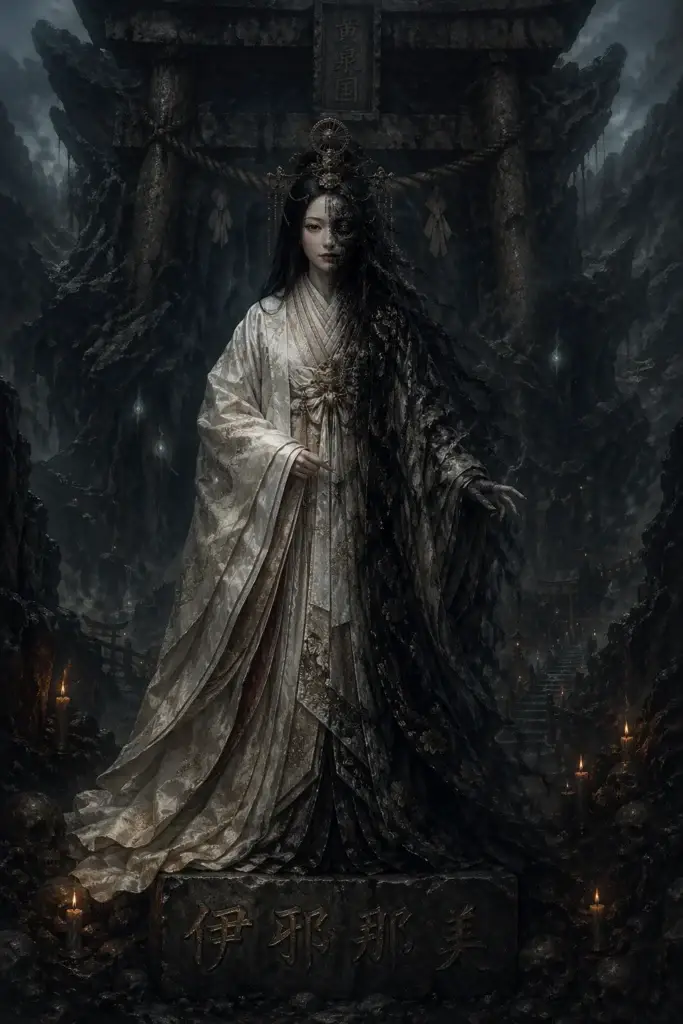
Izanami
Type: Japanese principal deity (Shinto), creator goddess and queen of the underworld of Yomi
Pantheon: Shinto
Function: creation of Japan and the kami, goddess of birth and of the dead
Principal attributes: court robe, comb tooth (with which Izanagi saw her), return to Yomi
Principal cult sites: Taga-Taisha (Shiga), Iya shrine (Matsue, Shimane), Mount Hiba (mythical grave)
Consort: Izanagi (creation couple)
Historical context
Izanami (Jap. Izanami-no-Mikoto, “she who invites to veneration”) is attested in literature from the 8th century AD onward in the Kojiki (712) and the Nihon shoki (720).
She is the central creator goddess of the Shinto tradition: together with her consort Izanagi she stirs the primordial sea with the spear Ame-no-Nuboko and from it creates the Japanese islands, then the kami.
At the birth of the fire god Kagutsuchi she burns herself and dies, descending to Yomi (the underworld). The principal flowering of her theology: central until the Middle Ages; thereafter pushed back relative to the Amaterasu-centered Ise tradition.
Principal cult sites: Taga-Taisha in Shiga Prefecture (together with Izanagi, one of the oldest shrines in Japan), the Iya shrine in Matsue (Shimane Prefecture), Mount Hiba in Shimane (the mythical grave of Izanami), the Kumano shrines (associated with Izanami in some traditions).
In the folk belief of rural Japan she remains present to this day as the creator mother.
Central sources: Kojiki (Book I, creation myth and descent to Yomi), Nihon shoki (Book I, several versions). Secondary literature: Aston, Shinto. The Way of the Gods; Breen/Teeuwen (eds.), Shinto in History; Heldt (trans.), The Kojiki. An Account of Ancient Matters; Bocking, A Popular Dictionary of Shinto.
Designation and spellings
Izanami was originally wondrous, a young goddess with gleaming hair, dignified in heavenly robes. Yet her myth image is dominated by her appearance of decay in Yomi: rotted skin, infestation with maggots, decaying entrails, the musty smell of death.
Izanagi, who followed her, saw her only by the light of a glowing comb tooth and was horrified. The spear that stirred the ocean (Ama-no-Nuboko) is her primary symbol of creative power.
Description
Izanami gave birth to the islands of Japan, the gods of the seasons and of the weather. Yet at the birth of the fire god she was fatally burned. She died and sank down into Yomi, where she became the goddess of the underworld, not evil, but sorrowful and captive.
The Kojiki reports Izanagi’s attempt to bring her back: he followed her into Yomi and asked her to return with him. She refused, too greatly deformed by Yomi, having become too much the goddess of death.
His flight and his ritual purification bath (misogi) after the encounter established Shinto’s concept of ritual impurity through contact with death.
Profile: Izanami
The most important aspects of Izanami at a glance. The following fields summarize origin, function, appearance, veneration, symbols and cultural parallels.
Izanami and Izanagi are the last generation of the Seven Generations of the heavenly kami. They step onto the floating bridge of heaven and stir the primordial sea with the spear Ame-no-Nuboko; from the drops the Japanese islands arise.
Then they beget together numerous kami: storm, mountains, rivers, sea. At the birth of the fire god Kagutsuchi, Izanami burns herself and dies.
Izanagi descends after her into Yomi (the underworld) and tries to bring her back, but she has already eaten of the food of Yomi and has decayed.
When Izanagi sees her in the light of his comb tooth, she is a decaying corpse; he flees in horror, she pursues him in a frenzy and swears to kill a thousand people each day; Izanagi swears to bring forth fifteen hundred each day.
Dual function: creator mother of the Japanese islands and of the kami; queen of the underworld of Yomi after her death. This tragic dual role is unique in world mythology: the same goddess who creates life becomes the ruler of the dead.
In personal cult she is invoked as a goddess of birth (above all at Taga-Taisha), but also as the mother of the dead in burials.
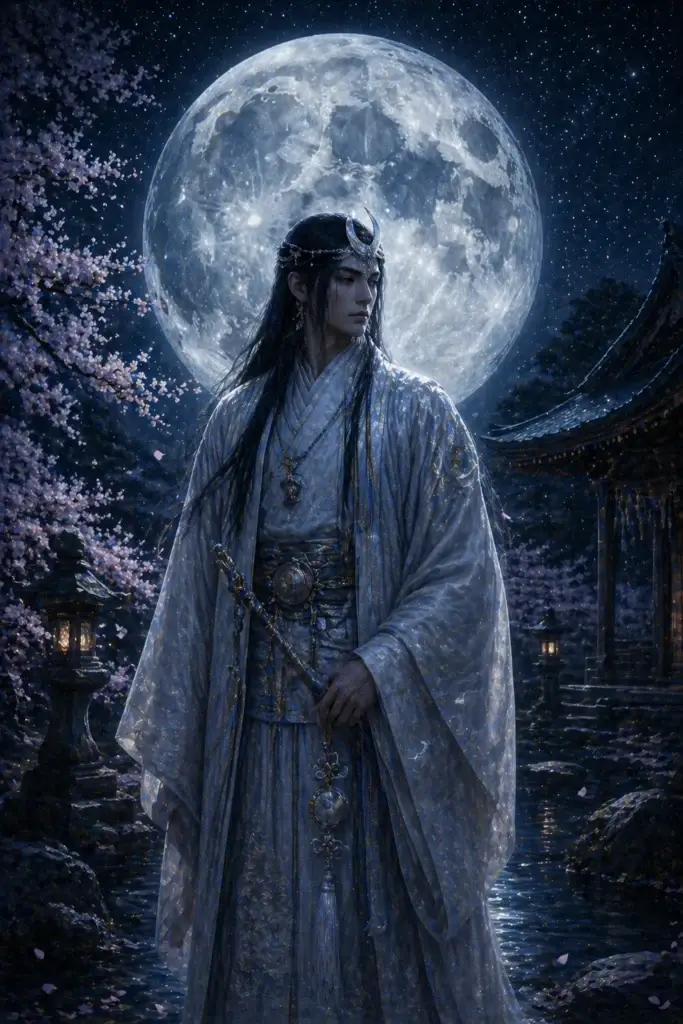
Izanami has no fixed iconographic depiction; in the orthodox Shinto tradition the making of statues of gods is avoided. In later pictorial traditions she is depicted as a solemn woman in a multi-layered court robe (junihitoe), frequently in the creation scene with the spear Ame-no-Nuboko (together with Izanagi on the bridge of heaven).
In Yomi scenes she appears as a decaying corpse with eight thunder spirits upon her body, one of the most haunting depictions of the dead in world mythology.
Sphere of action: Izanami is invoked at Taga-Taisha especially concerning birth and marriage. In rural folk belief she is central as the creator mother of Japan. In rites for the dead she appears as the ruler of Yomi.
The Kojiki story of her descent into Yomi is one of the most studied myths in the world history of religion (comparable with Persephone and Demeter, Inanna and Ereshkigal). At the Iya shrine an annual festival is held with unusual rites.
Spear Ame-no-Nuboko (creation tool), court robe junihitoe, food of Yomi, eight thunder spirits (upon her decaying body), the rock gate of Yomi (which Izanagi sealed after his flight). Sacred mountains: Mount Hiba (mythical grave). Sacred plants: peach (Izanagi threw peaches to ward off the demons of Yomi).
Persephone (Greece, abducted by the lord of the underworld), Inanna/Ishtar (Mesopotamia, descent into the underworld), Ereshkigal (Mesopotamia, queen of the underworld), Hel (Germanic, half-dead ruler of the underworld), Eve (Jewish-Christian, the first woman, associated with mortality), Pandora (Greece), Yamuna (Hinduism, sister of Yama). The motif of dying-at-birth-and-becoming-queen-of-the-underworld is unique in this configuration.
Practical defense
Rites of veneration (kept at a distance)
Izanami (Jap. “the one who invites”) is, in the Kojiki (712) and the Nihon Shoki (720), the creator goddess of the Japanese islands, together with Izanagi. After her death in childbirth (her burning at the birth of Kagutsuchi) she becomes the mistress of Yomi-no-Kuni (the underworld).
Direct veneration of Izanami is very limited within Shinto; the principal cult site is the Yomotsu Hirasaka in Shimane (the entrance to the underworld).
At the Higashi-Hongu shrine she is regarded as an ancestral deity. The rites are apotropaic and avoidant rather than devotional (cf. Nelson, A Year in the Life of a Shinto Shrine).
Invocations
In the Kojiki (vol. 1) the central invocation of Izanami by Izanagi appears at the entrance of Yomi; the myth ends with the ban imposed by the great rock. In the Norito purification prayer Oharae no kotoba the separation of the worlds (Yomi vs. Naka-tsu-kuni) is affirmed.
Amulets and protective symbols
Peach fruits (momo) have been regarded since the Kojiki as apotropaic in effect; Izanagi threw three peaches to drive away the shikome (the hideous women of Yomi).
Peach carvings are found at traditional Japanese house entrances. Purification salt (shio) is scattered before houses, a practice that mythically traces back to Izanagi’s first misogi purification after Yomi.
Izanami, parallels in other cultures
Izanami shares motifs with the Sumerian Inanna (descent into the underworld), the Greek Persephone, and the Indian Sati (burning). Unlike Persephone’s ambivalence, however, Izanami is definitively captive in Yomi, not a seasonal cycle but lasting decay.
She also resembles the Mexican Coatlicue or Japanese Mononoke concepts, goddesses who embody creation and destruction at the same time.
The Kojiki and the Nihon Shoki: the sources of the creation myth
What is known about Izanami stems almost entirely from two works of the early 8th century of our era. The Kojiki (“Record of Ancient Matters”), completed in 712, and the Nihon Shoki or Nihongi (“Chronicle of Japan”), completed in 720, both contain the myth of Izanami and her brother and consort Izanagi.
Both texts were composed on behalf of the court and served, among other things, to ground the descent of the imperial house from the gods. They are therefore not neutral transcriptions of ancient myths but deliberately shaped works with a political purpose.
The Nihon Shoki moreover often offers several variants of a narrative side by side, which shows that competing traditions were already in circulation in the 8th century.
According to these texts, Izanami and Izanagi belong to the last of a series of generations of gods that arise after the separation of heaven and earth.
The older gods commission the couple to consolidate the still unformed land. With a jewel-set spear they stir the primordial sea from the heavenly bridge; a drop of water dripping from the spear hardens into the first island.
On this island Izanami and Izanagi perform their marriage and begin to beget further islands and numerous deities. Izanami is thus one of the creator deities of the Japanese archipelago itself.
Whoever wishes to understand the myth precisely must take the two chronicles for what they are: courtly works that have brought older oral tradition into an ordered, legitimizing form.
The journey into the underworld: Izanami in Yomi
The most haunting episode of the myth is Izanami’s death and Izanagi’s descent into the underworld. At the birth of the fire god Kagutsuchi, Izanami is so severely burned that she dies.
She is thus the first deity to experience death. She goes down to Yomi, the “land of darkness,” the Japanese realm of the dead.
Izanagi, who wishes to bring his consort back, follows her. Izanami explains that she has already eaten of the food of the underworld and can therefore return only with difficulty, but that she wishes to discuss it with the powers of Yomi.
She forbids Izanagi to look at her in the meantime. He does not keep the prohibition, kindles a light and beholds her decaying body, covered with maggots.
Horrified, Izanagi flees. Izanami, shamed and enraged, sends the terrors of the underworld after him. At the border between the world of the living and Yomi, Izanagi rolls a mighty rock before the passage.
Separated from each other by this stone, the former spouses pronounce their separation. Izanami threatens to let a thousand people die each day; Izanagi replies that he will then let fifteen hundred be born each day.
This episode is dense in terms of the history of religion. It explains in mythical terms the irreversibility of death, the separation of the living from the dead, and at the same time the balance of dying and being born.
The motif of the forbidden look at the dead woman has parallels in other mythologies, such as the Greek tale of Orpheus, without one needing to assume a direct connection.
Purification and the birth of the great gods
The consequences of Izanagi’s return from the underworld are fundamental for Japanese religion. After he has escaped from Yomi, Izanagi feels defiled by his contact with death. He goes to a river and performs a ritual washing, called misogi in the myth.
From this purification further deities emerge. As Izanagi washes his left eye, the sun goddess Amaterasu arises; from the right eye the moon god Tsukuyomi; from the nose the impetuous storm god Susanoo.
These three rank among the most significant deities of Shinto, and Amaterasu is regarded as the ancestress of the imperial house.
It is remarkable that these central deities do not emerge from the union of Izanami and Izanagi, but from the act of purification after Izanami’s death. The myth thus connects the origin of the most important gods directly with the theme of defilement through death and its removal.
This connection explains a fundamental feature of Shinto: the great importance of purity and purification. Kegare, ritual defilement, above all through death and blood, and misogi as well as other acts of purification with which it is removed, belong to the core concepts of Shinto practice.
Izanami’s death and Izanagi’s subsequent washing are the mythical primal scene to which these notions are traced back.
Further links
Sources and literature
Further standard works in the literature index.