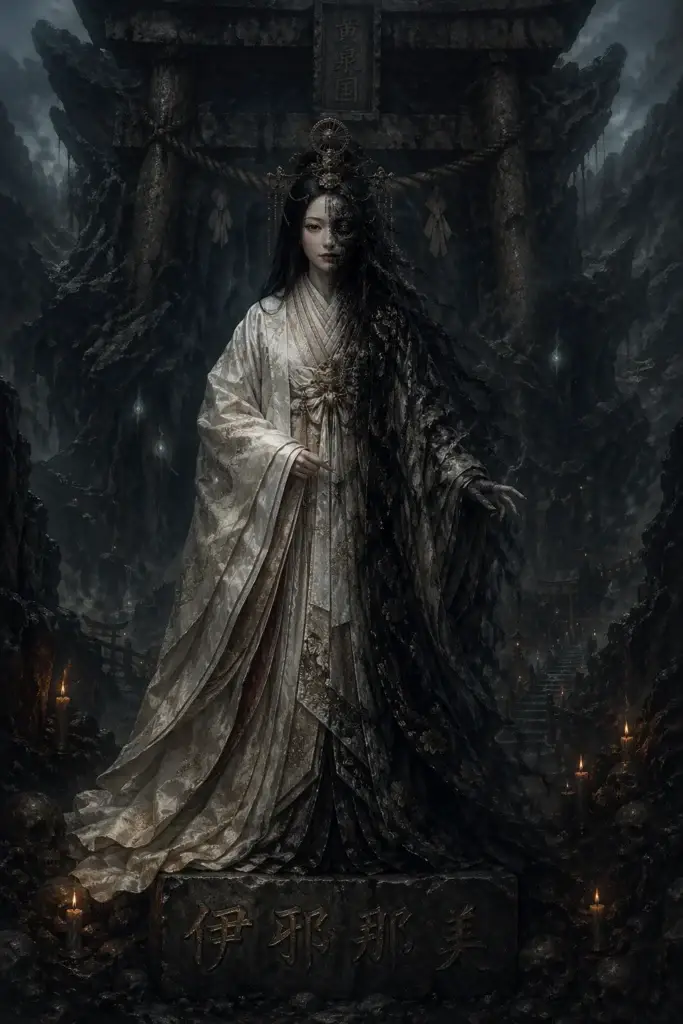
Konohanasakuya-hime, blossom princess of Fuji
By Ralf Ittermann · last reviewed on
Konohanasakuya-hime is a goddess of Japanese tradition.
Blossom goddess of Mount Fuji, who gave birth to her children in fire. As the blossom princess of Fuji, Konohanasakuya-hime embodies beauty and transience at once. The title name for Konohanasakuya-hime is Blossom and Fire Goddess of Fuji.
Konohanasakuya-hime is the Japanese goddess of the cherry blossom and of volcanoes, especially Mount Fuji. Her myth links her to fire: to prove her fidelity, she gave birth to her children in a burning house, which made her the protective goddess of birth and of volcanoes.
She is the daughter of the mountain god Oyamatsumi and the wife of the divine grandson Ninigi; the main sources are the chronicles Kojiki and Nihongi. As the goddess of Fuji, she is at the centre of the Sengen shrines, whose main shrine lies at the foot of the mountain.
Type: Blossom and volcano goddess, protectress of Fuji
Origin: Early Japan, daughter of the mountain god Oyamatsumi
Texts: Kojiki and Nihongi
Period: Early times to the present, a living shrine cult
Appearance: beautiful young goddess, associated with cherry blossom and volcano

Source Context
Period of the Texts
Early Japan: the main sources are Kojiki and Nihongi; the shrine cult remains alive to this day.
Area of Diffusion
Japan, especially Mount Fuji. The main shrine of the Sengen shrines stands at its foot.
Sources
Well attested: the classical myths of the chronicles and the cult of the Sengen shrines.
Name and variants
Japanese: The name means roughly the princess who makes the blossoms of the trees bloom. It links the goddess to the transient blossom, while her cult connects her to the volcanic fire of Fuji.
Being and effect
Appearance
Konohanasakuya-hime is depicted as a beautiful, young goddess, associated with the transient cherry blossom and the volcano Fuji. Her symbolism unites the delicate blossom with the fiery mountain; she stands for beauty, transience and the tamed power of volcanic fire.
Effect
She makes the trees blossom, watches over Fuji and protects those giving birth. Her connection to fire makes her mistress over volcanic fire and a helper in childbirth, an ordeal she herself passed through in fire.
Profile: Konohanasakuya-hime
The key aspects of the goddess at a glance.
Goddess of the classical chronicles Kojiki and Nihongi, daughter of the mountain god Oyamatsumi and wife of the divine grandson Ninigi.
Blossom, volcanoes and easy childbirth; Mount Fuji in particular stands under her protection.
Beautiful young goddess with the cherry blossom as her emblem; her symbolism unites the delicate blossom with the fiery mountain.
Mistress over volcanic fire and helper of women giving birth; also invoked for protection against conflagration.
The Sengen shrines with the main shrine at the foot of Fuji; invoked for easy childbirth and protection from fire.
Pele and the Aztec Chantico as volcano goddesses; within Japan, the fire god Kagutsuchi.
The birth in the burning house
According to the myth, Konohanasakuya-hime gave birth to her children in a sealed house set on fire, to prove that the children were of divine descent; the fire did not harm them. For this reason she is invoked for easy childbirth and for protection from conflagration, and her cult links volcano, fire and fertility.
The chronicles Kojiki and Nihongi record her origin: she is the daughter of the mountain god Oyamatsumi and became the wife of the divine grandson Ninigi. As the goddess of Mount Fuji, she is at the centre of the Sengen shrines, where her trial by fire still resonates today.
Afterlife and interpretation
Konohanasakuya-hime is present in Shinto, in the Fuji cult and in popular culture. The cherry blossom as a symbol of transience is closely linked to her.
From a religious-studies perspective, Konohanasakuya-hime unites volcanic fire, blossom and birth in a deity in whom destruction and fertility coincide. The birth in fire is a prime example of fire as an ordeal and proof of divine purity.
Sengen shrines and invocation
Well documented is her veneration at the Sengen shrines, whose main shrine stands at the foot of Fuji. The goddess is invoked for easy childbirth, for the protection of the mountain and for preservation from conflagration; her cult links volcano, fire and fertility. The trial by fire in her myth is the basis of this trust: whoever gave birth in fire is trusted to protect against fire.
Volcano goddesses in comparison
As a volcano goddess, Konohanasakuya-hime corresponds to the Hawaiian Pele and the Aztec Chantico; the motif of birth in fire links her to conceptions in which fire proves purity and divine descent. Within Japan, she stands alongside the fire god Kagutsuchi and the sun goddess Amaterasu.
Frequently asked questions about Konohanasakuya-hime
Who is Konohanasakuya-hime?
The Japanese goddess of the cherry blossom and of volcanoes, especially Mount Fuji. Her name means roughly the princess who makes the blossoms of the trees bloom.
Why did she give birth in fire?
To prove the divine descent of her children, she gave birth in a burning house; the fire did not harm them.
What is she invoked for?
For easy childbirth, for the protection of Fuji and for preservation from conflagration, above all at the Sengen shrines.
Further links
Further reading:
- Japan – all beings of the Japanese tradition
- Kagutsuchi – the fire god of Shinto
- Pele – the Hawaiian volcano goddess
- Amaterasu – the sun goddess of Shinto
- Protective candle, amulet, smudging – traditional protective means
Literature (selection)
Further standard works in the bibliography.
As the Japanese volcano goddess and goddess of Mount Fuji, Konohanasakuya-hime unites what seems hardly to belong together: the fleeting cherry blossom and the fire of the mountain over which she presides as patroness.