Pele: Hawaiian Goddess of Volcanoes, Fire, and Creation
By Ralf Ittermann · last reviewed on
Pele, whose full name is Pelehonuamea, is in Hawaiian religion the goddess of volcanoes, fire, and creative destruction.
According to traditional belief, she resides in the Halemaumau crater area of the Kilauea volcano on the island of Hawai’i. This article describes her position in the study of religion, her mythological cycles, and her continuing veneration in the Hawaiian tradition.
The myth of the Hawaiian volcano goddess Pele forms the religious core of the Pele family narratives on Big Island.
Profile: Pele
Pele: the most important aspects at a glance. The following fields summarise origin, function, appearance, veneration, symbols and parallels.
Pele, with her full name Pelehonuamea, is a specifically Hawaiian Atua. She belongs to the siblings of Pele who travelled to Hawai’i, among them her younger sister Hi’iaka, Kapo and Namaka. The stories describe her arrival in Hawai’i, often as a flight from her sea sister Namaka.
Pele is the goddess of volcanoes, of fire and of creative destruction. According to traditional belief she dwells in the Halemaumau crater area of the volcano Kilauea. With her arrival in Hawai’i she shapes the land itself, and her anger is to be avoided.
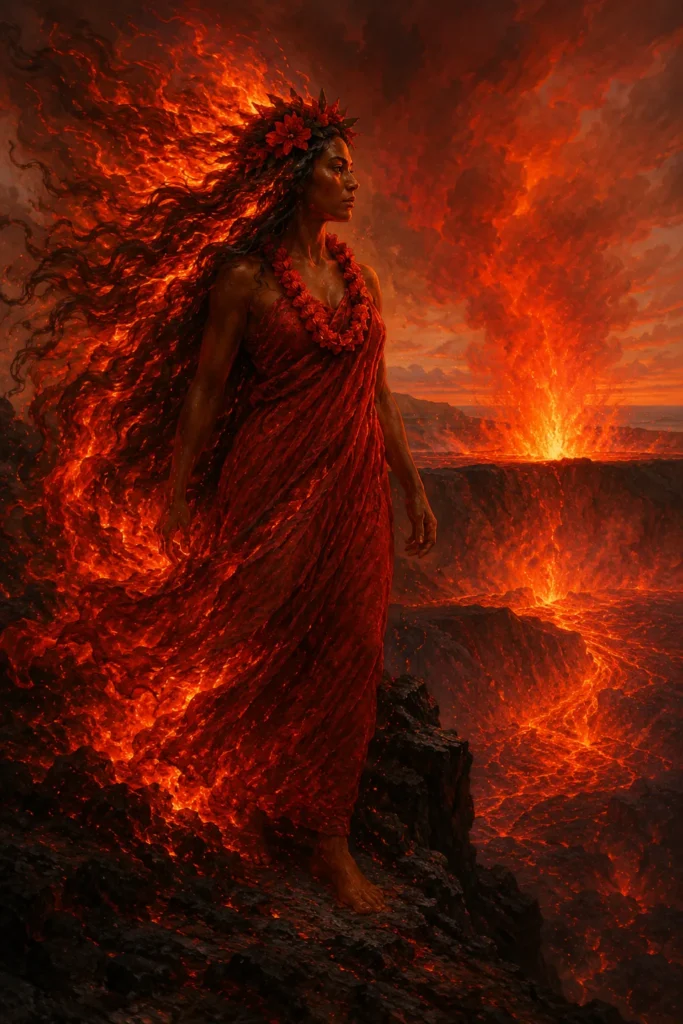
Pele is described as a beautiful woman, now young, now old. She can appear in any form: as an old woman at the roadside, as a young dancer or as a fiery being in the lava flow. This capacity for transformation is part of her theological character.
Pele is venerated to this day at the Halemaumau crater. Visitors lay offerings (Ho’okupu) at the crater rim, such as flower garlands (lei), bundles of ti leaves and berries; karakia (pule) are spoken and hula dances performed. Whoever takes stones from the volcano is said to suffer misfortune until he sends them back.
Her direct body is regarded as lava flows, volcanic gases, earthquakes, glassy threads of lava (Pele’s hair) and teardrop-shaped lava drops (Pele’s tears). The taboo against taking stones from the volcano is known as Pele’s curse.
Other volcano deities compared are Vulcan in Rome, Hephaestus in Greece and Agni in the Vedic tradition. Pele is female, which distinguishes her from most of them. In the Pacific region the Maori tradition knows the fire goddess Mahuika; in Japan there is the goddess Konohanasakuya-hime associated with Mount Fuji.
Classification within the Polynesian Pantheon
Pele is not a pan-Polynesian supreme deity but a specifically Hawaiian Atua. She belongs to a group of sisters and brothers, the Pele siblings, who migrated to Hawai’i. Her younger sister Hi’iaka is one of the central figures in Hawaiian mythology. Other siblings include Kapo, Namaka (the sea sister), and several others.
Martha Beckwith’s standard work Hawaiian Mythology (1940) documents the Pele family in detail. Mary Kawena Pukui (Hawaiian Dictionary, 1986; Olelo Noeau, 1983) has illuminated the Pele tradition in its linguistic and ritual depths.
Pele is a post-migration deity: the narratives explicitly describe her arrival in Hawai’i, often as a flight from her sea sister Namaka.
Like the related Maori theology, the religious tradition in which Pele stands also operates without a closed doctrinal system. There is no fixed doctrine; what reality the Atua have is proven in practice, in karakia, in gatherings at the Marae, and in whakapapa recitations.
This practice-based form of theology is regarded by the study of religion as a distinct contribution to the field.
The study of Polynesian Atua such as Pele faces a fundamental challenge: many sources date from the colonial period of the 19th century and are colored by the perspective of missionaries and ethnologists.
More recent research therefore undertakes an ongoing decolonization of these materials, by placing Polynesian voices at the center and subjecting Western categories to critical scrutiny.
Name and Etymology
The name Pele means in Hawaiian ‘lava’, ‘molten rock’, ‘volcano’. It is semantically closely connected with the goddess’s manifestation. Pelehonuamea means ‘Pele of the sacred earth’. Epithets include Pele-ai-honua (‘Pele who devours the land’) and Ka wahine ai honua (‘the land-devouring woman’).
Linguistically, Pele belongs to the Proto-Polynesian word group associated with fire and volcanism. In Tahiti and on Bora Bora there are related mythological traces of a volcano goddess, though without the canon that Pele has achieved in Hawai’i. The Hawaiian form is the most fully developed.
The fact that Pele appears under several epithets has a linguistic-historical background: such abundance of names testifies to an oral tradition that has branched out richly across regions.
The linguistic depth of Maori and Hawaiian theonyms is recorded in the lexicographical works of Bruce Biggs and Ross Clark, a body of research that is at the same time fundamental for understanding the relationship of the Polynesian languages.
Pele’s epithets are frequently more than decorative additions. They encode specific ritual functions and are fixed in karakia formulas. The kahuna, the ritual specialists, knew precisely which epithet was to be invoked on which occasion. Charles Royal and Pou Temara study this precisely regulated liturgical practice.
Description and Iconography
In the Hawaiian tradition, Pele is described as a beautiful woman, sometimes young, sometimes old. She can appear in any form: as an old woman at the roadside, as a young dancer, as a fiery being in the lava flow. This capacity for transformation is part of her theological character.
Visible manifestations of Pele include: lava flows, volcanic gases, earthquakes, glassy lava threads (Pele’s hair), and teardrop-shaped lava droplets (Pele’s tears). These natural phenomena are traditionally interpreted not ‘metaphorically’ but theologically as her direct body. Beckwith and Pukui emphasize this understanding as a central element.
Over the last five decades, the carving arts of the Maori and Hawaiians have undergone an impressive renaissance. Artists such as Cliff Whiting, Robyn Kahukiwa, Wright Bowman, and Sam Ka’ai cultivated both traditional forms and contemporary interpretations.
The Atua, including the volcano goddess Pele, appear in their works in diverse ways; her iconographic presence thus extends into contemporary art.
Polynesian art cannot be separated from its cosmological significance. Every spiral (koru), every ornament, and every line carries phenomenological religious meaning, including in depictions of Pele. Roger Neich, Damian Skinner, and other art historians have systematically explored these layers of meaning.
The Pele-Hi'iaka Cycle
The most important mythological complex surrounding Pele is the Pele-Hi’iaka cycle. Pele sends her youngest sister Hi’iaka to the island of Kaua’i to fetch Pele’s beloved Lohi’au. On the journey Hi’iaka experiences numerous adventures, battles demonesses, and revives Lohi’au from death.
Upon her return, Pele suspects her sister of infidelity and destroys her beloved and her forest with lava flows. Hi’iaka must revive Lohi’au once again.
This narrative is one of the longest and most complex in Polynesian mythology. It is recorded in several versions, most notably in that of Nathaniel Emerson (Pele and Hiiaka, 1915) and in the modern translation by Puakea Nogelmeier (The Epic Tale of Hiiakaikapoliopele, 2006).
From a religious-studies perspective, it is a classic sisters’ conflict myth in which Pele’s ambivalent nature, creative and destructive, becomes visible.
The Pele-Hi’iaka cycle also cannot be read from a religious-studies perspective as a self-contained narrative. Rather, it forms a network of narratives that interpret one another and are differently emphasized in individual tribal traditions.
This rhizomatic, web-like structure makes the study methodologically demanding, while at the same time opening up hermeneutic depth. Diverging versions of a story are not regarded as ‘wrong’ or ‘corrupted’ but as equally valid regional forms.
The Pele-Hi’iaka cycle is not merely remembered but actively passed on, in karakia, in speeches at the Marae, and in teaching. In this way it is living practice, not a static archive. The language programs for Te Reo Maori and Olelo Hawai’i have considerably strengthened this vitality over the past thirty years.
Pele and the Arrival in Hawai'i
Another narrative recounts Pele’s migration. She leaves her South Polynesian homeland (often referred to as Kahiki, the mythical land of origin) and searches for a new home.
On each island of the Hawaiian archipelago she digs a crater, but each time her sea sister Namaka pursues her with water. Only on Hawai’i, the youngest and largest island, does she find a permanent dwelling in the Halemaumau crater.
Geologically, this narrative corresponds exactly to the age sequence of the Hawaiian islands: the northwestern islands are the oldest, and Hawai’i (Big Island) is the youngest and still volcanically active.
From a religious-studies perspective this is a remarkable observation: the mythic narrative contains geologically accurate information. Transmission through inherited ecological observation appears plausible.
The fact that Pele shapes the land itself upon her arrival in Hawai’i illustrates a fundamental feature of Maori and Hawaiian religion: ritual and everyday activity are interwoven. While other religious systems draw a sharp boundary between the sacred and the profane, here references to the Atua permeate the whole of life.
This religiosity anchored in the lived world is the subject of phenomenological religious studies by Mason Durie, Charles Royal, Lilikala Kame’eleihiwa, and other Polynesian scholars of the current generation.
The extent to which ritual practice and everyday life are fused is also reflected in language: terms such as mana, tapu, aroha, and hauora today belong to the common English of Aotearoa and appear also in non-religious contexts. The fact that Maori theology has entered everyday language to this degree documents its deep cultural impact.
Cult and Rituals
Pele is venerated to this day at the Halemaumau crater. Visitors bring ho’okupu (offerings), including flower garlands (lei), ti-leaf bundles, and berries, and place them at the crater rim. Karakia (in Hawaiian: pule) are spoken and hula sequences are danced. Importantly, this practice is not merely historically reconstructed but a living tradition.
The Hawaiian tradition holds a taboo against taking stones from the volcano (‘Pele’s curse‘). Anyone who takes a stone is said to experience misfortune until returning it. The Hawaiian national park receives thousands of packages of returned stones each year.
From a religious-studies perspective, this is a taboo system that links the protection of the sacred landscape with ritual awe.
Polynesian religion remains alive above all at Marae and Heiau, those sites that serve simultaneously as places of assembly and cult. Each Marae and each Heiau has its own whakapapa, its own traditions, and its own Atua references, in the case of the Heiau on Hawai’i including those relating to Pele.
A Marae visit begins with the powhiri, the ritual in which the tangata whenua formally receive their guests. It is not ceremonial folklore but lived religious practice, and is among the best-documented Polynesian welcoming rituals in the study of religion.
In the 20th and 21st centuries, cult practice has changed perceptibly. Where once the kahuna bore the ritual, this role today often falls to the kaumatua, the elders, and to Marae committees. From a sociology-of-religion perspective, this shift is of interest; Manuka Henare and Mason Durie discuss it in their works.
Protective Traditions
In the Hawaiian tradition, Pele is not invoked primarily as a ‘protective goddess’ but as a power whose anger is to be avoided.
Protective practices therefore aim at correct behavior near the volcano and lava flow: respect, karakia, and offerings. Those who live in a volcanic area, such as the Puna region, maintain a continuous relationship with the goddess.
The ho’oponopono tradition (reconciliation practice) is applied in some families to address an offense against Pele. Mary Kawena Pukui (Nana I Ke Kumu, 1972) describes the ritual structure. The religious-studies framing of such protective practices is clearly documentary, not magical.
On the subject of protection, an important distinction must be made from a religious-studies perspective: Western thinking starts from the effective amulet, while the Polynesian approach starts from the cultivated relationship. Protection here is not magically causal but relational and ritualized in character.
One who stands in relationship with an Atua like Pele and maintains that relationship is considered ‘protected’, not because an object exerts power, but because an existing relation is cosmologically binding. In the anthropology of religion, this is discussed as ‘relational ontology’.
Protective practice in particular is a field where tradition and modernity meet. Smartphone applications with karakia, online guides to protective rituals, and virtual Marae visits show that Polynesian religion is adopting new media for its practice. This modernization should not be interpreted as a dilution but as an adaptive further development.
Parallels in Other Cultures
Pele can be compared in a cross-religious perspective with other volcano deities: Vulcan in Rome, Hephaestus in Greece, Agni in the Vedic tradition. The difference is important: Pele is female, which distinguishes her from most other volcano deities. She is not primarily a smith but the originator of volcanic creation itself.
Within the Pacific region, the Maori have the figure of Mahuika (fire goddess), who is not however volcanic. In Japan there is the goddess Konohanasakuya-hime, who is associated with Fuji. Such parallels arise independently in volcanically active regions.
Universal structures of religious experience, as also visible in the figure of Pele, have been systematically studied by Joseph Campbell and Mircea Eliade.
As foundational as their works are, they must nonetheless be rethought for the specific Polynesian contexts, without falling into a pan-globalizing simplification. More recent Polynesian research places great value on this context-sensitive interpretation.
Contemporary Reception
Pele is today one of the best-known Polynesian figures worldwide. She is the subject of numerous tourist narratives, which can create tensions with the Hawaiian tradition: commercialization of Pele by tourism is often a source of irritation for Hawaiians.
The cultural self-assertion movement, Aloha Aina, the movement for Hawaiian sovereignty, invokes Pele as a cultural anchor.
In scholarship, Pele also plays an indirect role in volcanology. Hawaiian volcanologists connect seismic and petrological research with cultural knowledge about lava behavior. This dialogue is the subject of more recent studies.
In international discussion, Polynesian religion is increasingly recognized as an independent religious system and is no longer dismissed as mere ‘mythology‘ or ‘folklore‘. The adoption of terms such as mana, tapu, mauri, and whakapapa into the technical vocabulary of religious studies demonstrates this recognition.
Their use, however, requires a contextual sensitivity that cannot be taken for granted.
Research and Sources
The most important contributions to the study of Pele are found in the works of Martha Beckwith, Mary Kawena Pukui, Nathaniel Emerson, Jack Halualani, and Marie Alohalani Brown. Hawaiian Mythology remains the standard reference work.
Pele remains a living goddess in a living tradition. A deeper classification within Polynesian-Hawaiian religion shows how she anchors the connection between land, family, and cosmos. Links to the Polynesian-Maori tradition as a whole exist through shared roots, but are to be read as culturally specific in their content.
The dialogue between Polynesian internal knowledge traditions and academic research is today carried by several institutions: the Royal Society of New Zealand, Te Aparangi; the Maori Studies Department of Auckland University; the University of Hawai’i at Manoa; and the Te Punga Tipu Foundation.
This institutional foundation ensures that Polynesian research is not conducted solely about Polynesia but equally from within Polynesia.
The Migration from Kahiki to Hawai'i
One of the central narrative traditions surrounding Pele describes not her character but a journey: the migration of the goddess from a distant land of origin to Hawai’i. In Hawaiian tradition, this land is called Kahiki, a term that refers less to a concrete geographical location than to the ancestral homeland lying beyond the visible horizon.
Scholars such as Martha Beckwith have noted that Kahiki is linguistically related to Tahiti, without this implying a direct identification.
According to the narrative, Pele leaves her homeland following a quarrel, frequently with her elder sister, the sea goddess Namaka-o-Kaha’i. She travels by canoe, accompanied by siblings, and seeks a suitable dwelling on each island of the Hawaiian chain.
Using a digging stick, the paooa or ‘o’o, she pierces the ground to create a fire pit. But on Kaua’i, O’ahu, Moloka’i, and Maui, seawater repeatedly floods in and extinguishes the fire, as Namaka pursues her.
Only at Kilauea on the island of Hawai’i, in the crater Halema’uma’u, does Pele find a location high and dry enough.
This narrative structure follows the actual geological age sequence of the Hawaiian archipelago, whose islands are oldest and most eroded in the northwest, while volcanic activity today is concentrated on the youngest island in the southeast.
More likely than conscious geological knowledge on the part of the tradition bearers is an observation of erosion stages and eruption sites condensed over generations. The migration narrative thus combines a cosmological statement about origins with a knowledge of the landscape that places each island in the chain in an ordered sequence.
Pele and Hi'iaka: the Conflict over Lohi'au
The most extensive connected narrative cycle in the Hawaiian oral tradition concerns not Pele alone but her youngest sister Hi’iaka-i-ka-poli-o-Pele. Several versions of this cycle were published in the late 19th and early 20th century, in Hawaiian-language newspapers for instance in the version composed by Ho-oulumahiehie (Ka Nāʻī Aupuni, 1905 to 1906), and as an English-language book by Nathaniel Emerson (1915).
These sources are not unmediated original texts but already the products of a phase in which Hawaiian authors were consciously writing against the threatened loss of tradition.
The action begins when Pele sees in a dream the young chief Lohi’au on the island of Kaua’i and falls in love with him. She sends Hi’iaka to fetch him, granting her a limited timeframe and supernatural powers.
Hi’iaka’s journey across the archipelago fills the greater part of the cycle: she passes through battles against mo’o, lizard-like water spirits, heals the sick, and establishes numerous place names. When she reaches Lohi’au, he has already died, and she must call his spirit back into the body.
The tragic turning point lies in Pele’s mistrust. Convinced that her sister has exceeded the deadline and taken Lohi’au for herself, Pele burns down Hi’iaka’s beloved lehua grove and kills her companion Hopoe. Upon her return, Hi’iaka openly embraces Lohi’au before Pele, whereupon the goddess covers him with lava.
The cycle ends differently depending on the version, often with Lohi’au’s revival by other siblings. From a religious-studies perspective, the cycle is significant because it shows Pele not as a distant force of nature but as an acting relative within a sibling group, whose jealousy and breach of trust motivate the destructive eruption.
Selected Bibliography
- Martha Beckwith: Hawaiian Mythology (1940)
- Mary Kawena Pukui: Nana I Ke Kumu (1972) and Olelo Noeau (1983)
- Nathaniel Emerson: Pele and Hiiaka: A Myth from Hawaii (1915)
- Ho’oulumahiehie (transl. by M. Puakea Nogelmeier): The Epic Tale of Hiiakaikapoliopele (2006)
- Valerio Valeri: Kingship and Sacrifice (1985)
Related key terms: Pele Hawaii volcano goddess Halemaumau Kilauea lava Pelehonuamea Aloha Aina.
iWell Guard and Protective Traditions
iWell Guard draws on the cultural-historical tradition of wearable protective objects, in the tradition of Polynesia / Maori and many other cultures worldwide. 41 levels, real gold, platinum, silver, made in Germany. 30-day return policy.
Individual experiences may vary. Not a medical product. No healing claims.