Zoroastrianism, founded by Zarathustra in the first or second millennium before our era, is one of the oldest documented monotheistic religions. Ahura Mazda stands at its centre as creator; the world is conceived dualistically, between his work and the destructive principle Angra Mainyu. Zoroastrianism has had a lasting influence on Jewish, Christian and Islamic eschatology.
A separate section places the Zoroastrian protective practice in a religious studies context.
Of the person of Zarathustra (Greek Zoroaster), only his own hymns, the Gathas, are reliably transmitted. The dating varies considerably in scholarship: conservative estimates place him in the 6th century BCE, but linguistic and historical analyses of his hymns suggest a much earlier dating, roughly 1500 to 1000 BCE.
His historical activity is assumed to have taken place in eastern Iran or Central Asia. The monotheism he formulated, with its ethical emphasis, stands in contrast to earlier polytheistic Indo-Iranian traditions.
The sacred scriptures of Zoroastrianism are collected in the Avesta: the Gathas (Zarathustra’s own hymns, in Old Avestan), the Yasna (liturgical corpus), the Visperad, the Vendidad and the Yashts.
Alongside Ahura Mazda and Angra Mainyu appear the six Amesha Spentas (holy immortals), Vohu Manah (good purpose), Asha Vahishta (best truth), Khshathra Vairya (desired dominion), Spenta Armaiti (holy devotion), Haurvatat (wholeness) and Ameretat (immortality), as personifications of divine aspects.
The Yazatas are beings worthy of veneration with specific cosmic functions: Mithra (covenant), Anahita (water), Sraosha (obedience, protection).
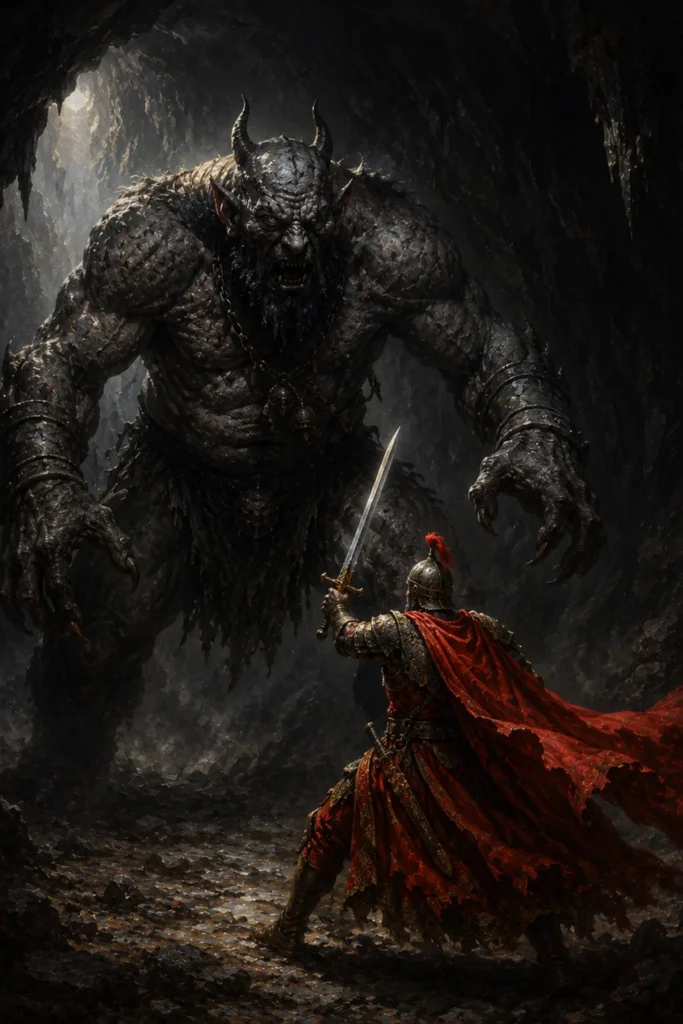
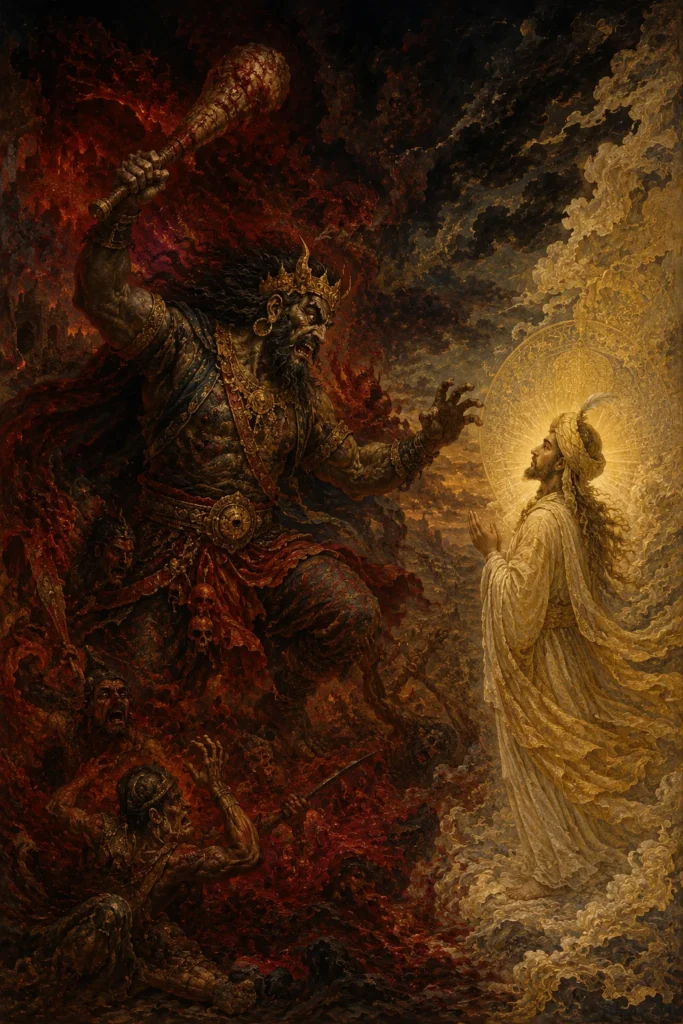
Zoroastrian cosmology is explicitly dualistic: Ahura Mazda and Angra Mainyu stand opposed to one another as independent principles; the human being is invited, through ethical action, to act on the side of Asha (truth, cosmic order) against Druj (falsehood, chaos).
The world is conceived within a linear concept of time: creation, the struggle between good and evil, and the final victory of Asha with the resurrection of the dead and a final judgement. This eschatology has deeply influenced the Abrahamic religions.
The Faravahar, the winged sun symbol with a human figure in a circle, is today the most visually striking emblem of Zoroastrian identity. It is attested on Achaemenid reliefs (Persepolis) from the 6th century BCE onward.
Its interpretation is debated in religious studies: traditionally read as a Fravashi (a divine guardian aspect of the soul), and by others as a representation of Ahura Mazda himself or as a royal emblem of fortune (Khvarenah).
After the Sedreh-Pushi initiation (comparable to confirmation, usually around the seventh or tenth year of life), practising Zoroastrians wear the sacred shirt Sudreh of white cotton and the sacred cord Kushti of wool, wound three times around the waist.
During the daily Padyab-Kushti ritual, the cord is loosened and retied, a bodily renewal of the commitment to Asha. The 72 threads of the Kushti correspond to the chapters of the Yasna.
After the Arab conquest of Persia in the 7th century, parts of the Zoroastrian community migrated to India, where, as Parsis (today mainly in the Mumbai region), they formed an economically and culturally influential minority.
In Iran, smaller communities exist in Yazd, Kerman and Tehran. The religion is not missionary, and its membership worldwide numbers a few hundred thousand. In the 20th century, a Zoroastrian diaspora emerged in North America and Europe.
Important translations: Mary Boyce, A History of Zoroastrianism (3 volumes, 1975, 1991), Helmut Humbach on the Gathas, Albert de Jong, Traditions of the Magi. Religious studies placement: Geo Widengren, Bruce Lincoln. Manichaeism too, founded by Mani in the 3rd century, builds upon Zoroastrian cosmology.
The oldest sources of Zoroastrianism are collected in the Avesta, a corpus of religious texts in an Old Iranian language, Avestan. Its core, the Gathas, are hymns that tradition traces back to the founder Zarathustra himself and that are linguistically very old.
They are embedded in the younger ritual prayer Yasna. In addition there are the Yashts, hymns to individual divine beings, as well as liturgical and purity-law texts such as the Vendidad.
The Avesta was transmitted orally over many centuries and only relatively late committed to writing. A considerable part was lost; what survives is regarded as a fragment of a once far larger body of material. The existing manuscripts are no older than the 13th century, which poses particular problems for textual criticism.
A second layer is formed by the literature in Middle Persian, also called Pahlavi, which arose above all in the late Sasanian period and in the first Islamic centuries.
This includes the Denkard, a kind of encyclopaedia of the religion, the Bundahishn with the Zoroastrian cosmology and eschatology, as well as numerous commentaries and legal texts.
These works are often summaries of lost Avestan material and are therefore indispensable, but at the same time they are shaped by the theological perspective of their time.
For Western scholarship, the decipherment of these languages was a long process. Abraham Hyacinthe Anquetil-Duperron published the first European translation of the Avesta in 1771, based on instruction from priests in India.
Later generations, such as Christian Bartholomae with his Old Iranian dictionary, established the philological foundations. The source situation nonetheless remains fragmentary, and much about the early period of the religion is reconstruction.
The Zoroastrian worldview is marked by an opposition of two fundamental principles. On the one side stands Ahura Mazda, the wise lord, source of order, light and life.
Opposed to him stands the destructive principle, called Angra Mainyu in the younger texts or, in Middle Persian, Ahriman, which stands for falsehood, chaos and death. Whether this is a strict dualism or an order ultimately encompassed by Ahura Mazda is an old point of scholarly dispute.
World history is conceived as a temporally limited confrontation. According to the scheme of the Bundahishn, it is divided into several great periods, at the end of which stands a renewal of the world, the frashokereti.
In it, evil is overcome, the dead are raised and a state of perfect order is established. In this process the human being is not a spectator but a fellow combatant who, through good thoughts, good words and good deeds, strengthens the side of order.
Between the highest god and the world stand the Amesha Spentas, the beneficent immortals, a group of beings who each embody an aspect of the good creation and protect the domains assigned to them, such as fire, water, plants or metal.
Alongside them appear numerous Yazatas, beings worthy of veneration to whom the Yashts are dedicated. The hostile side is populated by Daevas and other harmful beings.
After death, the soul must cross a bridge whose nature depends on the balance of its life. It becomes broad and easily passable for the righteous, narrow and dangerous for the wicked.
This idea of judgement, bridge and otherworldly retribution is among the elements much discussed in scholarship because of possible points of contact with Judaism, Christianity and Islam.

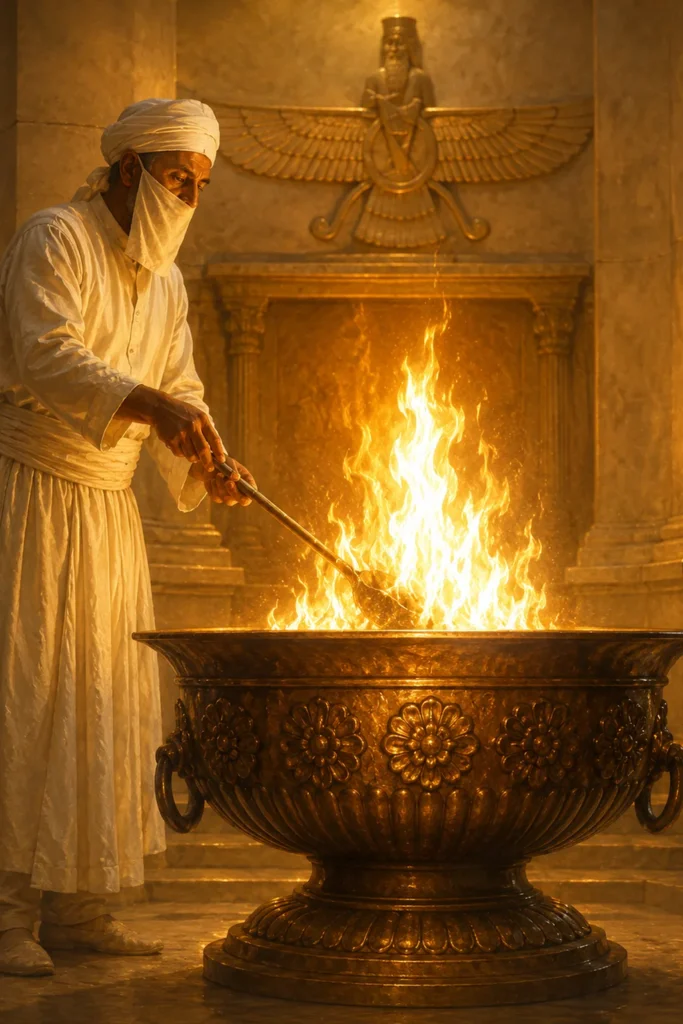
In Zoroastrianism, fire is not a god but a symbol and bearer of purity and divine order. In the temples, often referred to from the outside as fire temples, a consecrated fire is permanently maintained and tended by priests.
The highest grade of such a fire, Atash Bahram, comes about through a lengthy ritual in which fire from several sources is united and purified.
The centre of the main cult is the Yasna, a liturgy lasting several hours, in which a priest recites the Avestan texts and performs ritual acts with water, plants and the juice of the haoma plant. Alongside this there are shorter devotions and household prayers that lay people perform themselves.
Notions of purity run through daily life. Death and decay are regarded as the strongest attack of the destructive power. For this reason, corpses should not defile the pure elements earth, water and fire. From this logic arose burial in the so-called towers of silence, dakhma, on which bodies were left to carrion birds.
In the modern era this practice is in many places only limited or no longer possible at all, so that burials in specially sealed graves or cremations also occur, which is controversial within the community.
The ritual calendar is shaped by fixed festivals. The best known is Nouruz, the New Year festival at the spring equinox, which is celebrated far beyond the religious community in Iran and neighbouring countries.
In addition there are the six Gahanbar festivals, which correspond to the stages of creation, as well as commemoration days for the deceased. These festivals connect cosmology, the agricultural year and community life.
After the Arab-Islamic conquest of Iran in the 7th century, Zoroastrianism lost its position as state religion and became, over the centuries, a small minority.
A part of the faithful migrated to India, according to tradition around the 8th to 10th century. Their descendants are the Parsis, who settled above all in the region around Gujarat and later in Mumbai.
Under British rule the Parsis developed a prosperous, education-oriented community with its own foundations, schools and temples.
At the same time, their small numbers, a low birth rate and a strict rule of descent led to a steady demographic decline that continues to this day and is discussed controversially within the community, for example on the question of whether children from marriages with non-Zoroastrians are admitted.
In Iran itself a smaller community remained, the Iranis, with centres in Yazd, Kerman and Tehran. It long lived under legal disadvantages, but is today constitutionally represented as a recognised religious minority, although very small in number. In addition there are communities in the diaspora, above all in North America, Great Britain and Australia.
The scholarly study of the religion is closely tied to names such as Mary Boyce, whose field research among Iranian Zoroastrians in the 1960s and whose multi-volume history of the religion remain standard works to this day.
Later researchers such as Jenny Rose or Albert de Jong have refined the picture and emphasised above all the diversity of practice.
An adequate account must present Zoroastrianism as a living, if endangered, present-day religion and not merely as an ancient phenomenon. There are points of contact with the cultural area treated in the hub Mesopotamia.
Related key terms: Zarathustra Avesta Ahura Mazda Angra Mainyu Faravahar Kushti Sudreh Amesha Spentas Yazatas Asha Druj Gathas Yasna.
The Zoroastrian-Iranian tradition accompanies its wearers through the sacred shirt Sudreh and the sacred cord Kushti; the Faravahar serves as a visible sign of identity and protection, complemented by Avesta-verse pendants and protective amulets.
iWell Guard fits into this cultural-historical line of wearable means of protection, in a contemporary material architecture, made in Germany. 41 layers, solid gold, platinum, silver. 30-day right of return.
Personal experiences may vary. Not a medical device. No promise of healing.
The lexicon of protective symbols covers several signs and objects from Iran and Zoroastrianism on dedicated pages: Faravahar and Kushti. A cross-cultural overview is provided by the page on protective symbols.