Aeshma, the Daeva with the Bloody Club
By Ralf Ittermann · last reviewed on
Aeshma is a demon of the Persian tradition.
The daeva of wrath with the bloody club, messenger of Ahriman.
Aeshma is the Zoroastrian daeva of wrath and violence, embodying blood lust, war fury and drunkenness. As Ahriman’s messenger, he corrupts sacrifice, sows discord and besets souls at the Chinvat Bridge.
He is attested as early as the Gathas, the oldest part of the Avesta, and appears widely in the Younger Avesta and in Pahlavi literature. His name means wrath, rage or fury and denotes both the demon and the trait active within human beings.
Type: daeva of wrath and violence, messenger of Ahriman
Origin: Zoroastrian tradition of the Iranian region
Texts: Gathas, Younger Avesta, Pahlavi literature
Period: from the Gathas to the Pahlavi era
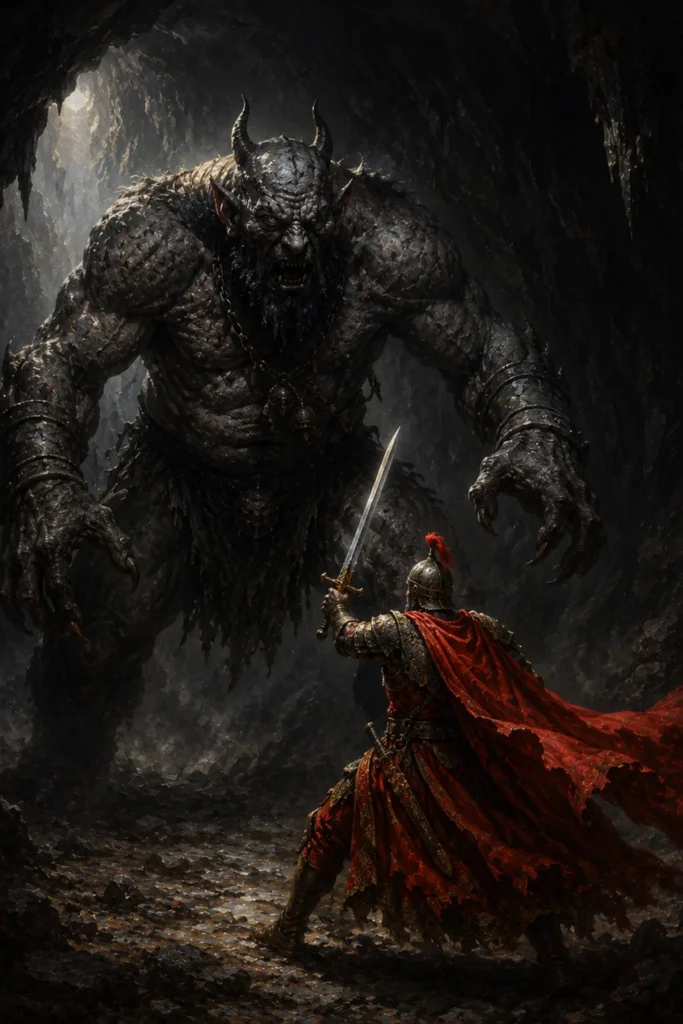
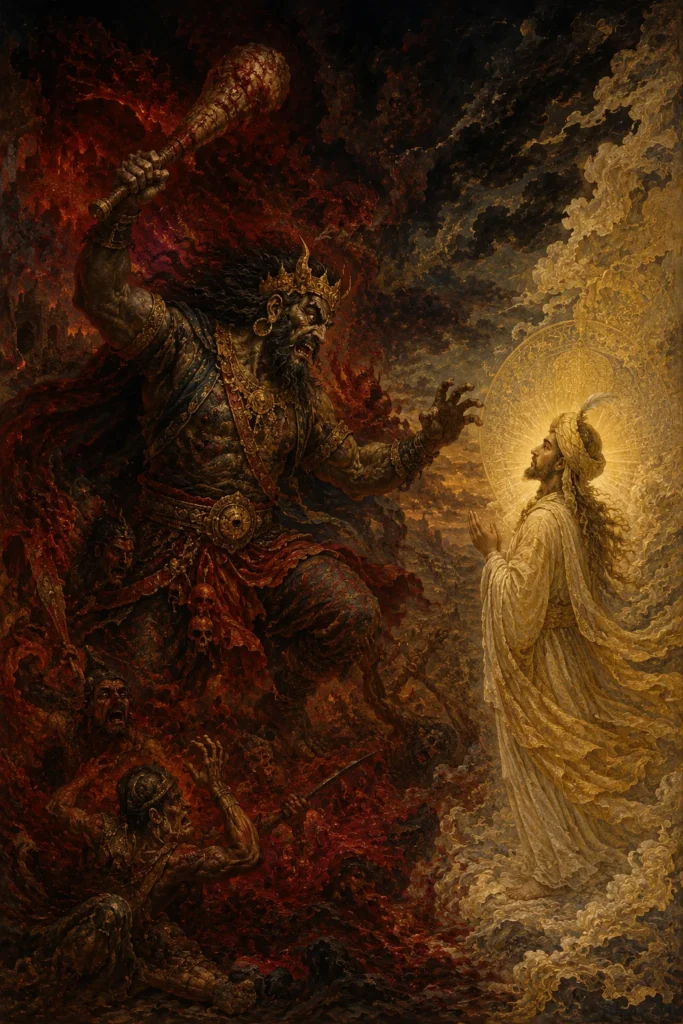
Appearance: the demon with the bloody club
Textual history
Period of the Texts
Zoroastrian from the Gathas to Pahlavi literature: Aeshma is attested as early as the oldest Avesta and remains present into the Middle Persian books.
Area of Diffusion
The Iranian region: Aeshma belongs to the established stock of the Zoroastrian world of demons and its texts.
Sources
Well documented: the Avesta from the Gathas to the Younger Avesta, Pahlavi literature and the Encyclopaedia Iranica.
Name and variants
Avestan: aeshma, wrath, rage or fury. The word denotes both the demon and the trait active within human beings; in Middle Persian it is eshm, in New Persian khashm, wrath, still today.
Nature and effect
Appearance
His standing epithet is the one with the bloody club, deliberately contrasted with the yazata Sraosha, who bears the strong club. Further epithets include malicious and possessor of the Lie; his offspring is described, in a late source, as having tangled hair.
Effect
Aeshma is the demon of wrath, violence, blood lust, war fury and drunkenness, and messenger of Ahriman. He corrupts sacrifice through cruelty toward cattle, sows discord and besets souls at the Chinvat Bridge; he is closely linked to Az, greed.
Profile: Aeshma
The key aspects of the demon of wrath at a glance.
A daeva of the Zoroastrian belief world, attested from the Gathas to Pahlavi literature; his name is at the same time the word for wrath.
Wrath, violence, blood lust, war fury and drunkenness; his targets are humans, cattle and the souls at the Chinvat Bridge.
The one with the bloody club, malicious and possessor of the Lie; his offspring is described, in a late source, as having tangled hair.
Messenger of Ahriman: he corrupts sacrifice through cruelty toward cattle, sows discord and is closely linked to Az, greed.
The pious rites that Aeshma fears, and the worship of Ahura Mazda; his chief opponent is the yazata Sraosha.
The Manichaean Eshm as a destructive spirit of greed; via the debated Asmodeus connection, the name extends into Western demonology.
From the word for wrath to Ahriman's messenger
Avestan aeshma means wrath, anger or fury and denotes both the demon and the trait active within the human being: the daeva and the emotion share the same name. In Middle Persian this became eshm, in New Persian khashm, which still means anger today.
Aeshma is already attested in the Gathas, the oldest part of the Avesta, and widely in the Younger Avesta and in Pahlavi literature. His standing epithet, he of the bloody club, is deliberately set against the Yazata Sraosha, who bears the strong club: the demon of wrath is confronted by obedience as his armed adversary.
From Aeshma to Asmodeus: the reception
In the Western tradition, Aeshma is present as Asmodeus, the demon of lust and wrath; popular depictions often distort him. In Manichaeism, Eshm became the destructive spirit of greed.
From a religious-studies perspective, Aeshma is a daeva of wrath. Three clarifications: the derivation of Aeshma to Asmodeus in the Book of Tobit is a hypothesis, not an established fact, since the presumed compound form is not attested in the surviving Avesta. The Hebrew root derivation is regarded as folk etymology. And the thesis remains debated.
Sraosha, Mithra and the pious rites
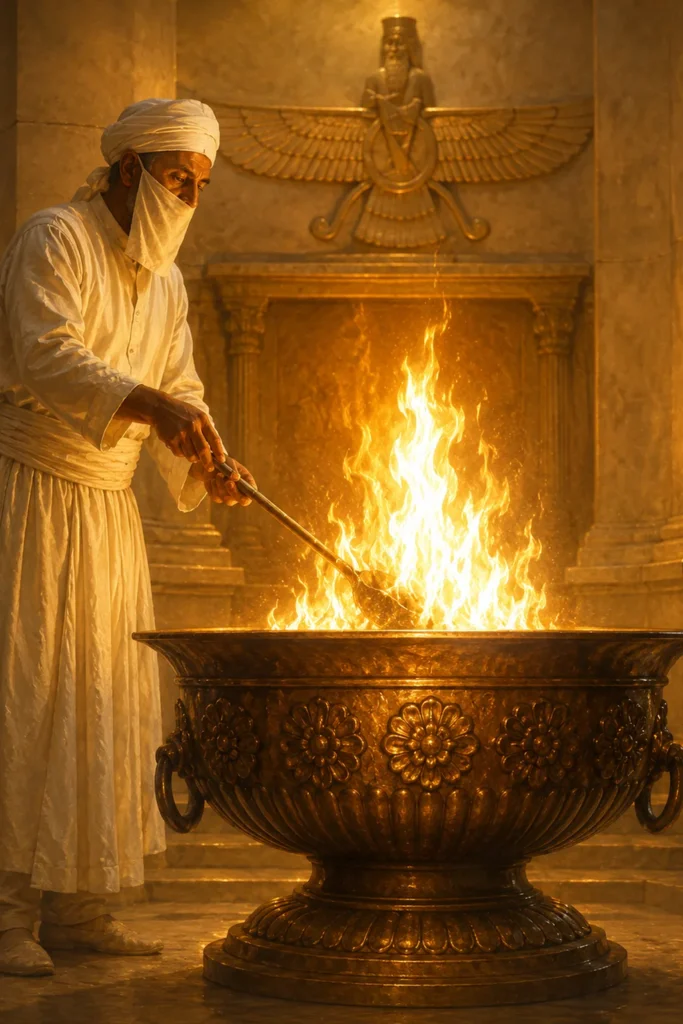
His chief adversary is the Yazata Sraosha, obedience and devotion, who casts Aeshma down at the end of the world; this victory is also attributed to Mithra. Aeshma fears the pious rites and flees before the Saoshyant on the Last Day. Protection is granted by the veneration of Ahura Mazda and by proper ritual: according to Zoroastrian understanding, ordered piety itself is what helps against the demon of wrath.
From Eshm to the Asmodeus line
In Manichaeism, Eshm became the destructive spirit of greed. Via the Asmodeus line, Aeshma extends, according to the widespread but debated hypothesis, into Western demonology: the demon Asmodai of the Book of Tobit is often traced back to him, though this derivation is not established. Within the Persian tradition, Aeshma stands alongside the demon class of the Div, the seductress Pairika and the drought demon Apaosha.
Frequently asked questions about Aeshma
Who is Aeshma?
The Zoroastrian daeva of wrath and violence, messenger of Ahriman. He embodies bloodlust, warlike fury and drunkenness, and assails souls at the Chinvat Bridge.
What is his distinguishing feature?
The bloody club. The epithet is deliberately set against the strong club of the Yazata Sraosha, his chief adversary.
Is Aeshma the same as Asmodeus?
This is a plausible but debated hypothesis, not an established fact. The presumed compound form is not attested in the surviving Avesta.
Further links
Further reading:
- Div – the demon class of Persian mythology
- Apaosha, Pairika – further beings of the Persian tradition
- Asmodai – the Western demon of the debated Asmodeus line
- Holy Water, Amulet, Iron – traditional protective means
- Protection Compass – an overview of protective means
Literature (selection)
Further standard works in the bibliography.
As the Zoroastrian demon of wrath, Aeshma is the daeva in whom a feeling itself becomes a demonic person: wrath bears the bloody club, and its counter-remedy is ordered devotion.