Apaosha, the black horse of drought
By Ralf Ittermann · last reviewed on
Apaosha is a demon of the Persian tradition.
The drought demon who withholds the rain at the sea Vourukasha.
Apaosha is the Zoroastrian demon of drought and dryness, the adversary of the rain star Tishtrya. In the mythical rain battle at the sea Vourukasha, the two fight over the rain, which Apaosha seeks to withhold.
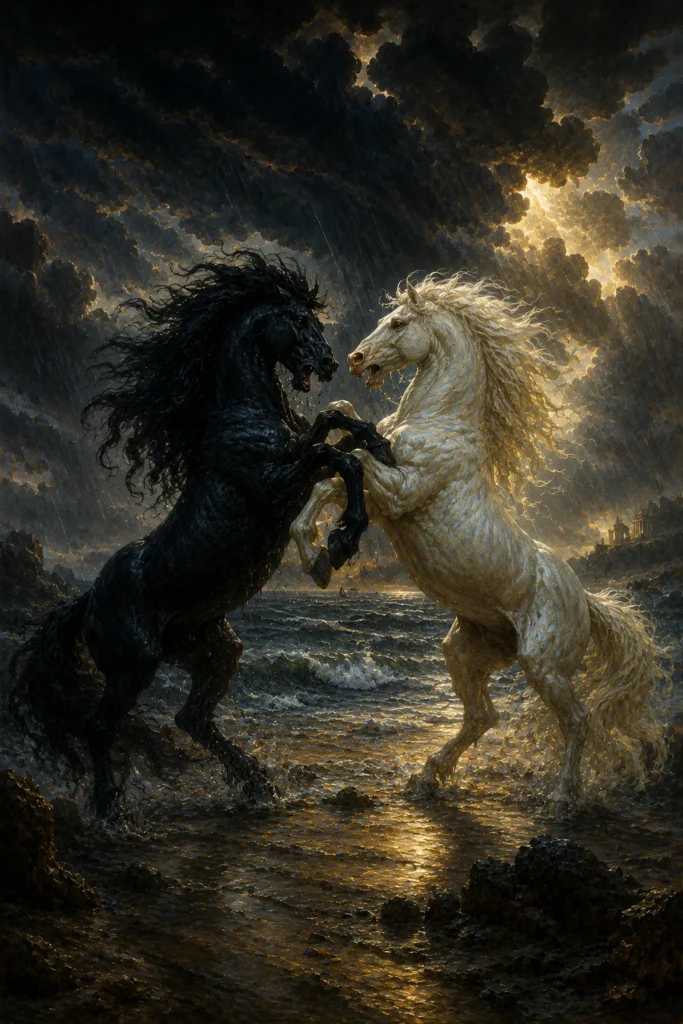
He is chiefly transmitted in the Tishtar Yasht, Yasht 8, of the Younger Avesta, supplemented by Pahlavi literature. In the rain battle, Apaosha appears as an ugly black horse, his adversary Tishtrya, the star Sirius, as a magnificent white horse.
Type: Demon of drought and infertility
Origin: Zoroastrian tradition of the Iranian region
Texts: Tishtar Yasht (Yasht 8) in the Younger Avesta, Pahlavi literature
Period: Younger Avesta to Pahlavi era
Appearance: ugly black horse with black ears and a black tail
Region of origin and sources
Period of the Texts
Zoroastrian, Younger Avesta: the central source is the Tishtar Yasht, Yasht 8, supplemented in Pahlavi literature.
Area of Diffusion
The Iranian region, whose fields and waters Apaosha threatens with drought and infertility.
Sources
Well documented: the Tishtar Yasht, the Bundahishn of the Pahlavi tradition, and the Encyclopaedia Iranica.
Name and variants
Avestan: Apaosha, Middle Persian Aposh. The interpretation now considered authoritative reads a-pausha, not thriving, or infertile; this is the only etymology regarded as tenable.
Appearance and behaviour
Appearance
In the rain battle at the mythical sea Vourukasha, Apaosha appears as an ugly black horse with black ears and a black tail. His adversary Tishtrya, the star Sirius, confronts him as a magnificent white horse with golden ears and a golden tail.
Effect
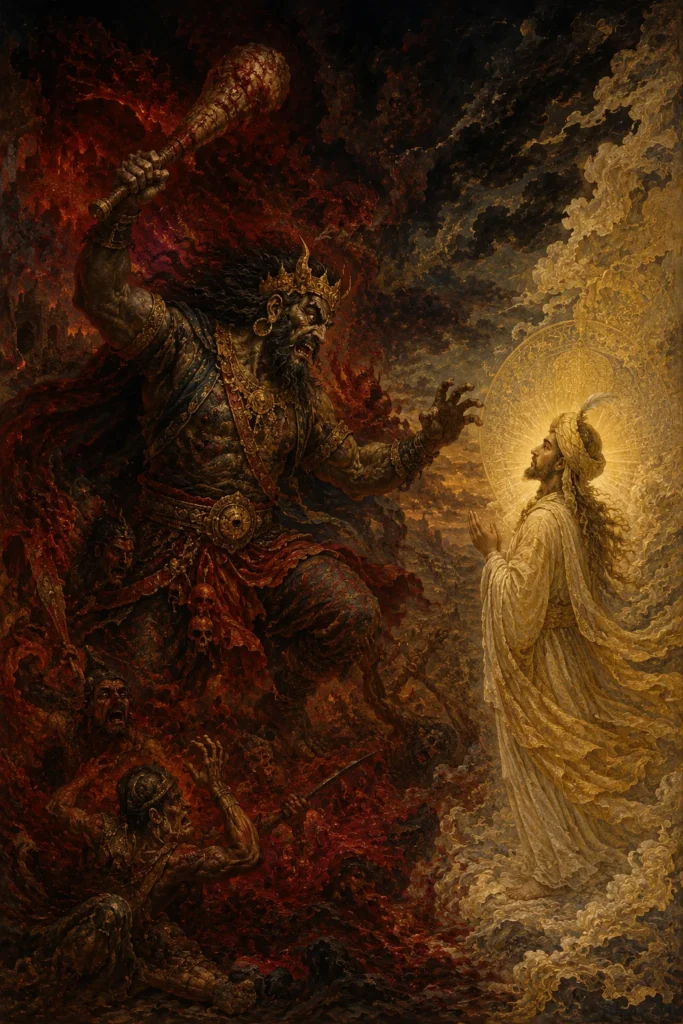
Apaosha brings drought and infertility. In the course of the myth, Tishtrya descends to the sea as a white horse, but Apaosha first defeats him and drives him away, because Tishtrya was too little venerated. Tishtrya prays for greater veneration, Ahura Mazda himself brings him an offering and strengthens him, and thus strengthened, Tishtrya beats Apaosha back, so that the rain flows.
Profile: Apaosha
The most important aspects of the drought demon at a glance.
Demon of the Younger Avesta and adversary of the rain star Tishtrya; his myth is recorded in the Tishtar Yasht, Yasht 8.
Fields and waters: Apaosha brings drought and infertility by seeking to withhold the rain.
An ugly black horse with black ears and a black tail, the counterpart to Tishtrya’s white horse with golden ears.
The mythical counterpart in the rain battle at the sea Vourukasha: as long as Apaosha prevails, the rain fails to come.
Ritual invocation and offerings for Tishtrya; he is aided by Vata, the wind, and by the Khvarenah, the divine glory of fortune.
The Indian Vritra, who holds back the waters and is slain by Indra; the parallel is thematic, not etymologically established.
The rain battle at the sea Vourukasha
In Avestan the demon is called Apaosha, in Middle Persian Aposh; the interpretation now considered authoritative reads a-pausha, not thriving, or infertile. The central source is the Tishtar Yasht, Yasht 8, in the Younger Avesta, supplemented in Pahlavi literature.
The myth tells the rain battle in a clear sequence: Tishtrya descends to the sea Vourukasha as a white horse, but Apaosha first defeats him and drives him away, because Tishtrya was too little venerated. Tishtrya prays for greater veneration, Ahura Mazda himself brings him an offering, and thus strengthened, Tishtrya beats the drought demon back, so that the rain flows. The point of the myth: the god prevails only because he is offered sacrifice.
Afterlife and interpretation
Today Apaosha appears mainly in fantasy and gaming contexts as well as in mythology overviews, usually as an appendage to the Tishtrya story.
In the study of religion, Apaosha is the demon of drought. Three clarifications: the primary sources say disfigured and black, not bald or mangy. The late Zoroastrian equation with the planet Mercury is not Avestan. And the etymology ‘not thriving’ is not viable on its own.
Offerings for Tishtrya: protection from drought
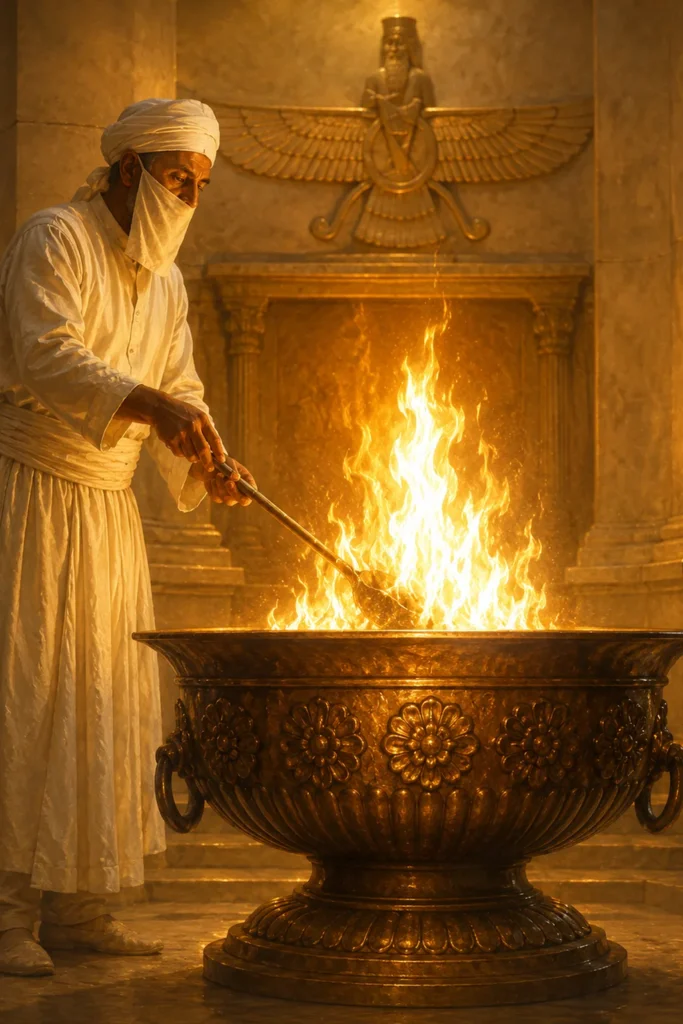
Protection from Apaosha lies in ritual invocation and in offerings to Tishtrya. Tishtrya’s helpers are Vata, the wind, and the Chwarenah, the divine glory of fortune; the Pahlavi version additionally names the Fravashis of the faithful. The myth itself gives the grounds for this practice: Tishtrya is defeated at first because he was insufficiently venerated, and only triumphs after Ahura Mazda has made an offering to him.
Vritra and the Persian neighbours
Apaosha is often compared to the Indian Vritra, the dragon who withholds the waters and is slain by Indra; this parallel is thematic, not etymologically confirmed. Within the Persian tradition he stands alongside the demon class of the Div, the wrath demon Aeshma, and the Pairika, who in her early form likewise prevented rain.
Frequently asked questions about Apaosha
Who is Apaosha?
The Zoroastrian demon of drought, opponent of the rain star Tishtrya. He seeks to withhold rain and brings barrenness to fields and waters.
What does Apaosha look like?
As an ugly black horse with black ears and a black tail, in battle against Tishtrya’s white horse with golden ears and a golden tail.
How is he defeated?
Only after Ahura Mazda makes an offering to Tishtrya and strengthens him does Tishtrya strike Apaosha back, so that the rain flows.
Further links
Further reading:
- Div – the demon class of Persian mythology
- Aeshma, Pairika – further beings of the Persian tradition
- Holy Water, Amulet, Salt – traditional protective means
- Protection Compass – protective means at a glance
Literature (selection)
Further standard works in the Bibliography.
As a Zoroastrian drought demon who confronts the rain star in the form of a black horse, Apaosha embodies a fundamental experience of the Iranian region: without rain there is no growth, and without offering there is no rain.