iWell Guard

Kushti: the sacred braided girdle of the Zoroastrians

The Kushti is a sacred braided girdle made of wool. The Zoroastrians wear it around the waist, wound over the white shirt called Sedreh. The girdle and the shirt are among the most important signs of the Zoroastrian faith.

Protective symbolIran and ZoroastrianismSacred girdle
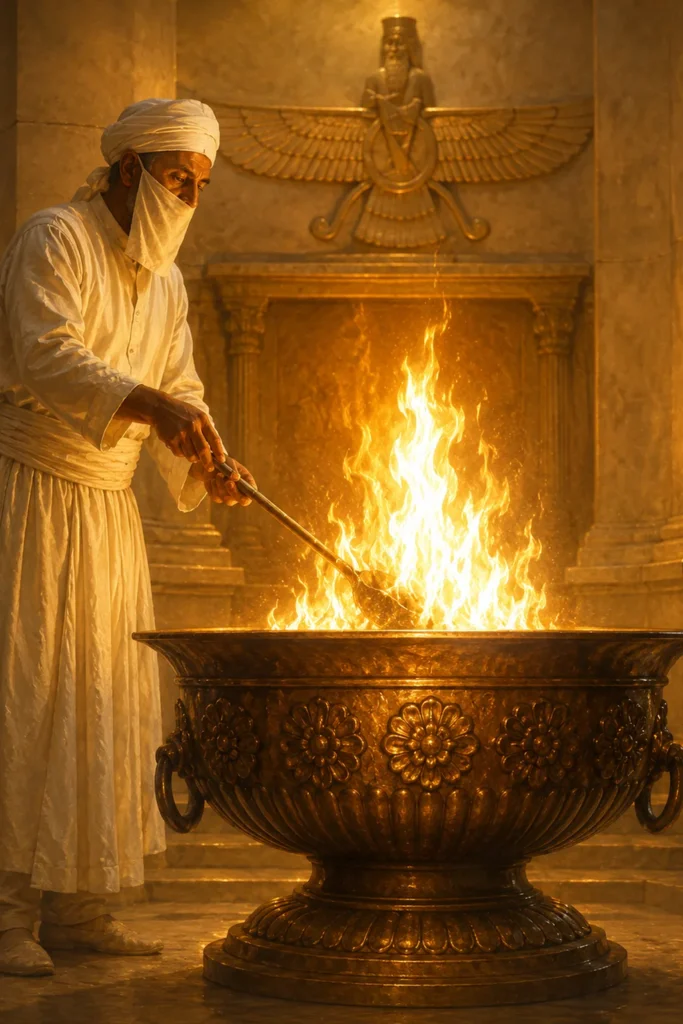
Kushti, protective symbol, museum-style illustration

Classification

The Kushti is a sacred girdle. It belongs to the religion of Zoroastrianism, one of the oldest religions still in existence, which has its origin in the world of Iran and Zoroastrianism.

The Kushti is a thin braided girdle made of wool. It is wound several times around the waist and tied in front of the body.

The Kushti is worn over the Sedreh, a white shirt. Shirt and girdle belong together and jointly form the most important visible sign of the Zoroastrian faith.

The Kushti is not put on a single time but is loosened and retied several times a day. This repeated tying is connected with prayers and forms part of daily religious life.

The girdle has a protective purpose. It is regarded as a sign that arms its wearer against evil and binds him to his religious duties.

In religious studies the Kushti is a good example of a sacred girdle, a holy garment that marks the believer and at the same time protects and obligates him.

Zoroastrianism

The Kushti belongs to Zoroastrianism. This religion goes back to its founder Zarathustra, who lived in early Iran. His exact dating is disputed among scholars.

Zoroastrianism was for a long time the major religion of the Iranian empires. It shaped the religious life of large parts of ancient Iran.

At the center of Zoroastrianism stands the belief in the one good god Ahura Mazda. He is opposed by an evil power. The world is a field of conflict between good and evil.

Humanity is placed within this conflict. Through good thoughts, good words and good deeds, a person is to stand on the side of good and push back evil.

After the spread of Islam in Iran, Zoroastrianism became the religion of a minority. A portion of the believers emigrated to India, where they became known as the Parsis.

Zoroastrianism thus continues to exist to this day, carried by a community in Iran, in India and in further countries. The Kushti is among the signs that bind this community together.

Sedreh and Kushti

The Kushti belongs inseparably together with the Sedreh. The Sedreh is a white shirt, the Kushti is the girdle worn over this shirt.

The Sedreh is a plain white cotton shirt. The white color stands for purity, a central idea of Zoroastrianism.

According to tradition the shirt bears a small pocket on the front. This pocket has a symbolic meaning. It is to be filled with the good deeds that the believer gathers.

The Kushti is wound over the Sedreh. Shirt and girdle complement one another. The shirt clothes the believer, the girdle girds him and binds him.

Both pieces are put on for the first time at a dedicated ceremony. This ceremony marks admission into the community of believers.

Sedreh and Kushti are thus the two garments by which the Zoroastrian believer is recognized. They are the visible sign of belonging to the religion.

Making the girdle

The Kushti is made with great care. Its manufacture follows a fixed order and is connected with meanings.

The girdle is made of wool, usually sheep’s wool. The wool of a pure animal was regarded as a suitable material for a sacred girdle.

The Kushti is not a simple band but is braided from numerous threads. Tradition names a particular number of threads that are joined together into the girdle.

This number of threads carries a symbolic meaning. It is associated with fundamental ideas of the faith and makes the girdle itself a sign of the teaching.

The braiding of the Kushti was traditionally among the tasks of women from priestly families. Its manufacture was thus itself a religiously ordered activity.

The finished girdle is a narrow, long band. Despite its plain appearance, through its manufacture and through the number of its threads it is a substantial religious sign.

The daily tying

The Kushti is not put on a single time. It is loosened and retied several times a day. This repeated tying belongs to daily religious life.

The loosening and retying of the girdle takes place on particular occasions, for instance after rising, before prayers and before meals.

The tying is accompanied by prayers. While the believer loosens the girdle and winds it anew, he speaks traditional prayer texts.

This connection of action and prayer gives the tying its meaning. With each tying the believer renews his confession and his orientation toward the good.

The tying of the Kushti is thus a recurring reminder. Several times a day the believer is reminded of his faith, of his duties and of the conflict between good and evil.

In this daily tying it becomes clear that the Kushti is no mere ornament. It is a girdle that, through its repeated tying, orders and accompanies the believer’s religious life.

The girdle as a sign of protection

The Kushti has a protective purpose. It is regarded as a sign that arms its wearer and strengthens him against evil.

The idea of girding is essential here. Whoever puts on a girdle arms himself, as it were, for a task. The girded person is ready, the ungirded one is not.

The Kushti girds the believer for the conflict between good and evil. It is the sign that the wearer stands on the side of good and is armed for the struggle against evil.

At the same time the girdle divides the body. The upper part is associated with the higher things, the lower part with the lower things. The Kushti is the dividing line between them.

The protection of the Kushti is therefore not a warding protection like that of a frightening image. It is a protection through arming and through binding to the good.

The Kushti thus belongs to the sacred girdles that protect through girding. It arms the believer, it binds him to his duties and places him on the side of good.

Sacred girdles in the religions

The Kushti can be viewed within the larger context of sacred girdles. The girdle as a religious sign is known from several traditions.

In numerous cultures girding is connected with the notion of readiness. To gird oneself means to arm oneself and to confront a task.

The Kushti gives this widespread idea a particularly pronounced form. It is a girdle that is specially made, tied several times daily and connected with prayers.

Within the Iranian world the Kushti stands in connection with further Zoroastrian signs. The most important among them is the Faravahar, the winged emblem. It is depicted on the page about the Faravahar.

While the Faravahar is a pictorial sign, the Kushti is a worn sign. Both belong to the world of Zoroastrianism, yet they are of different kinds.

The Kushti is thus the Zoroastrian expression of the sacred girdle. It combines the widespread idea of girding as arming with the particular teaching and the particular order of Zoroastrianism.

Confession and obligation

The Kushti is more than a sign of protection. It is at the same time a confession and an obligation. Both sides belong to its meaning.

As a confession the Kushti makes the believer visible. Whoever wears it over the Sedreh shows his belonging to the Zoroastrian community.

As an obligation the Kushti binds the believer to his duties. The daily tying reminds him of the good thoughts, the good words and the good deeds that are expected of him.

These three good things form the core of the Zoroastrian way of life. The Kushti holds them before the believer’s eyes several times a day.

Confession, obligation and protection cannot be strictly separated in the case of the Kushti. Whoever confesses the faith and binds himself to his duties thereby also places himself under the protection that belongs to the good.

The Kushti is thus a multilayered sign. It is a sign of confession, a sign of obligation and a sign of protection in one, and all three sides derive from its place in the Zoroastrian faith.

Reception today

Zoroastrianism today is the religion of a small community. Its adherents live above all in India, where they are called Parsis, as well as in Iran and in further countries.

Sedreh and Kushti remain among the most important signs of the Zoroastrian faith to this day. The first putting on at the admission ceremony is a significant event in the life of a believer.

Many practicing Zoroastrians wear Sedreh and Kushti and tie the girdle several times a day. The Kushti is thereby a living sign that is present in everyday life.

At the same time the Zoroastrian community faces the challenge of its small numbers. Questions about the transmission of the tradition are discussed within the community.

For religious studies the Kushti is an instructive sign. It shows how a garment can become the carrier of a teaching, a confession and an idea of protection.

The Kushti thus remains a striking example of a sacred girdle. In it the arming against evil, the confession of faith and the daily tying that reminds the believer of his duties are joined together.

Literature (selection)

  • Mary Boyce: Zoroastrians. Their Religious Beliefs and Practices (1979)
  • Mary Boyce: A History of Zoroastrianism (1975 to 1991)
  • Jenny Rose: Zoroastrianism. An Introduction (2011)
  • Michael Stausberg: Die Religion Zarathushtras. Geschichte, Gegenwart, Rituale (2002)
  • Jamsheed K. Choksy: Purity and Pollution in Zoroastrianism (1989)

Related key terms: Kushti Sedreh Zoroastrianism sacred girdle Parsis Ahura Mazda wool girdle Zarathustra Faravahar.

iWell Guard and protective traditions

iWell Guard stands within the cultural-historical line of wearable protective objects to which the Kushti girdle also belongs. A modern companion for people who live with protective symbols: made in Germany, 41 layers of solid gold, platinum and silver, with a 30-day right of return.

Personal experiences may vary. Not a medical device. No promise of healing.