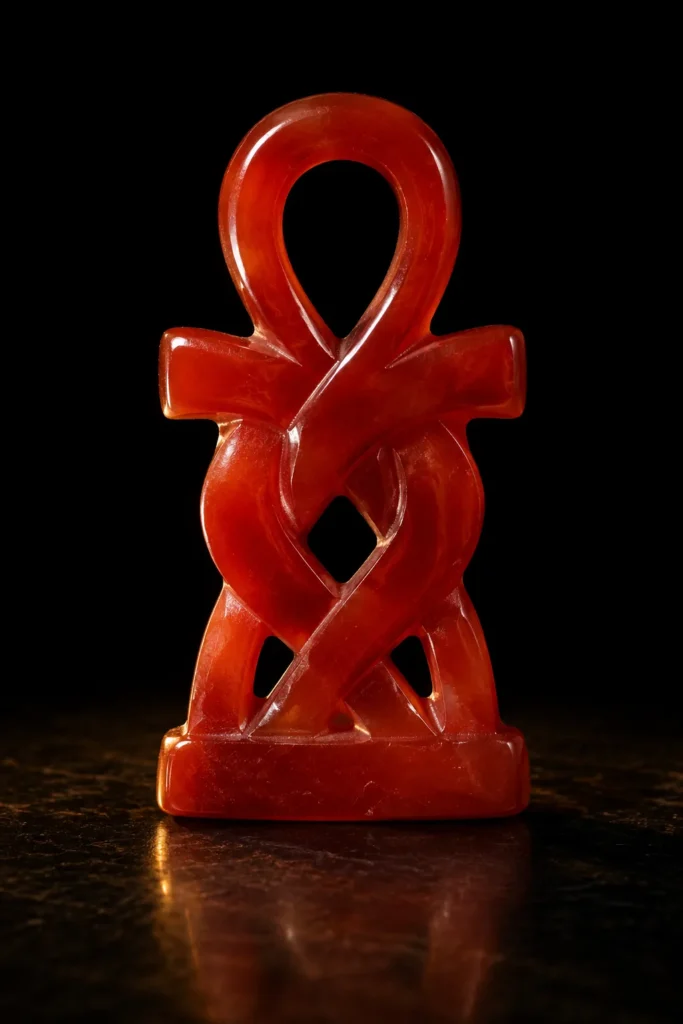
The Faravahar: the Winged Symbol of Zoroastrianism
By Ralf Ittermann · last reviewed on
The Faravahar is the best-known symbol of Zoroastrianism, one of the oldest living religions in the world. The winged figure is connected with the concept of the fravashi, the spiritual companion and guardian spirit of the human being.

Classification
The Faravahar is the best-known emblem of Zoroastrianism. It depicts the figure of a man rising from a large, horizontally spread winged disk. This winged figure is today the symbol by which Zoroastrianism is widely recognized.
Zoroastrianism is a very old religion that arose in the Iranian world. It belongs to the oldest religions that have remained alive to this day. The Faravahar is connected with this long history.
The name Faravahar is linked with a central concept of Zoroastrian teaching: the fravashi. The fravashi is the spiritual companion and guardian spirit that, according to Zoroastrian belief, belongs to every human being. In this connection lies the protective significance of the symbol.
In religious studies, the Faravahar is a prime example of a symbol whose precise interpretation is disputed and whose history reaches far back into antiquity. A factual presentation distinguishes the established from the interpreted and names the open questions.
The Faravahar is a good example of how a symbol can be simultaneously very well known and uncertain in its meaning. Almost everyone who engages with Zoroastrianism recognizes the winged symbol immediately.
At the same time, it cannot be stated with certainty what it originally depicted. This tension between wide recognition and uncertain interpretation is instructive. It cautions against prematurely fixing a familiar symbol to a single, seemingly settled meaning.
Zarathustra and Zoroastrianism
Zoroastrianism goes back to the founder Zarathustra, who was active in the Iranian world. Scholarly opinion varies on the precise period of his life, but it is certain that he belongs to a very early era.
At the center of Zoroastrian teaching stands the god Ahura Mazda, the Wise Lord. He is the creator and the god of goodness, light, and truth. Opposing him is a destructive, evil power.
Zoroastrian teaching understands existence as a framework in which good and evil stand opposed to one another. The human being is placed within this framework and called to side with the good and to contribute to its victory.
Zoroastrianism has undergone many changes over the millennia, and the number of its adherents is small today. Nevertheless, it has remained a living religion, with communities in the Iranian world, in India, and in many other countries. The Faravahar is their unifying symbol.
Zoroastrianism has influenced the history of religion far beyond the Iranian world. Ideas about the opposition between good and evil, about a final judgment, and about a future victory of the good also appear in other religions, and scholarship has discussed possible connections at length.
Zoroastrianism thus belongs among the most historically significant religions of all. The Faravahar is the visible symbol of this ancient and influential tradition.
The Form of the Faravahar
The Faravahar has a clearly structured form. The upper part is formed by the figure of a bearded man. He is depicted in a dignified posture, one hand raised, the other often holding a ring.
From the figure of the man grows a large, horizontally spread winged disk. The two wings are divided into several rows of feathers. These wings are the most distinctive feature of the Faravahar and give it its unmistakable appearance.
Below the figure the symbol continues in a central section and in two lateral projections that recall legs or a tail. These parts are also divided into rows of feathers. The entire Faravahar is symmetrically arranged around a central axis.
This form has remained essentially unchanged over a long period. The Faravahar is thus a clearly defined, stable symbol. Its balanced, winged form makes it immediately recognizable and has contributed to its wide renown.
The individual parts of the Faravahar receive careful attention in contemporary interpretation. The ring in the hand of the figure, the raised arm, the feather rows of the wings, and the two downward-pointing projections are each given their own interpretation.
These interpretations are thoughtful and meaningful for believers. Many of these individual readings, however, are of more recent origin. The ancient, original meaning of the individual parts is not established with the same degree of certainty.
Origin: the Winged Disk
The Faravahar did not arise from nothing. Its form goes back to an older pictorial motif, the winged disk. This motif was widespread throughout the ancient Near East and very old.
The winged disk appears already in Egyptian and Mesopotamian art, where it was associated with the sky, the sun, and divine or royal powers. The motif traveled across cultures and was adapted in many ways.
In the art of the ancient Persian empire, above all under the Achaemenid dynasty, the winged disk appears in a distinctive form, often with a figure within it. The modern Faravahar derives from this ancient Persian form.
The Faravahar thus has a dual root. It belongs to the Zoroastrian religion, and it also stands within the long pictorial tradition of the winged disk of the ancient Near East. This origin explains why the symbol appears so ancient and yet so clearly composed.
The winged disk is one of the most enduring pictorial motifs in human history. Across millennia and many cultures it stood for the sky, the sun, and divine or royal power.
The fact that the Faravahar emerged from this ancient motif connects it with a very long pictorial tradition. It is therefore not only a Zoroastrian symbol but also a late branch of a pictorial history reaching back to the earliest civilizations of the ancient Near East.
The Fravashi, the Guardian Spirit
The name Faravahar is linked with the concept of the fravashi. The fravashi is an important notion in Zoroastrian teaching and is directly connected with the idea of protection.
The fravashi is the spiritual component or spiritual companion that, according to Zoroastrian belief, belongs to every human being. It is understood as a primordial, higher part of the person that at the same time watches over the person as a guardian spirit.
The fravashis are venerated and invoked in the Zoroastrian tradition. A dedicated portion of the year and of prayers is set aside for them. They are regarded as helpers and protectors who assist human beings and the cause of the good.
When the Faravahar is connected with the fravashi, the symbol acquires a clear protective significance. It then stands for the spiritual companion and protector of the human being. In this way the Faravahar belongs within the broader context of protective symbols, even though it is far more than a mere protective amulet.
The concept of the fravashi is one of the most striking teachings of Zoroastrianism. The fravashi is a higher, primordial part of the person that at the same time watches over that person as guardian spirit.
The fravashis of all human beings, the living, the deceased, and those yet unborn, are conceived as a great host participating in the struggle for the good. In this teaching the idea of personal protection is joined with a comprehensive, cosmic order.
The Disputed Interpretation
Caution is warranted when interpreting the Faravahar. As well known as the symbol is, its precise meaning is equally ambiguous. Scholarship maintains several interpretations side by side.
One interpretation connects the Faravahar, as its name suggests, with the fravashi, the spiritual companion and guardian spirit. Another interpretation relates the symbol to a notion of divine radiance and divine distinction. A further interpretation sees in the figure an image of the god Ahura Mazda himself.
This uncertainty has several causes. The pictorial motif is very old and was used over a long period, possibly with shifting meaning. The ancient sources do not explain the symbol explicitly. Much must therefore be inferred.
An honest presentation names this open situation. The Faravahar is an ancient, meaningful symbol whose precise original interpretation is not established with certainty. This uncertainty does not diminish its significance, but it belongs to any candid description of the symbol.
The fact that several interpretations of the Faravahar stand side by side is not a failure of scholarship but a consequence of the available sources.
The pictorial motif is old, it was used for a long time, and the early texts do not explain it. One interpretation sees the fravashi, another a notion of divine radiance, a third the god Ahura Mazda himself.
The symbol may even have carried more than one meaning over the course of its long history. An honest presentation keeps this openness in view.
Good Thoughts, Good Words, Good Deeds
In contemporary Zoroastrianism the Faravahar is frequently interpreted in the light of this religion’s central ethical teaching. This teaching can be summarized in a brief formula that speaks of good thoughts, good words, and good deeds.
These three are inseparable in Zoroastrian ethics. A person is called to choose the good in thinking, in speaking, and in acting. This threefold orientation toward the good lies at the heart of the Zoroastrian way of life.
Many modern Zoroastrians interpret parts of the Faravahar in light of this teaching. For example, the three large rows of feathers on the wings are associated with good thoughts, good words, and good deeds. Other parts of the symbol also receive a moral interpretation.
This detailed moral reading is above all a modern interpretation carried by contemporary Zoroastrians. It is meaningful for believers and belongs to the living present of the symbol. It should not, however, be presented without qualification as the original, ancient meaning.
The formula of good thoughts, good words, and good deeds is the most concise expression of Zoroastrian ethics. It calls on the person to choose the good at all three levels: inwardly, in speech, and in action.
This teaching makes the human being a participant in the victory of the good. When modern Zoroastrians interpret parts of the Faravahar in light of this formula, they connect the symbol with the core of their faith. The symbol thus becomes a constant reminder of the good life.
The Faravahar as a Symbol of Identity
For the Zoroastrian community the Faravahar is today above all a symbol of identity. It makes belonging to this ancient religion visible and connects believers with one another across national borders.
Zoroastrians today live scattered across many countries: in the Iranian world, in India, and in a worldwide diaspora. In this situation a shared, clearly recognizable symbol holds great value. The Faravahar fulfills this unifying role.
Beyond the religious community, the Faravahar has also become a more general symbol. In the Iranian world it is understood by many as an emblem of pre-Islamic history and cultural roots, including by people who do not belong to the Zoroastrian religion.
In this way the Faravahar has attained a position similar to that of other great religious symbols. It is at once a symbol of faith and a symbol of identity. In it the history of an ancient religion and the contemporary self-understanding of its followers converge.
For a small, globally dispersed religious community a shared symbol has particular value. It creates visibility and cohesion across great distances. The Faravahar fulfills this role for Zoroastrians in Iran, in India, and in the worldwide diaspora.
It appears at places of assembly, on jewelry, and in design. In this unifying function it resembles the great identifying symbols of other religions, such as the cross or the Star of David.
Contemporary Reception
The Faravahar is today widely known. It appears at Zoroastrian temples and places of assembly, in design, and as a worn symbol. As a pendant it is worn by Zoroastrians who thereby make their affiliation and faith visible.
In the Iranian world the Faravahar is present beyond the Zoroastrian community. Many regard it as a symbol of the long pre-Islamic history of the country. In this usage it carries a cultural significance that reaches beyond the purely religious.
The renown of the symbol brings with it the risk that its meaning may be reduced or embellished with unverified interpretations. A factual presentation therefore records what is known while also naming what remains open.
The Faravahar thus remains a remarkable symbol. It joins the very ancient pictorial history of the winged disk with the teaching of one of the oldest living religions. Through its connection with the fravashi, the spiritual companion of the human being, it belongs among the great protective and religious symbols of the world.
With the growing renown of the Faravahar the risk of oversimplification also grows. In popular presentations it is often assigned a definitive, settled meaning that the open state of the sources does not support.
A factual view counters this by holding that the symbol is ancient, meaningful, and disputed in its precise interpretation. This restraint does not diminish the Faravahar. It shows it for what it is: a venerable symbol with a long history and a preserved mystery.
Selected Bibliography
Related key terms: Faravahar Zoroastrianism fravashi Ahura Mazda Zarathustra winged disk Iran guardian spirit.
iWell Guard and Protective Traditions
iWell Guard stands in the cultural-historical line of wearable protective objects, to which the Faravahar also belongs. A modern companion for people who live with protective symbols: made in Germany, 41 layers of solid gold, platinum, and silver, with a 30-day right of return.
Individual experiences may vary. Not a medical product. No health claims.