The Horseshoe: protective and good-luck symbol above the door
By Ralf Ittermann · last reviewed on
The horseshoe is one of the best-known good-luck and protective symbols in Europe. Mounted above the door, it combined two old ideas of protection, the power of iron and the shape of the crescent moon, and it has remained a familiar sign to this day.
Classification
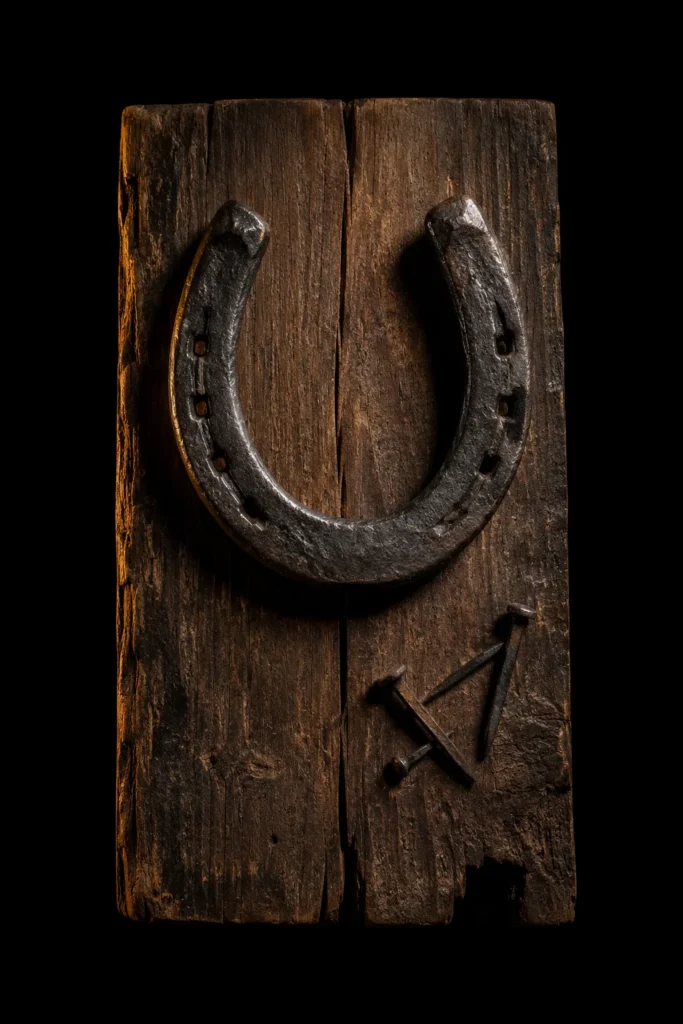
The horseshoe is a curved iron fitting that originally served to protect the hooves of horses. Beyond this practical purpose, it became a widely used protective and good-luck sign in European folk belief.
In this meaning the horseshoe is mounted not on the horse but above doors, on house walls and at thresholds. There it is meant to preserve the house and its occupants and to attract good fortune.
The horseshoe combines two older ideas of protection. One concerns the material, iron, to which folk magic ascribed a warding power. The other concerns the shape, the crescent moon opened upward or downward.
The horseshoe is thus a good example of how an everyday utilitarian object can become a protective sign. Its meaning is explained not by a religion but by popular thinking about material and shape.
The horseshoe does not stand alone but belongs to a whole group of means of protection that had their place at the threshold of the house. Salt, iron nails and certain plants were likewise mounted at doors and entrances. Within this group the horseshoe is the best-known and most readily available means of domestic protection.
Iron as a Protective Metal
In European folk magic, iron was long regarded as a metal with warding power. It was credited with keeping harmful forces at bay, and it played a role in numerous protective customs.
The notion that witches, spirits and other ominous beings shun iron was widespread. Iron objects, nails and blades were therefore mounted at thresholds, cradles and stables to secure these places.
One reason for this notion may lie in the special standing of iron. Its extraction and working in the fire of the forge required skill and were regarded as an art with its own, almost mysterious significance.
The horseshoe is an iron object, and so from the outset it carries within it the protective meaning of the material. Even as a piece of iron above the door it would, in popular thinking, be a warding sign, before its shape is even added.
Closely connected with the protective power of iron was the figure of the smith. The smith mastered fire and shaped the hard metal, and in folk belief his craft was regarded as an art with a particular, almost mysterious power.
This esteem for the smith and his material is also reflected in the meaning ascribed to the horseshoe.
The Shape of the Crescent Moon
Alongside the material, the shape of the horseshoe also contributes to its protective meaning. The horseshoe forms an arc opened to one side, which recalls the sickle of the waxing or waning moon.
The crescent moon is a very old sign. As early as antiquity, crescent-shaped pendants were worn as protective amulets, for instance the lunula, which in the Roman world was placed on girls as protection.
The crescent shape was regarded as favorable and protective in many cultures. It was associated with growth, with the course of time and with female protective powers. The horseshoe takes up this shape, without those who wore it necessarily always being aware of it.
Part of the special standing of the horseshoe lies in the combination of protective iron and protective moon shape. Two independent ideas of protection come together in a single, everyday object that is readily available.
The crescent-shaped protective amulets of antiquity were worn over centuries, long before the horseshoe took on its role. When the horseshoe finally became a protective sign, it unconsciously carried on the old esteem for the moon shape.
Many who hung up a horseshoe hardly thought of the moon, and yet the old meaning of the shape continued to work in the background.
Above the Door: Mounting and Orientation
The typical place for a horseshoe is the door. It is mounted above the entrance of a house, an apartment or a stable. The door is the spot at which, according to popular belief, harmful things can enter the protected space.
There are differing views about the correct orientation of the horseshoe. One widespread opinion holds that the horseshoe must be mounted with its ends pointing up, so that good fortune is held within it as in a bowl.
Another view holds the opposite. With its ends pointing down, the horseshoe pours its good fortune and its protection over everyone who steps through the door. Both interpretations are old and attested side by side.
This disagreement shows that there is no single uniform rule. The orientation follows regional customs and personal convictions. To many, more important than the direction was the simple fact that a horseshoe hung above the door at all.
The disagreement about the correct orientation cannot be resolved, for both views are old and rooted in different regions. In some places people even hung the horseshoe deliberately in such a way that both interpretations were covered.
This variety shows that in folk custom there is rarely a single binding rule, but rather many traditions existing side by side.
The Legend of Dunstan and the Devil
To the protective meaning of the horseshoe belongs a well-known legend connected with Saint Dunstan. Dunstan was an ecclesiastical figure of the early Middle Ages, and the tale ascribes to him the craft of a smith.
The legend relates that the devil came to Dunstan and demanded to be shod on his own hoof. Dunstan recognized his visitor and deliberately caused him great pain during the work.
Only when the devil pleaded did Dunstan let go of him. He released him, however, only on one condition. The devil had to promise never to enter a house above whose door a horseshoe is mounted.
This tale provides a vivid justification for the custom. It explains why it is precisely the horseshoe above the door that keeps evil at bay, and it links the protective sign with a memorable story.
The tale of Dunstan is not the only one of its kind. Folklore knows several stories in which a clever smith outwits the devil.
The motif of the outwitted devil was popular because it gave the listener a sense of security. The combination of this motif with the horseshoe anchored the protective custom in a memorable and gladly told story.
The Found Horseshoe and the Nails
In folk belief not every horseshoe was regarded as equally effective. Particular good fortune was ascribed to a horseshoe that one had found by chance. A found horseshoe was an unexpected gift and was regarded as a good omen.
The nails and the nail holes of the horseshoe also played a role. The notion that a horseshoe with seven nail holes was especially fortune-bringing was widespread, for the number seven was often ascribed a favorable meaning.
In some places it was important that the old nails were still in the horseshoe or that it was mounted with the original number of nails. Such details show how closely folk belief regarded the object.
In these notions various ideas of good fortune combine with the horseshoe. The finding, the number and the iron come together and turn the fitting into a sign to which a manifold favorable effect was attributed.
The belief in the special power of a found object was widespread in folk custom. A chance find was regarded as a hint of fate and thus as a good omen.
The number seven, too, had a favorable meaning in many contexts. In the found horseshoe with its nail holes, several of these ideas of good fortune came together vividly.
Distribution in European Folk Belief
The custom of mounting a horseshoe as a protective and good-luck sign is widespread across large parts of Europe. From the British Isles through the German-speaking region to Eastern Europe, the horseshoe is known as a sign above the door.
This wide distribution is connected with the importance of the horse. For centuries the horse was ubiquitous in agriculture, transport and craft, and horseshoes were correspondingly readily available.
Regional differences accompanied the spread of the custom. Views about the correct orientation, about the number of nails and about the best way of mounting differed from place to place.
The horseshoe is thus an example of a protective sign of folk magic that follows no single doctrine. It lived in oral tradition and in everyday custom and took on many local colorings in the process.
With emigrants and travelers the horseshoe custom also spread beyond Europe, for instance to North America, where it likewise became established. At farms and in stables, everywhere that horses were kept, the horseshoe was present in any case. This availability made it a protective sign that fitted into everyday life without special effort.
From Protective Sign to Good-Luck Symbol
Over the course of time the meaning of the horseshoe has shifted. In the older notions, warding stood in the foreground. The iron horseshoe above the door was meant to keep harmful forces at bay and to secure the house.
With the decline of belief in witches and ominous spirits, this idea of warding receded. The horseshoe nevertheless remained in use, now understood more strongly as a general good-luck sign.
Today the horseshoe stands above all for good fortune. It appears at weddings, at the turn of the year and on other festive occasions on which people wish one another good luck. The original idea of protection at most still resonates in the background.
This development from a warding sign to a good-luck sign can be observed with many protective objects. The horseshoe shows it particularly clearly, because without any religious attachment it is carried solely by popular custom.
The change from a warding sign to a good-luck sign proceeded gradually and cannot be pinned to a single date.
With the decline of belief in harmful forces the idea of warding lost weight, while the wish for good fortune remained. Many old protective signs have taken this path and live on today as general good-luck charms.
Reception Today
The horseshoe is a familiar sign to this day. As a small pendant, as a motif on greeting cards and as jewelry, it appears in the everyday life of many people, often in connection with good wishes.
In this use the horseshoe is mostly detached from its origin. It stands alongside other good-luck signs such as the four-leaf clover and the chimney sweep, and is scarcely still associated with the iron or the moon shape.
Genuine iron horseshoes above doors can nonetheless still be found, above all at farms, old houses and stables. There the custom has been preserved in its original, tangible form.
The horseshoe is thus a protective sign that has outlasted the change of the ages. It shows how a simple object has been worn, interpreted and finally turned into a general sign of good fortune over the centuries.
The horseshoe also appears in heraldry, in club coats of arms and in sport, where it is chosen as a sign of good fortune and success.
At weddings it is presented to the couple in some places as a good-luck charm. In all these uses the old meaning, originally directed toward protection, lives on to this day in a weakened, friendly form.
Related pages in the lexicon: an overview of the protective symbols at a glance as well as the page on the good-luck charm.
Literature (Selection)
Related key terms: horseshoe iron good-luck symbol protective sign crescent moon Dunstan threshold folk magic good-luck charm.
iWell Guard and Protective Traditions
iWell Guard stands in the cultural-historical line of wearable protective objects, to which the horseshoe also belongs. A modern companion for people who live with protective symbols: made in Germany, 41 layers of solid gold, platinum and silver, with a 30-day right of return.
Personal experiences may vary. Not a medical device. No healing promise.