Thor's Hammer – Mjölnir as a Germanic-Norse Protective Sign
By Ralf Ittermann · last reviewed on
Thor’s Hammer Mjölnir is a Germanic-Norse protective sign that embodies strength, blessing and the warding off of hostile powers. Thor’s Hammer, called Mjölnir in Norse tradition, was a widespread protective pendant in the Viking Age.
It joined the idea of divine defensive power with a personal sign that placed its wearer under the protection of the god of thunder.
Classification
Thor’s Hammer is a protective pendant from the Germanic-Norse world. It reproduces Mjölnir, the hammer of the thunder god Thor, and was worn above all in the Viking Age between the ninth and the eleventh century. Numerous examples have survived from Scandinavia, the Baltic region and the areas settled by the Norse.
Unlike many ancient amulets, Thor’s Hammer is not an image of a deity, but the likeness of its tool. What was worn was not Thor himself, but the implement with which he defended the world of humans and of gods. The sign thus pointed directly to an act of protection.
In religious studies, Thor’s Hammer is regarded as a well-documented example of a personal protective sign that was at the same time an expression of religious belonging. Precisely in the period of transition to Christianity, the hammer took on a meaning that reached beyond the mere warding off of misfortune.
The archaeological record is extensive. More than a thousand hammer pendants are known so far, together with casting moulds and pictorial representations. This large number makes Thor’s Hammer one of the best-studied amulets of the Viking Age.
It allows researchers to grasp distribution, workshops and chronological development more precisely than is possible with many other protective signs. The hammer is thus not only a religious sign, but also an important source for the material culture of the North.
Mjölnir, the Hammer of Thor
The tradition concerning Mjölnir comes above all from the Old Norse sources, the Poetic Edda and the Prose Edda of Snorri Sturluson. There it is told how the hammer was forged by dwarves.
An intervention by the god Loki caused the handle to turn out too short, yet this did nothing to diminish the effectiveness of the weapon.
Mjölnir possessed extraordinary properties. It always struck its target, returned to Thor’s hand and could be shrunk so that the god could carry it concealed. In the myths, the hammer is the decisive weapon against the giants, who appear as adversaries of the world of the gods.
Mjölnir was, however, more than a weapon. The sources also show it as a consecrating implement with which Thor blessed and sanctified. This double role, weapon and consecrating tool at once, is decisive for understanding the hammer amulet, for both aspects entered into its protective meaning.
The name Mjölnir is interpreted in different ways linguistically. A common derivation traces it to a word for crushing or pounding, which marks the hammer as a tool of shattering. Other interpretations connect the name with terms for lightning.
Both lines fit Thor as the god of thunder, whose hammer blow was, in people’s imagination, identified with thunder and lightning. The name itself thus already carries the double nature of the implement, which is at the same time tool, weapon and force of nature.
Thor as Protector of Gods and Humans
Thor was one of the most widely venerated gods in Norse religion. He was regarded as the protector of Asgard, the world of the gods, and of Midgard, the world of humans. His task was to defend order against the powers of chaos, which appeared in the form of the giants.
Unlike Odin, who was associated rather with rulership, poetry and the realm of the dead, Thor was close to farmers and ordinary people. He secured weather and fertility and protected house and farm. Place names and personal names that refer to Thor are spread across all of Scandinavia and bear witness to this broad veneration.
Anyone who wore a Thor’s Hammer placed themselves under the protection of precisely this god. The amulet connected the individual with the protective power that, in the myths, preserved the world of humans from hostile forces. It was thus an expression of trust, not of a frightful image.
How closely the hammer belonged to Thor is shown by the Lay of Thrym from the Poetic Edda. There Mjölnir is stolen by a giant, and at once the world of the gods is threatened.
Only the cunning with which Thor regains the hammer restores order. The narrative makes clear that the hammer was not merely one weapon among many. It was the pledge of security, and its loss meant immediate danger for gods and humans alike.
Form and Material of the Pendant
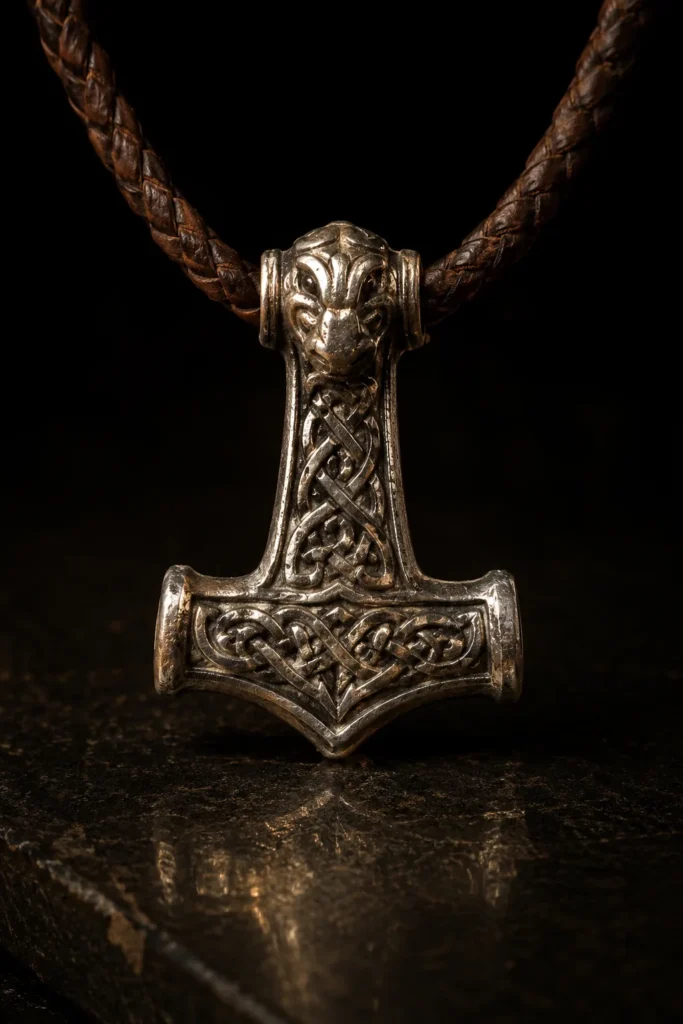
The surviving Thor’s Hammer pendants show a clear basic form. They render the hammer with a short shaft and a stocky head, often with a suspension loop at the upper end of the shaft. This loop shows that the pieces were worn on a cord or chain around the neck.
In terms of material, silver and bronze predominate; alongside these, iron, amber and, more rarely, gold are attested. Many pendants are kept plain, while others bear fine decoration of punched patterns, interlace or geometric ornament. On some pieces, the upper terminal is worked as a stylized animal or bird head.
The sizes range from small, light pendants to sturdier examples. This variety in material and execution shows that Thor’s Hammer was worn across different social strata. Simple iron pieces stood alongside artfully worked silver pendants of wealthy wearers.
Research distinguishes several regional types that differ in form and decoration. Some hammers were worn singly, others were threaded onto iron rings from which several small hammers hung.
Such hammer rings were found above all in central Sweden and are connected with particular burial customs. The range of finds, from plain iron to finely worked silver, shows that the hammer held meaning in quite different contexts.
The Hammer as a Consecrating Tool
The protective meaning of Thor’s Hammer goes beyond its role as a weapon. In the myths, Thor sanctifies important transitions with Mjölnir. The sources report that the hammer played a part at weddings and at burial, in that it consecrated the occasion and placed it under protection.
This consecrating function makes it understandable why the hammer was so well suited as an amulet. It stood for warding off and, beyond that, for the sanctification of an area of life. A hammer that could bless wedding and burial also protected the one who wore it as a sign on the body.
Thus Thor’s Hammer combines two ideas of protection. It is the image of a weapon that wards off enemies, and at the same time the image of an implement that consecrates and blesses. In this double meaning lies part of its special position among the protective signs of the North.
An impressive example is provided by the Prose Edda. At the burial of the god Baldr, Thor consecrates the pyre with his hammer. This scene shows Mjölnir explicitly as a sanctifying implement at one of the most important thresholds, the passage into death.
Runic inscriptions also take up this idea when they ask, in effect, that Thor may consecrate the event. The hammer as an amulet carried this idea on the body, for it stood for the power to place an occasion under protection.
Protective Sign in the Time of Conversion
Thor’s Hammer gained a special significance in the time when Christianity advanced into the North. In this transitional phase, the worn cross of the Christians and the worn hammer of the followers of the old gods met directly.
Research interprets the striking spread of hammer pendants in the ninth and tenth centuries partly as a deliberate response to the Christian cross. The hammer thus became a visible avowal of the inherited religion.
Telling is a find in which, within the same workshop, a casting mould is attested in which cross and hammer could be produced side by side.
In this period, then, Thor’s Hammer was more than a sign for warding off misfortune. It was a sign of identity and of religious belonging. The amulet protected its wearer and at the same time showed in which tradition they stood.
The transitional period was no simple coexistence of old and new faith. Sources report people who invoked both powers at once, and rulers who wavered between the religions. In this environment, the hammer became a visible avowal.
Whoever wore it showed loyalty to the inherited gods in a time when this loyalty increasingly required explanation. The amulet thus gained a meaning that, beyond personal protection, aimed at the community.
Distribution and Archaeological Evidence
Thor’s Hammer pendants have been found in large numbers, above all in Scandinavia, but also in the Baltic region, in England, in Iceland and in the territories of the Rus. This wide scatter follows the routes of the Viking-Age traders, settlers and warriors.
The find sites comprise graves, settlements and hoards. In the grave, the hammer accompanied the deceased; in the settlement, it belonged to the personal equipment of the living. The distribution across many social groups confirms that this was a widely worn sign.
Archaeological research has studied Thor’s Hammer intensively and distinguishes various regional types. These types make it possible to place the pendants in time and space, and they make Thor’s Hammer an important source for the religious history of the Viking Age.
Hammer pendants are found strikingly often in women’s graves, which shows that Thor’s protection was not limited to warriors. Significant find sites are the trading centres of Hedeby and Birka as well as the area around Wolin on the Baltic Sea.
The amber from which some hammers were made points to the Baltic region as a source of material. The distribution of finds along the trade routes confirms that the sign travelled with the movements of the Viking-Age world.
Runic Inscriptions and the Name of the Object
Some protective signs of the Viking Age bear runic inscriptions that illuminate their meaning. Well known is the formula that says, in effect, may Thor consecrate or protect. Such inscriptions show that the invocation of the god was understood as part of the protective effect.
For a long time it was unclear what the people of the Viking Age themselves called the hammer-shaped pendants. A find from southern Sweden brought clarity here. A hammer pendant bears a short runic inscription that explicitly designates it as a hammer. This proves that the pendants were indeed understood as images of Mjölnir.
Such inscriptions are rare, but of great value. They connect the archaeological find with the written tradition and show that the worn hammers and the Mjölnir of the myths belonged together in people’s imagination.
A well-known testimony is the amulet of Kvinneby from Öland, a small copper plate with a longer runic inscription. The text calls upon protection and names Thor, who wards off misfortune with the hammer.
Such inscriptions are especially revealing because they put the idea of protection into words. They show that people understood the hammer as more than an image; they connected it with an active plea for aid that the god was to fulfil through his implement.
Reception Today
Thor’s Hammer has far outlasted the Viking Age. Today it is one of the best-known signs of Norse culture and is widely worn as jewellery. In this use it often stands generally for a connection to the Old Norse world.
At the same time, the hammer is the central symbol of modern pagan movements that draw on the pre-Christian religion of the North.
In several countries, Thor’s Hammer is recognized as a religious sign of these communities. The amulet has thus taken on a role similar to that held by the cross or other signs of faith.
Original Thor’s Hammers of the Viking Age can be seen in many museums of northern Europe, for instance in the Swedish History Museum in Stockholm and the National Museum in Copenhagen. They bear witness to a protective sign that has gone from a personal amulet to a lasting cultural symbol.
The recognition of the hammer as a religious sign is today a reality in several countries. In Iceland, the pagan religious community received state recognition as early as the 1970s, and the hammer there, as elsewhere, stands for a living religious avowal.
In scholarly and museum presentation, Thor’s Hammer is carefully classified as a testimony of Viking-Age religion. This factual conveyance helps to keep the sign understandable in its historical sense.
Literature (Selection)
Related key terms: Mjölnir Thor Viking Age hammer pendant Edda apotropaion Asgard runic inscription Scandinavia.
iWell Guard and Protective Traditions
iWell Guard stands in the cultural-historical line of wearable protective objects to which Thor’s Hammer also belongs. A modern companion for people who live with protective symbols: made in Germany, 41 layers of solid gold, platinum and silver, with a 30-day right of return.
Personal experiences may vary. Not a medical device. No promise of healing.