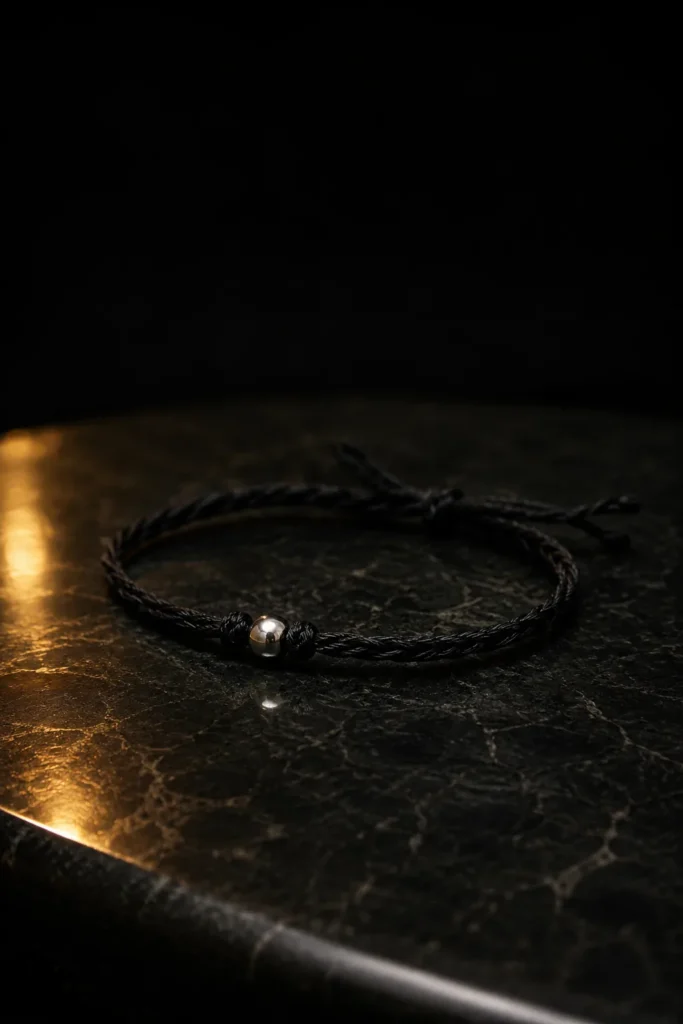
The black thread is a simple protective band that is placed around the wrist, hip or ankle of many people in India, especially small children. It is meant to guard against the evil eye and against misfortune, and it ranks among the most widespread everyday means of protection.
The black thread is a simple protective band from the world of Hinduism and of everyday Indian life. It is a plain black cord that is tied around a part of the body.
The black thread is worn on the wrist, on the ankle or around the hip. It is placed especially often on small children, who according to a widespread belief are considered particularly at risk.
The purpose of the black thread is protection. It is meant to guard against the evil eye and, more generally, to keep misfortune and harmful influences away from the wearer.
The black thread is closely related to other protective bands of India, above all to coloured and blessed threads that are tied in a ritual context. Unlike these, the black thread is usually plain and without any special ceremony.
The black thread is widespread across religious boundaries. It is worn by Hindu families, but it also appears among other population groups in India, where it is regarded as a general means of protection.
In religious studies, the black thread is a good example of a simple everyday means of protection. Its effect rests less on an elaborated doctrine than on a broadly shared notion of protection through the band and through the colour black.
The black thread belongs to the protective bands. The tied band is a means of protection that appears in many cultures and is also widespread in India.
A band is placed around a part of the body and knotted there. This tying is meant symbolically. It encloses the wearer, as it were, and establishes a protected boundary around them.
The knot plays a part of its own here. In many notions the knot is regarded as a means of holding something fast or of warding something off. A knotted band is therefore more than just a cord.
The band is often worn on the wrist, because this spot is visible and easily accessible. On children the band is also placed around the hip or the ankle, where it remains hidden under the clothing.
Protective bands are numerous in India. There are blessed threads tied by a priest, coloured bands for particular festivals, and bands placed at places of pilgrimage. The black thread is the plainest among these forms.
The black thread shares the basic idea with the other protective bands. The tied band encloses the wearer and is meant to guard them against harmful influences. Its distinctive feature lies in the colour and in its plain, everyday use.
The most striking feature of this protective band is its colour. Unlike the red or the yellow protective threads of India, this thread is deliberately black.
The colour black carries a special meaning in the Indian context with regard to the evil eye. Black is regarded as the colour that draws the harmful gaze to itself and diverts it.
The idea behind this is a redirection. According to this notion, the evil eye is directed first at the conspicuous black sign and not at the protected child. The black band intercepts the gaze, as it were.
For the same reason, a black dot is also often applied to small children in India, usually on the cheek or on the forehead. This black dot too is meant to divert the gaze and to slightly disturb the flawless impression of the child.
Behind both stands a common notion. A perfectly beautiful, healthy child is considered particularly at risk because it attracts admiration and envy. A small black blemish diverts the gaze and lessens the danger.
The colour black is therefore not chosen by chance for the black thread. It is part of the protective idea. The band works not only as a tied band, but also through its diverting colour that catches the gaze.
The most important purpose of the black thread is protection against the evil eye. This belief is widespread in India as in many parts of the world.
According to the notion of the evil eye, a gaze can cause harm. It is often associated with envy and with ill will. Whoever regards something with hurtful envy can, according to this notion, do it harm.
Children are considered particularly at risk. A healthy, beautiful child attracts admiration, and it is precisely this admiration that can, according to the notion, turn into a harmful gaze, even without any ill intent.
This is where the black thread comes in. It is placed on children in order to guard them against this gaze. The conspicuous black band is meant to divert the gaze and to make the child appear less conspicuous.
The belief in the evil eye and the means against it form a distinct and widespread field of protective notions. The black thread belongs to this field, which is presented in more detail on the page on the evil eye.
The black thread is thus one of the simplest and at the same time most widespread means against the evil eye in India. It requires no effort and no ceremony, and it is available to every family.

The most frequent wearer of the black thread is the small child. Many infants and young children in India are given such a band shortly after birth.
The reason lies in the particular vulnerability attributed to small children. They are regarded as not yet settled and therefore as especially susceptible to harmful influences and to the evil eye.
The band is usually tied around the child’s wrist, ankle or hip. At the hip it remains hidden under the clothing and accompanies the child inconspicuously through the day.
The black thread is often combined with further protective measures. Among these is the black dot mentioned earlier, on the child’s cheek or forehead, which is likewise meant to divert the gaze.
Placing the band is usually a matter for the family, often for the mother or the grandmother. No priestly office is required. The black thread thus belongs to the domestic, familial practice of protection.
This use shows that the black thread is above all a sign of care. It expresses the family’s concern for the well-being of the child and gives this concern a visible, tangible form.
The black thread can be understood well in comparison with the red thread. Both are protective bands, yet they differ in colour and in meaning.
The red thread is the widespread blessed protective band in India. It is often tied by a priest, placed at places of pilgrimage or given out at particular festivals. Red is regarded as an auspicious, powerful colour.
The red thread therefore stands rather for the blessing and for the bond with the sacred. It transfers an auspicious power onto the wearer. It is often connected with a ceremony and with a spoken formula.
The black thread, by contrast, is usually plain and without ceremony. Its colour is not directed toward the blessing, but toward defence. Black diverts the evil eye and catches it.
The two threads complement each other. The one works through auspicious blessing, the other through defensive protection. Some children therefore wear both bands, the red and the black, at the same time.
The comparison shows that the colour of a protective band helps to determine its meaning. Red and black stand for two different ways of protection, for the attracting blessing and for the diverting defence.
The black thread can be viewed within the larger context of protective bands. The tied band is a means of protection that appears in many cultures.
In numerous traditions a band is tied around the wrist or ankle in order to protect the wearer. The colours differ, yet the basic idea is related: protection through the enclosing, knotted band.
The black colour as a means against the evil eye is not confined to India either. In various cultures of the Mediterranean region and the Near East, dark or conspicuous signs are regarded as a means of diverting the harmful gaze.
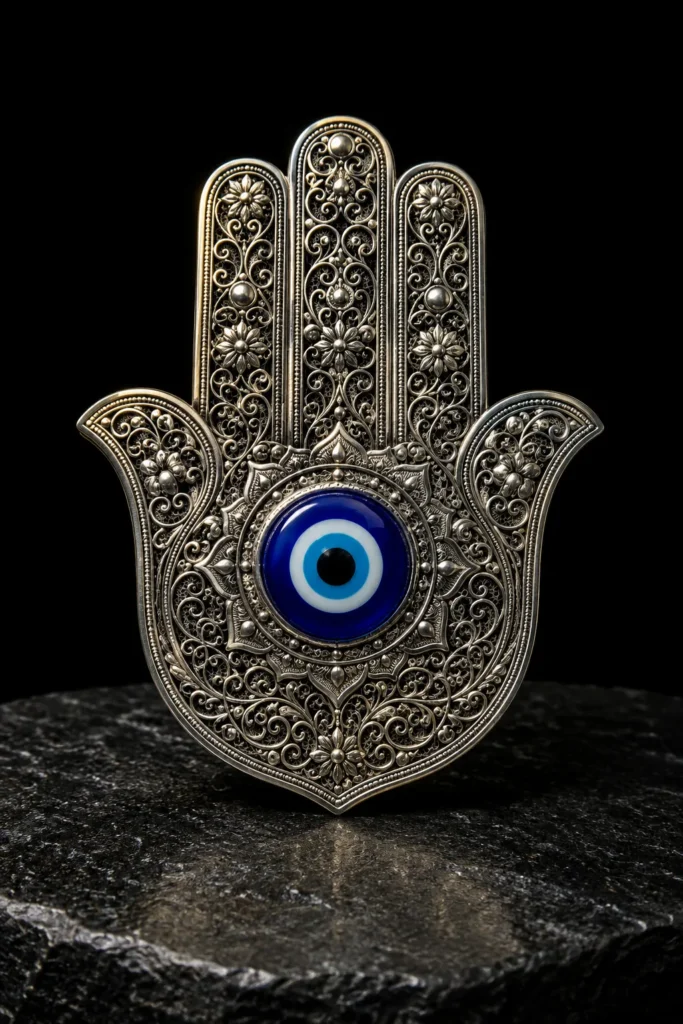
Related to this is also the blue eye amulet, which is widespread in the Turkish and Mediterranean region. It wards off the evil eye by catching it. This means of protection is described in more detail on the page on the Nazar Boncuğu.
The black thread of India and the blue eye of the Mediterranean region follow a similar idea. A conspicuous sign draws the harmful gaze to itself and diverts it away from the protected person.
The black thread is thus the Indian form of an idea found worldwide. The protective band and the diverting colour combine in it into a simple means of protection firmly anchored in everyday life.
With a means of protection as plain and everyday as the black thread, an honest classification is important. Much about it rests on a widespread notion, not on a fixed doctrine.
The black thread belongs to popular protective practice. It is not laid down in the learned religious texts of Hinduism, but is handed down and passed on within families.
Its age cannot be determined exactly. The tying of protective bands is very old in India, yet the plain black thread in its present form can hardly be dated precisely as a single custom.
The interpretation of the black colour is not strictly fixed either. The explanation that black diverts the gaze is widespread and plausible, yet it is an interpretation of the custom and not its only possible explanation.
The black thread is moreover not a purely Hindu sign. It is used across religious boundaries and belongs to the shared protective culture of everyday Indian life.
An honest account therefore names the black thread as what it is: a simple, widespread protective band of everyday Indian life, whose meaning lies in lived practice and not in a fixed doctrine.
The black thread remains extraordinarily present in India to this day. On many wrists and on many children the plain black band can be seen.
Precisely because it is simple and inexpensive, the black thread has held its place across all social strata. It requires neither effort nor ceremony, and it is available to every family.
In the Indian diaspora too, and in Indian communities outside India, the black thread continues to be worn. It belongs to the customs that travel with the family across national borders.
In the present, the black thread is understood partly as a conscious religious practice of protection, partly as a matter-of-course custom whose precise interpretation recedes into the background. Both attitudes exist side by side.
A factual account names the black thread as a simple protective band that is meant to guard against the evil eye and that is placed above all out of care for the children.
The black thread is thus a striking example of a plain everyday means of protection. In it combine the protection through the tied band, the diverting meaning of the colour black, and the family’s concern for the well-being of the child.
Related key terms: black thread, protective band, evil eye, children, wrist, knot, colour black, Hinduism.
iWell Guard stands in the cultural-historical line of wearable protective objects, to which the black thread also belongs. A modern companion for people who live with protective symbols: made in Germany, 41 layers of solid gold, platinum and silver, with a 30-day right of return.
Personal experiences may vary. Not a medical device. No healing promise.