Beings from the Egyptian tradition on iWell Guard. Mythology of the ancient Nile Valley from the predynastic period to the Roman-Byzantine late antiquity. A central cult of the gods, a pronounced funerary practice, a high degree of literacy.
Besides gods and demons, the Egyptian tradition knows numerous protective beings.
The Egyptian myth binds these gods into a dense web of creation, death and return.
The Egyptian mythology spans more than three millennia, from the Pyramid Texts of the Old Kingdom (from 2400 BC) to the Ptolemaic-Roman late period. It differs from all other pantheons through the central position of the funerary cult and of Maat, the cosmic order.
Three concepts give Egyptian religion its characteristic form. Maat stands for the cosmic order, just, truthful, balanced, and is at the same time goddess, ethical principle and rule of life.
Preserving it was the task of the pharaoh, of the daily temple rituals and ultimately of every individual person. Whoever violated Maat endangered not only themselves but the equilibrium of the world.
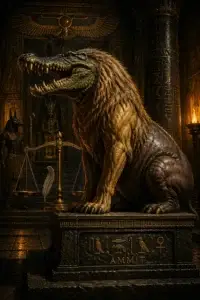
The funerary cult was not a marginal specialism but a structuring point of reference for the entire religion. The notion of the judgement of the dead before Osiris, of the weighing of the heart against the feather of Maat and of the journey through the Duat shaped funerary architecture, textual production and everyday piety.
The Pyramid Texts, Coffin Texts and the Book of the Dead document this practice across more than two millennia.
The temporal depth is unique: across more than three millennia, from the Pyramid Texts of the Old Kingdom to the Ptolemaic-Roman late period, the religious core remained recognisably the same, even as local gods, theologies and ritual forms changed. Only the Christianisation in the 4th to 6th century broke this continuity.
Period: Predynastic period (4000 BC) to Roman-Byzantine late antiquity (5th century AD).
Distribution: the Nile Valley from Nubia to the Mediterranean, spread across the Mediterranean region through syncretisms (Isis mysteries, the cult of Sarapis).
Sources: Pyramid Texts (24th century BC), Coffin Texts, the Book of the Dead, temple inscriptions (Karnak, Edfu, Dendera), Plutarch.
Pantheon and classes of beings: several local systems of gods (Heliopolitan, Memphite, Hermopolitan), with central lines around Ra, the Osiris family and Amun-Ra.
The Egyptian religious tradition extends across more than 3000 years and ranks among the oldest documented religious systems of humankind. It developed in several phases: from the archaic polytheism of the predynastic era, through the classical period of the pharaohs, to the Hellenistic syncretisms.
The pantheon was not a rigid hierarchy but a dynamic system in which gods regularly changed their functions, manifestations and associations. Central figures such as Ra, Osiris, Isis and Thoth embodied cosmic principles: sun god, god of the dead and resurrection, magical wisdom and the art of healing.
The cosmology rested on the concept of Maat (cosmic order), whose preservation had to be ensured through ritual and sacrifice. With the Hellenistic period came a synthesis with Greek elements; Sarapis became a universal god of salvation.
The Christian expansion from the 4th to the 6th century gradually displaced the traditional system, with some practices (such as the veneration of Mary) taking up Egyptian goddess motifs.
Egyptian everyday life was permeated by rituals and protective practices. Domestic worship was directed at household gods and ancestors; small private chapels in wealthy families attest to the persistence of local veneration.
Public temples celebrated their offering rituals daily according to strict protocol. Funerary practices were central: mummification and burial rites aimed at securing the passage into the afterlife.
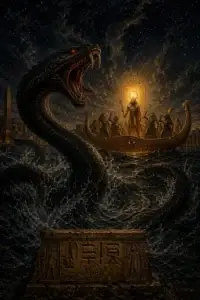
Protective amulets, scarabs and magical formulas were everyday objects. Priests acted as specialists for contact with the world of gods and spirits. Popular piety manifested itself in votive offerings, healing and fertility customs, as well as in the interpretation of signs and dreams. The expectation of the afterlife (Duat) shaped all social strata.
The Egyptian tradition no longer exists as a living form of belief; the Coptic Church took over its cultural space. Academically and archaeologically, Egyptian religion remains one of the best-documented ancient religious systems and a source of deeper historical insight.
In esoteric and New Age circles, Egyptian mythology receives a romanticised reception (Thoth traditions, the Horus-Christology theory). Popular culture has taken up the aesthetic and individual motifs (scarabs, pharaonic curses) without preserving the theological foundations.


The Egyptian pantheon is one of the most diverse of antiquity. Estimates range from about 700 deities transmitted by name to over 1,500 if one counts local numina, personifications and hybrid forms. The Heliopolitan creation theology centres on nine principal gods (the Ennead), while Memphis, Thebes and Hermopolis each developed their own systems.
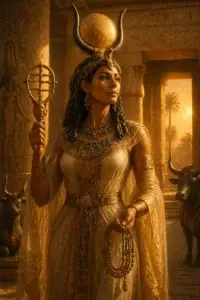
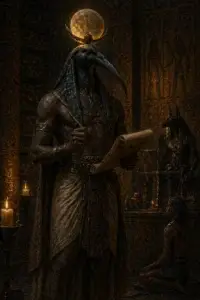
Among the foremost of the pantheon are Ra (the sun), Amun (the hidden creator, later Amun-Ra), Osiris (god of the dead and judge), Isis (magic and motherhood), Horus (the falcon and kingship), Anubis (mummification), Thoth (writing and wisdom), Hathor (love and music), Maat (truth and order), Ptah (craftsmanship), Set (chaos and the desert) and Nephthys (death and boundaries).
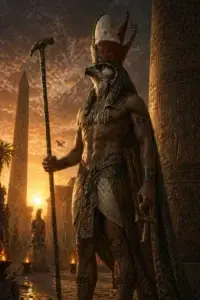
The principal sun god is Ra (or Re), often depicted with a falcon’s head and a sun disc. He has three forms across the day: Khepri (scarab, the morning sun), Ra (midday) and Atum (evening).
In Thebes he was fused with Amun into Amun-Ra. Akhenaten attempted in the New Kingdom to make the cult of Aten the sole religion, the only significant monotheism attempt in Egyptian history.
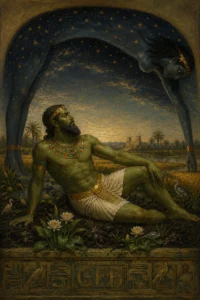
According to the Heliopolitan Ennead, at the beginning stands Atum, who brings himself forth from the primeval waters of Nun. From Atum arise Shu (air) and Tefnut (moisture), from these Geb (earth) and Nut (sky).
From Geb and Nut are born Osiris, Isis, Seth and Nephthys. Horus, son of Osiris and Isis, belongs to the third generation and unites kingship.
Names of gods are usually concluded in hieroglyphs with determinatives such as a falcon, cow, mummy or crown, which indicate the nature of the deity.
Ra is written with a sun disc and a seated god, Amun with a reed leaf and a water vessel. Theological texts often play with the polyvalence of the hieroglyphs, where a single phonetic value can invoke several aspects of a god.
Gods (netjeru) are immortal, are venerated in temples and stand above human beings. Demons (often genii or shedu) are ambivalent intermediary beings, some harmful, others guarding the gates of the underworld; the Book of the Dead lists 42 judge-demons.
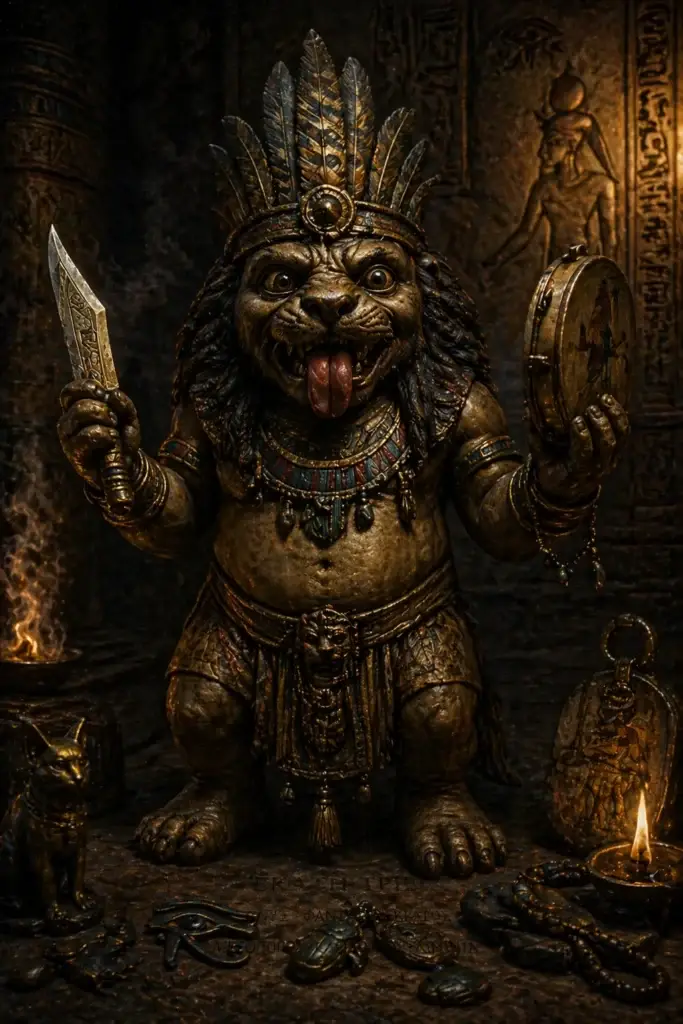
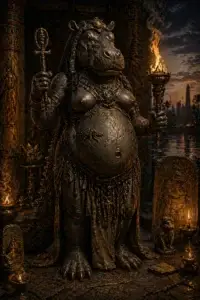
Protective beings such as Bes, Taweret or the household patrons are helpers of popular religion who appear in amulets and household figurines.

In ancient Egypt, portable amulets were a central part of everyday and funerary practice, from scarabs and wedjat eyes to figurines of Bes against powers that endangered children.
iWell Guard fits into this cultural-historical line of portable protective objects, in contemporary material architecture, made in Germany. 41 layers, solid gold, platinum, silver. A 30-day right of return.
Personal experiences may vary. Not a medical device. No promise of healing.
The lexicon of protective symbols treats several signs and objects from ancient Egypt on their own pages: Ankh, Eye of Horus, Bes amulet, Cippus of Horus, Djed pillar, Knot of Isis, Menat and Scarab. A cross-cultural overview is offered by the page on protective symbols.