Anubis, god of the Egyptian tradition
By Ralf Ittermann · last reviewed on
Anubis is a god of the Egyptian tradition.
Guardian of the mummies, judge of the dead, jackal god of ancient Egypt. From the earliest days of Egyptian civilisation, Anubis presided over the dead, embodying the transition from dying to the afterlife and the safekeeping of the mortal remains.
His name Inpu or Anpu is already attested in the Egyptian Pyramid Texts. His image, a jackal or a human body with a jackal’s head, became the embodiment of mummification and the hope of resurrection in the kingdom of the dead, the realm of the Two Truths.
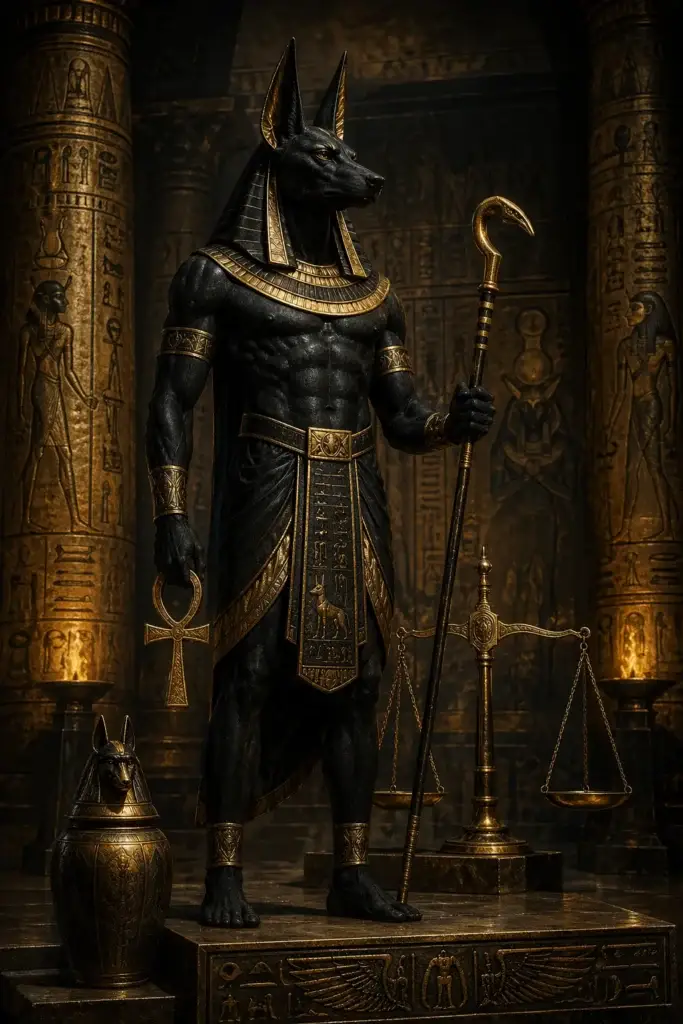
At a glance: Anubis
Type: Major Egyptian deity, god of the dead and of embalming
Pantheon: Egypt (all dynasties)
Function: Guide of the dead, embalming, guardian of the West, weigher of the hearts
Principal attributes: jackal head, was sceptre, ankh, mummy wrapping, scales
Principal cult sites: Cynopolis (Hardai, main cult site), Memphis, Thebes
Greek identification: Hermanubis (Hermes-Anubis syncretism, Hellenistic)
Classification
Anubis is attested as a chief god of the dead from the Pyramid Texts onwards (ca. 24th century BCE). His main period of prominence was the Old Kingdom, prior to the fusion with the Osiris myth in the Middle Kingdom, when Osiris rises to become the dominant deity of the dead.
Anubis, however, remains guardian and embalmer. In the New Kingdom he holds the canonical role of weigher of the hearts in the Judgment of the Dead. In the Hellenistic and Roman periods he undergoes syncretism with Hermes as Hermanubis.
The main cult site was Cynopolis (“city of dogs”, Egyptian Kasa, today El-Qis north of Asyut), with the central Anubis temple and thousands of mummified dogs in the cemeteries.
Further sites include Memphis, Thebes (Anubis as vizier in sarcophagus reliefs) and Saqqara (large dog cemeteries). In Hellenistic Egypt he was venerated in Alexandria, in syncretism as Hermanubis.
Principal sources: Pyramid Texts (spells 213 ff.), Coffin Texts (spells 6, 215), Book of the Dead (spells 17, 30, 125, the famous chapter on the weighing of the heart), inscriptions from Cynopolis and Saqqara.
Scholarly literature: DuQuesne, The Jackal Divinities of Egypt; Bonnet, Reallexikon; Wilkinson, Complete Gods and Goddesses; Lurker, Götter und Symbole der alten Aegypter.
Name
Egyptian: Inpu or Anpu (the etymology is uncertain; possible readings are “the unclean one” or a reference to decaying matter). Greek transcription: Anoubis, Ἀνουβις (Anoubis).
Epithets: Khenty-imentiu (Foremost of the Westerners, that is, of the dead), Neb-ta-djeser (Lord of the Sacred Land, the necropolis), Neb-Sahu (Lord of the corpses), Imy-ut or Im-p (He who is in his wrappings, embodied in the Imiut fetish).
Roman and Hellenistic counterpart: Hermanubis (fusion with Hermes Psychopompos). In Roman transcription Anubis remains unchanged. Important relations: son of Osiris and Nephthys (in the classical reading); in older texts sometimes named as son of Re and Hesat. Close helper of Osiris. His companion is usually Anput, his female counterpart.
Characteristics
Appearance
Anubis is represented in two principal forms: either as an upright human figure with a jackal’s head, usually coloured black and often wearing a headdress (uraeus, crown); or as a fully black recumbent jackal on a standard.
The black colour signifies at once decay and the fertility of the earth, not evil. The standard with the recumbent jackal was used in processions and burial rites. Amuletic representations often show him in mummy form, that is, himself wrapped, which underscores his dual role as god and as bandaged dead.
Nature and activity
Anubis is not death itself, but the administrator and guarantor of the correct transition into the realm of the dead.
His principal tasks are: (1) the supervision of mummification carried out by priests wearing the Anubis mask; (2) the psychostasy, the weighing of the heart of the deceased against the feather of Maat (justice) before the Netre-nebu (assembly of the 42 judges) in the Hall of the Two Truths; (3) the protection of the tombs against desecration.
He thus held the central role of judge and guide that was later assumed more fully by Osiris.
Appearance and symbolism
Anubis is always represented with the head of a black or dark grey jackal or wild dog on a human body. The black colour symbolises decomposition and renewal in the grave.
In Egyptian perception, the jackal was the animal that roamed the cemeteries and threatened the bodies; Anubis personifies the mystical power to control and sanctify these processes. His attributes are the flail (the tool of mummification) and the lead of the dead. In the embalming temples the priests wore an Anubis mask.
Profile: Anubis
The most important aspects of Anubis at a glance. The following fields summarise origin, function, appearance, veneration, symbols and parallels.
Anubis is the son of Nephthys (in one tradition resulting from a liaison with Osiris) and was raised by Isis, because Nephthys, fearing Seth, exposed him. In later traditions he is the son of Osiris (linked to the Osiris myth).
He is the father of Kebechet (goddess of purification). Before the rise of the Osiris myth, Anubis himself was the central deity of the dead; after the fusion he serves as vizier of Osiris.
Guide of the dead into the afterlife. Patron of embalming: the embalming priests (wt) wore an Anubis mask during the preparation.
Weigher of the hearts in the Judgment of the Dead (Maat tribunal): the soul of the deceased is weighed against the feather of Maat (truth), and Anubis verifies the balance. Guardian of the cemeteries and of the mummies against tomb robbers and damage.
Jackal-headed figure on a human body, frequently with black skin (the black of mummification and of the fertile Nile soil, not understood as demonic). In his hand the was sceptre and the ankh.
Often shown in the pose of the Anubis bending over a mummy, with which the embalming is carried out. Also pure jackal form (recumbent on a shrine) as a sarcophagus symbol. In Hellenistic syncretism (Hermanubis) shown with the caduceus of Hermes.
Anubis' veneration
Sphere of activity: Anubis stood at the beginning and at the end of every Egyptian burial. Before mummification prayers were spoken to him, and the wt priests wore jackal masks. During the funeral procession he was the one guiding the dead.
In the Judgment of the Dead, his weighing of the heart determined entry into the afterlife. In personal cult practice he was invoked for protection of the deceased’s mummy against tomb robbery.
Anubis' symbols
Jackal (in recumbent pose, sarcophagus guardian), black skin colour, was sceptre, ankh, scales, mummy wrapping, flail (in some representations), Imiut fetish (bundle with animal hide, specific to Anubis). Sacred animals: jackal, black dog. Sacred plant: sycamore tree.
Hermes Psychopompos (Greece, guide of the dead, syncretised in the Hellenistic period as Hermanubis), Charon (Greece, ferryman of the dead), Yama-Dharmaraja (Tibet/Buddhism, judge of the dead), Yamaraja (Hinduism), Mictlantecuhtli (Aztec, god of the dead), Hel (Germanic, ruler of the underworld), Cerberus (Greece, as a parallel in canine form).
Veneration in everyday life
Anubis was more present in everyday Egyptian religious practice than many other gods. His cult pervaded all social classes and periods.
The principal role of Anubis was in funerary rites. Embalming began with a priestly ceremony, in which a priest wearing the Anubis mask, opened the body, removed the organs and deposited them in canopic jars. The masked priest acted, in the most literal sense, as the representative of Anubis.
The deceased was preserved through treatment with natron, then anointed with oils and balms, and finally wrapped in linen, each step accompanied by the invocation of Anubis.
The wrapping was central to the conception of resurrection: the sahu (the corpse) was to be preserved for the afterlife of the ka (the essence) and the ba (the personality).
In priestly service the Anubis priests wore the mask during embalming, and likewise during tomb consecrations and festivals of the dead. The standard with the recumbent jackal was carried at the head of processions.
Wearers of amulets across all social classes carried small figures of Anubis in faience or lapis lazuli for protection and in hope of a favourable fate in the afterlife.
The weighing of the heart (spell 125 of the Book of the Dead) was central to afterlife eschatology: the deceased stood before Anubis, Osiris and the 42 judges. The heart was weighed against the feather of Maat. If the deceased had lived a just life, the heart was light; lies or wickedness made it heavy.
The balance held by Anubis alone determined the outcome: admission to the Fields of Rushes (Sekhet-Iaru, the Blessed Fields) or consumption by Ammit, the monster called “devourer of the dead”. This belief permeated Egyptian spirituality for more than two thousand years.
Anubis, parallels in other cultures
Roman and Hellenistic tradition
Hermanubis (a composite figure of Hermes and Anubis) was promoted by the Ptolemaic dynasty as a syncretism between Greek and Egyptian conceptions. Apuleius describes processions of Anubis in Roman cities in his Metamorphoses.
Hermanubis combined the guiding function of Hermes Psychopompos with the mummification expertise of Anubis, and was venerated by Greeks and Romans into the 4th century CE.
Mesopotamian tradition
Nergal (ruler of the underworld) and Ereshkigal (its mistress) fulfil similar functions; Nergal, however, does not weigh the souls as Anubis does. Mesopotamian conceptions of the afterlife are bleak, without the hope of justice through a weighing.
Hindu tradition
Yamaraja (ruler of the realm of the dead, Yamaloka) shares with Anubis the function of the just, incorruptible judge and the weighing of souls. Yamaraja sits together with Chitragupta, his scribe and helper, and examines the deeds of the deceased. Like Anubis, Yamaraja is not malevolent, but just in his severity.
Greek tradition
Hades (ruler of the underworld) and Charon (the ferryman) share with Anubis the functions of guide and guardian, but not that of the weighing. Hermes Psychopompos (escort of souls) is functionally closest to Anubis as guide, which is why the syncretism took the form of Hermanubis.
Germanic tradition
Hel (daughter of Loki, mistress of the realm of the dead, Helheim) holds supervisory functions, but no weighing ordeal as in the case of Anubis. Helheim is morally less differentiated than the Egyptian Hall of the Two Truths.
Mesoamerica
Mictlantecuhtli (lord of Mictlan, the Aztec realm of the dead) is functionally a ruler of the underworld like Anubis, but without the weighing ordeal or hope of resurrection. Aztec eschatology is more martial in character than the Egyptian one.
The weighing of the heart and the Judgment of the Dead
The central scene in which Anubis appears is the Judgment of the Dead, the examination of the deceased before entry into the afterlife.
The most detailed pictorial and textual sources for this are the papyri of the so-called Book of the Dead, a collection of spells which from the New Kingdom onwards was placed with the deceased. The famous chapter 125 describes the weighing of the heart.
In this scene the heart of the deceased is placed on one pan of a pair of scales, and on the other the feather of Maat, which embodies truth and the right order. Anubis operates the scales.
He examines whether the heart is in equilibrium with the feather, that is, whether the deceased led a life in accordance with Maat. The god Thoth records the result. Beside them lurks a composite creature, the so-called Ammit, the devourer, ready to consume the heart of one who is condemned, which signifies definitive annihilation.
In this scene Anubis acts as an incorruptible, matter-of-fact examiner. He is not the judge in the strict sense, that role belongs to the god Osiris, before whom the hearing takes place, but the official who carries out the decisive procedure.
His role presupposes that the verdict is objective and cannot be manipulated. The weighing of the heart is among the most frequently depicted scenes of Egyptian religion and shows how closely ethical conduct in life and one’s fate after death were thought to be linked.
Anubis and the invention of mummification
In Egyptian tradition, Anubis is regarded as the god who invented embalming and who first performed it. This function is closely connected with the Osiris myth. After Osiris had been killed by his brother Seth and his body dismembered, the parts were gathered and the corpse reassembled.
According to tradition, it was Anubis who treated this body, and by doing so performed the first act of mummification. In this way Osiris became ruler of the realm of the dead.
From this mythical foundation the cultic practice was derived. The priest who played the principal role in the actual embalming wore an Anubis mask, a head in jackal form, and thereby acted as the deputy of the god.
The workshop of the embalmers and the place of treatment stood under the protection of Anubis. Collections of spells accompanying the procedure invoked him and described the individual actions as divine work.
In this context Anubis bears several telling epithets. He is called Tepy-dju-ef (“He who is upon his mountain”), a reference to the desert heights lying above the necropolises, and lord of the sacred place, by which the area of embalming and burial is meant.
Another epithet designates him as the overseer of the divine hall, the room in which the body was prepared for eternity. The connection between myth and ritual practice is here particularly close: every embalming repeated the mythical first act of the god on Osiris.
Iconography: the jackal god and his forms of representation
Anubis is depicted in two closely related ways. The first shows him entirely as a recumbent black animal with pricked ears and long tail, often resting on a shrine or pedestal. The second, more frequent form shows him as a man with the head of this animal.
Which animal is precisely meant has long been disputed. The traditional view is that of a jackal; more recent research is inclined to suggest a canid close to the African golden wolf. What is certain is that it is a dog-like desert animal.
The choice of this animal is explained by observation of reality. Jackals and related animals roamed at night through the desert cemeteries and dug there.
By conceiving the god of the dead in the form of precisely this animal, the Egyptians transformed the threat to the graves into a protective god of the graves. The being that could endanger the dead became their preserver.
The black colour of Anubis is striking. In Egypt, black was not the colour of mourning in the modern sense, but the colour of the fertile Nile soil and thus of rebirth and regeneration. At the same time it is the colour of the corpse darkened by the embalming resin.
Anubis frequently appears with a collar and with a flail or fan-like implement. On coffins, tomb walls and stelae he is ubiquitous, often beside the deceased or kneeling over the mummy. The frequency of his depiction makes him one of the most pictorially documented deities of Egypt.
Anubis through the ages: from the early period to the Greco-Roman epoch
The position of Anubis within the Egyptian pantheon was not the same throughout the whole of its history. In the early period and in the Old Kingdom, Anubis was among the most important gods of the dead.
The oldest surviving religious texts, the Pyramid Texts of the Old Kingdom, name him frequently, and at that time he was the leading deity of the realm of the dead.
With the rise of Osiris worship, which gained in importance during the Middle Kingdom, this position shifted. Osiris became ruler of the afterlife, and Anubis stepped back into a serving, preparatory role. This rearrangement was expressed mythologically by representing Anubis as son of Osiris, in some accounts as the son of Osiris and Nephthys.
From the independent god of the dead of the early period he thus became helper and embalmer in the service of Osiris. This restructuring is a good example of how hierarchies of gods change in the course of religious history without an older figure simply disappearing.
In the Greco-Roman period Anubis underwent a new flowering. The Greeks identified him with Hermes, from which the composite figure of Hermanubis emerged. Anubis became part of the Egyptian cults spread across the Mediterranean, especially in the context of the veneration of Isis.
In the processions of these cults a priest with an Anubis mask took part, which Roman authors also mention. The god thus remained present for centuries and far beyond Egypt. His history extends from the oldest Egyptian texts into the religious world of the Roman Empire.
Cult sites, animal cemeteries and the source situation
The main cult site of Anubis lay in Middle Egypt, in a city which the Greeks called Kynopolis, the city of dogs, because the dog-like god was particularly venerated there.
In addition Anubis possessed cult places in many locations, since as god of the necropolises he was present wherever burials took place. A particular role was played by him in the mortuary temples and in the workshops of the embalmers.
A distinct source category, important for research, are the animal cemeteries. At several sites in Egypt, particularly at Saqqara, archaeologists have uncovered underground galleries in which vast quantities of mummified dog-like animals are buried, consecrated to Anubis as sacred animals.
Such animal mummies were often donated by pilgrims, who deposited them as votive offerings in the sanctuaries. The number of these burials runs into the millions and attests a broad, popular piety that is scarcely visible in the major religious texts.
What we know about Anubis thus rests on several groups of sources that complement one another. There are, first, the religious texts, from the Pyramid Texts and the Coffin Texts to the Book of the Dead. Second, the pictorial representations on tomb walls, coffins and stelae.
To these are added the archaeological findings, the animal cemeteries, the workshops and the cult sites. Finally, Greek and Roman authors report on the cult of Anubis in their own day.
This variety of sources permits a comparatively precise picture, but also shows that conceptions over the long span of Egyptian history were not uniform but changed and varied regionally.
Further reading and links
Scholarly literature
Further standard works in the literature index.
Frequently asked questions about Anubis
Who was Anubis in Egyptian religion?
Anubis (Egyptian Inpw) was the jackal-headed god of the dead and patron of mummification in ancient Egypt. Before the rise of the Osiris cult, Anubis was the principal god of the realm of the dead.
At the Judgment of the Dead he weighed the heart against the feather of Maat and led the soul to burial. His connection with the jackal (or wild dog) has a real-world background: these animals visited cemeteries in the desert, hence the step to a ‘protective deity against tomb desecration’.
How was Anubis venerated in Hellenistic Egypt?
In Hellenistic Egypt (after 332 BCE), Anubis merged with the Greek Hermes to form Hermanubis, a mediator between the worlds, similar to the Greek Hermes Psychopompos.
In the Roman Empire the cult of Isis spread as far as Rome and Britain, and Anubis with it, as companion of Isis. In Pompeii there are wall paintings showing Anubis, and in the Coptic Christian miracle stories his image lives on as the dog-headed Saint Christopher.