iWell Guard

Taweret, Goddess of the Egyptian Tradition

Taweret is a goddess of the Egyptian tradition.

The protector of pregnant women in hippopotamus form, a protective power of birth and the postpartum period.

Table of Contents

Taweret - Gods from the Egyptian tradition, historical-illustrative

Taweret

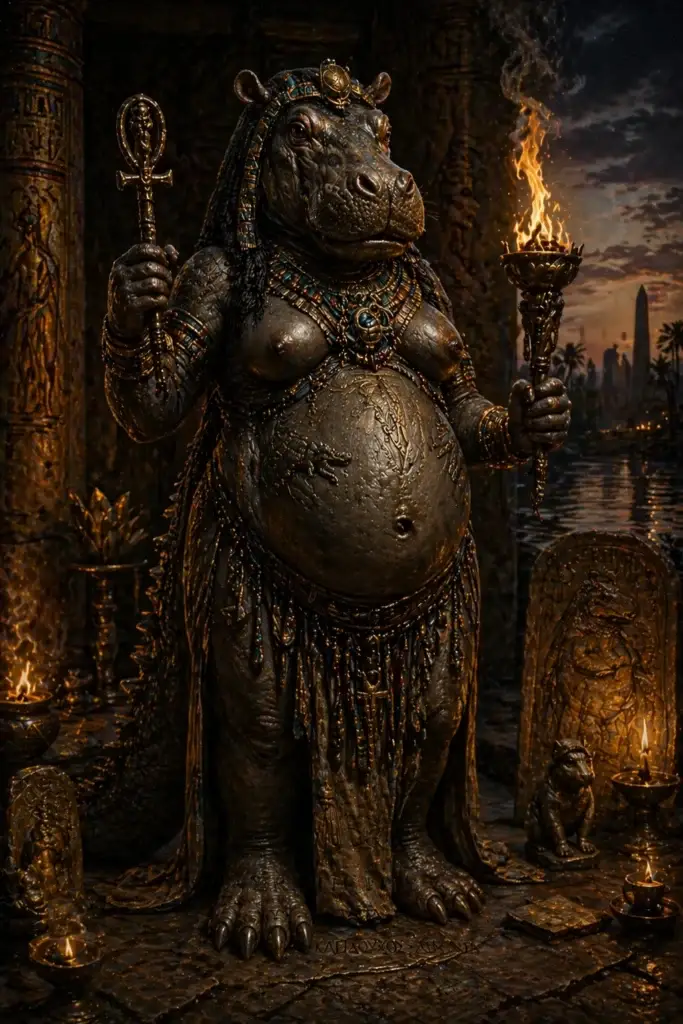
Taweret, “the Great One,” is the most prominent protective figure for pregnancy and birth in ancient Egypt. Her form as a pregnant hippopotamus woman with lion’s paws, a crocodile back, and human breasts is deliberately powerful and intimidating. She does not ward off danger through gentleness but through a concentration of dangerous traits.

She has been popular since the Middle Kingdom and remains a central figure in every household with pregnant women well into the late Roman period. Together with Bes, she forms the core pair of Egyptian birth and postpartum magic, both apotropaic, both deliberately grotesque, both unusually accessible to private piety.

Short Profile: Taweret

Type: Protective demon / Goddess (fluid boundary)
Origin: Connected to the Nile and the hippopotamus; divine ancestry unclear
Texts: Magical papyri, Book of the Dead, household altars, amulet inscriptions
Period: Old Kingdom to Late Antiquity
Distribution: Entire Egyptian cultural sphere
Use: Taweret amulets, magical knives, birthing chair, wall paintings

Context

Period of the Texts

Early attestations reach back to the Old Kingdom; the full iconographic form develops in the Middle and New Kingdoms. In the Late Period and Ptolemaic era, Taweret becomes one of the most frequently reproduced figures of all, appearing in countless amulets, statuettes, and wall paintings.

Mythological Classification

Taweret, the hippopotamus goddess, is one of the most venerated and beloved protective deities of Egypt, especially among women and children. Her name means “the Great One” and she is often depicted as a pregnant hippopotamus.

Although hippopotamuses are dangerous animals, Taweret was venerated as the protector of pregnancy and birth, using her strength and aggression to guard mother and child against demons and malevolent forces. Taweret is a goddess of fertility and life.

Area of Distribution

Her presence extends throughout the entire Nile Valley and beyond the borders of Egyptian culture into the Levant and Cyprus, where Taweret amulets were produced locally. She is thus one of the most widely travelled Egyptian protective figures.

State of Sources

The most productive source is the material tradition: thousands of amulets in faience, stone, and bronze; magical knives of hippopotamus ivory; statuettes for household altars. In textual sources she is regularly invoked in birth incantations and in the magical papyri, often alongside Bes.

Name

Egyptian: Tꜣ-wr.t, literally “the Great One.”
Greek: Thoëris.
Further names: Apet, Ipet, Reret (“the Sow”). These variants partly designate independent figures who converge in Taweret.

The name “the Great One” is an honorific title that remains deliberately open. It reinforces her stature as a protective power without confining her to a narrow category. This suits the ambiguity of her classification: in some texts she is a goddess, in others a demoness; what matters is her function.

Characteristics

Appearance

Taweret is a distinctive composite being. The body is that of a pregnant hippopotamus standing upright, with pendulous human breasts and a rounded belly.

The legs end in lion’s paws. The back often bears a crocodile spine or a crocodile as a crest. In her hands she holds the sa-sign (amulet protection) or the torch-letter.

Behaviour

Her effect is simultaneously protective and intimidating. She wards off childbed fever, birth complications, the evil eye, and nocturnal demons. Her posture is typically upright and frontal: she stands present, ready to intervene, not holding back.

Domain

Pregnancy, birth, the postpartum period, nursing, infant sleep. She also acts more generally as a household protective power, but her primary focus is clearly on the female and infant sphere of life.

Mythological Origin

A clear genealogy is absent. Taweret is occasionally linked to Seth or Hathor but retains an independent position. Her combination of hippopotamus, lion, crocodile, and human reflects both the dangerousness of the Nile environment and its transformation into protective power.

Appearance and Symbolism

Taweret is depicted as a large, pregnant female hippopotamus with pendulous breasts and a swollen belly, the arms of a lioness, the tail of a crocodile, and human feet. She often wears the feather of truth on her forehead.

This hybrid form combines the strength of several animals: the aggressive hippopotamus, the swiftness of the lion, and the cunning of the crocodile. Her body shape emphasises pregnancy and motherliness, marking her as a goddess of birth.

Profile: Taweret

The most important aspects of Taweret at a glance. Details on name, description, use, and parallels can be found in chapters 2, 3, 5, and 6.

Origin

Closely connected to the Nile and the hippopotamus; without a clear divine genealogy. The variants Apet, Ipet, and Reret converge in her figure.

Relevant to

Pregnant women, women in the postpartum period, infants, families. Secondarily also women hoping for children. In her function as a household goddess she protects the entire dwelling and its inhabitants against harmful influences.

Appearance

Pregnant hippopotamus woman with pendulous breasts, lion’s paws, often with a crocodile back. In her hands the sa-sign or the torch-letter.

Taweret's Effect

Warding off childbed fever, birth complications, and nocturnal attacks. Protection of pregnancy, birth, and infancy.

Protection

Not warding off Taweret herself, but her application: Taweret amulets worn on the belly of the pregnant woman, statuettes placed at the birthing chair, magical knives of hippopotamus ivory bearing her image.

Comparable Figures

Functionally closely related to Bes as the second Egyptian pregnancy protector with a grimly benevolent profile. Mesopotamian parallel: Pazuzu as an ambivalent protective figure. The Greek Hekate as a birth companion also belongs to this spectrum, though she does not share Taweret’s purely protective character.

Everyday Use

Rituals of Invocation

Taweret is invoked in everyday life, not conjured. Pregnant women wore amulets with her image on their bellies; Taweret statuettes stood at the birthing chair and by the cradle. In birth incantations she is typically invoked alongside Bes: she protects, he drives away.

Incantations

The magical papyri contain protective formulas for pregnancy and the postpartum period that name Taweret and Bes together. The text describes the dangers (nocturnal demons, fever, loss of the child) and calls the protective powers to be present.

Amulets and Protective Symbols

Taweret amulets in faience, stone, or bronze formed part of the standard equipment of every pregnant woman and every household with young children. The magical knives of hippopotamus ivory, flat, crescent-shaped objects bearing rows of apotropaic beings, almost always show Taweret prominently.

Taweret: Parallels in Other Cultures

Mesopotamia: Pazuzu and Bes share the profile of the ugly, grimly protective being for pregnant women and infants. The child-threatening Lamashtu on the opposite side shows how closely protection and menace are linked in this category.

Greco-Roman world

Eileithyia is the Greek birth goddess, though without a demonic profile. The Lamiae and Lamia stand on the threatening side of the complex. In Hellenistic Egypt, Taweret and Eileithyia partly merge.

Christian reception: In Late Antiquity, the veneration of Mary in Egypt takes over functions of Taweret; Mary as a protective figure for mothers and children represents a direct functional continuation. Iconographic echoes appear especially in Coptic popular piety.

Modern reception: Taweret is today experiencing a rediscovery in feminist spirituality and in wellness and pregnancy literature as a positively connoted mother-goddess of protection. She also appears in popular Egyptomania literature and as a character in genre fiction (Rick Riordan’s Kane Chronicles).

Iconography: The Composite Protective Animal

Taweret is one of the most iconographically distinctive figures in the Egyptian pantheon.

Her appearance is composed of several dangerous animals: the body is that of an upright, heavily pregnant hippopotamus cow; the back bears the mane and often the tail of a crocodile; the limbs end in the paws of a lion; and the pendulous female breasts emphasise the maternal aspect.

She frequently leans on the sa-sign, a hieroglyphic sign meaning “protection.”

This composition is not an arbitrary monster but follows an internal logic. The hippopotamus, crocodile, and lion were the three most dangerous animals of the Nile Valley for humans.

By uniting their features, Taweret combines their menace but turns it against the enemies of mother and child. The fearsome form is precisely the instrument of protection: whatever threatens the pregnant woman and the newborn is meant to recoil before Taweret.

The representations range from monumental temple statues to tiny amulets. Taweret was especially widespread on objects of the domestic sphere: on beds, headrests, ointment jars, and on the so-called magic knives of hippopotamus ivory, held over those who slept.

This material ubiquity sets her apart from the great state gods. Taweret did have a temple cult, especially in the Late Period, but her true domain was the house, the bedroom, the birth room. She was a deity to be touched, carried, and placed by the bed.

Protection at the Most Dangerous Transition: Pregnancy and Birth

Taweret is the Egyptian protective deity of pregnancy, birth, and early childhood, precisely the phase of life that in antiquity was associated with the highest mortality.

Birth was life-threatening for both mother and child, and Egyptian religion provided for this danger zone a particular ensemble of protective powers, at whose centre stood Taweret, often together with the lion-faced dwarf god Bes.

The veneration of Taweret was expressed less in great temple ritual than in a dense everyday practice.

Pregnant women wore amulets bearing her image; birth rooms and lying-in beds were decorated with her representations; milk vessels and ointment jars took her form so that their beneficial contents stood under her protection. The magical knives and apotropaia of the Middle Kingdom show her in long rows of protective beings.

From a religious-studies perspective, Taweret is a model example of a “household deity” whose importance is inversely proportional to her visibility in official religion.

In the royal lists and the great theological texts she plays barely any role; in the lived everyday life of Egyptian families, especially women, she was for millennia one of the most important deities of all.

This discrepancy cautions against reconstructing Egyptian religion solely from temple texts. A large portion of religious practice took place in the home, and there Taweret held sway. Her long-lasting popularity, from the Pyramid Texts to the Greco-Roman period, attests how stable this domestic protective cult was.

Plurality of Names and the Question of One or Several Hippopotamus Goddesses

The name Taweret means “the Great One” and is in fact a respectful circumlocution, not an original proper name. This observation raises a fundamental problem: Egyptian sources know several hippopotamus-shaped goddesses who closely resemble one another but appear under different names.

Alongside Taweret, figures such as Ipet, Reret (“the Sow”), and Hedjet are encountered, and scholarship debates whether these are distinct goddesses or regional and epochal manifestations of the same power.

The most plausible interpretation is that an underlying conception of the protective, pregnant hippopotamus goddess expressed itself at different places and times under different names and with slightly varying profiles.

Taweret ultimately established itself as the most common designation and largely absorbed the others. The circumlocution “the Great One” rather than a fixed proper name fits this development: it functions across local and traditional boundaries.

A further strand connects the hippopotamus goddess to the heavens and to stellar belief. In representations of the constellations on temple ceilings and coffin lids, a hippopotamus-shaped figure appears as the personification of part of the northern sky, often connected with guarding the region in which the never-setting stars circle.

How closely this cosmic hippopotamus figure relates to the domestic protective goddess Taweret remains unresolved. The evidence shows, however, that the hippopotamus goddess was not confined to midwifery but could also play a role in the ordering of the cosmos.

The apparently simple household deity stands in a broader theological context than her amulets might initially suggest.

Further Links

Recommended internal links for this page:

  • Egypt (parent culture page)
  • Bes (frequent partner in protective amulets)
  • Detail on Taweret to follow
  • Magical knives and birth amulets
  • Childbed and postpartum protection in the ancient world
  • Eileithyia and Juno Lucina (Greco-Roman parallels)

Bibliography (Selection)

A compact selection of key works on Taweret and on Egyptian birth magic:

  • Altenmüller, Hartwig: Die Apotropaia und die Götter Mittelägyptens. Munich 1965.
  • Bonnet, Hans: Reallexikon der ägyptischen Religionsgeschichte. Berlin 1952 (entries Taweret / Thoëris).
  • Houser-Wegner, Jennifer: “Taweret.” In: Donald B. Redford (ed.): The Oxford Encyclopedia of Ancient Egypt. Oxford 2001, vol. 3.

Further standard works in the literature index.

Within the pantheon of Egyptian gods, Taweret occupies an independent position as the protective power of pregnant and labouring women. Although she is depicted as female, in the language of religious studies she belongs to the gods of Egypt and was invoked in household rites alongside other gods such as Bes.

Her composite being body of hippopotamus, lion, and crocodile was understood as a visible sign of her apotropaic function against malevolent powers. The theological term “god” is used here in its feminine form (goddess).

Recommended protective means

iWell Guard

The simplest protective means in this collection: 41 layers of fine gold 999, platinum, silver and silicon, manufactured in Ruhla, Thuringia. It requires no activation, is bound to no person, and is effective within a radius of around 50 meters, even without being worn.

All protective means at a glance →