Sopdu, falcon over the eastern border
By Ralf Ittermann · last reviewed on
Sopdu is a god of the Egyptian tradition.
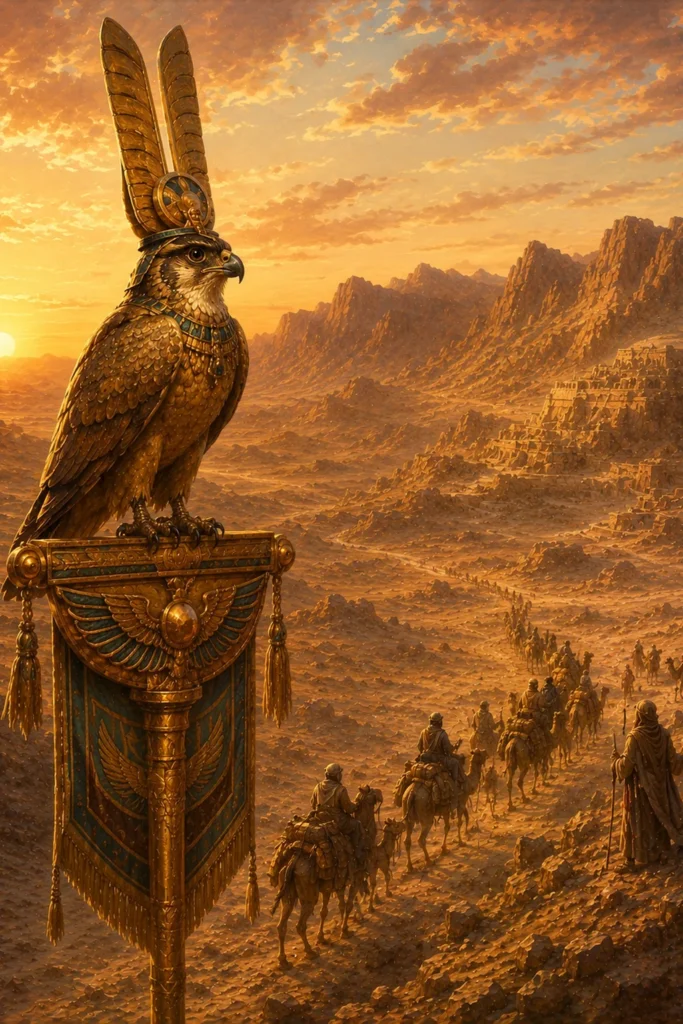
Lord of the East, protector of border posts and caravans. This falcon-headed guardian was said to keep watch over the eastern frontier of Egypt.
Sopdu is the ancient Egyptian god of the eastern desert and the eastern border, Lord of the East. He protected the Egyptian border posts, Bedouins and caravans and was regarded as the conqueror of the Asiatics.
He is attested extraordinarily early, already on ivory plaques from the tomb of King Djer of the 1st Dynasty, and he appears in the Pyramid Texts. His cult centre is Per-Sopdu in the eastern Delta, today’s Saft el-Hinna; on Sinai he had his own sanctuary near the turquoise and copper mines.
Type: Border and desert god of the east, also a war god
Origin: Ancient Egypt, first attested in the tomb of Djer (1st Dynasty)
Texts: Ivory plaques of the 1st Dynasty, Pyramid Texts, Sinai inscriptions
Period: 1st Dynasty to the Late Period
Appearance: Falcon with double-feather crown or Near Eastern warrior
Textual history
Period of the Texts
The line of evidence runs from the ivory plaques of the 1st Dynasty through the Pyramid Texts to the Late Period; a festival of Sopdu is already attested in the 1st Dynasty.
Area of Diffusion
The eastern Delta, Sinai and the eastern desert: Egypt’s border region against the Near East, with the cult centre Per-Sopdu.
Sources
Well documented, with a dedicated monograph by Inke W. Schumacher, alongside early Dynastic evidence, Pyramid Texts and Sinai inscriptions.
Name and variants
Egyptian: Sopdu, ‘the Sharp One’ or ‘the One at the Point’; the root also carries the meanings capable and effective. It is important to distinguish him: Sopdu should not be confused with the Sirius goddess Sopdet, with whom he shares only the word root.
Appearance and behaviour
Appearance
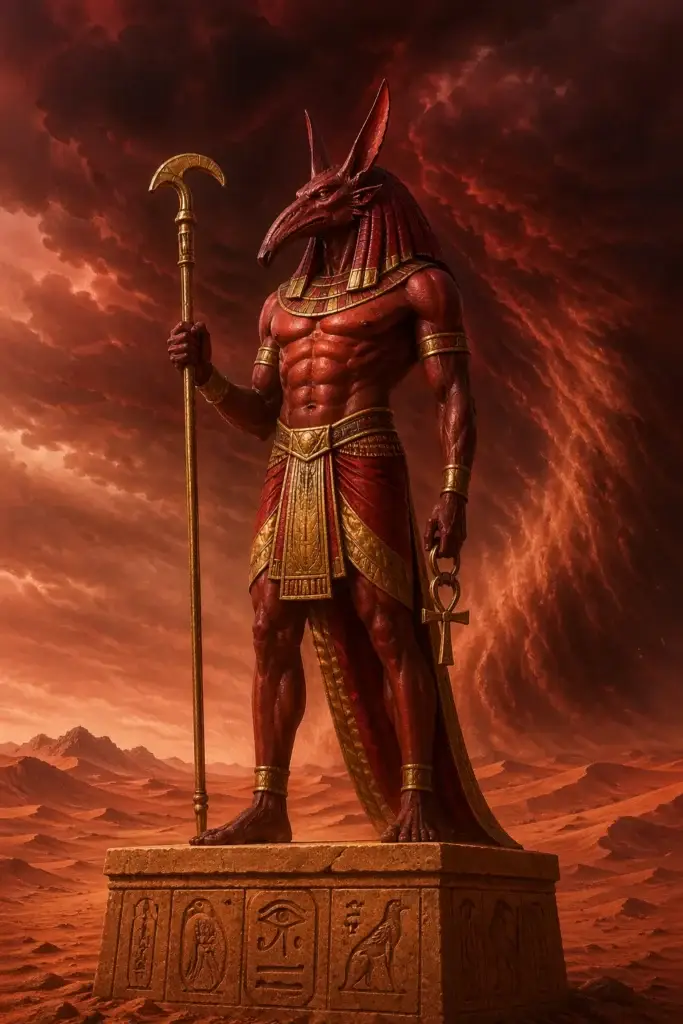
Sopdu appears as a falcon on a cult standard, with a double-feather crown and flail, and from the Middle Kingdom onward also as a falcon-headed man. A second type shows him as a Near Eastern warrior with a tall feather crown, Schemset belt and axe, expressing his function as guardian of the border.
Effect
Sopdu is god of the eastern desert and the eastern border, protector of the border posts and patron of Bedouins and caravans, and at the same time a war god against the Asiatics. In the Pyramid Texts he protects the teeth of the dead king; astrally he is regarded as the sun god of the east and as Venus, the morning star.
Profile: Sopdu
The key aspects of the border god at a glance.
A genuinely Egyptian god with a cult home in the eastern Delta; his Asiatic warrior iconography reflects his border function, not his origin.
Border posts, Bedouins and caravans: whoever guarded the eastern border or crossed the eastern desert stood under the protection of Sopdu.
Falcon on a cult standard with a double-feather crown and flail, a falcon-headed man, or a Near Eastern warrior with a feather crown, Schemset belt and axe.
Protection of the eastern border and the caravan routes, war god against the Asiatics; in the Pyramid Texts, protector of the dead king’s teeth.
His main temple is Per-Sopdu in the eastern Delta; on Sinai he had his own sanctuary at Serabit el-Khadim, along with an inscription at Wadi Maghara near the mines.
Not identical with the Sirius goddess Sopdet, despite the shared word root; as Horus of the East, however, he is closely linked to Horus.
From the tomb of Djer to the mines of Sinai
The name Sopdu means ‘the Sharp One’ or ‘the One at the Point’; the root also carries the meanings capable and effective. Sopdu is attested very early, on ivory plaques from the tomb of King Djer of the 1st Dynasty, and he appears in the Pyramid Texts. His cult centre is Per-Sopdu, today’s Saft el-Hinna in the eastern Delta.
His border function carried him as far as Sinai: there he had his own sanctuary at Serabit el-Khadim, and his name appears in an inscription from Wadi Maghara, which confirms his connection to the turquoise and copper mines. He must always be distinguished, however, from the Sirius goddess Sopdet, with whom he shares only the word root.
Question of origin and classification
The authoritative monograph regards Sopdu as a genuinely Egyptian god whose cult home lay in the eastern Delta; the Asiatic iconography reflects his border function, not his origin.
From a religious-studies perspective, Sopdu is a benevolent protective god of the eastern border. Important clarifications: he is not identical with the Sirius goddess Sopdet, despite the shared word root; he is not a foreign, imported god; and above all the epithets Lord of the East and of the Foreign Lands are attested for him.
Cult sites from Per-Sopdu to Serabit el-Khadim
Sopdu’s main temple is Per-Sopdu in the eastern Delta. On Sinai he had his own sanctuary at Serabit el-Khadim, directly beside the sanctuary of Hathor, and his name appears in an inscription from Wadi Maghara, confirming his connection to the turquoise and copper mines. How deep his cult reaches is shown by a festival of Sopdu already attested in the 1st Dynasty.
Horus of the East: Sopdu in the divine order
Sopdu is regarded as an aspect of Horus, as Horus of the East, and in the Late Period merged into Hor-Sopdu. In the astral triad of Sah, Sopdet and Sopdu, he stands structurally parallel to Osiris, Isis and Horus; his consort is Chensit. His western counterpart among the border gods is Ha, the lord of the western desert.
Frequently asked questions about the god Sopdu
Who is Sopdu?
The ancient Egyptian god of the eastern desert and border, Lord of the East. He protected border posts, Bedouins and caravans and was regarded as the conqueror of the Asiatics.
Is Sopdu the same as Sopdet?
No, these are different deities that share a common word root; Sopdet is Sirius.
Where was he worshipped on Sinai?
In his own sanctuary at Serabit el-Khadim beside the Hathor sanctuary; his name also appears in an inscription from Wadi Maghara.
Further links
Further reading:
- Egypt – all beings of the Egyptian cultural sphere
- Horus – the god whose eastern aspect is Sopdu
- Ha, Pakhet, Ash – further desert gods of Egypt
- Amulet, Smoke cleansing, Iron – traditional protective means
- Protection Compass – protective means at a glance
Literature (selection)
Further standard works in the bibliography.
As the Egyptian border god and Lord of the East, Sopdu stood where Egypt was most vulnerable: on the threshold to the eastern desert, above the caravan routes and the mines of Sinai.