Sekhmet, goddess of the Egyptian tradition
By Ralf Ittermann · last reviewed on
Sekhmet is a goddess of the Egyptian tradition.
Lion-headed goddess of war and healing, daughter of Ra. Sekhmet is violence and healing in a single form: the fiery eyes that take life are the same that restore it. With a lion’s head and a sun disk, as warrior and physician, she stands for the ambivalent power that destroys in order to purify.
She is the Eye of Ra, his destroyer of evil people, and yet the mistress of remedies.
Sekhmet is an Egyptian lioness goddess of war, healing, and vengeance.
Sekhmet
Quick Overview: Sekhmet
Type: Egyptian lioness and war goddess, goddess of healing
Pantheon: Egypt (all dynasties)
Function: War, avenger of the sun god, bringer of plague and at the same time healer
Main attributes: Lion’s head, sun disk with uraeus, long sheath dress
Main cult sites: Memphis (main cult site), Thebes, Bubastis (double sanctuary with Bastet)
Syncretisms: Sekhmet-Hathor (wild Hathor aspect), Sekhmet-Mut (Thebes)
Historical Classification
Period of the texts
Sekhmet is attested from the Old Kingdom onward (from ca. 2700 BCE). The famous series of Sekhmet statues of Amenhotep III (18th Dynasty, ca. 1380 BCE) in the temple of Mut comprises several hundred sculptures, presumably two for each day of the year, in order to appease the goddess.
In the myth of the Eye of the Sun she becomes the destroyer of humankind before Ra appeases her with red beer.
Area of distribution
The main cult site was Memphis, within the Memphite triad with Ptah (consort) and Nefertem (son). Alongside this: Thebes (temple of Mut, the large Sekhmet sculpture court), Bubastis (together with Bastet), and Esna. Special Sekhmet priests (wab) were also physicians; their healing art was grounded in religious medicine.
Source situation
Central sources: the Pyramid Texts (spell 539), the Book of the Dead (spells 17, 164), the Story of the Eye of the Sun (Book of the Heavenly Cow, KV 17 ff.), the medical papyri (Edwin Smith, Ebers, Sekhmet incantations).
Secondary literature: Hoenes, Untersuchungen zu Wesen und Kult der Göttin Sachmet; Bonnet, Reallexikon; Germond, Sekhmet et la Protection du Monde.
Name
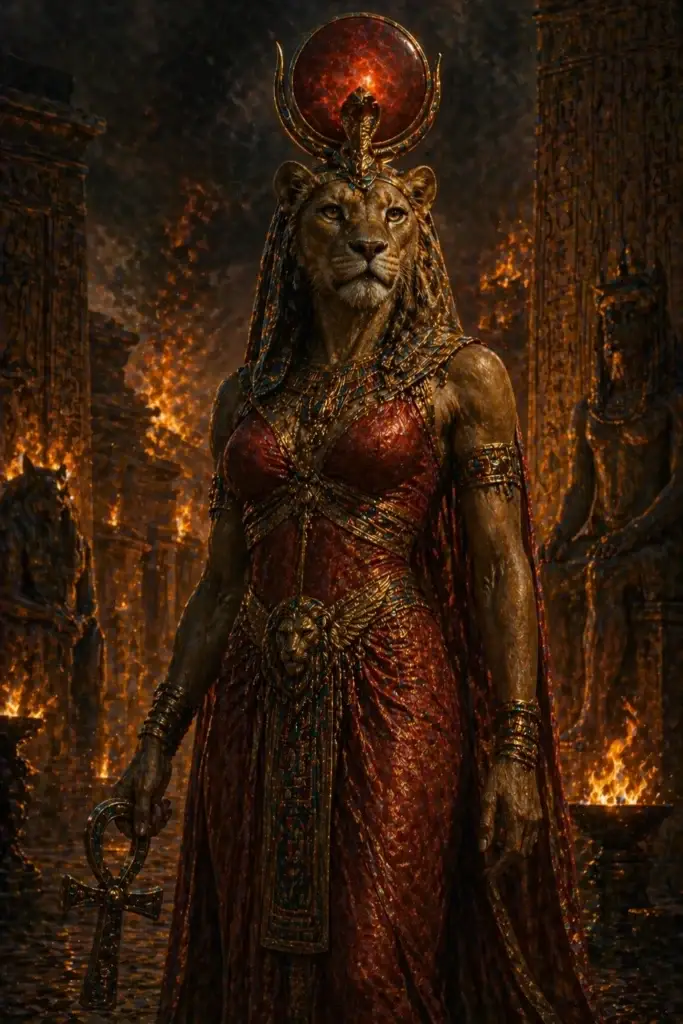
Sekhmet is depicted with a fiery lion’s head on a human female body. On her forehead shine the sun disk (Aten) and the uraeus (serpent of royal power).
She often carries a papyrus scepter (Wadj). Her body is sometimes golden or red. In martial scenes she carries weapons.
Characteristics
Sekhmet is the Eye of Ra, the goddess he sends out to destroy injustice and evil. According to the Pyramid Texts and the Book of the Dead, she creates illness and plague, and only she can heal it. Priests invoked her to ward off or overcome epidemics.
When she enters her martial form, she becomes a fury that kills thousands; when she becomes the healer, she heals with the same power. In the Memphis temple, offerings were made to her to ask for her favor. Physicians invoked her before operations.
Profile: Sekhmet
The most important aspects of Sekhmet at a glance. The following fields summarize origin, function, appearance, veneration, symbols, and parallels.
Sekhmet („the Mighty One“) is the daughter of the sun god Ra, his Eye of the Sun in its wrathful form. Consort of Ptah, mother of the lotus god Nefertem. Sister of Bastet (the gentle double aspect).
In the myth of the Eye of the Sun, Ra sends her out to destroy rebellious humankind; only a ruse saves the survivors: with Hathor beer (red like blood) she is made drunk and forgets the killing.
Double function: bringer of plague and healer. As avenger she sends out her „messengers“ (disease demons), but as a Sekhmet priest-healer she is also asked for healing.
The daily appeasement rites at the start of the year (heliacal rising of Sothis) were meant to ward off her wrath. Protection of the pharaoh in war, suppression of uprisings.
A lion-headed woman in a long sheath dress, frequently seated. On her head the sun disk with the uraeus serpent. In her hand a papyrus scepter (Wadj) and ankh.
Her skin color is traditionally red or pink-gold (the fire). Frequently shown with the lion-skin garment (which underscores the warrior aspect) and the Menit necklace. In the Amenhotep sculptures she appears magnificent in black granite, almost life-sized.
Area of effect: Sekhmet was invoked especially in times of plague, in war, and during acute illness. Physicians were regarded as her servants; the Sekhmet priest-physicians (wab Sekhmet) were healing and incantation in one person.
Annual appeasement festivals with offerings of red beer were meant to keep her wrath at a distance. In royal rituals she embodied the defeat of enemies.
Lion’s head, sun disk with uraeus, papyrus scepter (Wadj), ankh, lion skin, Menit necklace, red or blood-red skin color, bow and arrow (war attributes). Plants: lotus (through the connection with her son Nefertem), papyrus. Ritually: red beer (Hathor beer myth), granite stones.
Bastet (Egypt, gentle sister), Hathor (double aspect in the Eye of the Sun myth), Tefnut (lioness goddess, daughter of Atum and consort of Shu), Mut (Thebes, late merging), Inanna/Ishtar (Mesopotamia, love and war), Athena (Greece, war goddess and protector), Durga (Hinduism, tiger-riding war goddess), Kali (Hinduism, the raging wild aspect).
Practical repulsion
Veneration in everyday life
Rituals and invocations
At the turn of the year, appeasement rites took place against the „messengers of Sekhmet“, to whom epidemics were attributed. Her priests, the wabu priests, were at the same time regarded as healers.
Incantations and invocations
Textual tradition and formulas
The myth of the „Destruction of Humankind“ in the „Book of the Heavenly Cow“ portrays Sekhmet’s destructive power. Litanies and the „Book of the Last Day of the Year“ contain protective formulas against her plague arrows.
Amulets and protective symbols
Material apotropaia and archaeological evidence
Amenhotep III had several hundred Sekhmet statues set up. Lioness amulets and Sekhmet figures served as protection against illness and are widely attested in temples and tombs.
Sekhmet, parallels in other cultures
The Destruction of Humankind: the myth of the Heavenly Cow
The most important narrated episode concerning Sekhmet is found in the so-called myth of the Heavenly Cow, which is handed down above all from inscriptions in several royal tombs of the New Kingdom, including the tomb of Tutankhamun and tombs of the Ramesside period.
The sun god Ra has grown old, and humankind rebels against him. Ra convenes an assembly of the gods and sends out his “Eye” in the form of the goddess, which turns against the rebels on earth.
In the role of Hathor, who becomes Sekhmet, the Eye carries out a bloodbath. The goddess kills so many people that she wades in the blood of the slain, and she takes pleasure in it.
Ra does not wish to wipe out humankind entirely and resorts to a ruse. He has large quantities of beer made and dyed red, with red ochre or, depending on the reading, with red fruits, so that it looks like blood.
During the night the red beer is poured out over the fields. In the morning Sekhmet sees the flooded plain, takes the flood for blood, drinks of it, becomes intoxicated, and ceases her killing. Thus humankind is saved.
From the perspective of religious studies the myth is instructive in several respects. It links the goddesses Hathor and Sekhmet as two aspects of the same power, it explains the limit of divine punishment, and it provides the mythical justification for certain festivals in which ritual intoxication played a role.
The episode also shows Sekhmet’s close connection with the sun god and with the notion of the dangerous Eye sent forth.
The lion-shaped statues of Amenhotep III
Sekhmet is among the Egyptian deities most frequently depicted in stone, which is due above all to a single large building program. In the 18th Dynasty, Pharaoh Amenhotep III had an extraordinarily large number of Sekhmet statues made from diorite, most of them life-sized or larger.
They show the goddess as a woman with a lioness’s head, seated or standing, often with the sun disk and the uraeus serpent on her head, holding the sign of life in one hand and a papyrus scepter in the other.
Estimates assume several hundred of these statues originally, possibly well over six hundred. They stood above all in the temple precinct of Mut at Karnak and in the king’s mortuary temple in Western Thebes. Today examples are distributed across many museums of the world.
The purpose of this enormous commission is discussed in scholarship. A widespread interpretation links the statues with a ritual calendar: there may have been one statue of the standing type and one of the seated type for each day of the year, so that daily rites to appease the goddess were possible.
Other explanations point to the king’s health, since Sekhmet was closely connected with illness and healing, or more generally to the protection of the land. A definitive resolution is still pending.
It is undisputed that this building program shapes the iconographic image of Sekhmet to this day and supplies a large part of the surviving material on her cult.
Sekhmet, plague and healing: the ambivalent power
Sekhmet was understood at once as a bringer of illness and as a power of healing, an ambivalence characteristic of the Egyptian understanding of the gods.
As the goddess who could send epidemics, she was regarded as feared; her “messengers” or “arrows” were associated with the outbreak of diseases, especially with epidemics at the turn of the year.
Precisely because she sent illness, she could also protect against it and avert it. This logic shaped ancient Egyptian healing art.
The priesthood of Sekhmet stood in close connection with medicine; certain healing priests are referred to in the sources as “priests of Sekhmet.” Medical papyri, such as the Papyrus Ebers and the Papyrus Edwin Smith, combine anatomical and therapeutic knowledge with spells addressed to Sekhmet and related powers.
Particularly important were the ritual measures at the transition from the old to the new year, a time regarded as dangerous. Texts for the “appeasement of Sekhmet” were meant to keep the goddess and her messengers away from people and land. Amulets, invocations, and offerings served the same purpose.
From the perspective of religious studies, Sekhmet reveals a fundamental trait of Egyptian theology: the same deity embodies a power that, depending on its orientation, acts destructively or protectively.
Sekhmet is not “evil,” but a power whose effect must be directed through ritual. Her connection with the sun god Ra and with the protective function toward kingship underscores this role as a tamed, dangerous energy in the service of order.
Further links
Research literature
Further standard works in the literature index.
Frequently Asked Questions about Sekhmet
Who was Sekhmet in Egyptian mythology?
Sekhmet (Egyptian Sḫmt, the Mighty One) was the Egyptian goddess of war, vengeance, and illness, yet at the same time of healing. She was depicted with the head of a lioness on a human body, often with a sun disk and uraeus serpent on her head.
Sekhmet is regarded as an aspect of the wrathful Eye of the Sun (Eye of Ra). In the myth of the Destruction of Humankind she is sent by Ra against the rebelling people, and falls into such a killing frenzy that the gods have to stop her through a ruse (red beer instead of blood).
What role did Sekhmet play in Egyptian healing art?
Despite her wrathful character, Sekhmet was the most important protective goddess of Egyptian physicians (Sunu). The logic: whoever can send illness can also take it away again.
Sekhmet priests were specialized healers. In the precinct of Mut at Thebes (Karnak), several hundred Sekhmet statues were set up, presumably two for each day of the year (morning and evening Sekhmet). Many of these statues have been preserved at Karnak.