Amun is a god of the Egyptian tradition.
The Hidden Creator God, King of the Gods, Lord of Thebes. Amun is the god who created himself out of chaos; his name means “the Hidden One”.
Depicted with ram heads and a feather crown, first worshipped locally in Thebes, then imperially as Amun-Ra, with the sun god himself becoming his manifestation. No other deity of the Orient rose so quickly from regional significance to cosmic rule.
Amun is a principal Egyptian god of the New Kingdom.
Type: Egyptian principal deity, creator and imperial god
Pantheon: Egypt (Middle and New Kingdom, Late Period)
Function: Creation, wind and invisible effects, imperial unity (Amun-Ra)
Main attributes: Double feather crown, ram’s horn, Was sceptre
Main cult sites: Karnak and Luxor (Thebes), Siwa oasis, Napata (Sudan)
Greek identification: Zeus Ammon
Amun appears in the Pyramid Texts as a peripheral protective god; his rise to principal deity begins in the 11th Dynasty (Middle Kingdom, ca. 2050 BC) with Thebes as the centre of ascent.
In the 18th Dynasty (New Kingdom, ca. 1550 BC) he merges with Ra to become the imperial god Amun-Ra. Akhenaten’s reform (ca. 1350 BC) briefly banishes Amun in favour of Aten; after Akhenaten’s death there is a massive restoration. In the 21st to 25th Dynasties Amun is de facto Egypt’s state god.
The main cult site was Karnak near Thebes, the largest temple complex of antiquity. Alongside it were Luxor, the Amun temple of Siwa (the oracle visited by Alexander the Great) and Napata in Nubia. The influence of the Amun cult reached as far as present-day Sudan and Libya.
Central sources are the Karnak temple inscriptions, the hymns to Amun (e.g. the great Leiden Hymn), the Pyramid Texts (Spell 446), the Book of the Dead (Spells 17, 64) and the Greek tradition concerning the Siwa oracle (Herodotus II 42, Diodorus I 17).
Secondary literature: Assmann, Ägypten, Theologie und Frömmigkeit; Bonnet, Reallexikon; Wilkinson, Complete Gods and Goddesses.
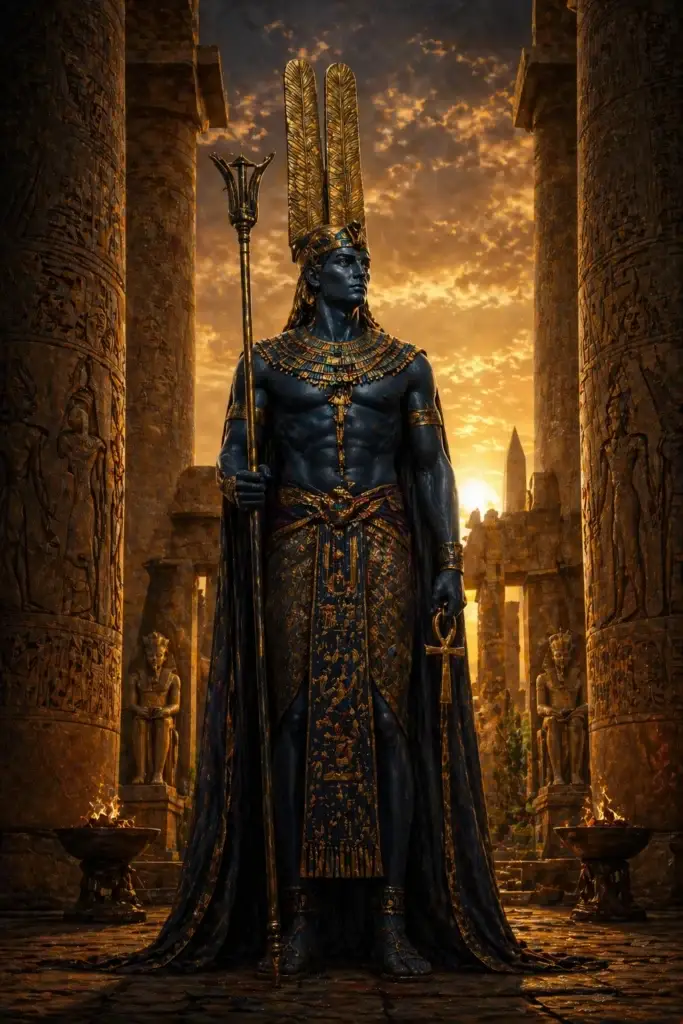
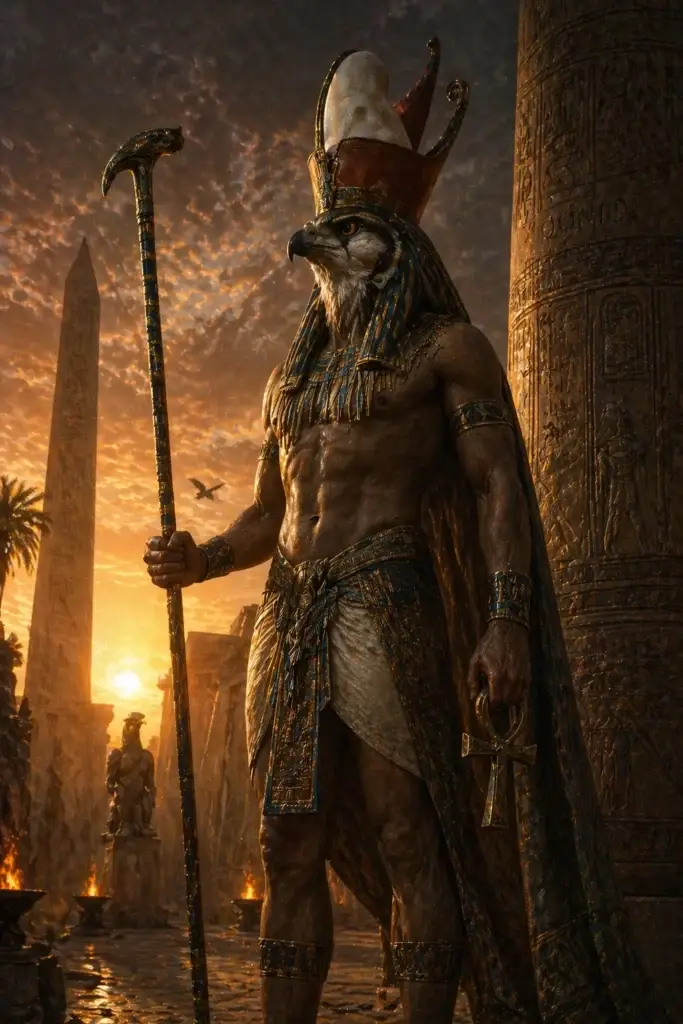
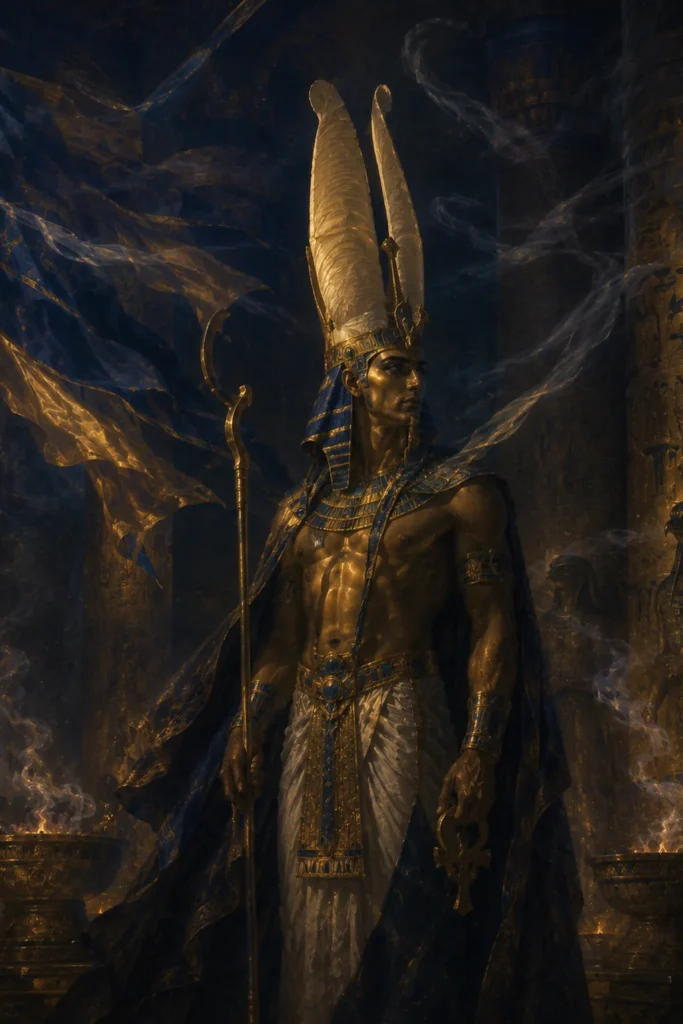
Amun is depicted with ram heads or with a human body and two large, upright feathers. His colour is blue or green, the colour of fertility and of hiddenness. The Atef crown or a special pair of feather crowns sits on his head.
Sometimes he carries the Ankh (sign of life) and a Was sceptre. In abstract depictions Amun is also represented simply by the feathers or by a hidden, invisible sign; his name states that he is invisible.
Amun is the Invisible One who created himself. His priests at Karnak became enormously powerful, at times more powerful than the pharaohs themselves. Kings had themselves legitimised by Amun and consulted his oracle. The Karnak temple precinct was richly endowed with offerings, gold and slaves.
Through the syncretism with Ra, Amun becomes the force behind the visible sun. Hymns are sung to him as the “secret name of God”. Priestesses and priests danced and sang in his honour. Pilgrims visited the oracle to ask questions.
Amun is frequently depicted as a bearded man with a double feather crown, from which two feathers of Maat, the goddess of truth, rise up. In some depictions he wears the sun disc of Ra on his forehead.
His colour is blue or black, the colours of the cosmos and of hiddenness. As a symbol of his invisibility, he is also depicted without a face. The ram and the goose were regarded as the sacred animals of Amun, which embodied him in sanctuaries and were carried along in processions.
The most important aspects of Amun at a glance. The following fields summarise origin, function, appearance, worship, symbols and parallels.
Amun is originally a local protective god of Thebes who becomes a principal deity in the 11th Dynasty.
In the theogonic speculation of the Late Period he is regarded as the Self-Created One, who emerged from the primordial waters of Nun before all other gods. In Thebes he forms a triad with Mut (consort) and Khonsu (son).
Creator god, breath and wind, the Hidden One (his name literally means “the Hidden One”). As the imperial god Amun-Ra he is the guarantor of pharaonic order.
In personal piety he is the addressee of petitionary prayers in sickness and need; the hymns of the Late Period show him as an approachable helper of ordinary people.
Anthropomorphic as a man with a double feather crown (schuti) and beard, holding the Was sceptre and Ankh. Also depicted ram-headed (Amun of Karnak) or as a gander; both animals are regarded as sacred.
At Karnak, avenues of sphinxes lined the temple grounds. Skin colour traditionally blue (symbol of the sky and of invisibility).
Sphere of influence: Amun grants protection on journeys, success in negotiations and help in personal need. His oracle at Karnak and Siwa was regarded as the most reliable information about future events.
Pharaohs requested confirmation of their rule, ordinary believers sought healing mediation. The Festival of the Valley and the Opet Festival were the greatest popular festivals of Thebes.
Double feather crown, Was sceptre, Ankh, ram’s head, gander, blue beard, sphinx (Karnak avenue). Plants: lotus, papyrus. Sacred sites: great pylons, hypostyle hall, sacred lake.
Ra (Egypt, merger Amun-Ra), Min (Egyptian fertility god, often syncretised), Zeus Ammon (Greek identification, especially via the Siwa oracle), Iuppiter Hammon (Roman). In the Indo-European sphere there is no direct parallel; functionally the closest are Indra (Hindu) or Zeus (Greece) as imperial god.
Rituals and invocations
At the centre stood the Opet Festival, during which the barque of Amun travelled from Karnak to Luxor, as well as the “Beautiful Festival of the Desert Valley”.
The daily temple cult provided the cult image with food, clothing and incense. During the barque processions Amun was also consulted as an oracle god.
Textual tradition and formulae
The great Leiden Hymn to Amun (Papyrus Leiden I 350, 13th century BC) unfolds the Theban theology of the hidden god, whose name “the Hidden One” already names his nature.
Amun appears in the Pyramid Texts as a primordial deity and in the temple liturgies of Karnak; numerous prayer stelae of ordinary worshippers address him as “vizier of the poor”.
Material apotropaia and archaeological evidence
Amun amulets made of faience served as protective signs, often in the form of the ram or with the characteristic double feather crown.
Ram-headed sphinxes lined the processional ways of Karnak. Such figurines are widely attested in tombs and temple deposits of the Theban region and document Amun’s role in personal protective belief.
Amun resembles Zeus (Greece), king of the gods. With Brahman (Hinduism) he shares the aspect of the hidden, invisible creator. He recalls Wotan (Scandinavia), a god who sacrifices himself to attain wisdom. The concept of a hidden creator god is universal; Amun is a particularly coherent theological elaboration of it.
Amun does not belong to the oldest Egyptian gods whose worship can be traced back to the early period. He first appears as a local deity of Thebes in Upper Egypt.
In the Pyramid Texts of the Old Kingdom he is mentioned only in passing, mostly as part of the Ogdoad of Hermopolis, a group of eight primordial gods who embody the state before creation.
Amun’s rise is closely connected with the political rise of Thebes. When Theban rulers in the Middle Kingdom and especially at the beginning of the New Kingdom accomplished the reunification of the realm and built Egypt into a great power, their city god rose with them.
Amun merged with the old sun god Ra to form Amun-Ra and thereby claimed the highest position in the pantheon.
In the New Kingdom Amun-Ra was the imperial god par excellence. The pharaohs attributed their victories to him, endowed his temples with plunder and legitimised their rule through him.
The temple precinct of Karnak in Thebes grew over centuries into the largest temple complex in Egypt. The Amun priesthood of Thebes thereby gained enormous economic and political influence.
Scholarship sees in the history of Amun a model example of how closely religion and power were interwoven in Egypt. The rise of a god reflects the rise of his city and its dynasty.
At the same time Amun was theologically flexible enough to absorb other gods into himself without losing his identity. This capacity for merger was a precondition of his lasting pre-eminence.
The most dramatic episode in the history of the Amun cult is probably the religious reform of Pharaoh Amenhotep IV, who renamed himself Akhenaten and ruled in the second half of the 14th century BC. Akhenaten raised the sun-disc god Aten to the only deity worthy of worship and acted against the other gods, above all against Amun.
Concretely this meant that the name of Amun was chiselled out of inscriptions, in some cases even in compound personal names and in hard-to-reach places.
Amun’s temples were closed or lost their income, the priesthood was stripped of power. Akhenaten moved the residence to a newly founded city, today’s Amarna, and thereby withdrew political significance from Thebes.
Scholarship discusses the motives of this reform controversially. Some see in it an attempt to break the power of the Amun priesthood, others emphasise the religious intrinsic value of Aten worship. It is also disputed whether this was genuine monotheism or a heightened form of sun worship.
The reform did not outlast its originator. Already under Akhenaten’s successors, especially under Tutankhamun, whose original name was Tutankhaten and who changed it to Tutankhamun, the Amun cult was restored.
The temples were reopened, Amun’s name reinstated in many places. Akhenaten’s own buildings and his name were later in turn destroyed. This episode shows how deeply Amun was anchored in the religious and social fabric of Egypt.
Amun was not only a temple god worshipped through priests, but also a god who spoke through oracles. In the New Kingdom a practice developed in Thebes in which the divine barque carrying the cult image of Amun was carried in procession and answered questions through movements.
Petitioners presented their concerns, and the reaction of the barque carried by priests was regarded as the god’s answer. Such oracles decided legal disputes, confirmed appointments to office and influenced political decisions.
Beyond Egypt, the oracle of Amun in the Siwa oasis in the Libyan desert became famous. The Greek world knew this god as Ammon and held his oracle in high regard.
As early as the Archaic period Greeks visited the place, and Siwa was regarded, alongside Delphi and Dodona, as one of the significant oracle sanctuaries.
The most famous episode is the visit of Alexander the Great in the year 332 BC. After the conquest of Egypt, Alexander travelled through the desert to Siwa to consult the oracle.
The ancient sources report that the god acknowledged him as his son. This confirmation was of considerable significance for Alexander’s self-understanding and for the legitimation of his rule.
Scholarship emphasises that the oracle institution gave Amun a function that went beyond the fixed temple liturgy. The god entered the sphere of concrete decisions. At the same time the history of Siwa shows how an Egyptian god could, through Greek reception, develop its own international history of influence.

Amun is mostly depicted as a man in human form wearing a characteristic crown with two tall feathers. Frequently his skin appears blue, a colour which in Egyptian symbolism is associated with the sky and with immeasurability. In this form he is enthroned or striding, often with the insignia of rule.
A second appearance is the ithyphallic Amun, a depiction with an erect member that characterises him as a procreator and fertility god and links him to the god Min, with whom Amun partly merged.
The ram and the Nile goose are assigned to him as sacred animals. The ram with the curled horns in particular became a widely recognisable sign of Amun. The avenue of sphinxes at Karnak consists of ram-headed sphinxes.
Theologically, Amun bears the name that can be interpreted as the Hidden One. This aspect shaped Egyptian reflection on him. Hymns from the New Kingdom describe Amun as a god whose true form no one knows, who remains hidden even from the other gods.
Scholarship, especially Jan Assmann, has emphasised that with Amun an Egyptian form of theological thinking developed that conceived the divine as ultimately unavailable and transcendent.
This tension is remarkable: Amun is at once the omnipresent imperial god with the largest temple complex in the country and the fundamentally hidden god who withdraws from access. Egyptian theology held both together without resolving the contradiction.
Further standard works in the literature index.
Against its influence, cross-cultural tradition names these protective means:
Recommended protective means
The simplest protective means in this collection: 41 layers of fine gold 999, platinum, silver and silicon, manufactured in Ruhla, Thuringia. It requires no activation, is bound to no person, and is effective within a radius of around 50 meters, even without being worn.
Related Beings

Nereus, the wise old man of the sea of Greek mythology and father of the Nereids. Origin, gift of...

Dalgyal-gwishin, the faceless egg ghost of Korea. Origin, the egg-shaped form, the deadly sight a...

Igaluk is the Inuit moon god, brother of the sun Malina and guardian of the hunt. Religious studi...

La Planchada, the spirit of a nurse in Mexico. Origin, the starched white uniform, the care of th...

Legion refers to the collective group of demons in the account of the Gerasene demoniac (Mk 5:1-2...

Mami Wata, the water spirit goddess with snake and mirror: origin between Africa and overseas, cu...