Amun and the Hidden Wind
By Ralf Ittermann · last reviewed on
Amun is a god of the Egyptian tradition.
The Hidden One: the invisible, moving air as a god.
Amun, the Hidden One, is in his original wind and air aspect the personification of the invisible air: perceptible, yet ungraspable. This aspect precedes his later role as imperial and sun god Amun-Ra; the name itself denotes the nature of the wind.
This page examines Amun’s wind aspect and air nature, not the imperial god of Karnak. In the Ogdoad of Hermopolis, Amun forms the principle of air and hiddenness together with his consort goddess Amaunet; the hymns of Papyrus Leiden I 350 expressly preserve this origin even after the fusion with Amun-Ra.
Type: Personification of the invisible, moving air; wind aspect of the supreme god
Origin: Ancient Egypt, Ogdoad of Hermopolis
Texts: Hymns of the New Kingdom, especially Papyrus Leiden I 350
Period: Old Kingdom to Late Period
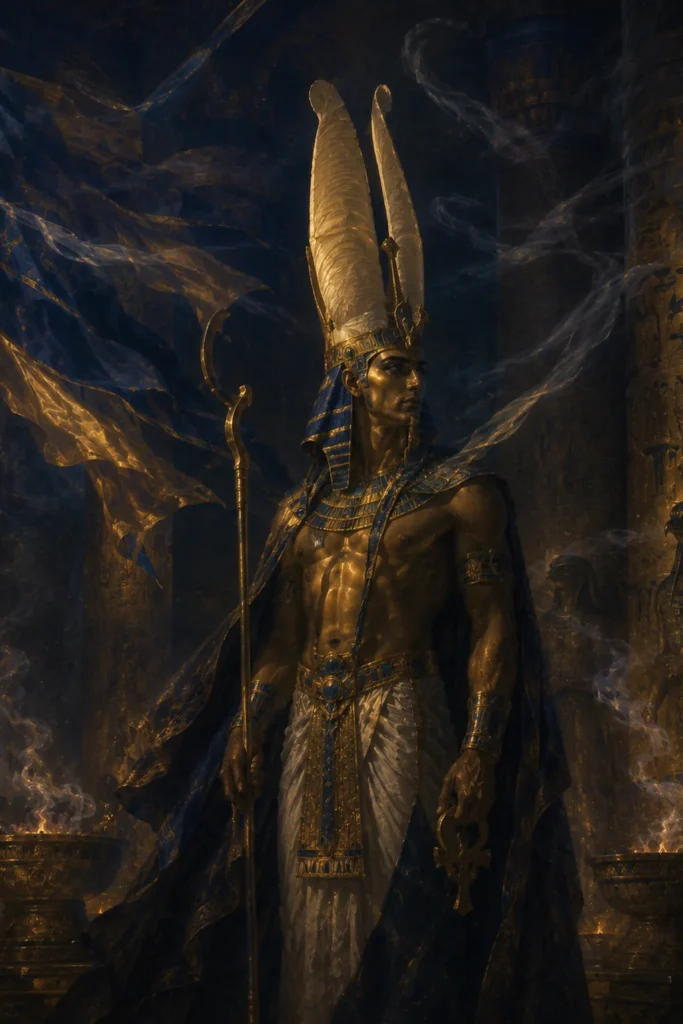
Appearance: Man with double feather crown; the air aspect itself remains unpictured
Textual history
Period of the Texts
Attested from the Old Kingdom to the Late Period; for the air aspect, the hymns of the New Kingdom are central, foremost among them Papyrus Leiden I 350.
Area of Diffusion
Egypt, with particular focus on Hermopolis, the seat of the Ogdoad, and Thebes, the centre of the later state cult.
Sources
For Amun overall, very well established; the wind aspect as an origin, by contrast, is partly a thesis, prominently advanced by Kurt Sethe, whom Henri Frankfort followed.
Name and variants
Egyptian: jmn, the Hidden One or Veiled One. The name designates the invisible air; hiddenness in Amun’s case is no mere embellishment but his very programme. In the Ogdoad of Hermopolis, he stands together with his consort goddess Amaunet for the primeval pair of air and hiddenness.
Beings and effect
Appearance
Amun is depicted anthropomorphically, as a man with a double feather crown, often in blue colour or as Amun-Min. The pure air aspect is scarcely captured in independent imagery: the invisible is deliberately left unpictured.
Effect
As an air aspect, Amun is the moving, life-giving air and breath. Within the context of the Ogdoad of Hermopolis, he acts as a creative primeval principle that precedes the ordered world.
Profile: Amun
The key aspects of the hidden wind god at a glance.
Primeval god of the Ogdoad of Hermopolis, consort of Amaunet; later rose to become the imperial god Amun-Ra, who overshadows this origin.
The invisible, moving air and breath; within the Ogdoad, the principle of air and hiddenness among the primeval divine pairs.
A man with a double feather crown, often in blue colour or as Amun-Min; the air aspect itself is deliberately not shown.
Life-giving breath and creative primeval principle; the name jmn, the Hidden One, describes the very nature of the wind.
A vast state cult in Karnak and Luxor, but for Amun-Ra as imperial god; a distinct wind cult around the pure air aspect is not attested as such.
The air god Shu, who separates heaven and earth; purely thematic, without any genetic connection, biblical images of the wind that blows where it wills.
From the Ogdoad of Hermopolis to Imperial God
Egyptian jmn, the Hidden One or Veiled One, designates the invisible air. In the Ogdoad of Hermopolis, Amun forms the principle of air and hiddenness together with his consort goddess Amaunet, one of the four primeval divine pairs of chaos. The god who would later come to rule all of Egypt thus begins as the most ungraspable thing any cosmology knows: as air.
The fusion with Amun-Ra in the New Kingdom overshadows this origin but does not erase it. The hymns of Papyrus Leiden I 350 expressly preserve the aspect of hiddenness and air; whoever reads them finds the wind again beneath the imperial god.
Scholarly Debate and Classification
The wind origin of Amun is a common but scholarly contested thesis, advanced above all by Kurt Sethe, whom Henri Frankfort followed. Some Egyptologists view the air aspect more as a secondary theological interpretation of the name than as a historical starting point.
In religious studies, Amun in his wind aspect shows how a concept of an element can become a supreme deity. Important clarifications: Amun was not originally a sun god, that is the later fusion Amun-Ra; and the wind as the true origin is a plausible thesis, not an established fact.
State Cult and the Question of a Wind Cult
Amun carries a vast state cult in Karnak and Luxor, yet this refers to Amun-Ra as imperial god. A distinct wind cult around the pure air aspect is not attested as such; this is honestly noted as an uncertainty. Whoever wishes to draw close to the air aspect will not find it in temple practice, but in the hymns that sing of the Hidden One.
Air Principles in Comparison
As an air principle, Amun is closely related to the Egyptian air god Shu, who separates heaven and earth; in the narrower sense of wind, the north wind god Qebui is the closest neighbour in the pantheon. The connection between wind and ungraspability recalls, purely thematically and without genetic connection, biblical images of the wind that blows where it wills.
Frequently Asked Questions about Amun's Wind Aspect
What does the name Amun mean?
The Hidden One or Veiled One; the name itself describes the invisible nature of the wind.
Was Amun a sun god?
Not originally. That is the later fusion Amun-Ra; in origin he is a principle of air and hiddenness.
Is the wind origin established?
No. It is a plausible but contested scholarly thesis, advanced above all by Kurt Sethe, whom Henri Frankfort followed.
Further links
Further reading:
- Egypt – all beings of the Egyptian cultural sphere
- Shu – the air god who separates heaven and earth
- Qebui – the god of the cool north wind
- Smudging, Protective Candle, Amulet – traditional protective means
- Protection Compass – overview of protective means
Literature (selection)
Further standard works in the bibliography.
As Egypt’s original god of air, Amun remains the hidden wind of his name: a god one does not see but feels, and it was precisely through this that he could become the highest power of the pantheon.