The Amulet: Worn Protection of Folk Magic
By Ralf Ittermann · last reviewed on
The amulet is an object to which tradition ascribes the ability to safeguard its bearer from harmful influences.
In contrast to the talisman, which is directed toward a specific effect through deliberate intention and often through a particular manufacturing process, the amulet is regarded as a passive bearer of protection: it works through what it is, through its material, its form, its signs or its place of origin, not primarily through an intention impressed upon it.
The word reaches us by way of the Latin amuletum. Pliny the Elder uses it in the first century CE without further explanation, as though it were self-evident. What exactly lies behind this word, whether a Punic, Arabic or Semitic root, has not been conclusively settled in scholarship.
The thing itself, in any case, is older than the word: objects worn on the body that, as far as the archaeological record allows, had a protective function reach back into the Old Stone Age.
The amulet belongs to the category Amulets and protective objects, the oldest and most widespread form of worn protection.
Since prehistoric times people have worn amulets; in folk magic they count among the oldest means of protection of all.
Quick Overview
The amulet is an object worn or fixed to a place to which an averting power is ascribed in its own right.
Its effect is held to be tied to the material, the form or worked-in signs, not to an ongoing action. It is attested in all known cultures, from Paleolithic sites to the present day.
Tradition distinguishes amulets that protect against the evil eye, those that ward off illness, and those that work against harm-causing spirit beings. A consecration by a qualified person or a priest is held in many traditions to strengthen the effect, but not to be a necessary condition.
Origin and Tradition
The oldest material evidence for the wearing of protective objects comes from Neolithic and Old Stone Age grave finds.
Pierced teeth, shells, perforated stones and small animal figures were worn on the body or clothing in a manner that points to notions of protection or power, even if the precise meaning can no longer be reconstructed.
In the high culture of Egypt an elaborate amulet practice developed that is documented across millennia. Particular objects, the djed symbol for stability, the Wedjat eye for wholeness, the ankh loop for life, were made of faience, carnelian, lapis lazuli or gold and given to the living as well as the dead.
The texts of the Book of the Dead describe exact rules of manufacture for numerous amulets: which material, which color, which inscription. This precision shows that one did not start from a general “protective object” but from objects working in a specific way.
Mesopotamia knows a similarly specialized amulet culture. Clay tablets bearing incantation formulas were folded and sewn into linen and worn on the body; at the same time, figurines of protective deities, so-called lamassu figures in miniature form, belonged to the protection of the house.
In Greek and Roman antiquity amulets are well documented: the bulla amulet that Roman children wore until adulthood, the lunula as a neck ornament for girls, phallus pendants as protection against the evil eye.
The Latin medical authors such as Pliny discuss amulets at times skeptically, yet describe them as a fixed part of everyday practice.
The Middle Ages continued this tradition. Christian amulets, relics, blessed palms, Agnus Dei medallions, came alongside older forms but seldom displaced them entirely.
The folk medicine of the fifteenth to eighteenth centuries, documented in numerous manuscripts and prints, knows a great number of amulets for specific purposes: fever-protection letters, slips of paper against erysipelas, stones against epilepsy.
Working Principle According to Tradition
The traditions describe the working principle of the amulet very differently, and it would be mistaken to try to reduce them to a single formula. A few recurring notions can nevertheless be named.
One group sees the effect in the material itself. Certain stones, metals or organic substances are held to be averting in their own right, because they bear a quality opposed to the harmful.
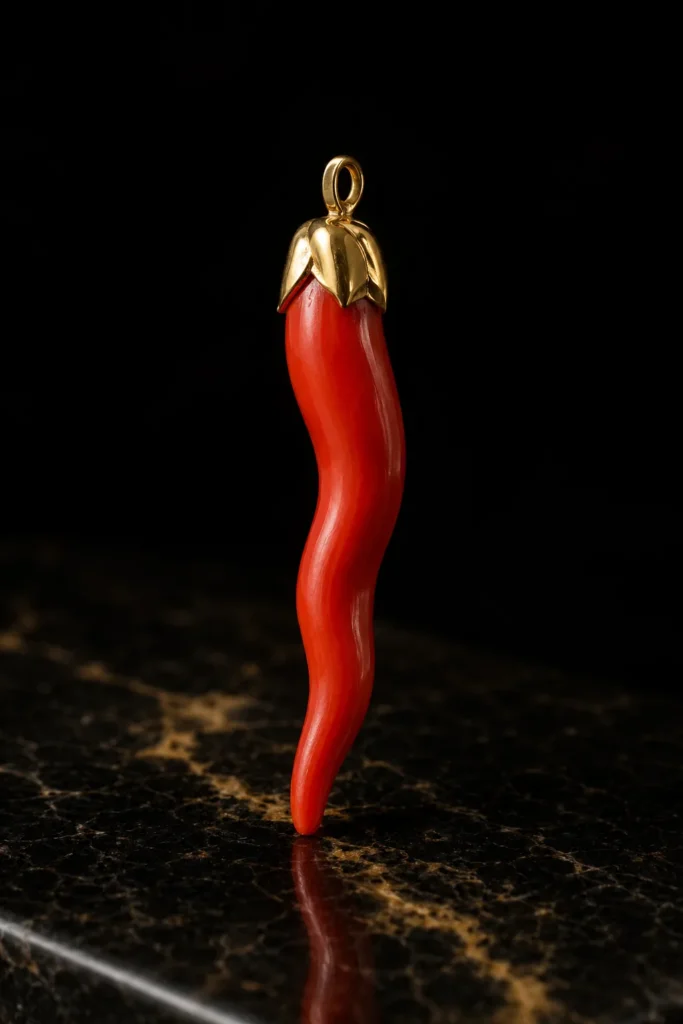
Red coral, for instance, was credited in the Mediterranean region with drawing in and neutralizing evil influences, which is why it grew cloudy or broke when it had absorbed something.
Another notion sees the effect in the form: the eye looks back, the knot binds, the circle encloses. According to this logic, forms have a symbolic resonance with particular forces that goes beyond the merely material.
A third group, dominant in the learned understanding of amulets in the Middle Ages and the Early Modern period, sees the effect as given by the inscribed name of God, the formula or the sign: the amulet is the bearer of a linguistic or symbolic reality that acts upon the cosmic information field.
In practice these notions intermingle. An amulet can bear a material of natural power in a symbolically effective form and carry an inscription besides.
Cross-Cultural Spread
The amulet knows no cultural boundaries. It is attested in Southeast Asia as well as in the pre-Columbian cultures of the Americas, in sub-Saharan Africa as well as on the Central Asian steppe. The forms differ considerably; the basic idea, to wear a small object on the body that works protectively, is the same everywhere.
A few comparisons are instructive. The Japanese omamori, a woven or printed pouch from the shrine or temple, corresponds in its basic structure to the Christian Breverl of the Alpine region: a mounted written sign or symbol, enclosed in cloth, worn on the body.
The basic logic, to carry a consecrated object or one furnished with power, is identical; the religious framing is entirely different.
In West Africa and in the African American diaspora one knows gris-gris or mojo bags, which contain a mixture of materials, signs and prayer formulas, are activated during manufacture by a qualified person and are worn on the body as lasting protection.
The similarity to the European protective pouch is striking, without any historical contact being needed to explain it.
What It Is Used Against
Tradition knows amulets that work against different kinds of harmful influence. In the Protection Compass the links between amulet types and particular beings are laid out. In summary one can say:
Against the evil eye, the malocchio or ayin hara, amulets with an eye motif or the color red are handed down: the blue eye amulet of the Near East, red coral in the Mediterranean region, horn amulets in the Italian sphere.
Against harm-causing spirit beings, demons, mares, night-faring beings, amulets are held to work that consist of averting materials or bear sacred names. In European folk belief a slip bearing a name of God or a Bible verse, worn around the neck, gave protection.
Against witchcraft and magical attack, counter-charm amulets served in particular: plants or materials said to throw back or dissolve the work of witches.
Against illnesses that folk-medical tradition traced back to supernatural causes, specific amulets are described that function according to the principle of likeness or the principle of contrast.
Application and Limits
An amulet unfolds its effect, according to the logic of tradition, only when it is correctly made, worn and cared for. That sounds self-evident, but it marks out important rules.
The quality of the material must be right: an inferior stone, a cheap imitation or a wrong metal undermine the intended effect according to many traditions. Authenticity of the material is not an aesthetic but a functional criterion.
Wearing it on the body is held to be decisive for personal protection. An amulet in the drawer is of little use according to this logic. Some traditions know exceptions for house amulets, which have their sphere of protection at a particular place.
Damage or destruction is held in many traditions to be a sign that the amulet has absorbed something, sometimes also as a warning that it is exhausted and must be renewed. To throw away a broken amulet without replacing it is held in some folk-belief traditions to be risky.
The limits are as clear as the possibilities. No amulet protects against everything. Tradition always knows a specificity: this and that protects against this and that. Whoever hopes to cover every form of harmful influence with a single object acts, by the logic of folk belief, naively.
Literature (Selection)
Related key terms: amulet meaning protective amulet effect.
iWell Guard and Protective Traditions
The iWell Guard stands in the tradition of the worn protective amulet as it took shape independently in Egypt, in Asia, in Europe and in the Americas.
It takes up the basic idea that a carefully designed object on the body condenses the cosmic information field in a way that sets a concrete object against harmful influences. No guarantee, no promise, but a counterpart to what cultures have experienced as meaningful over millennia.
Personal experiences may vary. Not a medical device. No promise of healing.