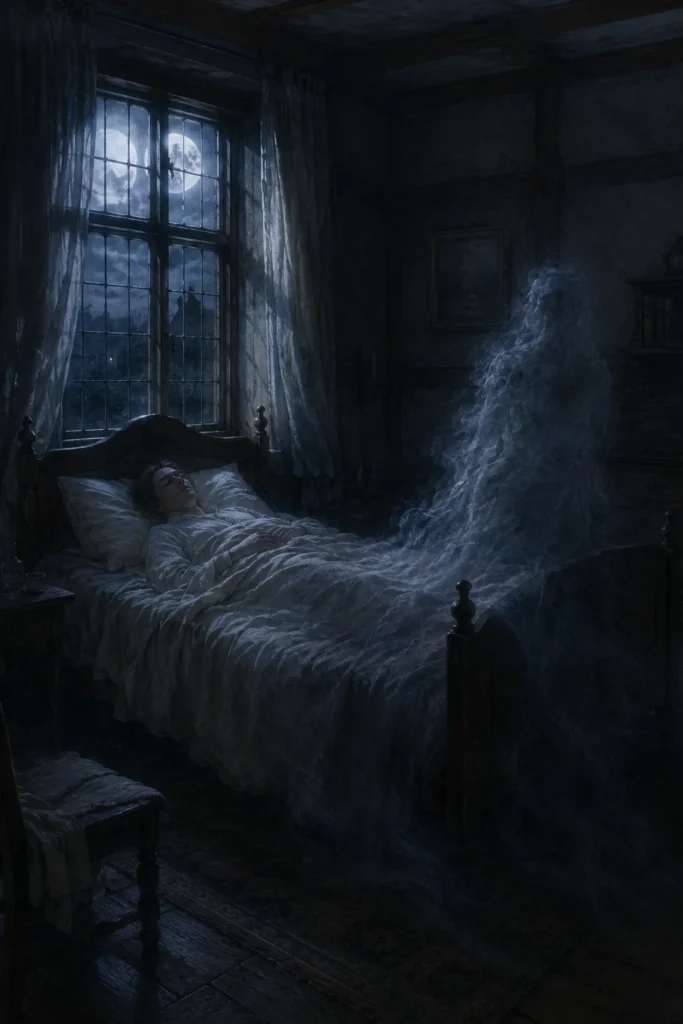
Sleep Paralysis, the Night-Mare Between Neurology and Tradition
By Ralf Ittermann · last reviewed on
Sleep paralysis is the night-mare between neurology (persistence of REM atonia) and the religious-historical tradition of the Mare, Old Hag and succubus figures.
Sleep paralysis describes the state in which a person is awake in consciousness yet simultaneously paralysed in the muscles, a transition between REM sleep and wakefulness.
The paralysis is often accompanied by shortness of breath, a sense of pressure on the chest, visual or auditory hallucinations, and sometimes the perception of an alien presence in the room. The experience is neurologically explicable and at the same time one of the oldest documented sources of folk conceptions of ghosts and demons.
Phenomenology
A typical episode lasts from a few seconds up to two minutes. Those affected report that they wake up but cannot move any limbs. A sense of breathing constriction is frequently felt, because the diaphragm continues to work while voluntary control of breathing is blocked.
The open eyes register the bedroom unfiltered, while remnants of the REM dream are projected into it. In some episodes a sense of presence occurs, the distinct feeling that another person or being is in the room, often at the edge of the bed or above the chest.
Neurological Basis
During REM sleep, the pontine atonia system inhibits the motor neurons in the spinal cord so that dreams are not acted out. Sleep paralysis arises when this inhibition persists for a few seconds after waking. The amygdala remains highly active, while the prefrontal cortex runs in an intermediate mode between sleep and wakefulness.
Hallucinations occur when the visual and auditory systems superimpose residual patterns from the REM generator onto the waking image that is just coming in. The impression of an alien presence is linked to overexcitation of the temporal lobe, which controls face and body recognition.
Frequency: about 8 percent of the general population experience at least one episode, and among students and shift workers the proportion rises to 28 to 35 percent. Risk factors include sleep deprivation, jet lag, irregular sleep times, stress, anxiety disorders, post-traumatic stress, and lying on the back when falling asleep.
Cultural Interpretations
Before the neurological explanation in the 20th century, practically all cultures interpreted sleep paralysis as the attack of a being. In Newfoundland it is called Old Hag, an old woman who sits on the chest. In Japan it is Kanashibari, being bound. In China Gui ya shen, being pressed by a Gui.
In Mexico Subirse el muerto, the dead one rises up. In Turkish culture it is a Karabasan, the black pressing.
In the Germanic world people know the Mare or the Alb, which oppresses the sleeper, and from this the word Albtraum (nightmare) is derived. In the English-speaking world the term nightmare arose from the Old English mære, a pressing spirit.
In his 1982 study The Terror that Comes in the Night, David J. Hufford demonstrated that the core structure of the experience, paralysis, pressure, presence, is identical across cultures, while only the interpretation varies. This makes sleep paralysis one of the best examples of a universal phenomenological basis behind divergent ghost narratives.
Modern Interpretation: Abduction Narratives
Since the late 1960s, sleep paralysis has frequently been recognisable in reports of abductions by extraterrestrials: nocturnal waking, paralysis, figures at the edge of the bed, flashes of light, and later implanted memories of medical examinations.
In studies at Harvard University, Susan Clancy and Richard McNally showed that people with high suggestibility, sleep paralysis episodes, and an affinity for paranormal literature can develop a consistently reconstructed abduction narrative.
This does not make the old ghost narratives any less worthy of being taken seriously, on the contrary: it shows that the same physical boundary experience imprints its own interpretation on every era.
Dealing with Episodes
A proven approach is not to fight against the movement block during the paralysis, but to breathe slowly and evenly and to try individual small movements, rolling the eyes, moving the tongue, wiggling a finger. The motor system typically comes back online through these micro-movements.
Anyone who regularly experiences episodes should build up good sleep hygiene: fixed bedtimes, reduction of caffeine, avoidance of lying on the back. In the case of frequent occurrence, a sleep-medicine assessment is worthwhile, since sleep paralysis can be associated with narcolepsy.
Distinction from Genuine Haunting
From a religious-phenomenological perspective, not every ghost experience can be reduced to sleep paralysis. Incidents that take place during the day, that are perceived by several people at once, or that are demonstrably physical, elude this explanation.
Anyone who experiences a recurring nocturnal pressure should first examine the sleep-paralysis hypothesis before concluding that there is a spiritual cause, which guards against unnecessary rituals and at the same time preserves respect for those phenomena that lie beyond this explanation.
Sources
- David J. Hufford: The Terror that Comes in the Night, Pennsylvania UP 1982 (standard study).
- Brian A. Sharpless, Karl Doghramji: Sleep Paralysis. Historical, Psychological, and Medical Perspectives, Oxford UP 2015.
- Susan A. Clancy: Abducted. How People Come to Believe They Were Kidnapped by Aliens, Harvard UP 2005.
- Allan Cheyne: Sleep Paralysis Episode Frequency and Number, Types, and Structure of Associated Hallucinations, Journal of Sleep Research 14 (2005).
Sleep paralysis is based on REM atonia, which normally paralyses the body during REM sleep and persists into waking awareness of the phenomenon.