Mahr, Spirit of the Germanic Tradition
By Ralf Ittermann · last reviewed on
Mahr is a spirit of the Germanic tradition.
The female night-pressure figure, an archaic form preserved in language.
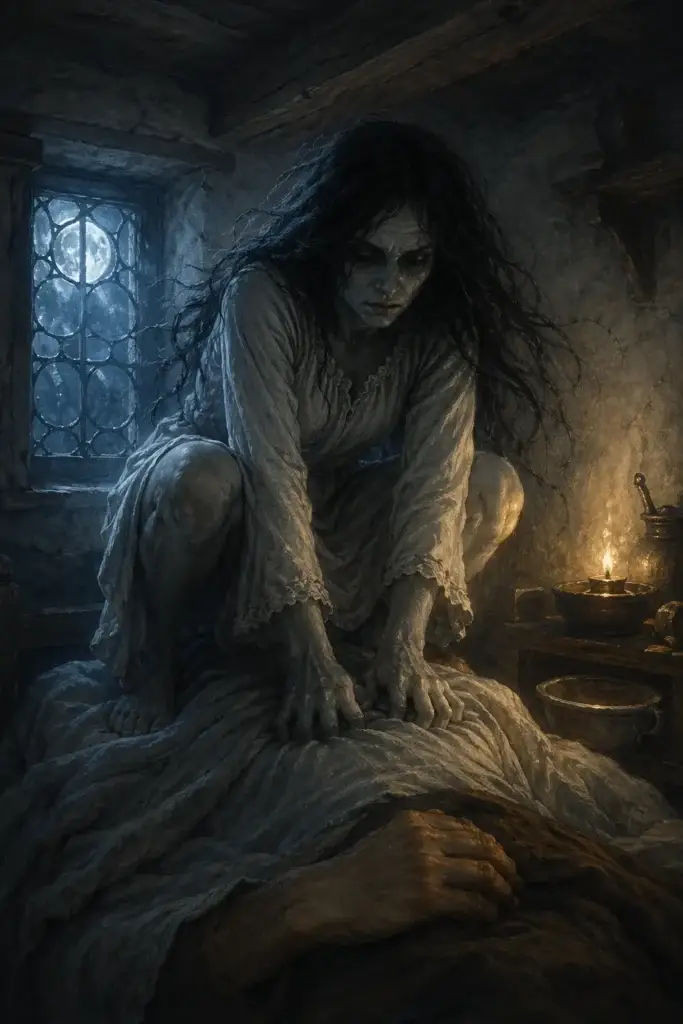
Mahr
The Mahr (also die Mahr, traditionally feminine) is a figure of Germanic folk belief closely related to the Alp. Both are nocturnal pressure beings, both cause nightmares and sleep paralysis.
The distinction is primarily linguistic and historical: the Mahr derives from an older, Proto-Germanic layer (Germ. *maran-), attested in Old English mære, Old Norse mara, and Old High German mara. The English word nightmare and French cauchemar carry this word to the present day.
A female figure in Norse and German tradition
The Mahr appears in Norse and German tradition frequently as a female nocturnal figure. In Snorri Sturluson‘s Ynglinga saga (Heimskringla), King Vanlandi is pressed to death by a Mara.
The nocturnal visitation described there corresponds to the Mahr accounts documented in later sources. Swedish and German folk tradition of the Early Modern period then defined this figure more precisely.
The Malleus Maleficarum (Kramer/Institoris, 1486/87) describes incubi and succubi who visited people and had intercourse with them; an equation with Mähre or Mahr is not attested there.
The Mahr was therefore not primarily an adoption from foreign traditions but a local figure with its own historical depth.
Overview: Mahr
Type: Female nocturnal pressure spirit
Origin: Early Germanic layer (*maran-)
Texts: Old Norse, Old English, Middle High German; Grimm, folkloristic collections
Period: Early medieval to the present (linguistically still alive today)
Protection: as with the Alp, pentagram (Drudenfuss), shoes, steel, prayer
Classification
Attested linguistically at the Proto-Germanic level (shared stem in Old Norse, Old English, and Old High German). Medieval evidence in literary and legal sources. Richly documented in the 19th century (Grimm). Still alive today in the words “nightmare” / “cauchemar” / “Albtraum” (the latter used synonymously for both figures).
Entire Germanic-speaking world, with regional names: Mahr (German), mare (English, in nightmare), mara (Old Norse/Swedish), Mart/Mårt, Mahrt, Dutch nachtmerrie. Via French cauchemar, the word also passed into Romance languages.
Old English medical texts, Old Norse sagas (King Vanlandi in the Ynglinga saga is killed by a mara), Middle High German legal sources, Grimm’s mythology, folkloristic archives of the 19th and 20th centuries.
Name
Old Norse: mara, plural marur.
Old English: mære.
Old High German: mara.
Modern forms: Nachtmahr, Nachtmar, Mart, Mårt, Mahrt, English nightmare, French cauchemar.
Related: Alp (masculine, often synonymous).
The Ynglinga saga tells how the Finnish sorceress Huld, hired by Vanlandi’s wife Drífa, sends a mara against King Vanlandi, who is trampled to death in his sleep. This passage is one of the oldest detailed literary attestations of the concept and demonstrates the lethal potential ascribed to the figure.
Characteristics
Appearance
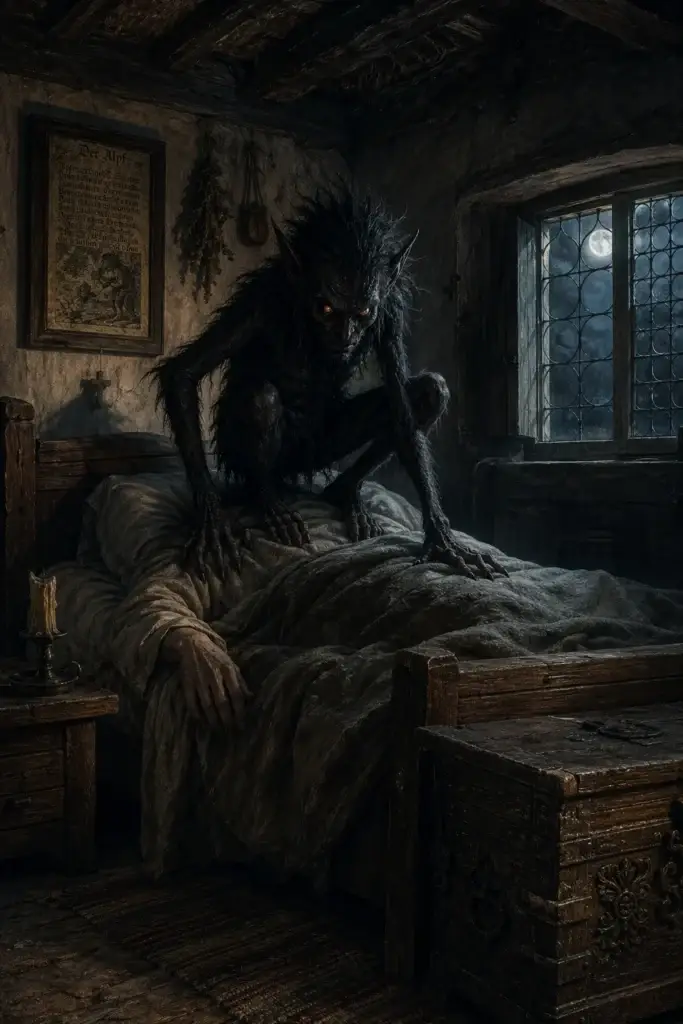
A female figure, small, with long matted hair. Capable of taking animal form: cat, dog, spider. Enters through a keyhole, chimney, or door crack. In some regions described as a beautiful young woman, in others as a wizened old crone.
Behavior
Sits on the chest of the sleeping person, presses down, steals breath, and causes nightmare states. Can “ride” horses; in the morning their manes appear disheveled (“Mahrenzöpfe”) and the animals exhausted. In the most severe cases, death can result (Ynglinga saga).
Domain
The sleeping chamber and the horse stable. Certain nights (boundary days, Thursday nights) are considered particularly vulnerable. In folk belief, people with weak circulation, those who have eaten heavily, or those sleeping on their back are thought to be more at risk.
Mythological Classification
Proto-Germanic. Possibly related to the concept of a wandering soul (mara as a detached female soul-figure that roams at night). Closely related figures exist in Slavic tradition (Mora, Mura).
Appearance and Symbolism
Mahrs are described as twilight shadows that settle upon sleepers. They sometimes appear as elf-like beings. The Alp can take animal form: horse, bird, or cat. Constriction and respiratory paralysis are their hallmarks. Iron is considered protective.
Witchcraft and Early Modern Folk Tradition
In German-speaking areas from the 16th to the 18th century, the Mahr was closely associated with witchcraft. Women accused of witchcraft were among those charged with riding upon sleeping persons as a Mahr at night, causing nightmares and seducing men.
The boundary between a demonic being and a witch who magically transforms into this form was frequently blurred. Village traditions spoke of women who could “ride as Mahr” (mahr fahren), sending their souls out in this form while their physical body lay asleep.
This belief was not confined to a single region but was widespread across the German-speaking lands and Scandinavia. Jacob Grimm documented hundreds of Mahr accounts from various areas in his Deutsche Mythologie (1835) and showed that the Mahr tradition was more enduring and widespread than academic attention at the time suggested.
Profile: Mahr
The most important aspects of the Mahr at a glance.
Proto-Germanic layer; possibly a wandering female soul-figure. Linguistically preserved to this day in “nightmare” and “cauchemar”.
Sleeping persons (lying on their back, after heavy meals), horses in the stable. Certain boundary nights are considered particularly susceptible.
Female, small, long matted hair. Capable of shape-shifting into animal form (cat, spider). Regionally described as a beautiful woman or as an old crone.
Presses down, steals breath, causes nightmares. “Rides” horses. Can prove fatal in literary tradition (Ynglinga saga).
As with the Alp: pentagram (Drudenfuss), shoes placed backwards in front of the bed, a knife under the pillow. Additionally: a hymnal or psalter under the head, making the sign of the cross when lying down.
Alp (closest relative), Slavic Mora/Mura, Lilū and Lilītu, Lilith, Empusa, Striga.
Warding Off and Interpretation
Protective Practices
Identical to those used against the Alp: pentagram (Drudenfuss), shoes placed backwards, a knife under the pillow, a psalter or Bible under the head. Regionally: a broom with bristles pointing upward in the corner, a straw figure at the stable entrance.
Horse Protection
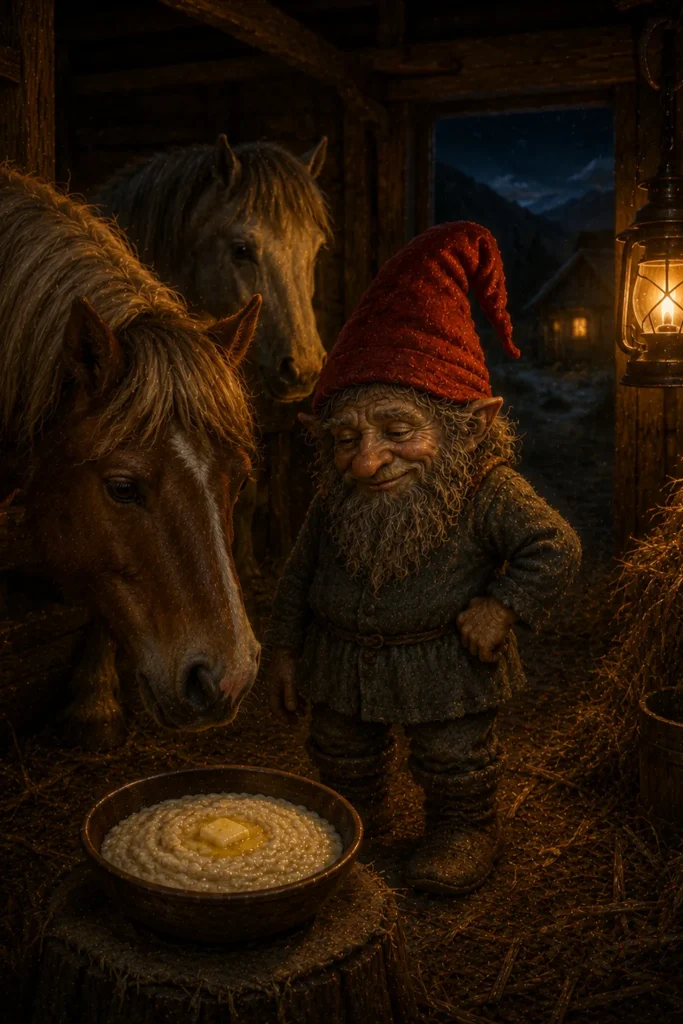
In the stable, to guard against being “ridden” by the Mahr: an Alp-mirror (a small mirror piece around the horse’s neck), consecrated amulets, a burning stable lantern. Mahrenzopfe (matted mane locks) in the morning were taken as clear evidence of a Mahr visit.
Modern Interpretation
Like the Alp, the Mahr is understood today as a sleep paralysis phenomenon. Folkloristic research (David Hufford and others) has shown that the experiential phenomenology is stable across cultures: the mythological imagery varies, but the experience remains constant.
Parallels and Reception
The Physical and Demonic Nature of the Mahr
A recurring motif in the accounts is the Mahr’s ambivalent physical presence. Some narratives speak of a tangible being, a gaunt woman with long fingernails and a pallid face making strangling motions.
Other accounts point more strongly to a spiritual or fleeting presence, a kind of internalized form of dread that resists physical objectification. This ambivalence makes the Mahr neither fully spiritual nor fully corporeal, but rather situated at the boundary between the two.
Whether the Mahr is to be understood as a demonic being, a projection of human fear, or a consequence of a medical sleep disorder has been answered in different ways within folkloristics. Contemporary religious studies acknowledges this ambivalence without resolving it, treating the Mahr as a cultural product with real social and psychological functions.
The Mahr and the European Word for Nightmare
The Mahr is linguistically one of the most consequential spirit beings in the Germanic tradition. Its name is embedded in the English word nightmare, the French cauchemar, and several further European words for the nightmare experience.
These traces show that the concept of a female pressure spirit who oppresses sleepers at night was widely distributed in western Europe and has deep roots.
The word family is well attested across the Germanic languages: in Old High German, in Old English as mære, and in Old Norse as mara.
Old Norse literature preserves a striking account in Snorri Sturluson’s Ynglinga saga: King Vanlandi is pressed to death by a mara, which first treads on his legs and then on his head.
This passage is one of the oldest detailed literary witnesses to the concept and shows that the Mahr could already be conceived as a lethal threat in the medieval period.
Linguistic research has proposed various interpretations of the root, including a connection to a verb meaning “to crush” or “to press,” which would accord well with the pressure spirit’s function. No fully established etymology exists. What is certain, however, is the word’s great geographic and temporal reach.
The Mahr is thus an example of how a spirit being exerts an influence through language that far outlasts its original religious context. Anyone who speaks of a nightmare today is, without knowing it, using the name of an ancient pressure spirit.
The Mahr between Spirit Being and Projected Soul
The folkloristic tradition surrounding the Mahr is not uniform but combines two distinct explanatory models. According to the first, the Mahr is an independent spirit being that comes from outside and oppresses the sleeper.
According to the second, the Mahr is the projected soul or will of a living person. In this second model, a person torments another during sleep, often without being aware of it, as a part of them leaves the body and goes about as a Mahr.
From this second concept, concrete narrative patterns emerged. A widely attested narrative type relates that the Mahr enters the sleeping chamber through a small opening, such as a knothole. If the opening is plugged, she can no longer leave and is trapped.
In the morning a person is found at that spot, usually a woman, who is thus unmasked as the Mahr. In some versions the man marries this woman, but as soon as the once-plugged opening is reopened, she disappears by the same route.
These narratives link the Mahr closely to witch belief and to concepts of the freely mobile soul. Religious-studies and folkloristic scholarship sees in them a confluence of several layers: an ancient concept of the nocturnal pressure being, the idea of the projected soul, and the Early Modern concept of the witch.
The Mahr is therefore not a clearly defined being with a fixed biography but a nodal point at which different belief traditions intersect. It is precisely this complexity that makes it so productive for the study of popular spirit belief.
The Ridden Victims: Mahr, Animal, and Human
A separate strand of Mahr tradition concerns not humans but livestock. Throughout much of the German-speaking world and Scandinavia, the Mahr was also regarded as a plague upon horses.
A horse found in the morning exhausted, sweating, and with a matted mane was said to have been ridden by the Mahr. The knotted, tangled strands of the mane were called Mahrlocken or similar terms and interpreted as visible proof of a nocturnal visit.
This belief explains a real agricultural observation: horses can indeed be found sweating and with matted manes in the morning, whether from illness, restlessness, or parasites. Against the background of Mahr belief, this observation became confirmation of a spirit visit.
Protective measures followed for the stable: certain objects were hung up, signs were carved into the wood, or protective plants were relied upon to keep the Mahr away.
In some regions, the term for the matted mane was even transferred to a human phenomenon, to severely matted hair that could no longer be untangled. Folkloristic research has documented well how the Mahr concept spread from the bedroom into the stable and from the experience of sleep paralysis to observations of animals.
It illustrates vividly how an established explanatory pattern extends to ever new phenomena. What the Mahr originally explained was the nocturnal sense of suffocation in humans. What it additionally explained was a range of further striking and otherwise inexplicable observations that could be fitted into the same interpretive framework.
Further Links
Further reading:
- Germanic
- Alp (closest relative), Draugr, Nix, Troll
- Lilū and Lilītu, Lilith
- Sleep paralysis research
Selected Bibliography
Further standard works in the literature index.
The protective practices described here represent a religious-studies classification of historical traditions. iWell Guard draws on this cultural-historical lineage of wearable protective objects and represents a contemporary form of it. More about iWell Guard →