Troll, Spirit of the Germanic Tradition
By Ralf Ittermann · last reviewed on
Troll is a spirit of the Germanic tradition.
A giant mountain being, situated between the Eddic thursar and the fairy-tale ogre.
The Troll is one of the most complex figures in the Nordic tradition. Originally a very broad concept (Old Norse troll can mean “magical being” in general), the term narrows in folk tales and literature to the giant mountain and forest dweller: dull or cunning, usually dangerous, sometimes comical.
It inhabits caves, mountains, remote forests, abducts people, steals brides, guards treasures, and shatters to stone in sunlight.
The background lies in the Jötnar and Thursar of the Edda, mythical giants standing in opposition to the gods.
In Scandinavian folk tradition, these merge with regional mountain and forest spirits to form the Troll of the folk tale, preserved in Asbjørnsen and Moe’s Norwegian legend collections, in Icelandic folklore, and in Finnish fairy tales. Modern fantasy literature (Tolkien, Rowling, Pratchett) has made the image of the Troll known worldwide.
Troll Children and Mountain Trolls in the Edda and Saga
Snorri Sturluson mentions trolls in the Prose Edda (around 1220), particularly in the Skáldskaparmál (Poetic Diction), mainly in heiti lists. The Skáldskaparmál also treats trolls as a poetic metaphor, suggesting a learned engagement rather than purely popular tradition.
In the Icelandic sagas (Heimskringla, Egils Saga, Grettis Saga), trolls appear as a chaotic force in conflict with humans and gods, yet rarely carry the main plot. Their presence functions as an embodiment of wildness or the otherworld, a marker in the narrative world rather than a fully developed character type.
Troll at a Glance
Type: Giant mountain/forest being
Origin: Eddic Jötnar and Thursar, regional mountain spirits
Texts: Edda, Icelandic sagas, Asbjørnsen & Moe, Grimm, modern fantasy
Period: Viking Age to the present
Countermeasures: Sunlight, church bells, steel, salt
Classification
Mythically rooted in the Eddic Jötnar. Flourishing literarily in the Icelandic sagas (Grettis saga, Bárðar saga). Folk-tale figure in Scandinavian tradition from the Middle Ages, richly collected in the 19th century (Asbjørnsen & Moe). Modern pop-culture figure since Tolkien.
Scandinavia, Norway, Sweden, and Iceland as the core region. Finnish and Sami variants exist. Germany knows “trolls” primarily through Scandinavian translation imports; its own mountain and forest giants bear different names.
Edda (Völuspá, Grímnismál), Icelandic sagas, Asbjørnsen and Moe’s Norske Folkeeventyr, Scandinavian and Finnish folklore studies, modern fantasy literature.
Name
Old Norse: troll, broadly used for “magic, monster, magical being”.
Eddic terms: jötunn (plural jötnar), “giant”; thurs, “fiend”.
Modern names: Mountain Troll, Forest Troll, Troldkone (troll woman), Trollkunig (Icelandic).
Tolkien: Trolls as a distinct species created by Morgoth, turning to stone in daylight.
The narrowing of meaning from a general magical being to a specific mountain giant takes place in the late Middle Ages and the early modern period. In some Icelandic texts the term remains broad; a troll there can also denote a witch.
Characteristics
Appearance
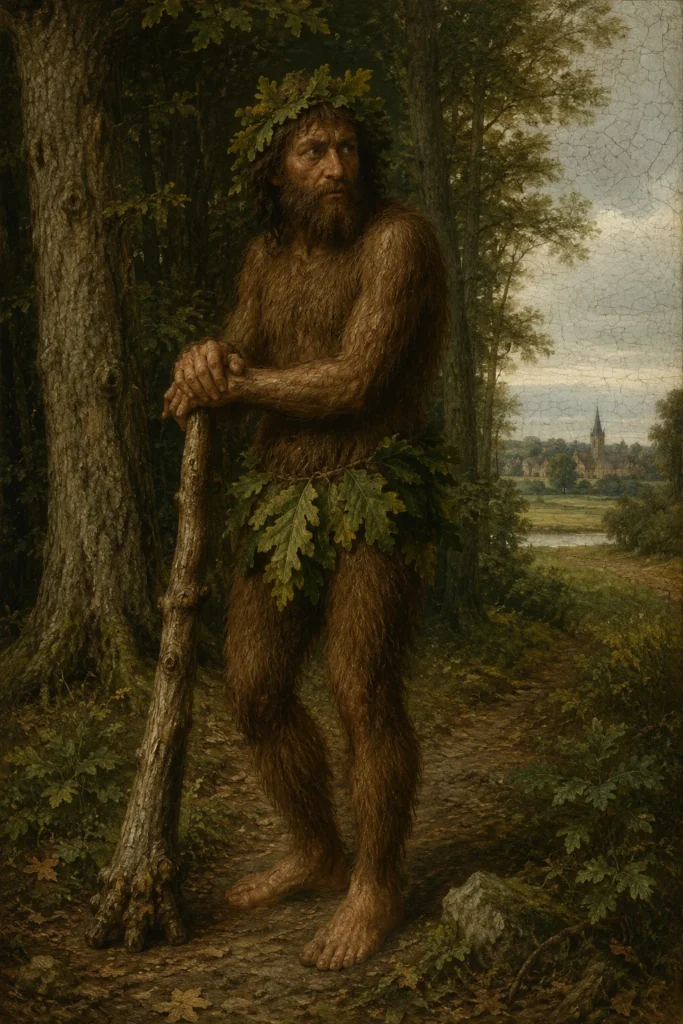
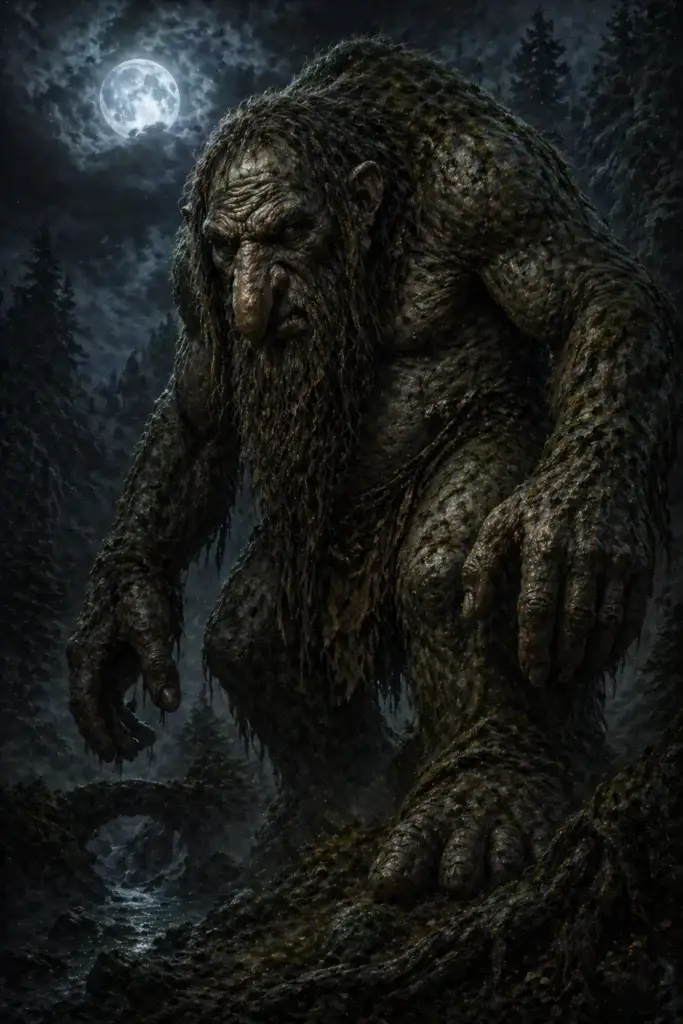
Gigantic, often several meters tall. Ugly, with a thick nose, warts, and matted hair. In some traditions with multiple heads. Skin usually gray or moss-covered, reminiscent of rock. In Norwegian folk tales often with a tail.
Behavior
Lives in caves and mountains. Dangerous to travelers, steals brides, abducts children, guards treasures. Duller than humans; in folk tales often defeated by cunning. Some trolls sneak into villages after dark; caught by sunrise, they turn to stone.
Sphere of Activity
Mountain regions, forest expanses, lonely caves and rocky gorges. Several iconic rock formations in Norway are still interpreted as petrified trolls today (Trolltunga, Trollveggen).
Mythological Classification
In Eddic mythology, the Jötnar belong to the primordial forces predating the gods. Thor is their chief adversary. In folk tradition this cosmic dimension loses importance; the Troll becomes an everyday being of the mountains and forests.
The Asbjørnsen-Moe Collection and Nordic Modernity
Norwegian folklorists Peter Christen Asbjørnsen and Jørgen Moe published their Norske Folkeeventyr (Norwegian Folk Tales) from 1841 onward. Their collection contained numerous troll stories: trolls guarding bridges, luring humans, or quarreling with the gods.
Asbjørnsen and Moe refined the descriptions of trolls and made them more narratively accessible. They also documented regional variation (fjord trolls, mountain trolls, sea trolls), which supported the specialization of the troll tradition.
This collection, reprinted many times and translated into several languages, became a canonical work for European Romanticism and set the standard for how Nordic trolls are understood in modern literature and folklore studies.
Profile: Troll
The most important aspects of the Troll at a glance.
Eddic Jötnar and Thursar as mythical origin. Merged in folk tradition with regional mountain and forest spirits.
Travelers, shepherds, children. Brides in folk tales. Heroes seeking treasure.
Gigantic, ugly, thick nose, matted hair, sometimes multiple heads. Skin color gray or moss-covered. Occasionally with a tail.
Steals, abducts, guards treasures, crushes. Defeated by cunning in folk tales. Loses life at sunrise and turns to stone.
Daylight (the central countermeasure), church bells, steel. Cunning and patience: folk tales show heroes keeping the Troll occupied until morning.
Giants of Greek mythology, ogres (French fairy tales), Cyclops, Germanic mountain giants, ogres in modern fantasy.
Encounter and Defense
The Daylight Rule
The most important defense is straightforward: keep the Troll occupied until sunrise. In numerous Norwegian folk tales the hero uses time, riddles, cunning, or long conversations to detain the Troll until the first ray of sunlight, at which point it shatters to stone.
Bells, Steel, Salt
Church bells drive trolls away, hence the customary bell-casting for new village churches. Steel (knife, axe, horseshoe) burns trolls. Salt is thrown into the fire when trolls are suspected nearby.
Negotiations
Not all trolls are purely enemies. In some narratives one can negotiate with them, trade, take service with them, or receive teachings. The risks remain high; so do the rewards (treasures, secrets).
Parallels and Reception
Germanic and Further Parallels: Giants, ogres, Cyclopes: everywhere the motif of the oversized, dull yet dangerous being that challenges heroes. The Jötnar of the Edda are mythical; the trolls of folk tales are closer to everyday life.
Tolkien and Fantasy
Tolkien (1937, The Hobbit) brings the Norwegian daylight rule into modern fantasy. From this the Troll becomes the standard adversary in role-playing games, fantasy novels, and video games.
Scandinavian Modernity
In Norway the Troll remains a culturally present figure, in tourism (troll souvenirs, Trollveggen), film (Troll Hunter, 2010; Troll, 2022), and literature. The mixed feeling of “uncanny and charming at once” shapes Scandinavian identity formation.
Social and Cosmological Role in the Nordic Worldview
In the Nordic cultural imagination, trolls were not merely monsters but an integral element of cosmological order. They inhabited regions outside human civilization and represented a force that could not be assimilated but had to be respected or feared.
The boundary between human space (Midgard) and demonic space (Jötunheim) was often marked by trolls. This functional role distinguished trolls from purely evil demons that could exist without cosmological grounding.
The troll tradition remained alive in Scandinavia while it faded in other parts of Europe. This partly explains why modern fantasy and Nordic cultural renaissances treat the troll figure so prominently: it is not an invention of the 19th century but the historically documented continuation of a tradition with continuity across centuries.
The Troll in Old Norse Tradition
The Old Norse word troll is well attested in the medieval literature of Iceland and Scandinavia, yet its meaning there is broader and less clearly defined than in modern usage.
In the sagas and in Eddic poetry, troll does not designate a clearly delineated type of being but rather a whole range of dangerous, supernatural beings. It can mean a giant, a monster, a revenant, or simply a malevolent magical being. The related word trolldómr likewise means nothing other than sorcery.
In the Íslendingasögur, the Icelandic sagas, troll-like beings appear mostly as a threat at the margins of the settled world: in the mountains, in impassable valleys, along the coast.
A distinct group consists of the tröllkonur, the troll women, who appear in several sagas and in skaldic verses. The Grettis saga contains a famous episode in which the outlawed hero Grettir fights one such troll woman and another adversary.
Research into Old Norse literature emphasizes that the medieval texts offer no systematic mythology of trolls. Troll is more of an umbrella term for the Other, the uncanny, whatever stands outside human and divine order.
The coherent, vivid troll image of later folk narrative, and still more of modern children’s literature, is a later development. Anyone wishing to grasp the Troll from a history-of-religions perspective must accept this ambiguity in the oldest sources and must not read the modern image back into the sagas.
Trolls in Scandinavian Folk Legend
The vivid troll image familiar today took shape primarily in the post-medieval folk legend and was recorded in the 19th century by collectors.
In Norway, Peter Christen Asbjørnsen and Jørgen Moe made important contributions with their Norske Folkeeventyr, and in Sweden various folklorists compiled comparable material. In this more recent tradition, the Troll gains clearer contours.
It is now imagined mostly as a being dwelling in mountains, cliffs, or hills: clumsy, strong, often dull, and outwittable by humans. Recurring motifs include its aversion to noise (especially church bells), its living under bridges, its wealth in livestock and treasure, and, in some traditions, the belief that sunlight turns it to stone.
This last motif has an old anchor point: already in Eddic poetry the dwarf Alvíss is turned to stone because the rising sun catches him unawares.
From a folklore perspective, troll legends served several functions. They explained striking landscape features, such as oddly shaped rocks interpreted as petrified trolls. They marked the boundary between cultivated and wild land and warned of the dangers of the wilderness. And they negotiated in narrative form the encounter with the foreign.
A widespread narrative type is that of humans taken into the mountain by trolls, a motif closely related to beliefs about subterranean beings and nature spirits. Religious-studies scholarship sees in this narrative material less a belief system than a flexible repertoire through which rural communities interpreted their environment and their fears.
From Frightening Figure to Children's Book Character
The reception history of the Troll in the 19th and 20th centuries is an instructive case study in the transformation of meaning of a spirit being. The starting point was the nationalist-Romantic revaluation of folk tradition in Scandinavia.
The Troll changed from a purely frightening figure into an element of national identity and artistic inspiration. The Swedish painter John Bauer, through his illustrations for the anthology Bland tomtar och troll in the early 20th century, established an influential image of the massive, gnarled, forest-dwelling Troll.
As the 20th century progressed, the image shifted even more clearly toward the friendly and child-appropriate. The Finland-Swedish author Tove Jansson created the Moomins, round, good-natured troll beings that have little in common with the threatening saga troll.
In the toy and entertainment industry the Troll became a harmless, often cute figure. In parallel, in fantasy literature influenced by the works of J. R. R. Tolkien, the image of the large, dull, dangerous Troll also lived on.
For the history-of-religions perspective this transformation is instructive because it shows how a being can lose one function and acquire another. The saga troll was bound to concrete fears and to a specific landscape.
The modern Troll has been released from this grounding and can embody, as the occasion demands, the cute, the comic, or the monstrous. The Swedish word troll has in this way regained its old breadth of meaning in a new form: today it designates almost anything a narrative wishes it to be.
Sources and Literature
Further standard works in the literature index.
The protective practice described here represents a religious-studies classification of historical traditions. iWell Guard connects to this cultural-historical lineage of wearable protective objects and constitutes a contemporary form of it. More about iWell Guard →
Frequently Asked Questions about Troll
What is a Troll in mythology?
A Troll is a being of Nordic and Germanic mythology that lives in mountains, forests, and under bridges. Trolls are considered large, ungainly, often dull, but dangerously strong. In the Old Norse tradition (Edda, sagas), trolls are described as a race of giants, relatives of the Jötunn. The modern fantasy tradition has significantly altered this image.
What types of trolls exist?
The later Scandinavian folk legend knows several troll types: mountain trolls (cliff dwellers), water trolls (in rivers and lakes), hill trolls, and the smaller hus-tomten of Swedish folklore. Trolls turn to stone in sunlight, a motif that recurs in many Norwegian rock-formation legends.