Heinzelmännchen, Cologne's nocturnal gnomes
By Ralf Ittermann · last reviewed on
The Heinzelmännchen are spirits of the Germanic tradition.
At night they do the work, as long as no one sees them. The profile classifies the Heinzelmännchen as Cologne’s best-known nocturnal house sprites within the Germanic legend tradition.
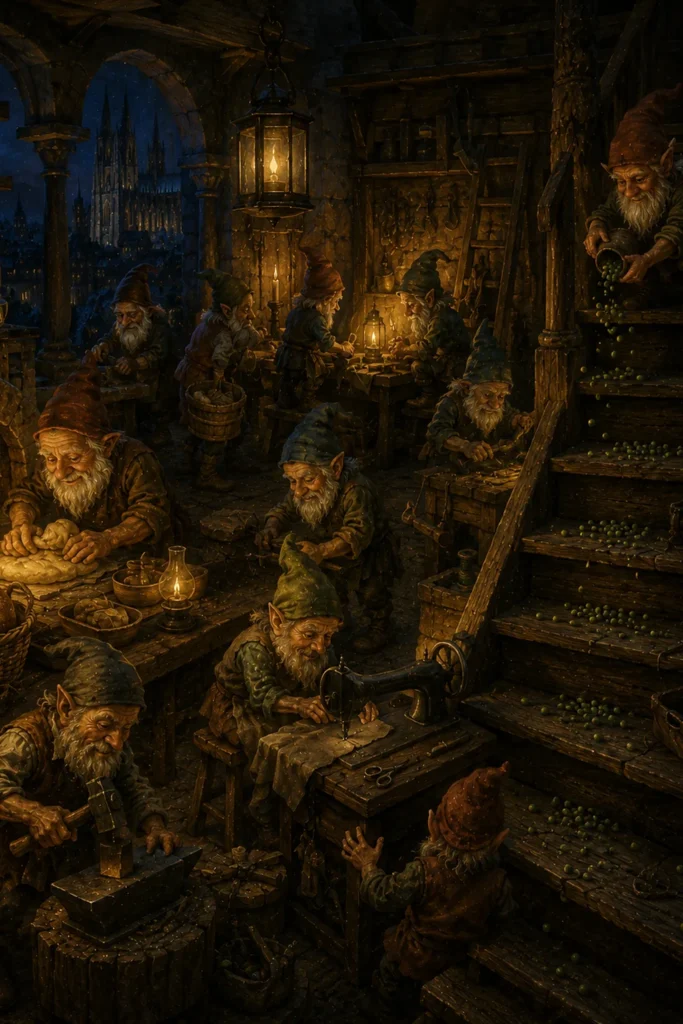
The Heinzelmännchen are the house gnomes of Cologne: small, industrious gnomes or dwarves who secretly did the craftsmen’s work at night, as long as no one spied on them. When the curious tailor’s wife scattered peas on the stairs so they would stumble and become visible, they vanished forever.
The Cologne local legend first appears in writing in 1826 in the work of Ernst Weyden; August Kopisch made the material popular in 1836 with his poem Die Heinzelmännchen zu Köln. In German the word has long since become a generic term for secret helpers.
Type: House gnomes, secret helpers of craftsmen
Origin: Cologne local legend, oral tradition
Texts: Weyden 1826, Kopisch 1836
Period: first written record 1826, popularised 1836
Appearance: small, industrious gnomes or dwarves
Textual history
Period of the Texts
The first written record dates from 1826, when the Cologne author Ernst Weyden recorded the oral tradition; August Kopisch popularised the material in 1836 with his poem.
Area of Diffusion
Cologne is the setting of the legend; through Kopisch’s poem and its reception, the material became known throughout the German-speaking world.
Sources
Well documented: the written record by Weyden in 1826, the poem by Kopisch in 1836, and the Handwörterbuch des deutschen Aberglaubens.
Name and variants
German: Heinzel is a pet form and diminutive of the given name Heinz, Heinrich. This follows a common pattern of naming household spirits with a familiar first name in diminutive form.
Appearance and behaviour
Appearance
The Heinzelmännchen are small, industrious gnomes or dwarves who act invisibly or unseen at night. Their iconography was later shaped by the Heinzelmännchenbrunnen fountain in Cologne from 1899 and by book illustrations; this visual tradition is younger than the legend.
Effect
At night they secretly carry out the work of Cologne’s craftsmen, from bakers and butchers to tailors and carpenters, as long as they remain unseen. The taboo is the core: if the secrecy is broken, the blessing is gone.
Profile: Heinzelmännchen
The key aspects of Cologne’s house gnomes at a glance.
Cologne local legend from oral tradition, written down by Weyden in 1826 and popularised by Kopisch in 1836.
The city’s craftsmen: bakers, butchers, tailors and carpenters, whose work the gnomes secretly carried out at night.
Small, industrious gnomes or dwarves; the familiar image stems from the Heinzelmännchenbrunnen fountain of 1899 and from book illustrations.
Nocturnal work in the workshops, bound to the taboo of secrecy: whoever spies on them loses the blessing.
No feeding or protective rite has been passed down; the legend is a tale of prohibition and curiosity built around the taboo of spying.
The English Brownies, the Scandinavian Nisse and Tomte, as well as Hinzelmann and Niß Puk.
From Weyden to Kopisch: the path of a Cologne legend
Heinzel is a pet form and diminutive of the given name Heinz, Heinrich, a common pattern of naming household spirits with a familiar first name in diminutive form. The Cologne local legend first appears in writing in 1826 in the work of the Cologne author Ernst Weyden as an oral tradition.
August Kopisch made the material popular with his poem Die Heinzelmännchen zu Köln from 1836; he thus popularised it, rather than inventing it. From this literary version grew the visual tradition of fountain and illustrations, which is younger than the legend itself.
From city symbol to generic term
The Heinzelmännchen are a symbol of Cologne, with a fountain and countless children’s book and advertising adaptations; in German, Heinzelmännchen has become a generic term for secret helpers.
From a religious-studies perspective, the Heinzelmännchen are purely helpful; their punishment is disappearance, not violence. Important clarifications: Kopisch popularised the legend rather than creating it, the earliest written record comes from Weyden in 1826; the pea motif in its well-known form is part of the literary version; and Heinzelmännchen and Hinzelmann are related in name but are not the same legend.
Peas on the stairs: the taboo of secrecy
In the classic Kopisch version there is no invocation, but rather a tale of prohibition and curiosity: the tailor’s wife scatters peas on the stairs so the gnomes stumble and become visible, whereupon they vanish forever. No positive feeding or protective rite is firmly recorded for the Cologne Heinzelmännchen; the material is predominantly literary and narrative.
Secret helpers on both sides of the North Sea
The Heinzelmännchen correspond to the English Brownies, the Scandinavian Nisse and Tomte, as well as the Hinzelmann and the Niß Puk, all sharing the motif of the secret helper who must not be spied on.
Frequently asked questions about the Heinzelmännchen
What are the Heinzelmännchen?
The house gnomes of Cologne, who secretly did the craftsmen’s work at night, as long as no one saw them.
Why did they disappear?
Because the curious tailor’s wife scattered peas, made them visible and thereby broke the taboo of secrecy.
Did Kopisch invent the legend?
No. He popularised it with his poem of 1836; the earliest written record comes from Ernst Weyden in 1826.
Further links
Further reading:
- Germanic – all beings of Germanic tradition
- Hinzelmann, Niß Puk – related German house spirits
- Brownie – the English counterpart
- Amulet, protective candle, salt – traditional protective means
- Protection Compass – overview of protective means
Literature (selection)
Further standard works in the bibliography.
As Cologne house imps and secret helpers, the Heinzelmännchen embody the friendliest face of German house-spirit belief: industrious, benevolent and gone forever the moment curiosity broke their taboo.