Brownie, the nightly helper of Scottish farms
By Ralf Ittermann · last reviewed on
The Brownie is a spirit of Scottish tradition.
He works at night for a bowl of cream; clothing drives him away. A nocturnal helper long associated with Scottish farms, the Brownie worked for little more than cream.
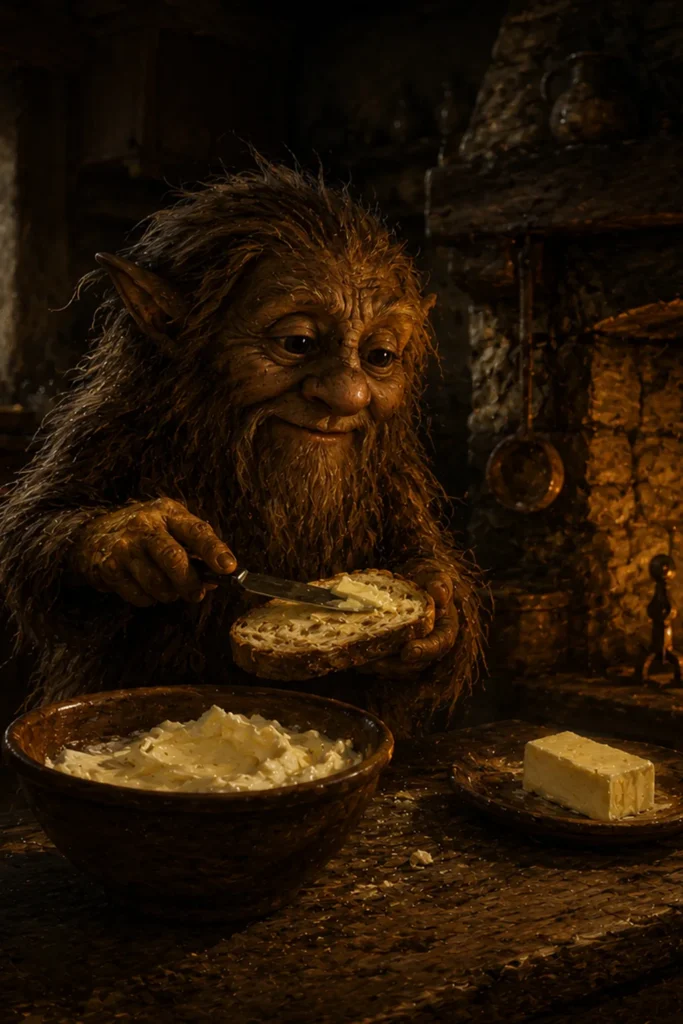
The Brownie is the Scottish-English household spirit and the prototype of an entire family of British household spirits. At night, when the house sleeps, he sweeps, churns butter and threshes grain, thereby securing the prosperity of house and farm; in return he expects no more than a bowl of cream by the hearth.
His name simply means the brown one, after the being’s brown skin and brown hair. The word is attested from the early 16th century in the Scottish Lowlands; Reginald Scot mentions the Brownie in 1584, King James VI classes him among the demons in 1597. A gift of clothing makes him disappear forever.
Type: household spirit, prototype of the British household spirits
Origin: Lowland Scotland and the Borders, attested from the early 16th century
Texts: Reginald Scot (1584), Daemonologie of James VI (1597), Briggs
Period: early 16th century into modern folklore
Appearance: brown-skinned, hairy, often noseless
Origin and sources
Period of the Texts
The word first appears in the early 16th century in the Scottish Lowlands and the Borders; Reginald Scot names the Brownie in 1584 in The Discoverie of Witchcraft, King James VI in 1597 in his Daemonologie.
Area of Diffusion
Scotland and northern England, with a focus on the Lowlands and the Borders. Usually only a single Brownie acts per farm.
Sources
Very good: the early mentions by Scot and James VI as well as the folklore collections, above all Katharine Briggs.
Name and variants
Scots/English: brownie, the brown one, after the being’s brown skin and brown hair. The Highland ùruisg is a related but etymologically distinct being.
Appearance and behaviour
Appearance
The Brownie is brown-skinned, hairy, often small and stocky, naked or dressed in rags. In the oldest tradition he was human-sized or larger; the tiny elf figure is a later development of the 19th century. Regionally, he lacks a nose in the Lowlands, and in Aberdeenshire he lacks fingers and toes.
Effect
At night the Brownie sweeps, churns butter and threshes grain, securing the prosperity of the household. He is good-natured but moody: he pinches lazy servants in their sleep, and offence turns him into a noisy spirit. His core nature is that of the place-bound, helpful house spirit.
Profile: Brownie
The most important aspects of the house spirit at a glance.
House spirit of the Scottish Lowlands and northern England, documented in writing since the early 16th century; the archetype of the British house spirit family.
House and farm: the Brownie sweeps, churns butter and threshes grain at night and secures prosperity; usually only one Brownie belongs to a farm.
Brown-skinned and hairy, often small and stocky, naked or dressed in rags; regionally without a nose or without fingers and toes.
Nightly housework in exchange for a bowl of cream; he pinches lazy servants in their sleep, and offence turns him into a noisy spirit.
A bowl of cream or milk by the hearth, also porridge or a small cake. Clothing, naming him, watching him or criticism drive him away.
Hob, Hobgoblin and Lob Lie-by-the-Fire as closest relatives; alongside these, the Nisse, Tomte and the Slavic Domovoi.
From the Brown One of the Lowlands to the Daemonologie
The name means the brown one, after his brown skin and brown hair. The word first appears in the early 16th century in the Scottish Lowlands and the Borders. Reginald Scot names the Brownie in 1584 in The Discoverie of Witchcraft, and King James VI classes him among the demons in his Daemonologie of 1597, an early testimony to how learned demonology interpreted the house spirit of folk belief.
The Brownie is to be distinguished from the Highland ùruisg, a related but etymologically distinct being. His shape has also changed: in the oldest tradition the Brownie was human-sized or larger; the tiny elf figure of popular imagination only arose in the 19th century.
From Milton to Kodak: the afterlife
Milton’s drudging goblin in L’Allegro is a Brownie in everything but name. James Hogg wrote The Brownie of Bodsbeck (1818), Juliana Horatia Ewing wrote The Brownies in 1865, which gave the youngest Girl Guides their name; Palmer Cox’s Brownies became the namesake of the Kodak camera. The house-elves in J. K. Rowling take up the clothing motif.
From a religious-studies perspective, the Brownie is a benevolent house-protecting spirit with a strong connection to ancestor and hearth cults. Important clarifications: he was originally human-sized, not tiny. The equation Boggart equals corrupted Brownie is modern, not traditional. And why the gift of clothing drives him away remains disputed in the sources.
Cream by the hearth: the proper approach
The household leaves a bowl of cream or milk for the Brownie by the hearth, also porridge or a small cake. Even the wrong manner of giving can drive him away. A gift of clothing ends his service for good; the interpretations of this contradict one another in the sources, ranging from insult through pride to release from service, as with the Cauld Lad of Hilton. Naming him, watching him or criticising his work also drives him away.
The family of British house spirits
The Brownie is the prototype of Hobgoblin, Hob, Lob Lie-by-the-Fire and the Manx Fenodyree; his evil counterpart is the Boggart. Related beings include the Welsh Bwbach, the Highland ùruisg and Gruagach, the Scandinavian Nisse and Tomte, the Slavic Domovoi and the Roman Lares. Like the place-bound Lares, the Brownie is bound to house and farmstead.
Frequently asked questions about the Brownie
What is a Brownie?
The Scottish-English house spirit and prototype of the British house spirits. He performs housework at night in exchange for a bowl of cream by the hearth.
Why does a gift of clothing drive him away?
This is disputed. The sources transmit contradictory interpretations: insult, pride or release from service, as with the Cauld Lad of Hilton.
Was the Brownie always tiny?
No. Originally he was human-sized or larger; the small elf figure is a later notion from the 19th century.
Further links
Further reading:
- Celtic – all beings of the Celtic cultural sphere
- Boggart, Hob, Hobgoblin – the closest relatives of the house spirit family
- Salt, Amulet, Smoke cleansing – traditional protective means
- Protection Compass – protective means at a glance
Literature (selection)
Further standard works in the bibliography.
As a Scottish house spirit, the Brownie has become the archetype of an entire family of beings, and the English-language brownie folklore has left traces far beyond folklore studies, from Milton’s drudging goblin to the Brownies of the Girl Guides.