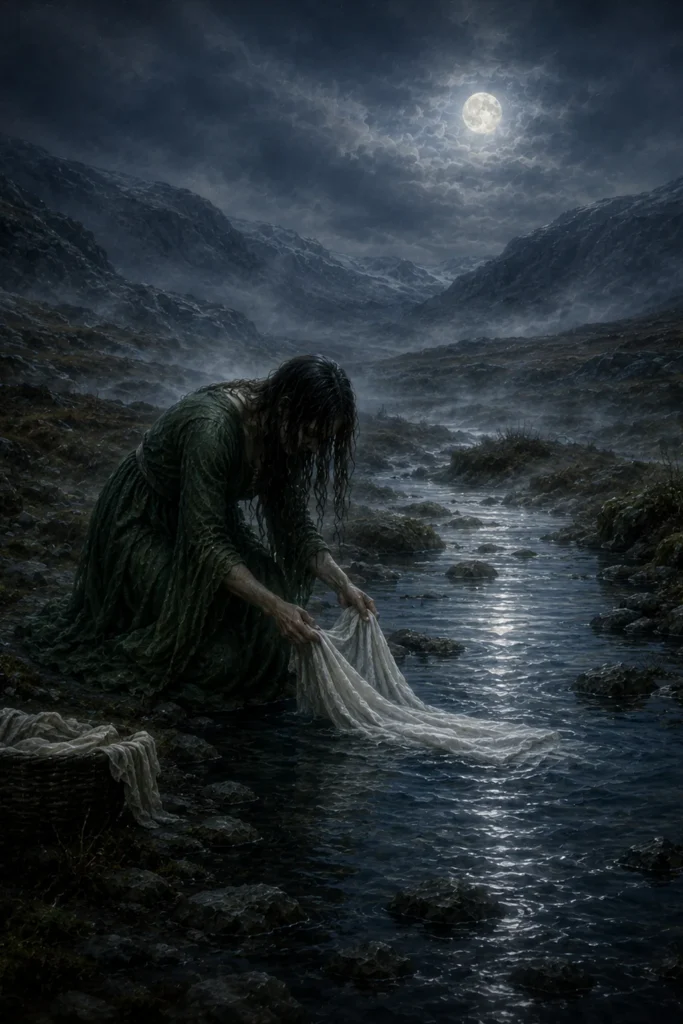
Fenodyree, the swift mower of the Isle of Man
By Ralf Ittermann · last reviewed on
The Fenodyree is a spirit of Celtic tradition.
The strong helper who is driven away forever by a gift of clothing.
The Fenodyree is the benevolent household spirit of the Isle of Man, a large, immensely strong and hairy helper of farmers who mows meadows, threshes and tends sheep at night. A gift of clothing drives him away forever.
The earliest substantial account is Joseph Train’s Account of the Isle of Man of 1845, followed by Moore, Rhys and Sophia Morrison. His byname is Yn Foldyr Gastey, the swift mower.
Type: Household and field protective spirit of the brownie type
Origin: Manx folklore of the Isle of Man
Texts: Train (1845), Morrison, Evans-Wentz
Period: attested from 1845
Appearance: large, strong, hairy, usually naked

Historical Classification
Period of the Texts
The evidence begins with Joseph Train’s account of 1845; around 1900 Moore, Rhys and Morrison made the Fenodyree a central figure of the Manx revival.
Area of Diffusion
The Isle of Man; tradition names Glen Rushen as the place of his departure.
Sources
Good source basis: Train and Morrison as main witnesses, supplemented by Evans-Wentz and the collectors of the Manx revival.
Name and variants
Manx: The name is usually derived from fynney, hair, and oashyr, stocking, meaning the hairy one or the one with the hairy stockings; this interpretation, however, is considered conjectural. In the Manx Bible the word translates satyr.
Appearance
Appearance
The Fenodyree is large, strong and covered all over in hair, ugly and usually naked, yet never feels the cold. Morrison describes fiery eyes and a strength that crushes an iron ploughshare like clay. Size estimates vary between giant and as little as two feet.
Effect
The Fenodyree mows whole meadows overnight with a scythe, threshes, grinds corn, brings in hay, tends and gathers sheep, especially before a storm, and carries huge stones, all for a modest reward. In one tale he mistakes a hare for a stray sheep and pens it in with the flock.
Profile: Fenodyree
The key aspects of the Manx helper at a glance.
Manx folklore of the Isle of Man: a solitary household and field protective spirit of the brownie type, attested in writing from 1845.
House and field: he mows, threshes, grinds corn, brings in hay and gathers the sheep before a storm.
Large, strong and covered all over in hair, usually naked and insensitive to cold; Morrison notes fiery eyes and immense strength.
Nocturnal field work for a modest reward: whole meadows in a single night, along with the carrying of huge stones; his byname is the swift mower.
Do not give him clothing: as with the brownie, a gift of clothing offends him and drives him away forever; otherwise a modest reward suffices.
From Train to the Manx revival
The name Fenodyree is usually derived from Manx fynney, hair, and oashyr, stocking, meaning the hairy one or the one with the hairy stockings; this interpretation, however, is considered conjectural. In the Manx Bible the word translates satyr, which shows how firmly the figure was anchored in the island’s language use.
The earliest substantial account is Joseph Train’s Account of the Isle of Man of 1845; he was followed by Moore, Rhys and Sophia Morrison, who around 1900 made the Fenodyree a central figure of the Manx revival. His byname Yn Foldyr Gastey, the swift mower, sums up what the farmers valued him for: the meadow mown in a single night.
Reception and classification
The Fenodyree is a central figure of the Manx revival around 1900 in the work of Moore, Rhys and Morrison. In modern times a figure named Fenodyree appears in Alan Garner’s The Weirdstone of Brisingamen and in further fantasy works; a Manx folk band carries the name.
In religious studies, the Fenodyree is a benevolent, solitary household and field protective spirit of the brownie type. Important clarifications: the origin legend of the banished fairy is a narrative myth, not a linguistic etymology. The evidence cited is Train 1845, not Waldron 1731. And his size is inconsistent in the sources.
The clothing taboo: cap for the head, coat for the back
As with the Brownie, a gift of clothing offends and drives away the Fenodyree. After he had carried stones, clothes were laid out for him; lifting each piece, he lamented in Manx, cap for the head, coat for the back, and departed for ever into Glen Rushen. In his lament the clothes are treated as an illness or curse; whether he is offended, banished or grieving, the sources leave open.
Brownies of the islands compared
The Fenodyree is the Manx Brownie and shares with him the clothing taboo as a motif of parting; related figures are the Highland Gruagach, the Irish Pooka and the type figures Hob and Hobgoblin. Train and Rhys compared him to Lob Lie-by-the-Fire and Milton’s lubber fiend.
Frequently asked questions about the Fenodyree
What is a Fenodyree?
The benign, very strong household spirit of the Isle of Man of the brownie type, who mows, threshes and herds sheep at night.
What drives it away?
A gift of clothing. Lifting each piece, it laments in Manx and departs forever to Glen Rushen.
Is the Fenodyree a giant?
This is disputed; sources vary between a giant and a size of only two feet.
Further links
Further reading:
- Celtic – all beings of the Celtic cultural sphere
- Brownie – the Scottish type model
- Gruagach and Hob – related household spirits
- Salt, Amulet, Smoke cleansing – traditional protective means
- Protection Compass – protective means at a glance
Literature (selection)
Further standard works in the bibliography.
The Fenodyree is the quintessential Manx household spirit: on the Isle of Man, the nimble mower stands for the quiet, powerful help given overnight, which ends the moment one tries to pay for it with clothes.